 Gary - stock.adobe.com
As the new senior vice president of government relations for the National Marine Manufacturers Association, I am grateful for the opportunity to work alongside such talented colleagues to protect and promote recreational boating. My home is in Maryland, I went to college in Maine, and I grew up in Connecticut. Being around water has always been part of my life, and I enjoy boating in the summer. My father is a retired harbor pilot, so I come to this role with an abiding appreciation for those whose lives and careers are in the marine trades.
Through engagements with elected leaders at the federal and state levels, we have a strong mission to ensure that recreational boating continues to play a critical role in the health of our country’s economy. The newest Bureau of Economic Analysis data shows that the outdoor recreation economy — of which boating is a leading sector — generates approximately $1.1 trillion in economic output. That represents 2.2% of our country’s GDP.
Recreational boating also accounts for more than $230 billion in economic output, and supports more than 800,000 jobs. Ours is a uniquely American industry, with roughly 95% of all boats sold in the United States made in the United States. Approximately 93% of boatbuilders are small businesses.
To support marine manufacturers and consumers, our policy priorities focus on protecting our industry’s ability to operate and grow. They fall into four categories: protecting public waters and boating access; keeping U.S. marine manufacturing globally competitive; improving and expanding recreation infrastructure; and driving industry sustainability and innovation progress.
This is a time of intense regulatory activity, with federal regulations hitting businesses and industries at a $3 trillion cost to our economy. One of the top regulatory issues facing the boating industry is a proposed federal rule colloquially known as the “vessel speed rule,” that mandates a 10-knot speed restriction along parts of the Eastern Seaboard for up to seven months of the year. Proposed by the National Oceanic and Atmospheric Administration in 2022, the draft rule misses the mark and threatens to cause significant economic damage to the recreational boating industry, and to our consumer and coastal economies.
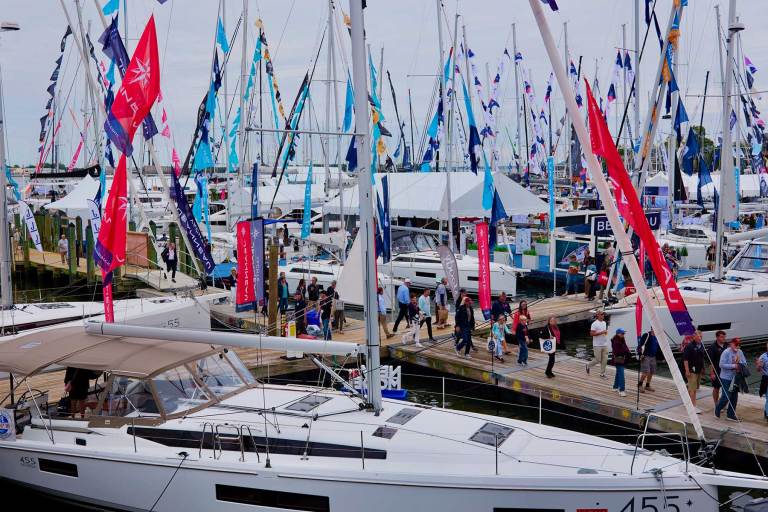
We continue to urge NOAA to use the best available marine technologies to better inform regulatory decisions. As an industry, we have demonstrated to NOAA the sophisticated technologies available today that can detect marine wildlife and prevent vessel strikes. That latest marine technology was on display at the Discover Boating Miami International Boat Show in February. We are proud to be the industry that is leading the way on solutions to protect endangered species. As our CEO, Frank Hugelmeyer, likes to say, commerce and conservation can coexist.
Given the environmental consciousness of anglers and boaters, it should come as no surprise that our sector is also at the forefront of developing sustainability innovations that benefit the environment and boaters. The groundbreaking report that the International Council of Marine Industry Associations released in November, titled Pathways to Propulsion Decarbonisation for the Recreational Marine Industry, accompanied by the global industry education campaign Propelling Our Future, underscores the portfolio of propulsion technologies best positioned to further reduce boating’s carbon emissions. This work also shows that there is not a one-size-fits-all approach for the marine sector.
At the NMMA, we are regularly sharing with lawmakers and regulators the innovative technology solutions our members are developing. Our advocacy team has a long history of collaborating with any lawmaker, regardless of political affiliation, to safeguard and advance the sector. The annual American Boating Congress, which will take place May 8-10, is one more way in which we and our allies ensure our top issues are at the forefront of Congress.
It is a privilege to represent the recreational boating industry in front of decision-makers at all levels of government, and we look forward to continuing to advance our industry’s issues.
This article was originally published in the April 2024 issue.