Ben Speciale thinks about the worst of the pandemic’s supply-chain problems from a multilayered perspective. Not only were there challenges at Yamaha, where he is president of the U.S. Marine Business Unit, but there also were subchannel issues and component-parts issues. They all added up to unprecedented wait times for quite a few elements that go into building Yamaha products. “In my head, we probably lost 60 days of supply,” Speciale says. “That’s about 16% of the annualized supply.”
The result of that unprecedented experience is that Yamaha today is doing far more supply-chain risk management. While it was always important to understand where problems may be cropping up, the company now places a far greater emphasis on realizing those problems are happening sooner. “We’re way more hypersensitive than we used to be,” Speciale says. “Where you look at the data points, how things are moving through the supply channel, we’re probably looking at 25 or 50 points as opposed to five points.”
 Fly frames -stock.adobe.com
Yamaha is far from alone in having adjusted its business practices to try to build a more resilient, post-pandemic supply chain. Boatbuilders, electronics manufacturers and aftermarket suppliers all say they’re doing things differently today, too. A lot more effort is being put into creating a granular understanding of potential supply-chain pain points, as well as ways to spot problems and adapt to them as quickly as possible.
“We’ve developed more robust internal processes to identify and mitigate potential disruptions earlier,” says Aaron Kouba, vice president of operations at Chris-Craft. “We’ve also partnered with some local companies so we can produce items if we can’t get them imported. That comes at a premium, of course, but we can do it.”
When Substitutions Aren’t Solutions
Trish Gyorey, vice president of global supply chain at Navico Group, says the entire pipeline for electronics components ran dry during the pandemic, especially for microprocessors. “We had orders placed before the pandemic, and all the sudden, the supplier would call you and say, ‘I know you ordered 40,000 processors for February, but we can get you 10,000 in July,’ ” she says.
 HOR - stock.adobe.com
Processors are an especially thorny problem because of the way marine electronics equipment is designed. Whereas a boatbuilder might be able to switch out its usual bilge pump for another brand that’s more readily available, processors are different. “You design your product and write your software specific to one kind of processor. There’s no alternative,” Gyorey says. “With capacitors, resistors, you could probably find a viable alternative with a minimal amount of testing that would make you comfortable about the product’s performance. With a processor, that’s a lot more time.”
The worst of it was when Navico saw lead times for components stretch out 76 weeks, well more than a year until estimated delivery. By contrast, that figure is between 26 and 52 weeks today for various components, with 52 weeks still being longer than prior to the pandemic.
To overcome the delays, Navico at first tried to redesign products so different components could be substituted. But that strategy, in addition to being difficult with processors, overwhelmed the engineering team as consumer demand continued to spike. At one point, there were months at a time when Navico could not fulfill
orders for some of its highest-volume sellers. “Even though we had increased our production output by 30 or 40%, we still couldn’t supply everything the market was demanding,” she says.
For all those reasons, Gyorey’s supply-chain approach today is different in multiple ways. First and foremost, Navico has changed its forecasting time window. “We found that it’s necessary to forecast as best you can at a fairly detailed level at least 18 months in advance. If you have to place orders a year in advance, you have to have a look at your expected demand at the SKU level,” she says. “Nobody gets it exactly right, and that is a huge challenge because you don’t know and you’re trying to plan for new-product introductions that might happen 18 months from now. What kind of volume are we going to see on those new products? You don’t necessarily have history to rely on with those things.”
 Nuttawutnuy - stock.adobe.com
Turning to Technology
To help with such long-range forecasting and other foreseeable problems, Gyorey and others are looking to technology. “Rather than just simple statistical models, some of the better forecasting tools now actually are using machine learning and AI to look for trends in your backward- and forward-looking demand, and then create custom algorithms to forecast those products,” she says.
Kouba, too, says Chris-Craft is staying keenly abreast of AI tools and systems as they develop. The boatbuilder is looking at forecasting options and thinking about ways that emerging technology will be able to fill in holes that supply-chain problems create. “I believe that long term, the solution to much of this is technology,” Kouba says. “Predictive AI will help to solve the gaps. We continue to research automation, which will help with the labor shortages, and in the long term, additive manufacturing like 3D printing will remove a lot of the problems from supply chain.”
In some cases, he adds, the technology that can help already exists. It’s still too expensive to work into the business plan of a builder the size of Chris-Craft, but prices should keep coming down as the tech evolves. “Some of these technologies are still cost-prohibitive for many builders,” he says. “I think it’s sooner rather than later, but the rate of change is so exponential, it’s coming, and it’s coming quicker than I think most of us will realize.”
Better Communication
At the aftermarket distributor SeaWide, president Bill Rogers says supply-chain problems taught his team to reach out more often to suppliers, and to communicate better with customers, as well. “We’re doing a lot of basic blocking and tackling,” Rogers says. “Better communication with suppliers. If there is a problem, we try to understand it earlier in the process so we can help in any way we can. If they need more on order, we can do that, as an example.”
As for customers, SeaWide’s improved communications include more robust data feeds. When a customer types in a product to purchase, if that product is unavailable, the system now serves up more alternatives and substitutes than it used to. “We spent a lot of time getting all of that information in there,” Rogers says. “The capability is not new, but we’ve added a lot more data to identify those alternatives. It’s part by part, trying to make sure you understand what is a substitute.”
SeaWide also now packages kits differently, leaving the individual products inside each kit available for purchase, as well. “If you’re looking for a chart plotter kit that has wiring and other stuff in it — brackets, hardware — now you can see it as the specific wire being available,” Rogers says. “It’s a kit, but it’s virtual. We don’t put the kit together until it ships.”
Speciale says Yamaha has also improved communications for supply-chain resiliency, especially in terms of understanding where various partners stand. “Where we used to talk to the dealers and boatbuilders once a month, now we’re talking to them once a week,” he says.
Gyorey, too, says Navico has realized how important it is to keep lines of communication open. “If you look at Navico Group and this microprocessor marketplace, we are small. We are a bit player, less than 1% of their revenue,” she says. “What we learned that helped us out was relationships. It was being able to share an honest view with suppliers about supply and demand.”
Safety Stocks
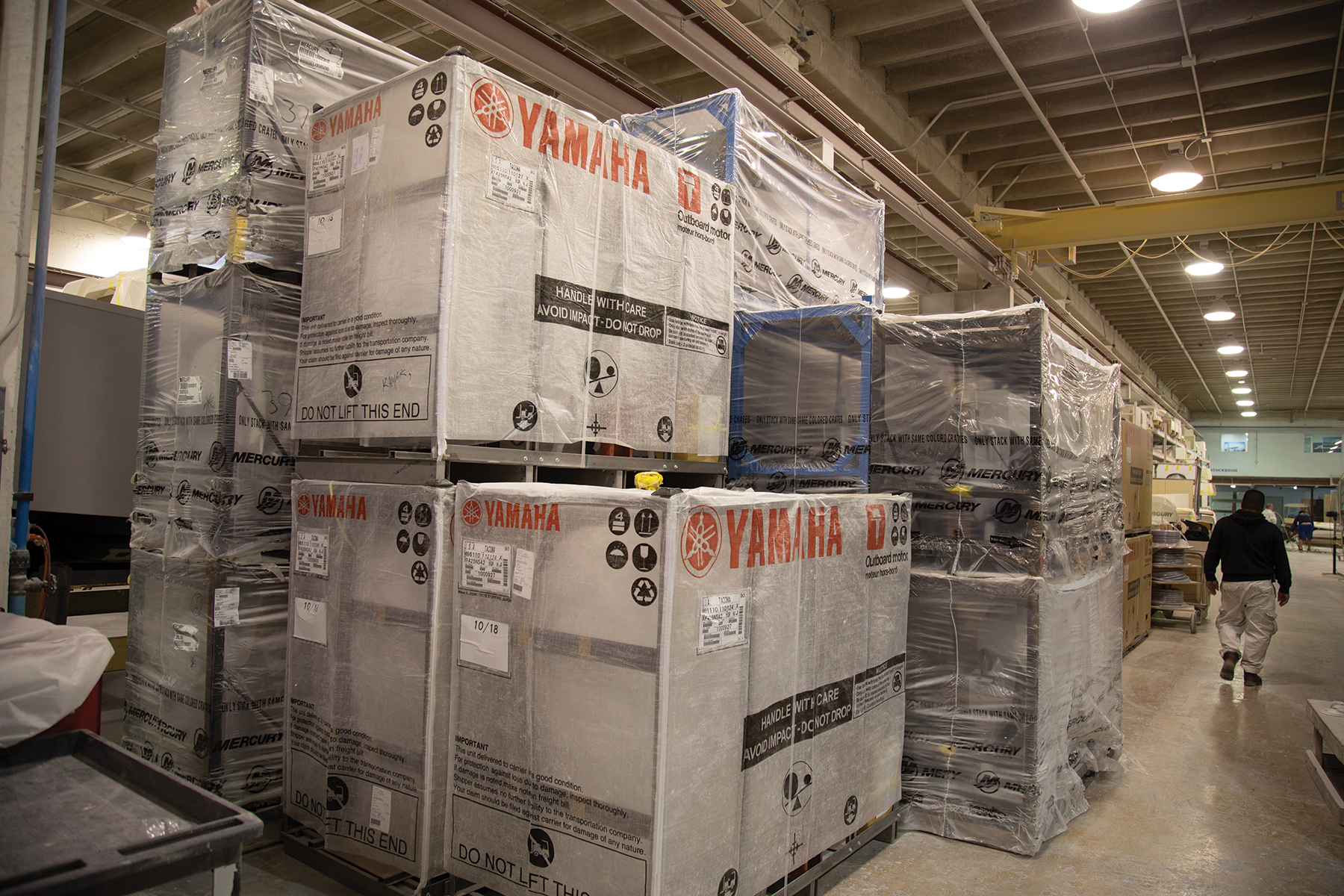
Another area where company leaders have a different approach today is safety stocks. That’s the amount of extra product on hand to prevent an out-of-stock situation. Speciale says the pandemic’s shutdowns and other challenges “wiped out our safety stocks around the globe.” Those stocks have stabilized, he adds, but the way Yamaha looks at creating safety stock is different than it used to be.
“Years ago, we would build the parts we need for tomorrow, yesterday,” he says. “Now we build those parts two or three days ago. You’re doing things like that so that if some component is late, it’s not affecting delivery of a product.” The trick, he says, is not to “lead it out too much,” but instead to lead it out enough, because “one screw can hold up the whole product.”
Chris-Craft also is holding more safety stock than in the past, Kouba says, because companies without enough safety stock got hammered in 2020 and 2021. “It’s always been about how fast you can turn your inventory, but the companies with really high inventory turns fared the worst in the pandemic,” he says, adding that the level of safety stock can be different for various components. “For us, it’ll be dependent on the level of risk in the supply chain and how hard it would be to get a replacement.”
This article was originally published in the April 2024 issue.