
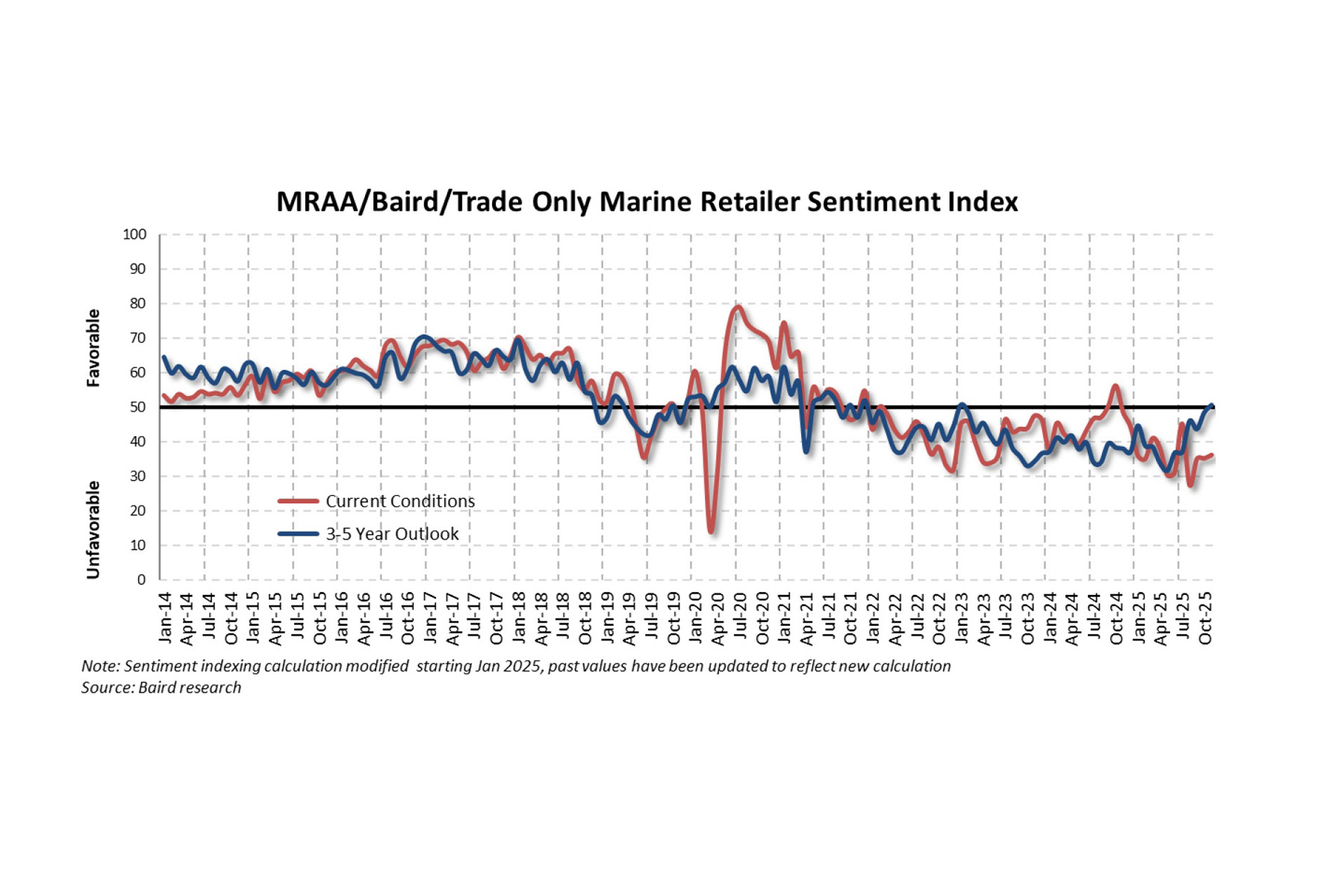
Dealer sentiment on current conditions inched higher to 36 in November (from 35 in October), while the 3- to 5-year outlook also ticked higher (51 versus 48 in October), according to the recent Pulse Report survey. A figure of 50 represents neutral sentiment.
For this month’s Pulse Report, Soundings Trade Only, Baird Research and the Marine Retailers Association of the Americas asked 70 retailers to assess trends in North America.
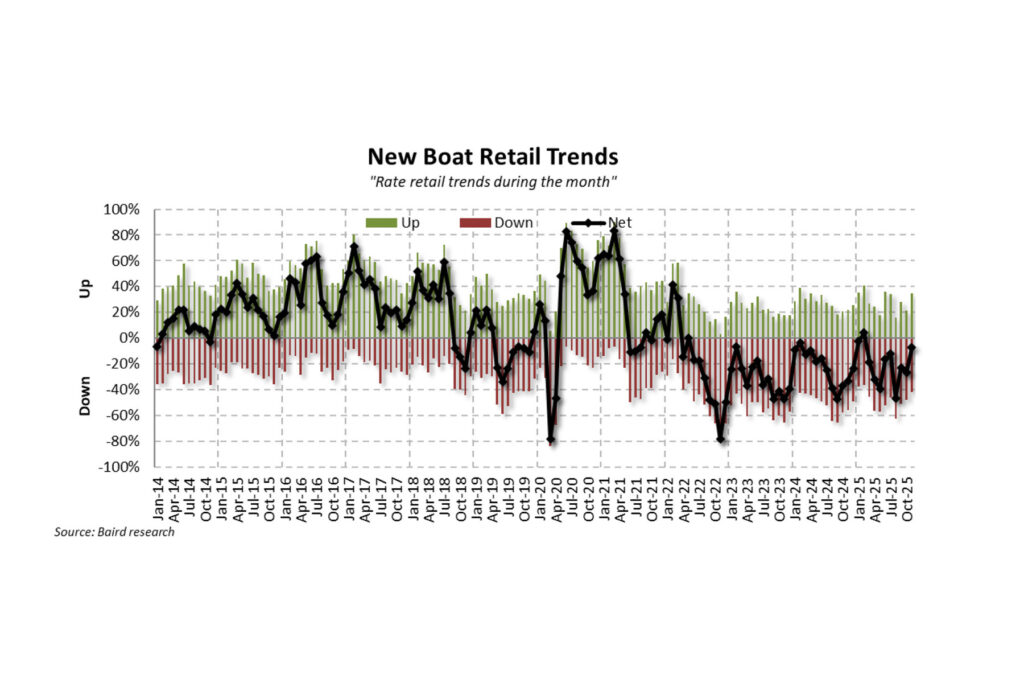
In November, 42% of dealers surveyed reported retail declines compared with 35% that reported growth. In these lower-volume off-season months, Baird said it expects dealers to focus more on the 2026 outlook than month-to-month trends. To this point, one dealer commented that “the market is still soft. Everything is just so incredibly expensive; the market is still saturated. We are doing whatever we can to move aged units and clean up inventory for 2026 and beyond, going to extreme measures to trim flooring-related expenses.”
Dealers also reported lower used-boat sales, as 51% reported declines versus 14% that reported growth.
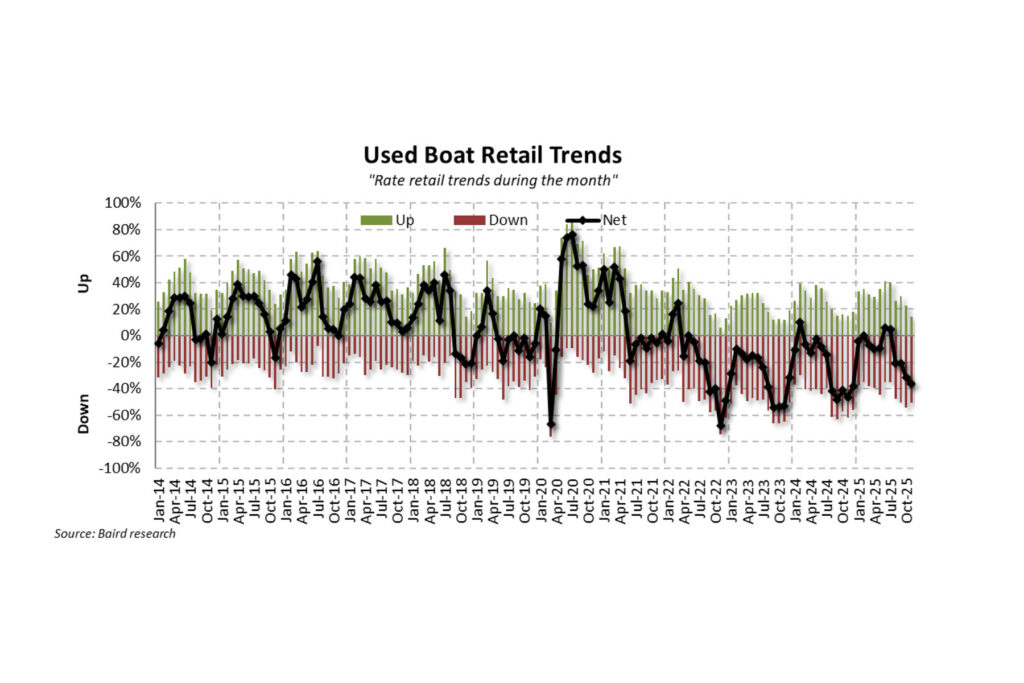
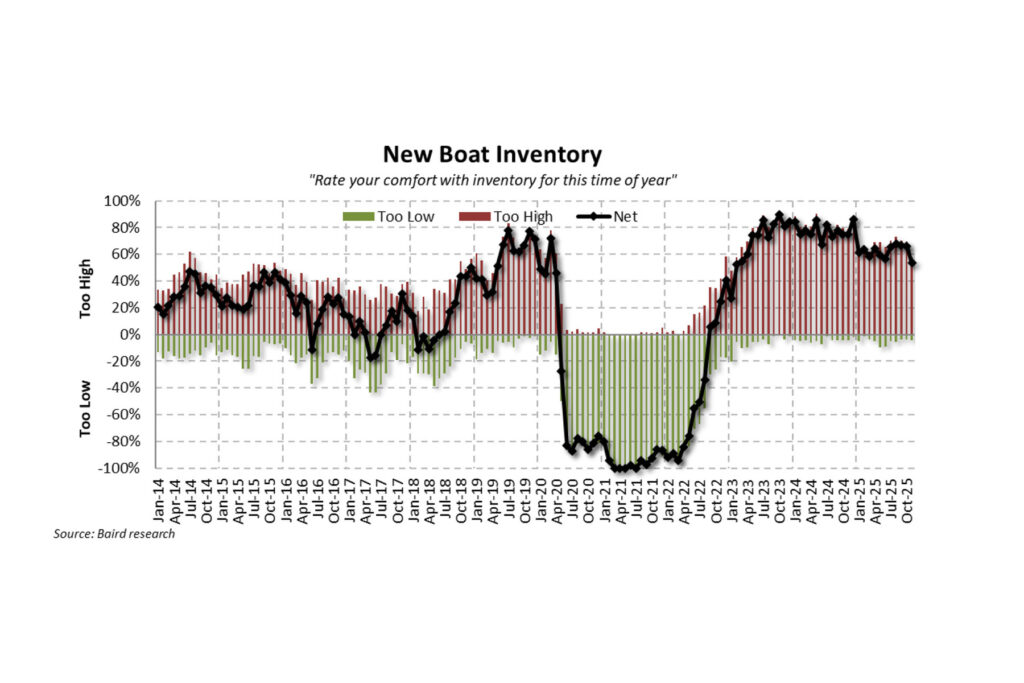
New-boat inventory remains high. Fifty-eight percent of dealers reported new-boat inventory was “too high” compared with 4% that reported it to be “too low.” While most dealers would prefer less inventory, that metric improved from recent months. In used boats, inventories appear more balanced, as 33% of dealers reported used inventory was “too high” versus 26% that reported “too low.”
Overall, Baird’s November data suggests “less bad” trends. The research firm sees evidence that dealers — and the broader marine industry — remain focused on managing channel inventory and positioning for the 2026 season, including early boat shows. “Big picture,” Baird noted, “we see reasons to be optimistic — lower interest rates, less tariff noise and better tax refunds — but acknowledge downside tied to affordability headwinds, employment anxiety, credit instability and policy wildcards.”
One dealer said that the “Fed must lower rates to get things moving. There is no market urgency, thereby causing inventories to age. Been here, done this, hold on.”
The Fed did lower rates by 0.25% in early December to a range of 3.5% to 3.75%, but whether that’s enough to move markets remains to be seen.
Regarding what strategies and techniques were working to reach buyers and close deals, one dealer said, “Building an HR department that helps you cultivate a happy employee base. Compensating them well and providing strong benefits and showing appreciation for their work. Being transparent about company goals and aligning your employees’ personal goals with your own to develop trust and collaboration. Strictly adhering to Omnia Profile when considering candidates for positions within the company to ensure new hires are good fits for the position and are set up for success.”
Another dealer mentioned the success of a promotion: “The six-year Yamaha promo created a little bit of urgency to get motors purchased and paid for the last month and a half or so. That is the only promotion we have available right now. Staff is as low as we can manage at the current volume, doing what we can marketing the product [with] personal Meta accounts/forums, Boat Mart, and some outside marketing partnerships. No local boat shows for us in 2026.”
Another said, “Big boats continue to sell; people who have money still have it. Delivery captain programs also continue to create highly satisfied customers every season.”
Regarding what’s not working, some comments focused on the ever-changing marketing landscape. One dealer said, “Broadcast marketing versus targeting. Not seeing much from general ads.” Another said, “Some of our marketing is still not getting the door swings we were expecting.” Another noted, “Anything that tries to get people into the showroom now. Folks are focusing a lot on holidays, and money is tighter than in years past.”
The survey also asked dealers about their expectations for changes they see in the use of technology in the next five years, and gathered a wealth of data and insight regarding what’s on the horizon, including more AI tools, online marketplaces, and more seamless digital processing of services and purchases.
One dealer said, “We are communicating electronically more and more every day both with our customers as well as internally. I can see even more mobile communication (texting) with our CRM and DMS.”
Another pointed out that technology is a “double-edged sword” for the service-oriented, experience-based business of boating. “We have boats right now that are overcomplicated, not reliable, harder and more expensive to fix,” the dealer said. “I feel we have overcomplicated a lot of things. I hope we develop more internal diagnostic systems. We have to remember it’s about experiences. If it doesn’t work and takes a long time to fix, we will not be doing much business. Interactions with customers will be interesting. I don’t want a generated response from my dealer; I want personal interaction. Guess we will see what other generations want.”
The survey also asked about new ideas dealers are putting into action that have had a positive impact. One said, “We’re starting a service department that is focused on sales only. It will bring rigging costs down and give us dedicated staff to take care of customer issues as they arise. It’ll also allow us to deliver a higher quality delivery and follow-up process for issues with customers’ brand-new boats.” Another dealer saw success adding an employee dedicated to customer service.
Another dealer emphasized the importance of recognizing employees’ hard work and efforts even under difficult conditions: “Probably the most meaningful positive impact we have seen in a tough economic year has been to make employees feel noticed for the good work that they are doing. There has not been a lot of profitability to be found this past year, but it is not for lack of effort on the part of our best employees.”
Dealers can take the Pulse Report survey each month through the Trade Only Today newsletter.