
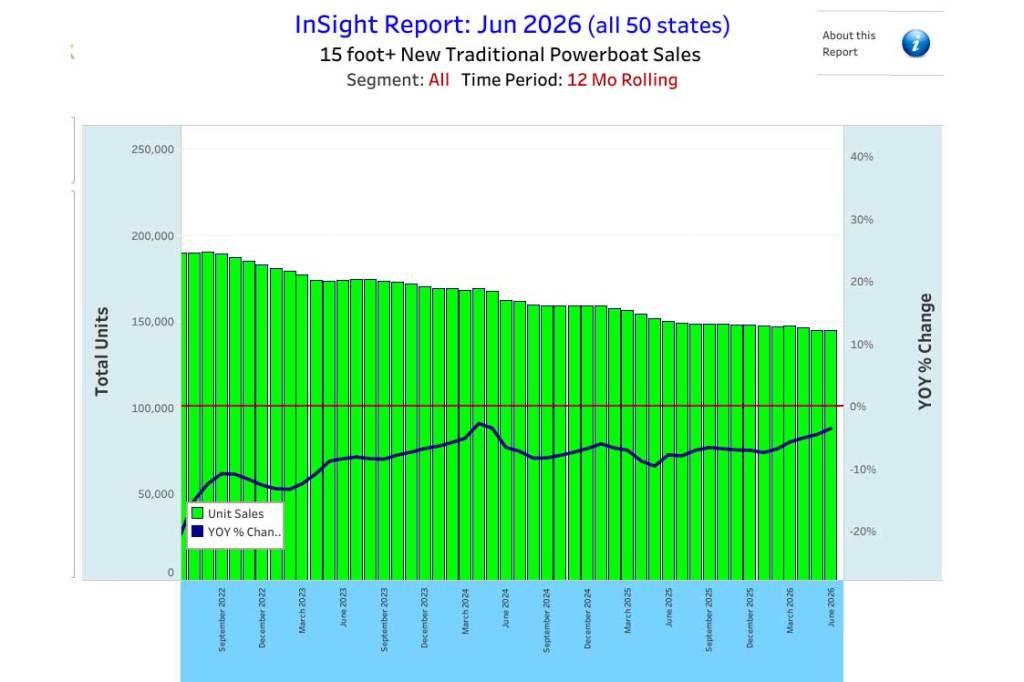
Registration numbers for the 15-foot-and-over U.S. powerboat market through June were down 3.5% relative to the 12-month rolling average, another consecutive month of improvement against that average. Registrations across all segments totaled 213,523.
The data for new-boat registrations was provided by Info-Link, a Florida-based company that compiles registration numbers from the Coast Guard and individual states.
In the report, towboats were down 9.9% for a running total of 7,529 units sold. Runabouts were down 11.4%, with a total of 13,261 units sold, and pontoons were 6.6% off their 12-month average, with 47,119 units. The pontoon segment’s numbers were a slight improvement over the previous month’s numbers.
“The June registration data suggests the market is stabilizing relative to earlier in the year, which is encouraging, especially given the disruption caused by the Iranian conflict just as the selling season was set to kick off,” says Matt Ginsburg, Huntington Distribution Finance’s marine sales leader. “That said, I’m hesitant to say we are seeing a full, broad-based rebound quite yet. Consumers remain cautious and more selective with discretionary spending, making higher-ticket purchases a challenge for retailers to capture.
“The positive takeaway is that the market appears to be finding a more normal level after several years of post-Covid volatility,” he adds. “Freshwater fishing continues to be one of the steadier segments, pontoons appear to be improving modestly, and several regional markets, particularly in the Southeast, are showing better momentum. That supports the idea that the summer selling season has been better than previously forecast, although performance remains somewhat uneven across segments and geographies.”
The freshwater fishboat category gained 0.4% on its 12-month average, with a total of 54,461 units sold. That category has been a strong performer for more than a year.
Another category that showed continued improvement relative to its 12-month average was unclassified/other, which includes houseboats, Fliteboards, airboats and other watersports vessels. The category showed a 7.8% increase on its 12-month average with 5,352 units sold. Additionally, the category has also been showing improvement in recent months.
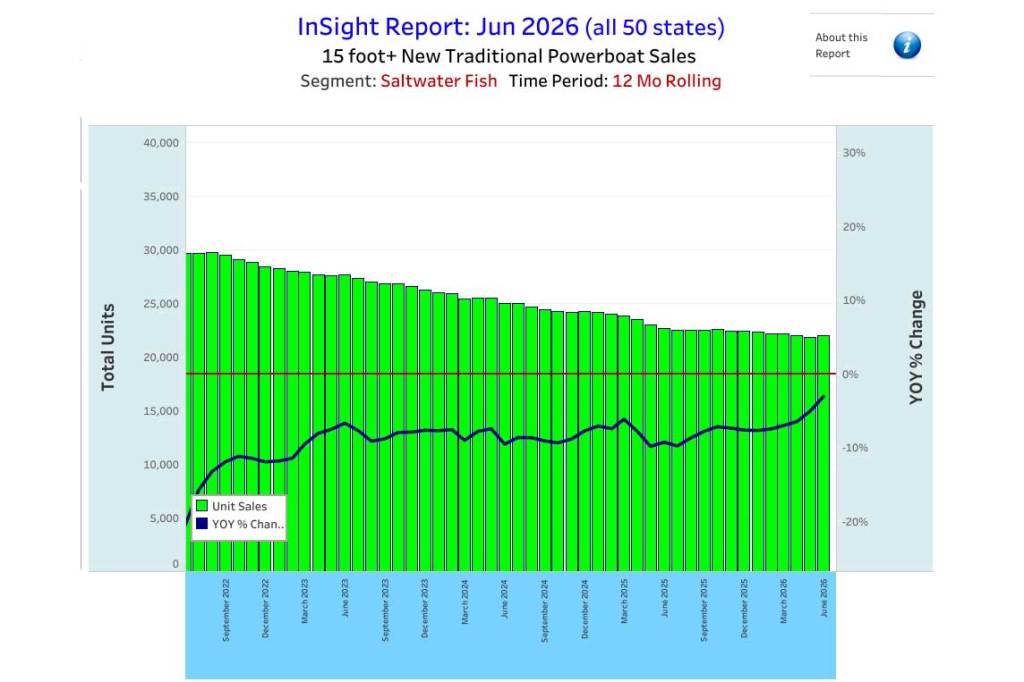
Saltwater fishboat sales were off 2.8% from their 12-month averages, for a total of 21,523 units sold, the numbers perhaps showing some of the improvements at the start of the summer selling season.
The yacht/cruiser category was down 6.8% from its 12-month total with a total of 4,515 units.
In other categories, PWC sales were 4.9% under their 12-month rolling average with a total units figure of 59,762.
Among the bigger state markets, Florida was 4% below its 12-month average for 27,774 units yearly. Texas was down 3% with 15,933 units. Michigan was up 1% on its 12-month average with 11,590 units, while Minnesota was down 8% with 8,859 units. Georgia showed a 9% increase in its 12-month average with 8,391 units for the year on that basis. North Carolina was up 2% at 9,814 units.
Otherwise, there were a lot of states with improved numbers across the country. Alabama was up 3% with 7,324 boats sold on the yearly average, Mississippi rose 17% with 2,841 units, and Arkansas was up 2% with 3,731 units.
Other states that showed increases were Idaho, which was up 9% with 2,064 units on the running figure; West Virginia, up 8%; Rhode Island, up 14%; Vermont, up 4%; Connecticut, up 4%; and Illinois, up 3%. Iowa was up 3% on its average, with 2,260 units.
“Field inventories have improved year-over-year,” Ginsburg says, “but many dealers continue to report that their inventory levels are still too high, especially in some categories where the midrange target buyer is facing elevated retail interest rates, rising fuel costs and other pressures that are driving the overall cost of ownership higher.
“Used inventory is a different story,” he adds. “Preowned units remain in demand and, in some cases, are a more compelling value proposition for consumers than higher-priced new products, as we’ve seen many dealers focus on driving revenue and profitability through the preowned market. Dealers are continuing to work through new inventory carefully while still looking for quality preowned inventory that can turn faster and provide buyers with another option at a lower price point.”
Overall, Ginsburg says the industry continues to be in a period of recalibration. While boating participation remains healthy, he says, consumers are cautious, more payment-sensitive and more willing to consider preowned units.
He also says the strongest market segments continue to include higher-income buyers who are less sensitive to rising costs. The more challenged categories rely heavily on monthly-payment buyers, or are struggling under significant post-pandemic price increases.
The good news, Ginsburg says, is that “we are encouraged by the market improvements thus far this season and expect lower inventory levels, stable pricing and any future improvement in rates to bring more buyers back into the market.”