
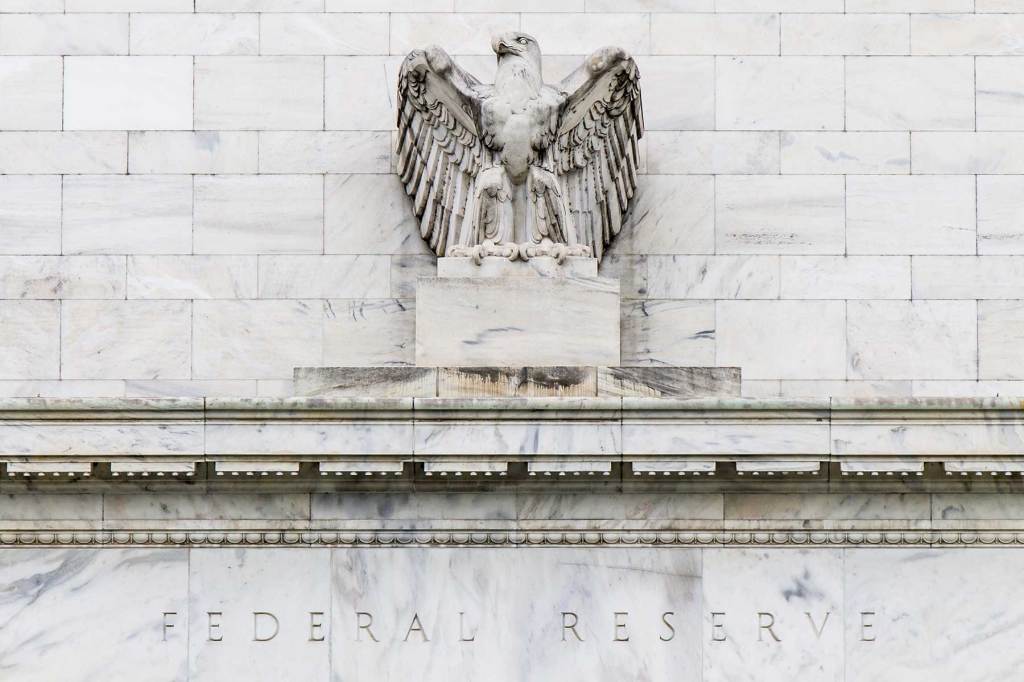
Federal Reserve chairman Kevin Warsh on Wednesday forcefully restated his and other Fed policymakers’ commitment to driving inflation down to their 2% target, but he did not commit to raising the federal funds rate to accomplish that.
So how, Americans might ask, will the newly Warsh-led Fed try to attain a goal it has pursued for five years? An important clue could lie in Warsh’s effusive press conference praise for the ways financial markets have responded to developments in the economy since he made it clear he won’t be providing the forward guidance on which they had relied under former chairman Jerome Powell.
“Market participants are learning to play the ball, not the referee,” Warsh told reporters after the Fed’s two-day meeting.
The Fed’s short-term federal funds rate wasn’t adjusted – the Federal Open Market Committee voted 9-3 Wednesday to keep it in a range of 3.5% to 3.75%. But Warsh reminded the Fed press corps that longer-term market interest rates were higher Wednesday than they had been 42 days earlier — the date of the committee’s previous meeting, when he made it clear that the era of forward guidance was at an end.
“Markets are working in concert to keep us on our toes, and they have tightened financial conditions in this intra-meeting period,” Warsh said. “And that has provided us some comfort that we’ve got the ability and capability to deliver” on the 2% inflation goal.
Economist Ian Wyatt agreed that Warsh is looking to the financial markets for help in the Fed’s fight to contain inflation.
“Yes, Chair Warsh is leaning on the move up in rates for all durations (six-month to 30-year) to do the work of monetary policy by applying a brake on the economy and preventing higher inflation,” Wyatt, senior vice president and chief economist at recreational marine lender Huntington Commercial Bank, told Trade Only Today.
“For the boat industry, it means that floorplan loans will not move, as they are tied to the overnight fed funds rate, but boat buyers will face higher financing costs, as their loans are priced based on longer-duration Treasuries.”
Chad Lyon, managing director, global inventory finance, at Wells Fargo, likewise recognizes ways that the financial markets can help the Fed deal with inflation.
“Financial markets can do some of the tightening for the Fed,” Lyon told Trade Only Today. “Rising Treasury yields, tighter financial conditions and shifting expectations for future policy tightening can help moderate economic activity and contain inflation without an immediate rate increase.
“If those conditions remain in place and inflation continues to trend lower, the Fed may see little need to act in the near term, allowing market forces to reinforce its commitment to price stability,” Lyon added. “If the Fed remains on hold, elevated borrowing costs could potentially weigh on boat purchases. However, a resilient labor market and an improving inflation backdrop could help support demand if consumers gain confidence that rates have peaked.”
Lyon said one takeaway from the Fed’s rate decision is that central bank policymakers continue to see the U.S. economy as fundamentally resilient.
“Economic growth remains steady, the labor market is healthy, and there is little evidence of the type of broad-based weakness that would warrant rate cuts or additional policy support,” he said. “For the boating, RV, powersports and other discretionary durable-goods sectors, that’s a mixed signal. On one hand, it appears the Fed is not expressing concern about an imminent recession, which should support consumer confidence. On the other hand, it’s also not signaling any urgency to lower interest rates, meaning financing costs are likely to remain elevated.”
Lyon added that the “committee appears to be saying that the broader economy is strong enough to absorb current borrowing costs and that its primary focus remains returning inflation to its 2% target, even if that might create ongoing headwinds for interest rate-sensitive industries. For manufacturers and dealers, this suggests continued pressure on affordability and financing-driven demand, particularly for larger-ticket purchases that typically rely on consumer credit.”
Investor and DePaul University clinical economics professor Brian Thompson also thinks Warsh is correct that financial markets are now working in ways that benefit the inflation fight.
“He noted that, between meetings, the moves in market rates rank ‘around the top decile’ of the last two decades, with real and nominal yields materially higher across the curve,” Thompson told Trade Only Today. “If the curve tightens, you get disinflation without a rate hike.”
NMMA chief economist Shawn DuBravac said the question of whether the Fed made the right decision in holding its benchmark rate steady “still feels like a very open question.”
“Chair Walsh reaffirmed a very strong commitment to 2% inflation, and with inflation trending well above that, keeping rates at the current rate feels inconsistent with trying to achieve that 2% objective,” DuBravac told Trade Only Today. “At the same time, higher interest rates might not be the best tool to address the inflationary pressures from a supply shock — something Chair Walsh also alluded to.
“Right now, the market strongly anticipates a rate increase in September, and the bond market has also risen, suggesting the Fed is likely to raise rates at the next meeting,” DuBravac added. “If inflation stays high over the next month, it will make it easier for voting members to vote to increase rates. I don’t think a lot needs to change to get a majority of the committee to vote for a rate increase. If inflation doesn’t improve meaningfully, the majority could vote for an increase. If the labor market remains firm and the economy stays strong, voting members will have greater latitude to increase rates.”
DuBravac said Walsh believes that the financial markets are doing a lot of the work of controlling inflation already. “He said as much [on Wednesday]. Chair Walsh is outsourcing some of the fight against inflation to the bond market. And working to have less attention on the Fed. The risk is, he doesn’t fully control the bond channel.”
Former NMMA president Thom Dammrich rejected the idea that the financial markets can affect inflation rates.
“They react to changes in inflation but do not cause changes in inflation,” he told Trade Only Today. “The worst-case scenario for Warsh is a major (20% or more) correction in financial markets. So he is happy seeing the market remaining steady. But we did see an 1,110-point slide in the Dow [on July 28], which will not draw praise from the Fed chairman unless the market recovers in the coming days.”
DuBravac said the Fed effectively declared on Wednesday that the economy does not currently need to be saved.
“But saying ‘the economy is fine’ is very different than saying ‘now is a great time to make big ticket purchases,’ ” he said. “Financing costs are likely to remain elevated. If anything, rising bond yields point to higher consumer borrowing in the short term. Also, the same pressures pushing inflation higher (energy, tariffs, etc.) are also impacting manufacturers by pushing up costs.”
Wyatt noted that Warsh referred to the labor market as “solid, steady” while describing economic output as “solid” and business capital expenditures and productivity as “strong.”
“All of these point to a Fed that has more confidence in the state of the economy and the labor market compared to the beginning of the year,” he added. “This confidence gives the Fed more room to hike rates and address inflation while having confidence the economy can handle higher rates.”
Wyatt was not surprised that the Fed held its benchmark rate steady.
“We saw this meeting as an easy call — rates would not move, as the most recent data made the case for holding rates stronger than it was back in June,” he said. “While we are still leaning toward no moves this year, based on a continued slowing rate of inflation and somewhat slower job growth, we also see a reasonable chance that over the next two months inflation will be elevated and job growth will be similar to what we saw in March to May. If this were to occur, we would expect one hike in September and, depending on the data, another in December. Right now, we still consider no change in rates the most likely scenario.”
Lyon said although inflation remains above target, recent data have shown signs of improvement, supporting the Fed’s decision to hold interest rates.
“However, the presence of three dissenting votes suggests a growing willingness among some policymakers that inflation could prove more persistent than expected,” he added. “Should core inflation remain sticky, inflation expectations rise, energy-driven price pressures persist and the labor market continue to show strength, a 25-basis-point rate hike in September remains a realistic possibility.”
Thompson said he believes three things would have to happen before a majority of policymakers on the FOMC would vote for a rate hike at their next meeting, Sept. 15-16, and they would need to occur together.
Thompson said that the core Personal Consumption Expenditures Price Index — the Fed’s preferred inflation gauge — would have to continue to climb, shocks from Iran war-driven oil price increases and President Trump’s new tariffs would need to visibly leak into services and wages, “and the labor market would have to firm enough that a hike wouldn’t be the factor that breaks it.”
The June reading of the PCE price index, released this morning, showed that inflation cooled, in line with what the Consumer Price Index showed two weeks earlier. The PCE index fell by 0.1% in June but rose by 3.7% on a year-over-year basis, remaining well above the Fed’s 2% target. It was up 4.1% in May.
The core PCE index, which strips out the volatile food and energy categories, rose by just 0.1% for June and 3.3% year over year. It was up 3.4% in May.
The June CPI reading showed inflation falling by 0.4% for the month and rising by 3.5% year over year, with core CPI unchanged for the month and up 2.6% year over year.
Thompson agreed with the Fed’s decision to keep its benchmark interest rate unchanged.
“What tips me toward the hold is where the pressure is coming from,” Thompson said. “Headline [Consumer Price Index] decelerated to 3.5% in June from 4.2% in May, core CPI is running at 2.6%, and the swing factor was energy, down 5.7% for the month, even as crude has since climbed more than 20%. Meanwhile, demand is cooling on its own — 57,000 jobs [created nationally] in June, [labor force] participation down to 61.5%, confidence at 90.8 [on the Consumer Confidence Index for July, a drop of 1.4 points]. Hiking into that is a bit challenged.”
Thompson said the hold was the Fed’s fifth in a row since a cut last December and that the “next move is likelier up than down. The 30‑year mortgage is at 6.58%, the high for the year. Financing costs will be a factor. Additional upward trends in oil raise the cost of using the boat you just bought, adding to the total cost, alongside higher financing. The Fed believes the aggregate economy is holding up, and it’s probably right. However, the ‘aggregate’ is also probably not the core.”
Dammrich said the central bank’s decision to keep the fed funds rate steady “is likely the best choice, given the divergence of data on inflation and employment. While inflation appears to be ramping up, the economy is showing signs of stress. The Fed must thread a needle here. I think the Fed will need to see stronger inflation numbers between now and September to be in a position to raise interest rates, or much stronger economic growth numbers.”
Dammrich, who is now an adviser at Global Marine Business Advisors, also said the Fed’s decision to hold signals that the economy is holding its own.
“But both consumer confidence and CEO confidence are weakening significantly in recent reports,” he added. “This is not a good omen for the boating industry or other industries selling big-ticket consumer items. The current malaise in new-boat sales could well continue through 2027.”