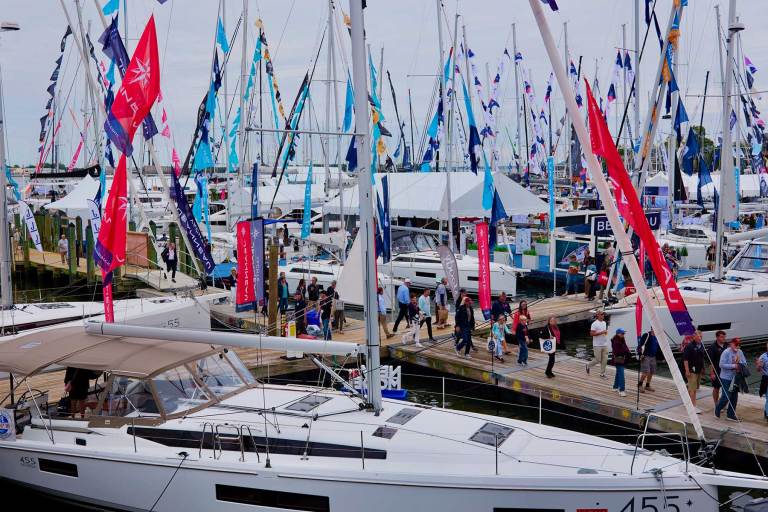

 Courtesy NMMA
The recreational boating industry has long been a leader in conservation efforts, recognizing the important role healthy waters play in boating. Our industry has made impressive advancements toward reducing emissions. Marine manufacturers are constantly innovating to make processes and products cleaner. As a result of those collective efforts, recreational marine accounts for just 0.7% of transportation carbon dioxide emissions, and we consume about half of 1% of the gasoline in the United States.
In fact, since 2010, the recreational boating industry has reduced emissions from internal combustion marine engines by more than 90% and increased fuel efficiency by more than 40% through ongoing innovation in hull design and engine technology.
As we look to the industry’s future, the nation’s policy-makers and global leaders must understand that when it comes to decarbonization, marine manufacturing and maritime transportation are unlike any other industries. Given the diversity of products and experiences across recreational boating, there is no one-size-fits-all solution or approach to reducing emissions. The variety of boat types, operational cycles and unique energy requirements of recreational boats requires a portfolio of products and technologies to address climate initiatives and meet the needs of boating consumers.
 Pogonici - stock.adobe.com
There are many marine-propulsion technologies laying pathways to sustainability today, encouraging consumers to reduce greenhouse gas emissions and environmental impact. These technologies include sustainable marine fuels, hybrid-electric propulsion systems, fully electric propulsion systems, advanced hull designs, advanced combustion and efficiency management systems. Each technology plays a role in minimizing carbon dioxide emissions from recreational boating, and in letting consumers choose products that meet their needs while preserving their boating experience.
The International Council of Marine Industry Associations and its decarbonization steering committee recently commissioned Ricardo, a global strategic, environmental and engineering consultancy, for the Greenhouse Gas Reductions in Marine Leisure Propulsion study. This study compared the suitability of five propulsion technologies — baseline fossil fuels (gasoline and diesel), hybrid-electric, hydrogen, sustainable marine fuels and battery electric — for nine representative recreational boats. The goal is to help reduce carbon emissions through 2035.
The final report is expected later this summer, including information about cost increases and range decreases, but preliminary findings reinforce the idea that recreational boats and automobiles are different in terms of suitability for decarbonization technologies. Again, there are no one-size-fits-all technology solutions for recreational boats.
In the meantime, it’s important to note that the U.S. National Blueprint for Transportation Decarbonization also plays an important role in identifying long-term
opportunities to decarbonize the maritime industry. The table below illustrates technology solutions for travel sectors to reach a net-zero economy in 2050. The recreational boating industry has adopted the government’s recommendation through a portfolio of sustainability-focused product offerings.
Also, remember that the recreational boating industry has long been focused on minimizing carbon emissions. In addition to the current ICOMIA study, the industry pioneered the first on-water emissions sampling device to quantify greenhouse gas emissions from recreational boats, and worked with the Environmental Protection Agency to approve the test method; worked alongside the U.S. Department of Energy and Argonne National Laboratory to test and approve next-generation biobutanol fuels for use in recreational boats; implemented evaporative emissions controls on boat fuel tanks to significantly reduce emissions and improve the consumer experience; and implemented the Clean Vessel Act, which created pump-out stations for recreational boats.
The recreational boating industry also leads U.S. conservation efforts through the creation of states’ Office of Outdoor Recreation, by funding the Sport Fish and Restoration Trust Fund, and through manufacturer-led sustainability programs and initiatives.
In short, a variety of solutions will be necessary to meet the needs of boating businesses, consumers and global climate priorities, and to ensure a healthy environment for generations to come.
Jeff Wasil is senior director of environment, health and safety compliance for the National Marine Manufacturers Association.
This article was originally published in the July 2023 issue.