

Today’s jobs report, which showed that the U.S. economy lost 92,000 jobs in February, delivered a jolt but did not come as a great surprise to the economists and recreational marine executives who discussed the results with Trade Only Today.
The Labor Department said the unemployment rate rose slightly, to 4.4%, and that revisions to prior months’ totals included a drop of 65,000 in the December figure that also dropped that month into negative territory — a loss of 17,000 jobs — before January’s bounce back. The January figure was also revised downward, but only by 4,000, to a still strong gain of 126,000.
The health care category, which had led all industries in job gains during most months for a year or more, showed a job loss of 28,000 in February, primarily because of a strike by nurses and other health care professionals at Kaiser Permanente in California and Hawaii.
“The jobs miss did not entirely surprise me,” said Brian Thompson, an investor and clinical professor of economics at DePaul University in Chicago. “Beyond the job losses in health care associated with the strikes, there is a fair amount of uncertainty, which makes it difficult for firms to add positions. Looking across sectors, the continued declines in information services — likely tied to AI‑related adjustments — and reductions in transportation suggest that global uncertainty has begun to filter into the job market.
“On the other side of this, consumers eventually respond, which can lead to further slowing going forward,” he added. “I would look to retail sales and consumer confidence as reasonable gauges of sentiment. However, income remains a significant driver of future spending.”
Ian Wyatt, chief economist at recreational marine lender Huntington National Bank, said today’s report shows that “we are still stuck in terms of job growth. With the revisions, employment has not grown since April last year. In a couple of months, if this trend continues, we will get year-over-year job numbers that are flat or even slightly negative.
“The data shows us the January job growth was a blip and the lack of growth since April remains the baseline trend,” he added. “However, the labor force isn’t really growing, so unemployment is basically flat, as well, as we have both a lack of demand and supply in the labor market.
“Wages are still rising at 0.4% month-over-month and 3.8% year-over-year. This is a positive for consumer spending since it is solidly above inflation. What is concerning for spending is the drop in the stock market and increasing uncertainty, which has a greater negative impact on large purchases, like boats, rather than smaller-ticket items, like travel.”
Former NMMA president Thom Dammrich said the February jobs report did not surprise him, “as we have seen a growing number of companies announcing layoffs. We have been in slow-hire/slow-fire environment for some time that may be turning to a period of contraction, based on the decreases we have seen in two of the past three months.
“Consumer spending, especially among the middle class, is softening, and we see a continuing hollowing out of the middle class,” he added. “The middle class is the bedrock of the recreational boating industry, and these trends make the outlook more uncertain for the remainder of 2026.”
Drew Pope, president of the 16-member Independent Boat Builders Inc., said that although today’s jobs report was softer than many economists were expecting, it doesn’t necessarily change the broader narrative that marine industry executives have been seeing develop over the past several months.
“The labor market appears to be cooling modestly rather than deteriorating rapidly, and that still fits within the environment of cautious optimism many in the marine industry have been expressing heading into 2026,” Pope said.
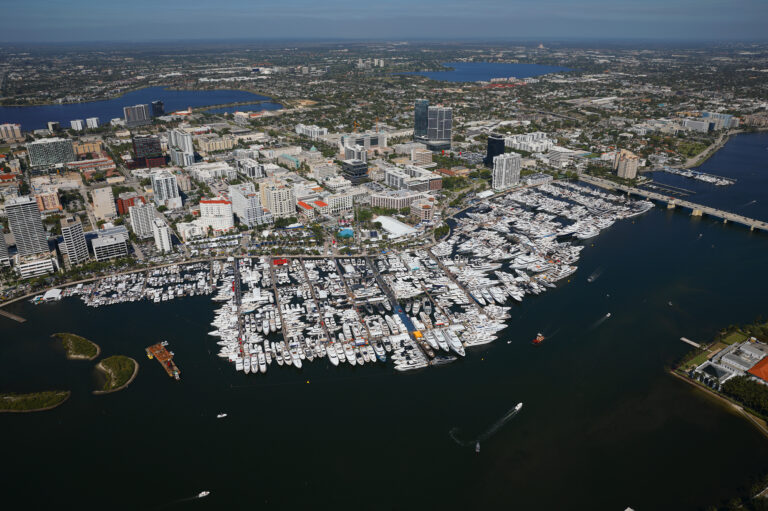
“From an industry perspective, builders remain focused on maintaining disciplined inventory levels and responding carefully to regional demand signals,” he added. “After the Miami International Boat Show last month, for example, several of our builders reported solid sales, and a few have already filled all of their model year ’26 production slots. They also noted that many buyers arrived at the show having already done extensive research and were ready to finalize a purchase once they found the right boat or deal.
“That kind of deliberate buyer behavior suggests that while consumers may be more thoughtful about large discretionary purchases, the underlying interest in boating remains strong as we head into the season. Overall, the boat show season appears relatively flat or slightly up compared with 2025 for most of our builders.”
NMMA chief economist Shawn DuBravac noted last month that U.S. job creation has been concentrated in service sectors, such as health care and social assistance, during the past two years rather than in higher-paying industries, such as manufacturing and professional services, that generally produce more boat buyers.
Dammrich said he is not optimistic that the country will be able to create more of those kinds of jobs this year in an economy that is K-shaped — the term used to describe conditions in which affluent Americans freely engage in luxury spending while lower-wage workers whose incomes are stagnant spend less and purchase less-expensive goods when they do buy.
“I am hopeful that continued slow growth won’t turn into recession, but that is possible later this year,” he said. “However, our K-shaped economy is creating more upper-class households with the financial wherewithal to purchase boats at the premium end of the market. But middle-class buyers are disappearing faster than we are creating premium buyers.”
Construction is one job category that has lately been productive, adding 33,000 jobs in January, although the Labor Department said there was little change in that industry in February.
“Yes, job growth in construction is a positive for the [boating] industry,” Wyatt said. “Blue-collar sectors, like construction, utilities and manufacturing, have some of the strongest wage growth over the past year. If I were a boat dealer, I’d be focusing on these customers. I’d also expect people will have larger tax refund checks this year, so dealers should look at that as an opportunity over the next month or so.”
Thompson agreed that health care and construction have been “significant drivers of job growth.”
“I believe that achieving broader‑based gains will require greater certainty going forward,” he said. “Businesses need the ability to plan and to have a reasonable understanding of interest rates, inflation and relevant risks. That gap in certainty is likely a considerable driver behind the lack of a sustained uptick in jobs.”
“Many [IBBI] builders tell us that a significant portion of their customers are small business owners, professionals or executives whose purchasing decisions are closely tied to how confident they feel about their own businesses and investments,” Pope said. “When hiring and compensation are strong in those sectors — along with stable markets and equities — we tend to see that translate fairly quickly into increased showroom traffic and stronger boat show activity.
“While the labor market overall remains resilient, we are watching closely to see whether job growth begins to broaden into those higher-paying sectors later this year. If that happens, it could provide a meaningful boost to consumer confidence among many of the households that historically make up a large portion of boat buyers.”
Pope said the overall mood he has heard consistently from IBBI builders is one of cautious optimism.
“Buyers are still being thoughtful about large purchases, but the enthusiasm for boating and time on the water remains very much intact,” he said.
“Promising leads and strong attendance at boat shows are encouraging indicators for our builders, though they aren’t the only metrics they’re watching,” Pope added. “Consumer sentiment was relatively flat compared with January, and broader market volatility — with the [Chicago Board Options Exchange’s CBOE Volatility Index] up roughly 45% over the past month amid geopolitical tensions and uncertainty in energy markets — is another factor many are monitoring. Borrowing costs and financial market stability will continue to play an important role in shaping longer-term demand.”
Economists’ consensus opinion has been that the Federal Reserve will again hold the line on interest rates at the central bank policymaking committee’s March 17-18 meeting. But the Fed lifts its benchmark federal funds rate to tame inflation and lowers it to support a struggling job market, and today it finds itself fighting fires on opposite sides of its mandate. Which one should it try to put out first?
“The Fed is in a tough spot,” Dammrich said. “Today’s labor report would seem to improve chances of a rate cut. But the impact of the Iran war on energy prices and inflation is going to make a rate-cut decision more difficult as the Fed seeks to avoid adding fuel to inflation. The concern is that we may be entering a period of stagflation, and the Fed’s tools generally work in opposite directions.”
Wyatt said that given somewhat higher recent inflation numbers, “we still see the Fed holding rates steady in March, but we expect by the second half of the year weak job growth, and a new Fed chairman, will lead to two to three cuts by the end of the year, leaving the fed funds rate around 3%. Fed funds is almost the same as the secured overnight financing rate, which is the key rate for boat floorplan loans.”
Thompson said he thinks the Fed is largely concerned about inflation as it weighs a future rate cut.
“The recent uptick in energy prices, along with increases in other key consumer areas such as food, makes it more difficult to entertain a rate cut in March,” he said. “I would expect the Fed to use upcoming data releases as a more appropriate gauge for future rate decisions. I don’t think today’s miss on jobs meaningfully changes that factor.”