
 ERIC COLBY PHOTO
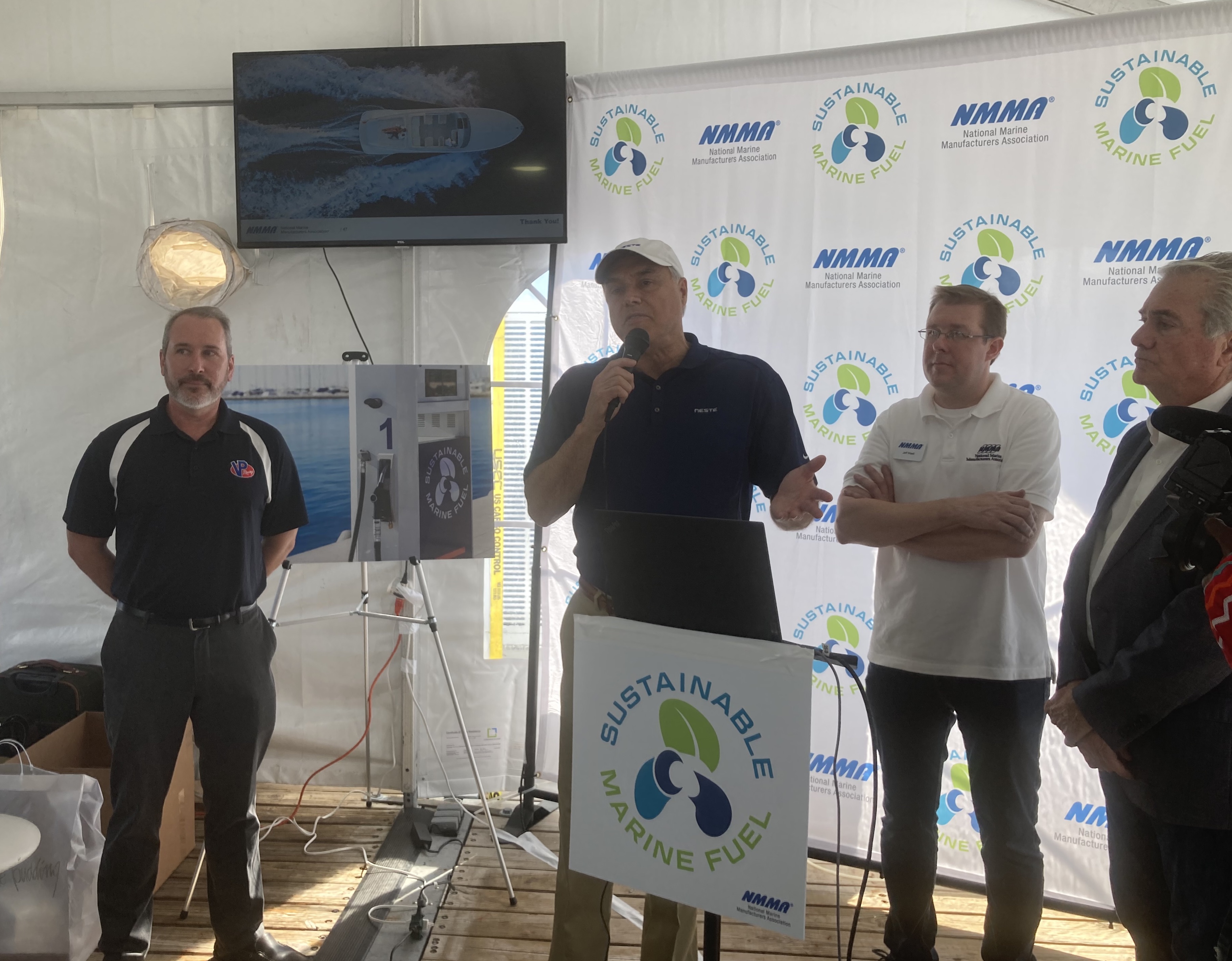
In conjunction with the Discover Boating Miami International Boat Show, the National Marine Manufacturers Association this week hosted a panel discussion about sustainable fuels. With the growing popularity of electric technology and its future, the organization took some time to address what boaters can do now to help reduce CO2 emissions.
“The goal is not, how do we electrify,” said Jeff Wasil, NMMA director of environment, health and safety compliance. “It’s, how do we reduce CO2 emissions. The marine industry needs to do its part.”
NMMA said in a statement that the boating industry has taken significant strides to reduce CO2 emissions and continues to pursue solutions. Since 2000, NMMA said, emissions from marine engines have decreased more than 90%, and fuel efficiency has increased more than 40%.
Wasil pointed out that here are 12 million registered powerboats in the United States, and that boating accounts for 0.7% of CO2 emissions in this country and 0.1% in Europe. If manufacturers designed hulls that are more efficient, considered hybrid-electric propulsion and implemented sustainable fuels, the industry could start reducing its carbon footprint sooner. “You have to make it easy for folks to be able to do their part,” Wasil said.
Dirk Vaughn, head of market development for Renewable Road Transport, talked about its Neste MY renewable diesel. “Our renewable diesel is made with a petroleum-diesel hydrocarbon,” he said. “It looks like water and smells like water.”
Neste said the fuel can reduce CO2 emissions by up to 75% and has a flashpoint greater than 60, which makes it safer to handle than conventional diesel fuels. It’s also non-polar, meaning it doesn’t attract water.
Panelists Mark Walls, director of research and development, fuel technology and quality for VP Racing Fuels, and Dan Porneau Sr., of plastics, chemicals and refining company LyondellBasell, said their companies are partnering to formulate Ecogen 93 gasoline. Ecogen 93 is a sustainable marine fuel that Walls said is a direct replacement for rec-90 (an ethanol-free, 90-octane gas blend) and reduces CO2 emissions by nearly 30% more than gasoline with 10% ethanol.
Jess Hewitt, president of Hyperfuels in Houston, discussed his company’s gasoline with Gevo biobutanol, a marine-industry-approved sustainable fuel. “This product is EPA-approved for blending with gasoline, and it’s endorsed by the NMMA,” Hewitt said.
He said the American Boat & Yacht Council endorses the fuel for use in a vented fuel system. It can reduce CO2 emissions by up to 30%.