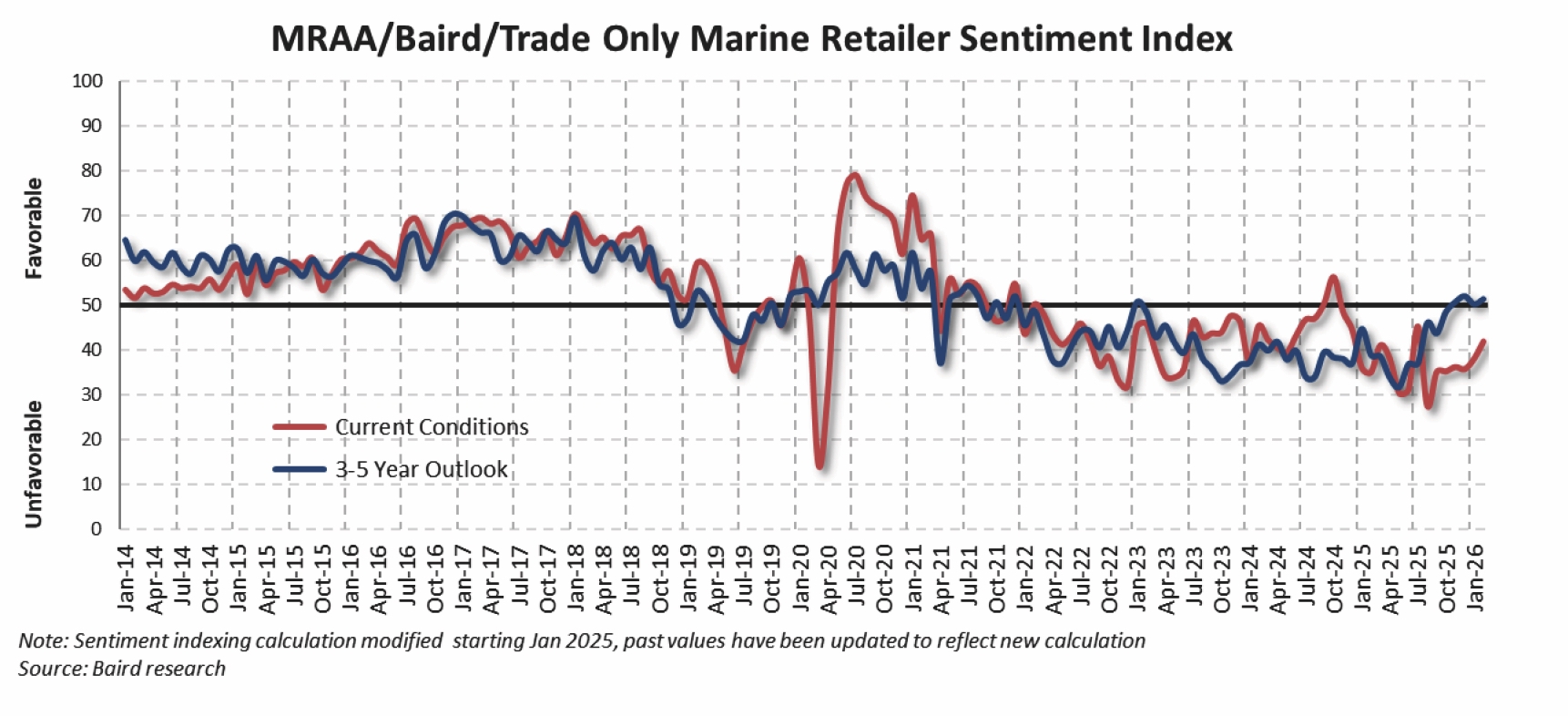
Dealer sentiment on current conditions inched up to 44 in February from 38 in January, while the three-to-five-year outlook ticked up to 51 from 50 in January, according to the recently released Pulse Report. A figure of 50 represents neutral sentiment.
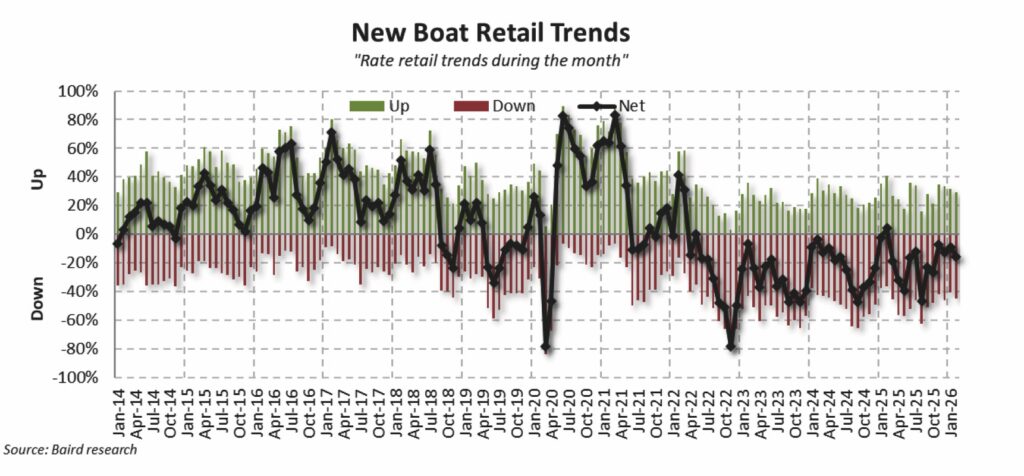
For this month’s Pulse Report, Soundings Trade Only, Baird Research and the Marine Retailers Association of the Americas asked 63 retailers to assess recent trends in North America. Consistent with recent trends, 45% of dealers reported retail declines, while 29% reported growth. Some builders appeared to be doing better, according to Baird. For example, Brunswick Corp. reported stronger retail activity early this year, doing significantly better than other sources.
On a late-January call about the fourth quarter of 2025, Brunswick CEO Dave Foulkes said that “retail is up double digits so far this year despite the inclement weather and a few other things going on around the country.” Baird’s contacts at the Miami International Boat Show, the report said, also struck a cautiously optimistic stance on the upcoming season.
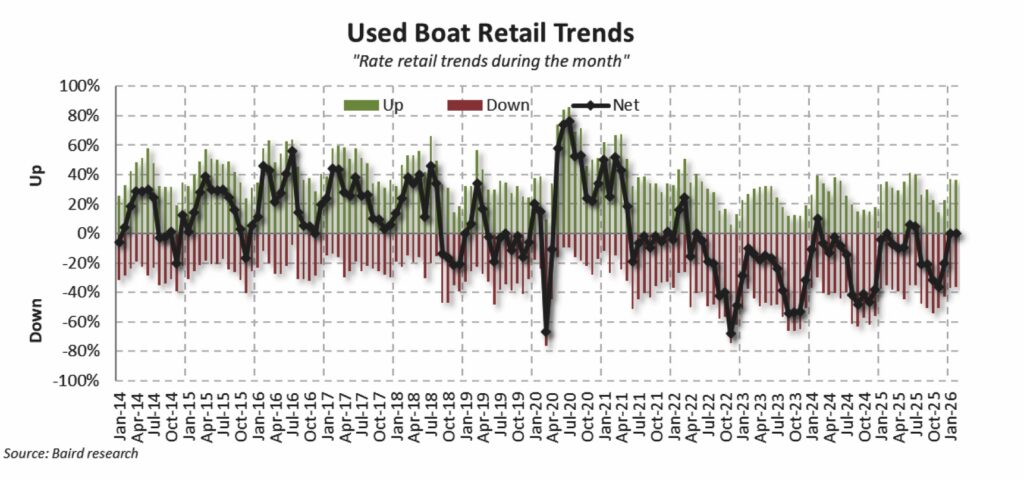
Dealers reported flattish used-boat retail, with 36% of respondents reporting declines and 36% reporting growth.
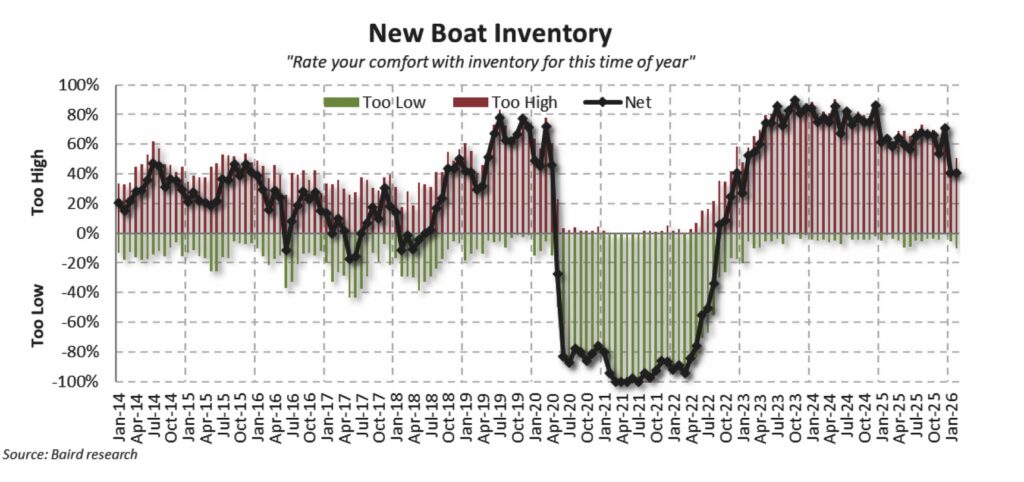
Dealer comfort with inventory levels was mostly consistent with January; 51% reported new-boat inventory being “too high” (versus 46% in January, down from 71% in December). Some 10% of dealers said new-boat inventory was “too low” (versus 5% in January). Dealers also reported leaner used-boat inventories, with 51% saying it was “too low” versus 25% who reported “too high.” One dealer said that “higher boat prices, higher interest rates, consumer fear and hesitation, economy, pending war news and an unstable political environment combine to drive more wait-and-see than purchasing.”
The Baird report noted that higher tax refunds and lower interest rates should help retail this spring, but added that “new geopolitical risks may weigh on already hampered consumer sentiment.”
When asked what was working, one dealer said, “Customers seem to be researching online significantly more — from products and services to dealers and service centers. Our strong search visibility and digital performance are driving more business than any other form of advertising right now, although all are still slow.”
Another dealer commented, “Our February boat show had some nice weather, which helped bring people in. That, along with some great deals (some from the manufacturers and some from us) and some great sales guys, helped us have one of our best shows ever.”
When asked what was not working, one dealer described a lack of innovation and change on entry-level boats. “Most brands are focusing on the higher-margin boats and leaving the first-time buyer out of their vision,” that dealer said. “I believe they are not looking to the future and getting the first-time buyer in a boat, which will end off killing the industry. The fishing and pontoon segment has done a good job on gathering the first-time buyer and promoting the die-hard. The fiberglass day boater has been forgotten.”
Numerous dealers also cited challenges with new-boat affordability. One said, “Boat prices have priced us out of a lot of the market.” Another said, “High-end pontoons not doing what they normally do for us.” Yet another said, “We have seen a variety of price increases from OEMs due to raw material costs (1% to 6%) when product is already too expensive. Tariffs have priced our bestselling OEM that we source outside of the U.S. right out of the market (15% at the port). Now with the war in Iran and the fuel prices likely seeing a hike, I worry about how the rest of the year is going to play out.”
The survey also asked dealers about their plans for using artificial intelligence. Most respondents said AI use at their dealerships was “driven by individual initiative,” followed by “no defined approach.” After that came AI use led by “informal direction from leadership,” with the fewest dealers reporting a “formal strategy or roadmap.”
Some dealers faced challenges understanding AI’s efficiencies. One dealer said, “The number of calls we get in a day for companies offering AI services, and their sales staff don’t even fully understand what they’re selling. They keep using the AI buzzword, and when you ask how you can customize this, they don’t know how to answer. We need to be able to scale some sort of AI tool that can communicate across multiple platforms or look at companies that can serve all of our needs from POS, DMS, CRM, website, manufacturer platforms, etc.”
Another dealer pointed out “the misunderstanding of what AI can and will do. It is changing so quickly that the outcome is inconsistent on the business side. It is making advertising a little easier, but [we are] noticing false/fake components to social media posts and advertising.”
Many dealers expressed distrust of some AI results and said there was a learning curve to using it, as well as some resistance among staff to adopt AI tools. “We are trying it,” a dealer said, “but everything is changing so fast, it’s hard to keep up with it.”
This story originally appeared in the April 2026 edition of Soundings Trade Only.