
Today marks three months since the United States launched its first military strikes against Iran. During those 89 days, the Strait of Hormuz has given Iran strategic leverage in the conflict, resulting in skyrocketing fuel prices around the world.
The aftershocks of the crisis in the strait have had profound effects on boatbuilders, rippling through nearly every supply-chain input needed to assemble boats in an environment already dealing with cost increases due to tariffs, inflation and other macroeconomic headwinds.
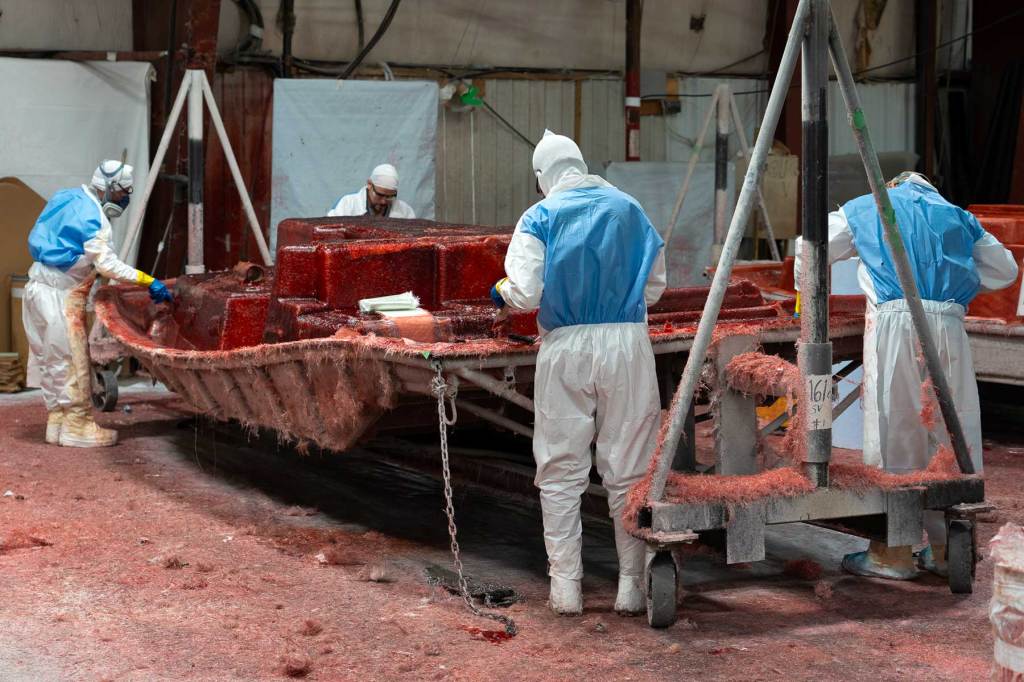
“With a fiberglass boat being almost 100% petroleum products, it’s a real challenge for our operation,” Smoker Craft CEO Peter Barrett told Trade Only Today. “From the resin to the foam and vinyl, the plastic on the wiring — they all are made in some way or another from petroleum.”
Interplastic Corp. recently raised its prices on polyester and vinylester resins, gelcoat, bonding compounds and colorants by $0.23 per pound, citing a “rapid surge in raw material and operating costs resulting from ongoing instability in the Middle East.”
Asked how Smoker Craft can mitigate these sort of price increases, Barrett said timing is his biggest challenge.
“We’re ramping up our production line for our new model year, which starts July 1,” he said. “It’s very difficult at this point to make changes — the products going into these boats are already set. We’ve seen price increases as high as 25% on some components recently.”
Additionally, Barrett said, the increased price of diesel means Smoker Craft has had to implement surcharges for shipments to dealers.
“We deliver our boats all over the country,” he said, “and we can’t control where a truck may have to fill up. So we have been adjusting the surcharge on a week-by-week basis. It’s not something we like doing, but we can’t absorb the brunt of all these increases, especially diesel fuel.”
Christophe Lavigne, president of RIB builder Highfield USA, told Trade Only Today that his business is also being pinched by rising costs associated with the conflict in Iran.
“Since the start of the conflict, container pricing from overseas has literally doubled, from approximately $4,500 to more than $9,000 in our latest quotes,” Lavigne said. “Ultimately, these costs are passed on to the retail customer, with margin added throughout the chain.”
Lavigne said he has been swift to react to market changes, shifting some production from aluminum to fiberglass hulls in reaction to tariffs and general price increases as high as 50% for the metal.
“Tariffs on Canadian goods significantly impacted aluminum pricing, with increases approaching 50%, affecting our U.S.-made trailers and boats,” Lavigne said. “To mitigate this issue, we shifted more aggressively toward [fiberglass] boats in late 2025, and unfortunately, another challenge emerged. Resin pricing is directly tied to oil prices, and costs are now skyrocketing, as well.”
Barrett, whose company in addition to fiberglass boats produces aluminum boats and pontoons, also said aluminum pricing has been problematic, even from U.S.-sourced flat sheet, extrusion and cast products.
“I believe all of our flat-sheet aluminum is U.S.-sourced,” Barrett said, “and our castings are generally from recycled materials manufactured here, too. But there have been smelting factories put offline, and the costs for getting it all shipped to us goes up every time fuel prices do. It’s a moving target.”
Despite the difficulties, Lavigne and Barrett remain optimistic about the 2027 model year.
“While things are challenging, when I look at the boats we’re building, between the engine technology, the materials and the way they’re built, I still think the product is the best we’ve ever made being delivered to the retail customer,” Barrett said.
Added Lavigne: “Overall, while Highfield is performing very well in this traumatic environment, I believe we will emerge from this difficult period stronger and with additional market share. I sincerely hope our political leaders find ways to support businesses rather than creating additional obstacles.”
If you are a boatbuilder dealing with increased production costs and would like to go on the record about the subject with editor-in-chief Gary Reich, please e-mail him at gary.reich@firecrown.com.