
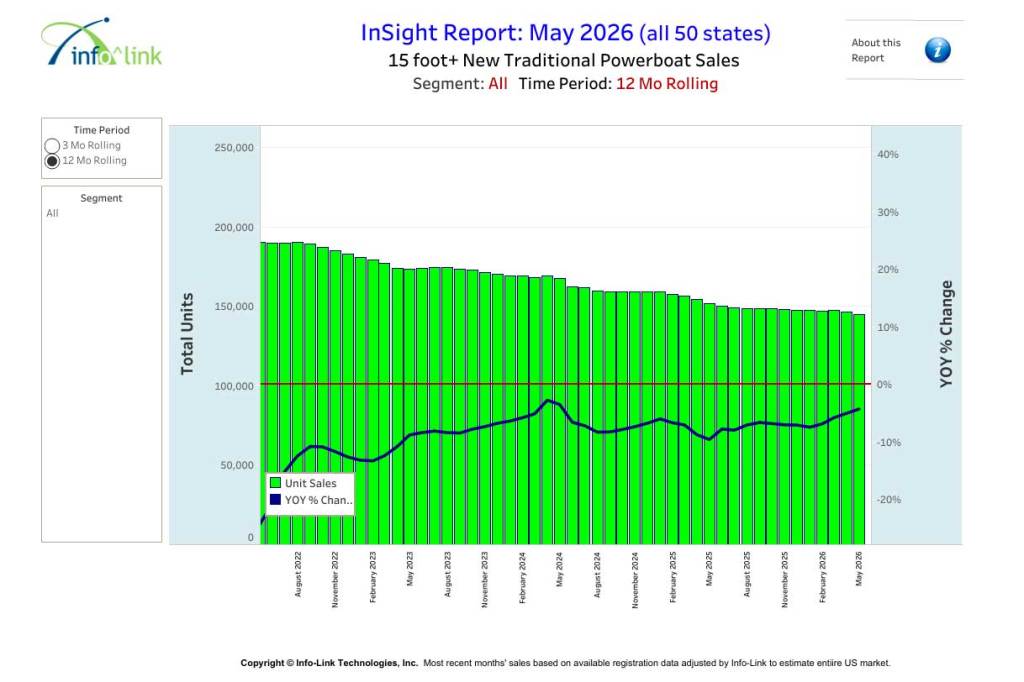
Registration numbers for the 15-foot-and-over U.S. powerboat market through May were down 4.3% relative to the 12-month rolling average, marking another consecutive month of improvement against that average. Registrations across all segments totaled 213,549.
The data for new-boat registrations was provided by Info-Link, a Florida-based company that compiles registration numbers from the Coast Guard and individual states.
In the May sales report, towboats were down 10% for a running total of 7,670 units sold. Runabouts were down 12.5%, with a total of 13,486 units sold, and pontoons were 8.1% off their 12-month average, with 47,108 units.
The freshwater fishboat category gained 1.2% on its 12-month average in May, with a total of 54,723 units sold, another increase in the category’s 12-month running average of units.
“Freshwater fishing continued to achieve solid performance in the ’26 model year,” says Russell Baqir, senior vice president of business development at Northpoint Commercial Finance. “Inventory turn has averaged two times throughout the model year. Aging is under 15%. The average cost of this category has doubled since 2019. However, the cost of product remains affordable compared to other segments. Recent shipments, according to [the National Marine Manufacturers Association], are outpacing retail, which is a risk, and we have seen a slight inventory trend slow down.”
In May, another category showed continued improvement relative to its 12-month average: unclassified/other, which includes houseboats, fliteboards, airboats and other watersports vessels. That category showed a 6.8% increase on its 12-month average with 5,269 units sold.
In the May report, saltwater fishboat sales were off 4.5% from their 12-month averages, for a total of 21,438 units sold, marking another consecutive month of improvement. “Unfortunately,” Baqir says, “this segment continues to lag compared to the overall market. If you look at the NMMA shipment data, it does reflect that saltwater shipments outpaced retail during ’24 and ’25. This is no longer the case; shipments are significantly below retail due to OEMs cutting back and dealers holding off on orders.
“Typically, you would expect to see the inventory turn increase due to the reduced volume. However, the turn continues to remain below 1.5 times, and aging inventory over 12 months is swelling to the mid-20% range. We did expect an upswing in this segment that has not materialized based on our latest liquidations as a percent of portfolio. The cost of inventory in this segment has more than doubled. Consumers will turn to lower-cost options if they cannot budget product cost combined with higher interest rates. Used inventory will fill the gap until the credit buyer can cash-flow the payment for new inventory.”
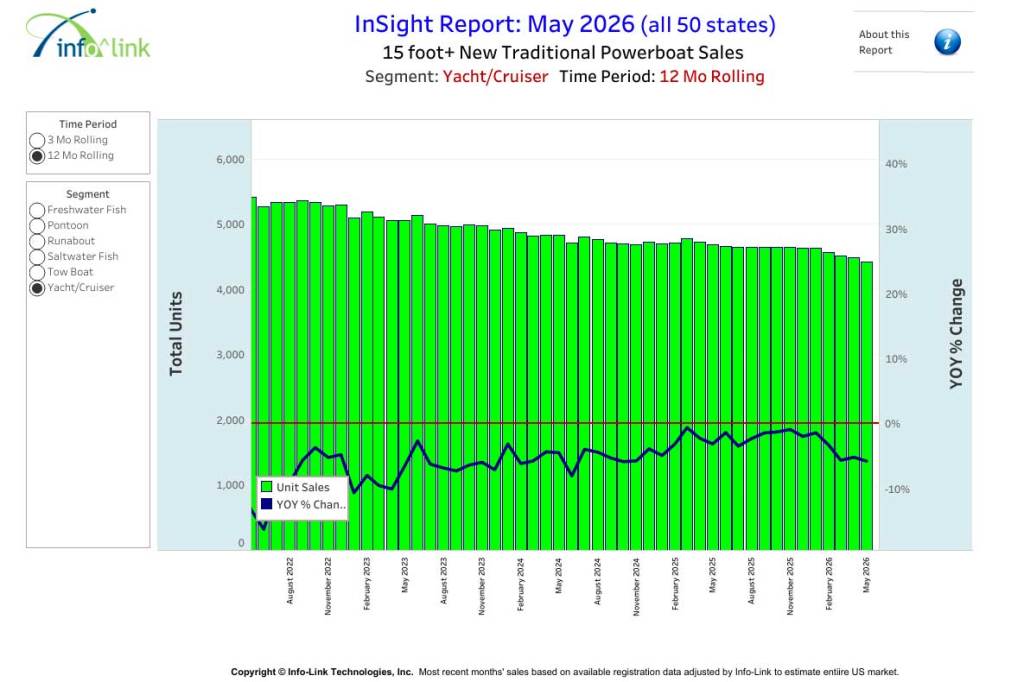
One category not tracking overall registrations’ curve is yacht/cruiser. This category was down 6.5% from its 12-month total with a total of 4,556 units — another decrease from the previous month. “The yacht category has gone through significant change since 2018 when Sea Ray exited the yacht market,” Baqir says. “Foreign OEMs have worked to fill the gap, but retail sales have not caught up to historical numbers. However, those numbers were inflated by products being sold below production cost. Granted, yachts and cruisers do bleed into each other, but cruisers’ turns and aging are in a better position. It is also shrinking concerning inventory in the field faster than the yacht segment.”
In other categories in May, PWC sales were 8.4% under their 12-month rolling average with a total units figure of 59,299.
Among the bigger state markets, Florida was 5% below its 12-month average for 27,799 units yearly. Texas was down by 3% with 15,854 units. Michigan was also below its 12-month average by 3% for 11,282 units, while Minnesota was down 11% with 8,665 units.
Again in May, Southeast states showed strength. Georgia showed a 6% increase in its 12-month average with 8,403 units for the year on that basis. Alabama was up 5% with 7,435 boats sold on the yearly average. Mississippi rose 10% with 2,841 units yearly.
Freshwater fishing is a strong driver in these markets, Baqir says: “Also, if you break down historical consumer confidence by region, the Southeast typically outpaces the national average, driven by robust population growth, strong labor market, and inflation runs at lower pace in these markets, as well.”
Other states that showed increases in May were Idaho, which was up 11% with 2,075 units on the running figure; West Virginia, up 4%; and Rhode Island, up 12% in the 12-month average
Overall, Baqir sees marine continuing to improve incrementally. Dealer defaults have trended down through this selling season, he says. Inventory turn overall is approaching 1.7 times compared with 1.5 times last year.
“Inventory aging improved significantly,” he says. “The health of the industry is improving despite the shrinking market. An aspect that is not reflected by measuring the number of boats registered was the desire of OEMs to grow their higher-margin product over the past decade, which was accelerated by the Covid bubble. As manufacturers shifted toward higher-margin products, production of lower-margin, high-volume models declined. While this improved short-term operational efficiency for OEMs, it also reduced options for value-oriented buyers.
“This dynamic contributed to the relative success of aluminum freshwater fishing products in a contracting market,” he adds, “as the segment continued to offer affordable entry-level choices.”