 Courtesy Garmin
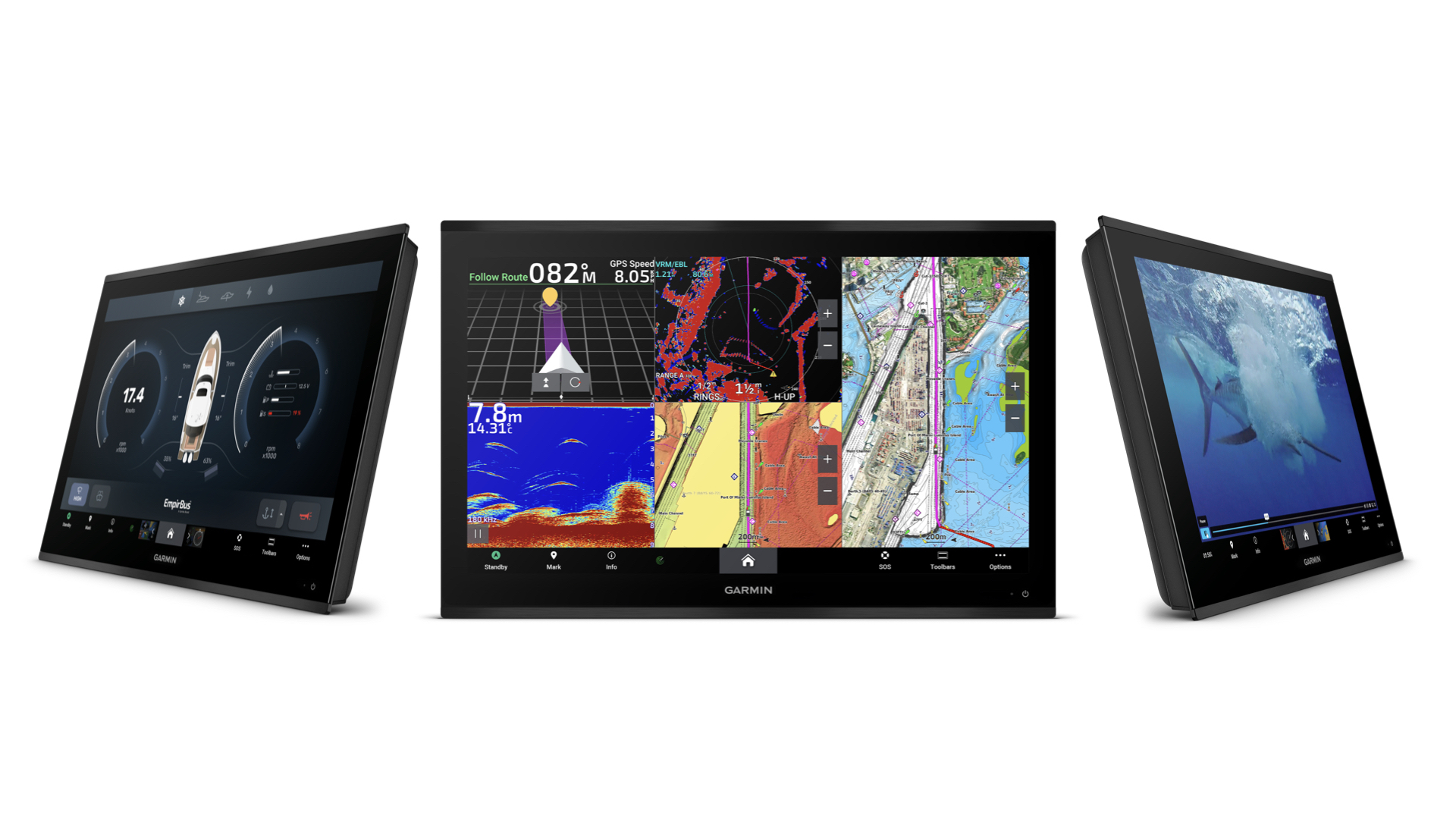
Garmin recently introduced the GPSMap 9000 series of multifunction devices with the industry’s first 4K display. The 9000s represent a logical step forward from GPSMap 8000 products, with faster processors, higher-resolution displays and larger sizes — and provide valuable insights into trends throughout this marine-electronics category.
First, let’s talk about product life cycles. Until recently, one of the biggest complaints among boaters has been how quickly products become obsolete. However, in the past five years or so, mature product lines have received relatively minor hardware refreshes. And while the pace of hardware changes in multifunction displays has slowed, major software developments continue. This shift represents a significant potential benefit for boaters: new features and updates without the expense of new displays.
For example, Furuno, Garmin, Navico and Raymarine added integration capabilities, allowing their displays to control third-party systems such as stabilizers, lighting and cameras. In most cases, the integration capabilities have been added through a software update to existing models.
Garmin’s new GPSMap 9000 series follows the GPSMap 8000 line that premiered more than a decade ago. Even more notable for consumers: Although the 9000s take over as the flagship line for large displays, the 8600 displays continue to sit atop Garmin’s line below 19 inches. The software experience is identical on a brand-new GPSMap 9227 and a 5-year-old 8612.
Displays are the Difference
The headline feature of the GPSMap 9000 family is the 4K display, along with the availability of an eye-popping 27-inch screen. Comparisons to living-room televisions are nearly unavoidable.
Simply put, 4K refers to the number of pixels used in a display. High definition, found on most newer multifunction displays, has resolutions of 1920 by 1080, or 1920 by 1200 pixels, for a total of 2,073,600 or 2,304,000 pixels. A 4K display has a resolution of 3,840 by 2160 pixels, totaling 8,294,400 pixels.
HD and 4K are both a lot of pixels. In fact, with smaller displays, boaters may not be able to see the difference. But displays have gotten larger over the years, and Garmin’s 9227 continues that trend. Larger displays increase the ability to take advantage of additional resolution. So it makes sense that Garmin makes the 9000s in 19-, 22-, 24- and 27-inch sizes.
One of the primary advantages is the ability to split the display into multiple areas, each showing different information. For example, with a 24-inch display, a boater might see a chart view, radar scope, sonar and gauges, each in its own quadrant.
On three different 24-inch models — Garmin’s GPSMap 9224 and 8624, and Raymarine’s Axiom XL 24 — each of the four windows on the display will have a diagonal measurement a bit over 12 inches, but their resolution will be vastly different. On the higher-pixel displays, the boater can see a more detailed image with more information. Put another way, the GPSMap 9224 can effectively be split into four separate windows with the same resolution as an entire previous multifunction display.
In recent years, it hasn’t been unusual to see the helm stations of smaller boats built around a single, large display. The introduction of 4K displays is likely to increase the utility of that large display significantly. But builders that designed dashes for the largest available displays, then 24 inches, will need to tweak helm designs to accommodate the new big kid, the 27-inch 9227.
A Path for the Future
The GPSMap 9000 series offers several other improvements compared with prior systems: network interfaces that are 10 times faster, processors that are seven times faster, and improved media handling.
The changes to the 9000’s networking aren’t limited to faster connections speeds. With these multifunction displays, Garmin introduced a BlueNet gigabit Ethernet networking system. BlueNet replaces Garmin’s long-running Garmin Marine Network and its 100-megabit ethernet communications. BlueNet also introduces IPV6 for additional network access control and security, greater power-over-ethernet compatibility, and an easier-to-route, water-resistant connector.
Garmin also has been a longtime participant in creating and implementing the National Marine Electronics Association’s OneNet standard. However, BlueNet isn’t OneNet, and it appears that communications between a BlueNet network and a OneNet network will require a gateway.
Still, in addition to offering all these new features today, Garmin’s new multifunction displays are poised to meet the needs of boaters well into the future. These displays embody a trend across the industry of longer life for products, as well as dramatic increases in functionality during that lifespan. The models manufacturers introduce today are likely to determine product direction for many years to come.
This article was originally published in the February 2024 issue.