
 Courtesy Brunswick Corp.
For more than 70 years, the marine industry has been in a 12-volt rut. However, with the recent push toward electrification and batteries not just for propulsion but also for accessories aboard smaller boats, many companies are looking at more efficient 48-volt systems.
A 48-volt system, which often includes 12-volt components, has several advantages. Higher voltages mean fewer amps are needed to deliver a given amount of energy. More volts allow lighter wires to be used, increasing efficiency while reducing weight and cost for boatbuilders.
In many ways, boatbuilders are now addressing what the automotive world has been adapting to for years, with the addition of subsystems such as driver assist, diagnostics, electric turbochargers, hands-free driving, giant displays, sensors, seat and steering-wheel heaters, and cameras. It’s a lot to handle for a 12-volt system. There’s also a growing pressure to increase fuel economy, meaning loads directed from internal combustion engines to 48-volt electrical systems.
 Courtesy Brunswick Corp.
Wherever there’s a need, innovation will follow. Delphi Automotive System used 48 volts to create a mild hybrid (which means the technology level falls somewhere between true gas-electric hybrids and having only the basics). Delphi’s product uses electric motors to assist small, efficient combustion engines during acceleration, and boosts fuel economy while reducing emissions. That’s just one solution; in early 2023, Tesla announced a move to a 48-volt electrical system, starting with the Cybertruck and later to include all new models.
So far, the marine industry’s biggest impediment to embracing 48-volt systems is the relative scarcity of compatible accessories, such as air conditioners, pumps, water heaters, windlasses and bow thrusters. However, several companies are developing these items. The Dometic Group has been in acquisition mode, with president Eric Fetchko saying the company intends to be a leader in developing and manufacturing 48-volt systems and accessories.
“Air conditioning units are the single biggest draw, and one of our recent strategic acquisitions, Go Power, is developing 48-volt units,” Fetchko says. “Balmar is another Dometic company developing 48-volt alternators and smart regulators to deal with the complexities of charging and managing different voltages.”
 Courtesy Brunswick Corp.
Vetus marketing director Sander Gesink says his company is getting behind 48 volts as a future standard voltage for electrification. “We have led the world for many years with state-of-the-art bow thrusters and windlasses,” Gesink says, “so the choice to make much of the range 48-volt-compatible is a move that the rest of the industry has noticed.”
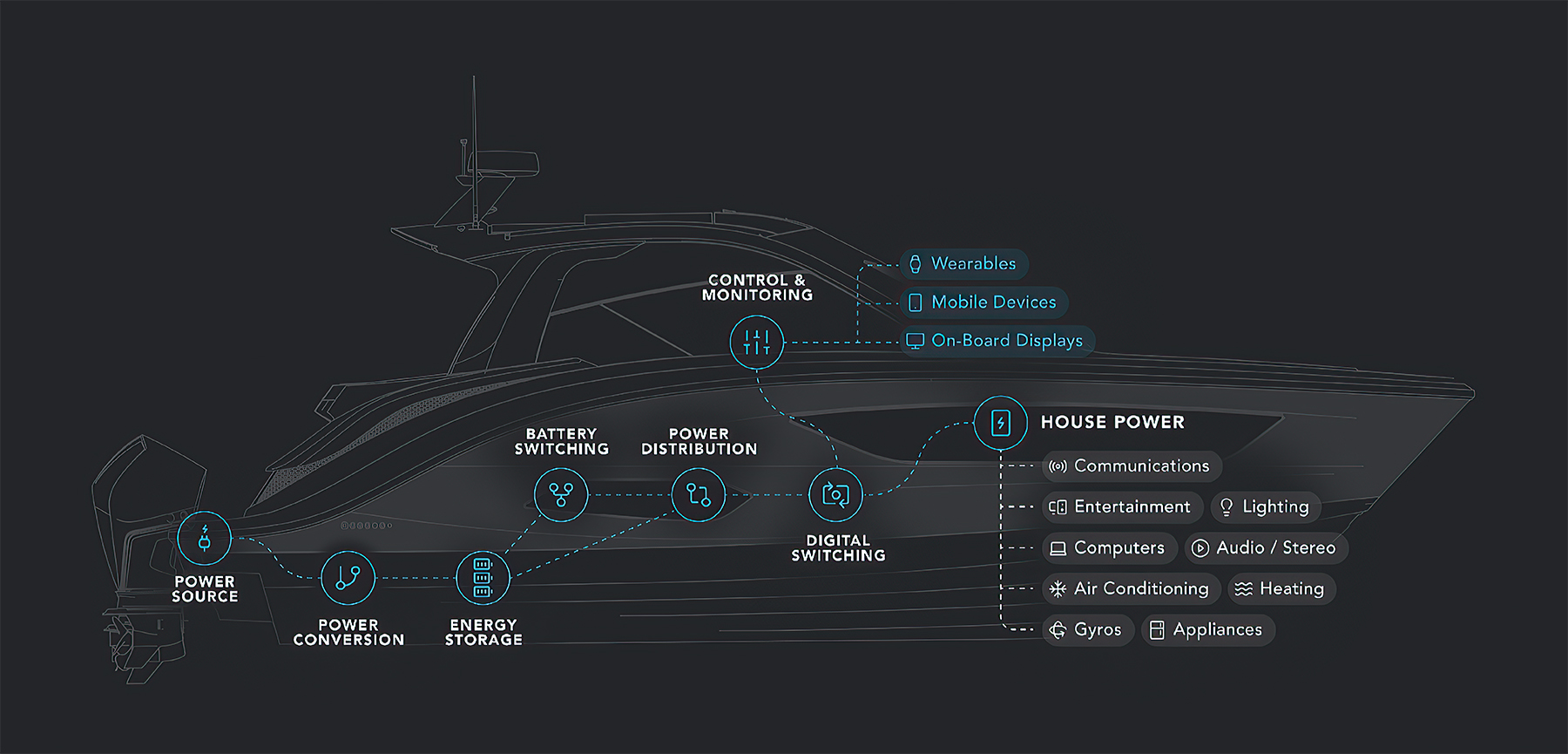
Brunswick’s Navico Group demonstrated the benefits of a 48-volt system with its fully integrated Fathom e-Power. It’s a lithium-ion auxiliary power management system that uses components from Brunswick brands Mastervolt, BEP, CZone, Ancor and Blue Sea Systems. The goal with Fathom e-Power is to replace noisy, carbon dioxide-emitting gas and diesel generators. It will be available to select boatbuilders outside of Brunswick.
Mastervolt, to support its 48-volt systems, created an inverter/charger CombiMaster 48/5000 and DC-DC Mac Plus 48/12 and 48/24 converters. The 48/12 Mac Plus provides bidirectional conversion to charge multivoltage systems. Creating a dual-voltage system helps builders phase into offering 48 volts while still running a 12-volt system for items, such as chart plotters, that don’t have a 48-volt counterpart.
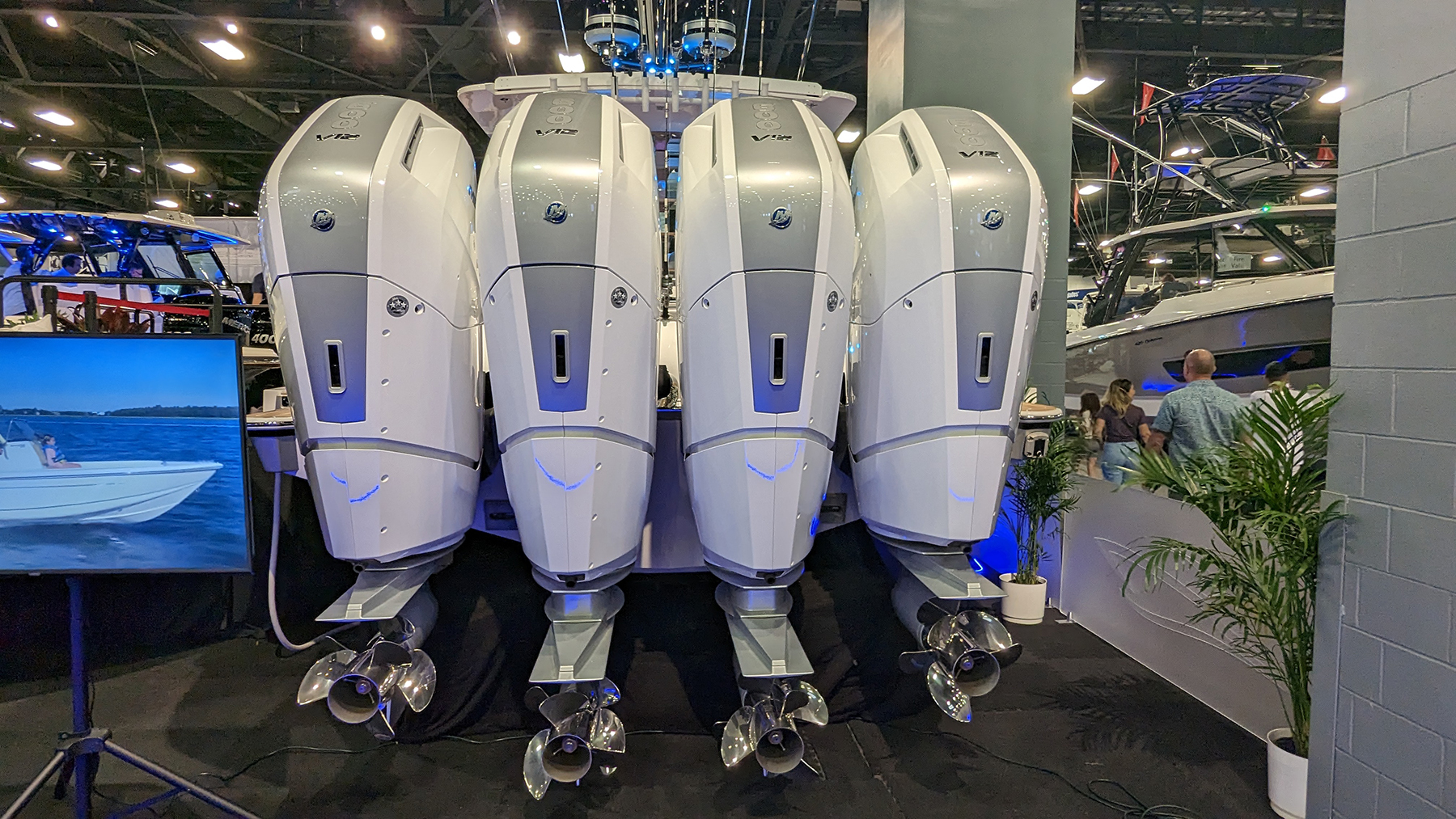
Mercury Marine recently launched an optional 12/48 dual-voltage, 150-amp alternator on Verado V-10 and V-12 outboards used with Fathom e-Power systems. At cruising rpm, the 48-volt alternator can produce up to 7,200 watts of power to charge the 48-volt Fathom system. On a quad-engine boat, this could mean up to 28,800 watts of energy produced.
Fetchko says the Fathom e-Power system is “fantastic, and Brunswick is setting a good example for the industry. When a market leader like that embraces change, that sends the right message to the rest of the market. It’s going to benefit us and the rest of the industry.”
According to Navico president Brett Dibkey, about 10% of RVs are adopting 48-volt systems today. “We anticipate seeing similar early adoption within the marine segment in the coming years,” he says.
Fetchko says most boatbuilders aren’t ready to take the plunge just yet. “But if at least 50% of cars have a 48-volt system, you would see much faster adoption in the marine industry because of the corresponding economies of scale,” he adds. “My best guess is that five years is probably a good timeline for that.”
Gesink says that with more and more 48-volt marine items becoming available, the movement toward a new standard has reached “a critical mass.” And the commitment from companies such as Brunswick, Dometic and Tesla will likely create a fear of missing out among companies that are slower to adapt. That will be especially true in three to five years, when vastly more efficient solid-state lithium-ion batteries — pushed by Toyota and Samsung — are expected to become a reality.
This article was originally published in the November 2023 issue.