
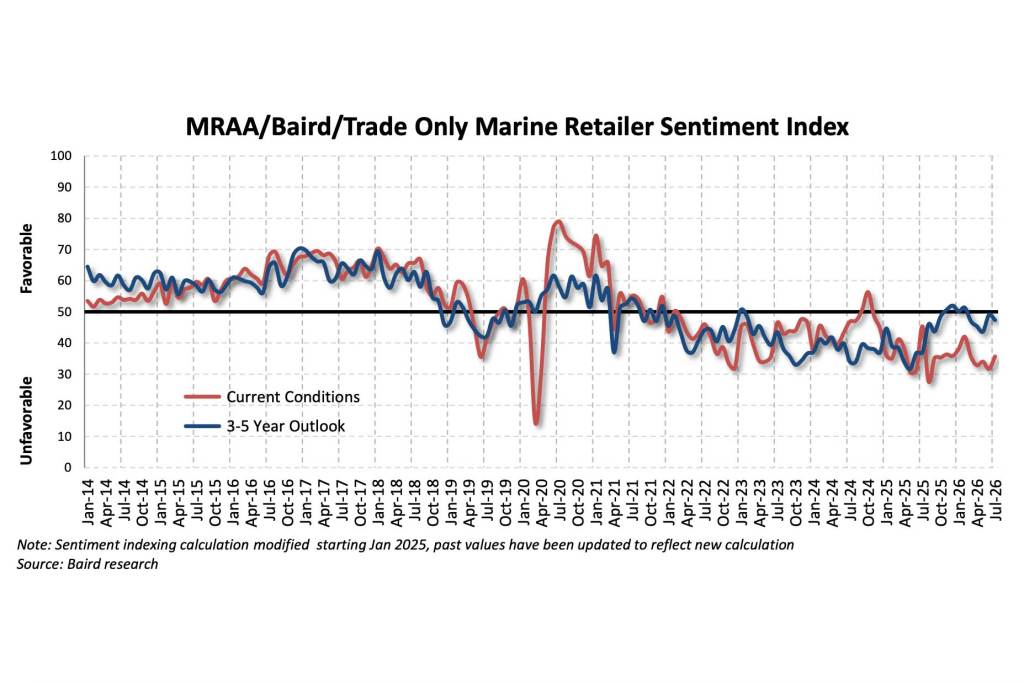
Dealer sentiment on current conditions moved up to 36 in July (from 32 in June), while the three-to-five-year outlook dropped to 47 (from 49 in June), according to the recently released Pulse Report. A figure of 50 represents neutral sentiment.
For this month’s Pulse Report, Soundings Trade Only, Baird Research and the Marine Retailers Association of the Americas asked 121 retailers to assess trends in North America.
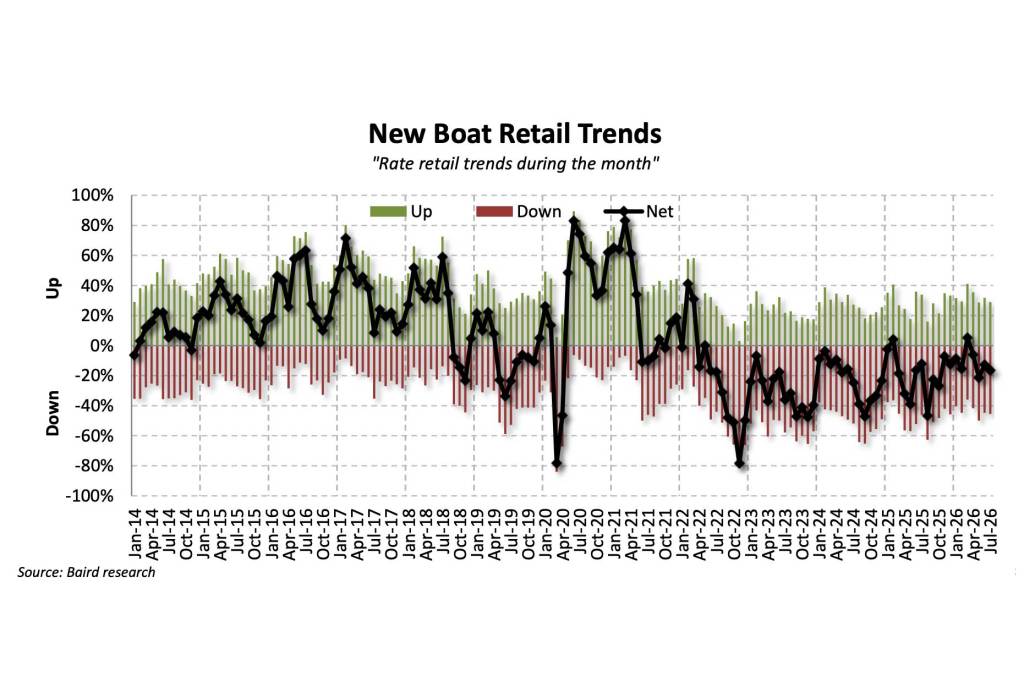
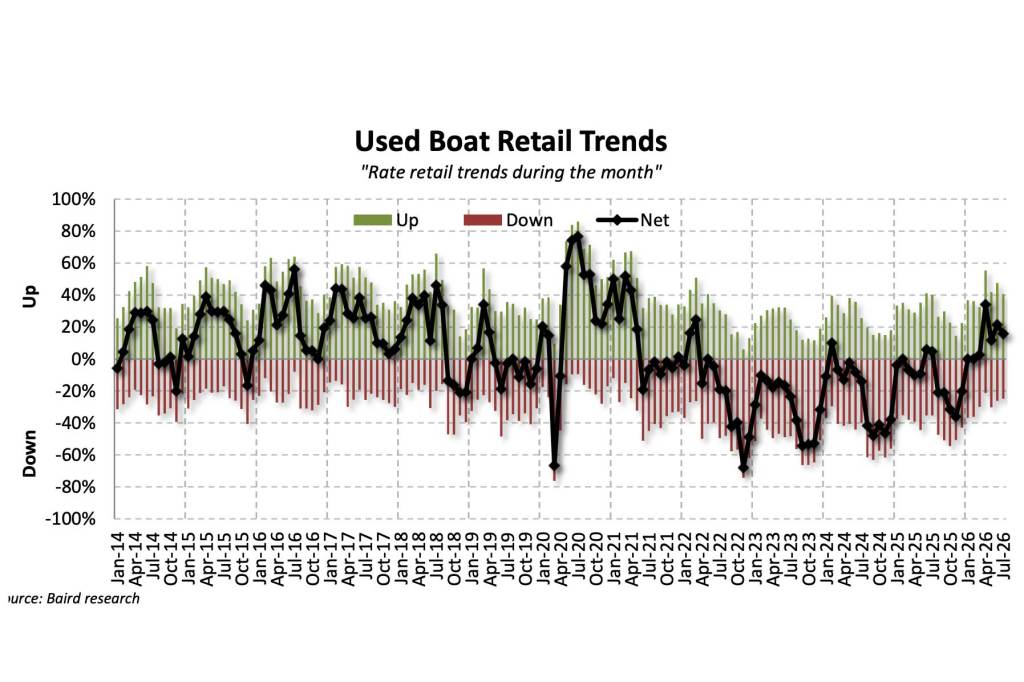
Dealers reported continued retail declines in July: 45% reported a decline, compared with 29% that reported growth. (Baird noted that July typically represents about 12% of annual retail sales.) Dealers again reported positive trends in used-boat retail. Comments suggest affordability remains a key challenge, and trends are choppy overall.
One dealer noted, “With the economic uncertainty in the market, customers are much more payment-focused, rather than price-focused, gravitating toward lower end or higher end. The middle market buyer is just not there now.”
New-boat inventory remains higher than dealers prefer. In July, 63% of dealers reported new-boat inventory was “too high” (up from 54% in June), while 10% reported “too low.” One dealer summed up the cost of carrying inventory: “We have been keeping inventory at absolute minimum. Interest rates on the floorplan are still very high, and the expense is just money flowing out the door unnecessarily.”
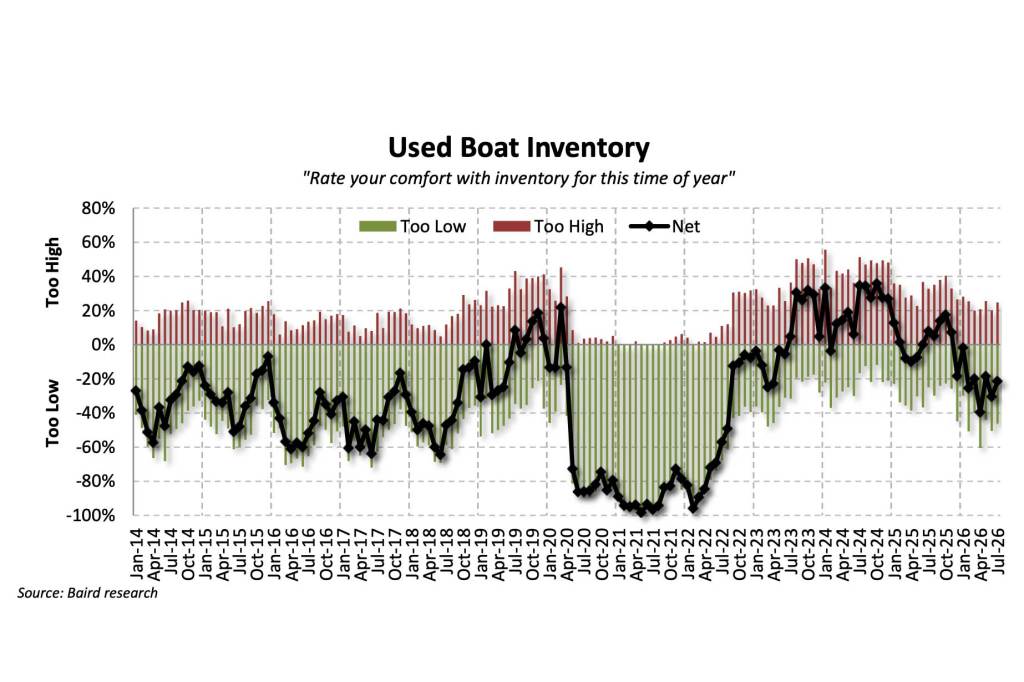
Used-boat inventory was leaner by comparison: 46% of dealers reported used inventory was “too low” versus 25% that reported “too high,” though that gap has narrowed since June.
Asked what was working, dealers pointed to a mix of niche products, used-boat value plays and promotions. One dealer called the market “super volatile,” adding: “Small pockets of things work for short periods, and then it goes back to being slow. Seems as though Seakeeper Ride-equipped boats and adventure-style boats have been doing well. Used is selling great if it’s $150,000 or less.”
Another described a more general churn: “Some trade activity interest. People with newer boats want new boats … not enough new-to-boating buyers, older boat owners not trading or buying.”
Many dealers also said discounts and promotions were helping drive interest. “It’s all working,” one dealer said, “but at a slower pace than in recent years. The marine industry has always been cyclical, like the ocean waves, so one has to keep a close eye on the horizon for upcoming market condition changes and be ready to change course quickly to take advantage.”
On what wasn’t working, dealers circled back to price and affordability. “Price increases or expected price increases may affect our decisions as to which boat lines we continue with,” one said.
Another noted a shift in spending rather than a retreat: “The uncertainty of the economy is still making customers hesitant to make large purchases. Our pro shop items have been selling well, but customers have been more likely to repower existing boats than purchase new ones.”
The survey also asked dealers which metric carries the most weight when evaluating inventory decisions today. The top three answers were “customer demand signals,” “floorplan cost” and “historical sell-through rate,” followed by “inventory age,” “gross margin potential” and “manufacturer incentives.”
Asked about the hardest inventory decision this season, one dealer described the rocky year so far: “For us it has been hard to meet minimum required orders when we had a slow patch during March and April, when we should have been busier. We had good boat shows and have been doing well recently, but what are normally expected to be peak months were not great for selling this year. So we are glad to have caught back up to projections, but we were sweating out our inventory in the spring. We still have a couple of albatross units, but overall inventory picture is clean.”
A recurring frustration across responses: Customers increasingly price-shop parts online before asking the dealership to order them, then balk at the price difference. “Everyone is buying all their parts on Amazon,” one dealer said, “and when they do come in and ask, and you have it, they turn it down because your price is higher than Amazon’s.”
Zooming out, one dealer offered a fitting marker for where they believe the industry stands: “Despite the economy, this has been a good sales year. I’m not sure that will last into next year if prices continue to rise like they have, but we will see.”