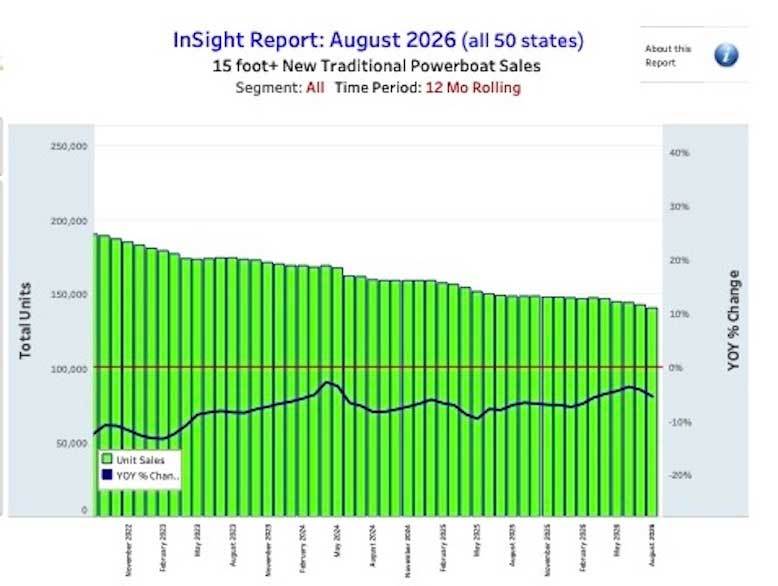
Registration numbers for the 15-foot-and-over U.S. powerboat market through August were down 6.2% relative to the 12-month rolling average. Registrations across all segments totaled 207,459. Those figures indicate a possible downward shift from the past year’s improvements.
The data for new-boat registrations was provided by Info-Link, a Florida-based company that compiles registration numbers from the Coast Guard and individual states.
Towboats were down 9.5% for a running total of 7,309 units sold. Runabouts were down 16.1%, with a total of 12,216 units sold, and pontoons were 8.6% off their 12-month average, with 45,269 units.
The freshwater fishboat category, a steady gainer for most of the past year, was off 0.4% on its 12-month average, with a total of 54,340 units sold. PWC sales were 7.7% under their 12-month rolling average with 57,870 total units. Saltwater fishboat sales were off 4.9% from their 12-month averages, for a total of 20,931 units sold.
The one category that showed improvement relative to its 12-month average was unclassified/other, which includes houseboats, fliteboards, airboats and other watersports vessels. That category had an 8.4% increase on its 12-month average, with 5,393 units sold.
“That category is interesting because it shows that even in a softer overall market, buyers haven’t stopped spending on boating,” said Naiche Sedillos, national sales manager at OceanPoint Funding, which specializes in financing for boat purchases and refinancing. “They are being more selective about where they spend. A category that includes houseboats, foiling products and other specialty watersports equipment can benefit from buyers looking for a different boating experience or a lower overall commitment than a traditional larger boat.
“I would be careful about reading too much into one smaller category,” he added, “but an 8.4% increase while most of the major segments are down does reinforce something we’re seeing from the financing side: Demand is still there. It has just become much more product-specific and buyer-specific.”
A steep decline, ongoing for months, was again seen in the cruiser/yacht category as builders and dealers prepared for the fall boat-show season. The category was down 11.2% from its 12-month total, with 4,292 units.
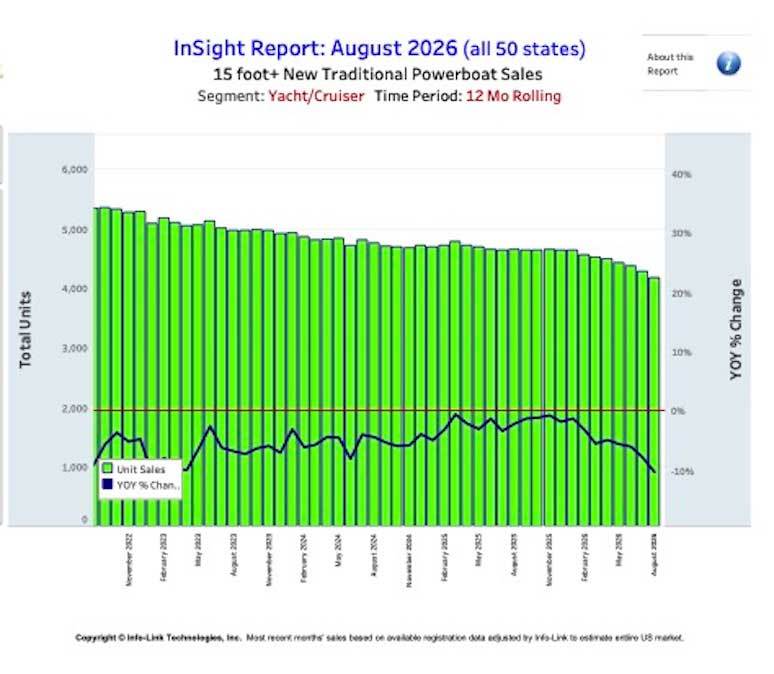
“The cruiser and yacht numbers don’t surprise me,” Sedillos said. “These tend to be larger-ticket purchases, and buyers in this category are very conscious of the total cost of ownership, not simply the purchase price.”
At the same time, he says he wouldn’t interpret an 11.2% decline in new registrations as a significant decline in interest in boating, given all the preowned and new products available right now. “A buyer looking at a $500,000 or $1 million boat has a lot of choices,” he says, “and late-model used inventory can be very compelling.”
So far, he added, fall boat shows have been generating financing conversations and applications.
“Today’s buyer is doing more homework, comparing rates and programs, and negotiating harder before making a decision,” Sedillos said. “We specialize in the complex deals, and that’s becoming increasingly important in this market. Whether it’s a unique ownership structure, an older vessel, a larger transaction or simply a deal that doesn’t fit neatly into one lender’s program, having multiple financing options can make the difference in getting the transaction done. The sale may take more work, but qualified buyers are absolutely still out there and buying boats.”
Among the bigger state markets, Florida was 7% below its 12-month average for 26,834 units yearly. Texas was unchanged with 15,983 units. Michigan was also below its 12-month average, by 3% for 11,186 units, while North Carolina was down 2%, with 9,138 units. California was 20% below its 12-month average with a running yearly unit total of 7,284.
“I would be cautious about drawing a long-term conclusion from a single month’s 20% decline in California registrations,” Sedillos said. “California is a large market, but individual months can move considerably based on timing, inventory and when transactions are actually registered. From our own business, we continue to see financing activity on the West Coast, including around the fall boat shows.”
California buyers are dealing with the same affordability pressures as the rest of the country, he said, and in a high-cost market, those pressures can be amplified. “I’d want to see several months of data before calling this a structural 20% decline in California demand,” he said.
In the green, Arkansas was up 3%, Mississippi was up 19%, Oklahoma was up 1%, and Illinois was up 5%. Idaho was up 15%, and West Virginia was up 25% with a yearly total of 958 units sold. New Hampshire was up 1% for 2,218 units, and Rhode Island increased 8% with 582 units on the yearly basis.
Overall, Sedillos said, 2026 has been about normalization.
“This was a year when the industry continued adjusting from the unusual conditions of the pandemic and immediate post-pandemic years,” he said. “Consumers had more inventory to choose from, sellers had to be realistic on price, and financing again became a major part of the purchase decision. The lesson from 2026 is that this is no longer a market where everything sells simply because it’s available. The right boat at the right price with the right financing still moves.”
For 2027, he said he expects affordability to remain one of the biggest variables.
“I wouldn’t predict a huge rebound in 2027. I would look for stabilization first, with opportunities for modest improvement if consumer confidence and affordability cooperate. From where we sit in marine finance, there are still plenty of people who want to own boats. Our industry’s job is to make sure the product, price and financing all make sense for them.”