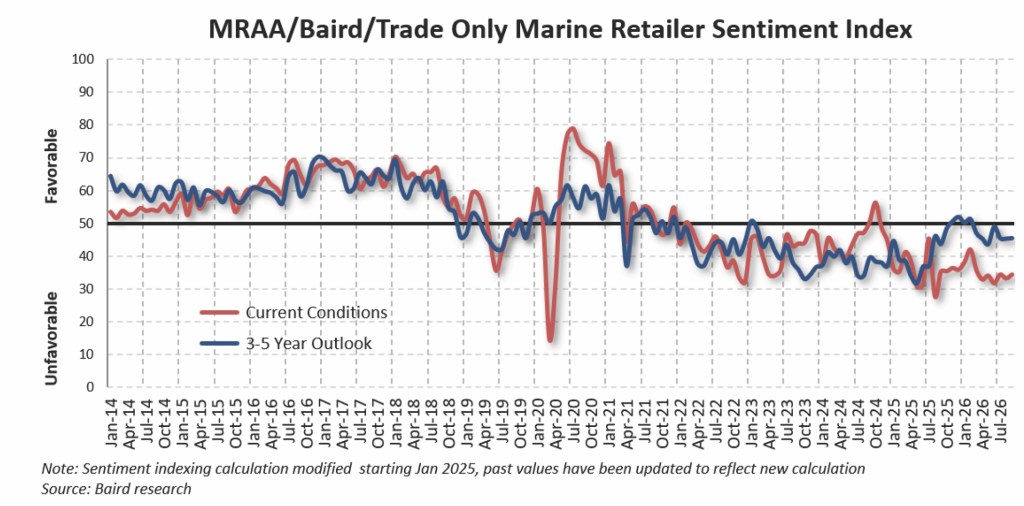
Dealer sentiment on current conditions increased slightly to 34 in September from 33 in August, while the three- to five-year outlook remained the same at 45, according to the recently released Pulse Report. A figure of 50 represents neutral sentiment.
For this month’s Pulse Report, Soundings Trade Only, Baird Research and the Marine Retailers Association of the Americas asked 118 retailers to assess recent trends in North America. Dealers reported continued new-boat retail declines in September: 53% saw a decline, compared with 26% that saw growth.
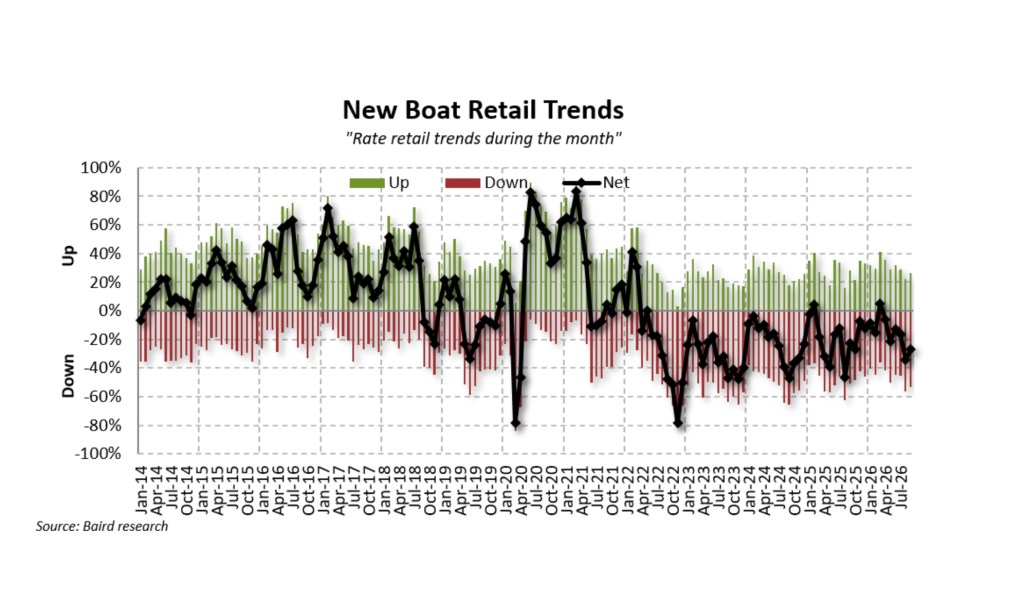
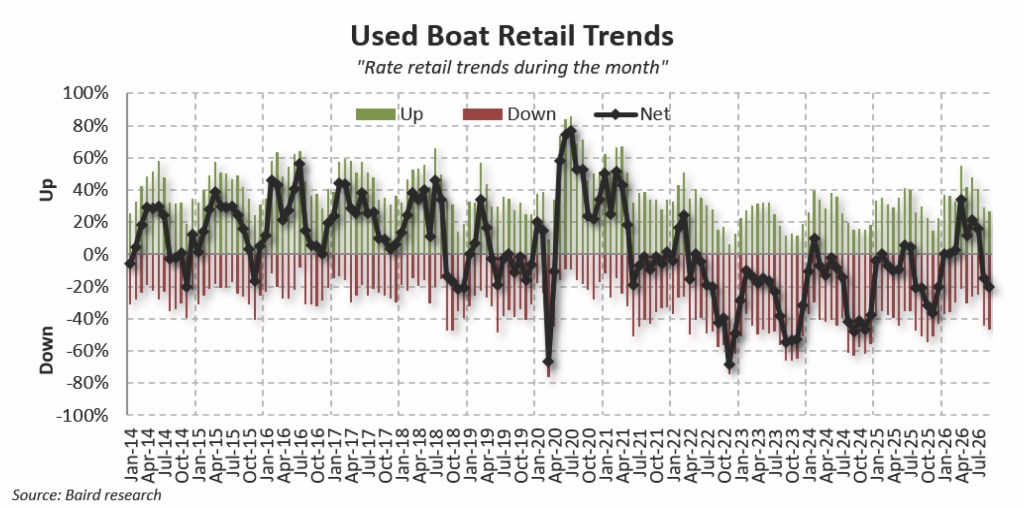
Dealers reported similar trends in used-boat retail, with 47% noting declines and 26% citing growth. According to Baird, September typically represents approximately 6% of annual retail sales.
On challenges in the marketplace right now, one dealer said: “The list is long. High interest rates and financing costs are causing customers to delay large purchases. Boat prices for 2027 models have risen beyond the average wage increase. Very little showroom traffic. Inventory levels are too high, and we are going into the slow season. The short answer is that nothing seems to be working, and consumers are not even shopping.”
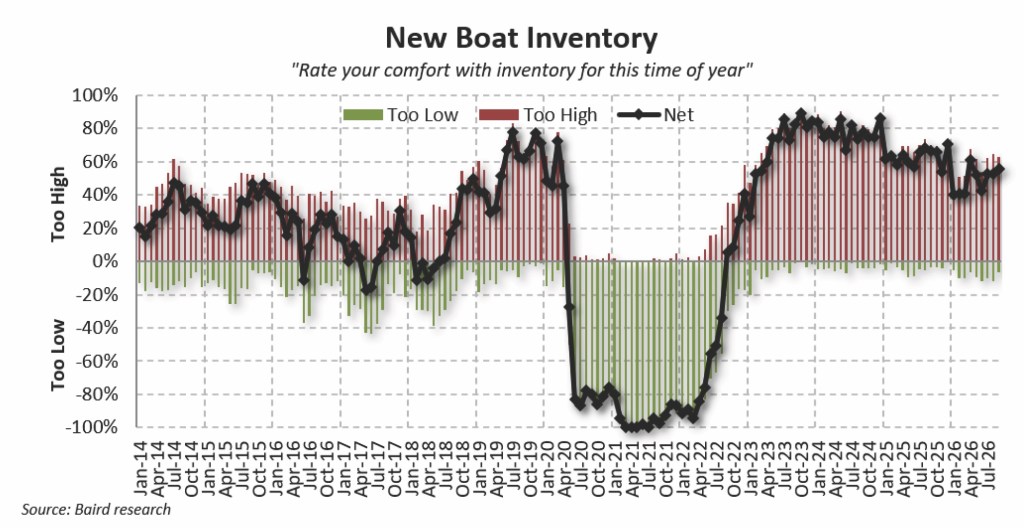
New-boat inventory remains higher than dealers prefer. In September, 63% of dealers reported it being “too high” while 7% reported “too low.” In used boats, 34% of dealers reported inventory was “too low” versus 35% that reported “too high.”
One dealer said, “The consumer is feeling the cost of everything going up with no end in sight. They are holding back. We need to work for every sale.” Another said, “We don’t see customers feeling confident about making large, discretionary purchases, and rising interest rates may be taking people out of the market altogether.”
This month’s survey also asked dealers: “If market conditions improved tomorrow, what would your dealership need most to capitalize on the opportunity?” The vast majority of respondents, 40%, chose “more customer leads.” The next three most popular answers were “more service capacity,” “more sales capacity” and “better financing options.” The answers “more working capital” and “more inventory” each received less than 10% of the vote.
Asked what was working, one dealer said: “Unit sales have seen an increase since we increased our advertising and decreased our profit margins. It’s not that we are trying to undercut any competition; we are trying to increase our customer base for future business in a time when the economic conditions have stalled the natural growth of our customer base. Manufacturers’ time-sensitive promotional offers are helping create an urgency for the consumer to buy.”
Another commented, “As always, our people are our strength. We had a boat show recently that was dead. Very little traffic. But then the week after, two different existing customers came in to buy new boats from us because they like us and trust us to start their season off right next year.”
Many dealers cited a positive return on social media, digital marketing, and “advertising and getting web page AI-capable.” One dealer said, “AI or SI, whatever we are calling it today, will increase productivity more than the internet in coming years. I fear those that have not taken steps to have clear data to draw from in their DMS will be left behind if they have not already taken action.”
On other factors at play, one dealer said, “Incentives have been helpful in getting deals across the finish line. Facebook prospecting and strong prospecting in general is what is bringing leads in the door.” Yet another dealer cited the value of “cheap in-house events and two years’ free storage with purchase of new boat or order out.”
On what wasn’t working, a few dealers cited aging product and said customers were looking for new, innovative offerings. One said, “Products have become stale in some areas, and pricing continues to climb. Dealers’ margins are being squeezed by the consumer and manufacturers as inventory levels have been higher. Leads coming in are down, with what seems like more and more disinterest in the hobby.”
One dealer offered this insight: “Manufacturers that are investing in long-term relationship-building with dealers are the ones that are winning. The boat business is, and always has been, a relationship business, and the corporate companies who have ruined the relationships chasing the higher stock price suffer the worst losses over time. Dealers want to work with manufacturers who stand behind them and show their commitment in longer-term agreements and support in providing and moving inventory.”
Another dealer gave this opinion: “The industry has opportunity. The key is to focus on loyalty and adjust to spending more on current customers and less on conquest.”