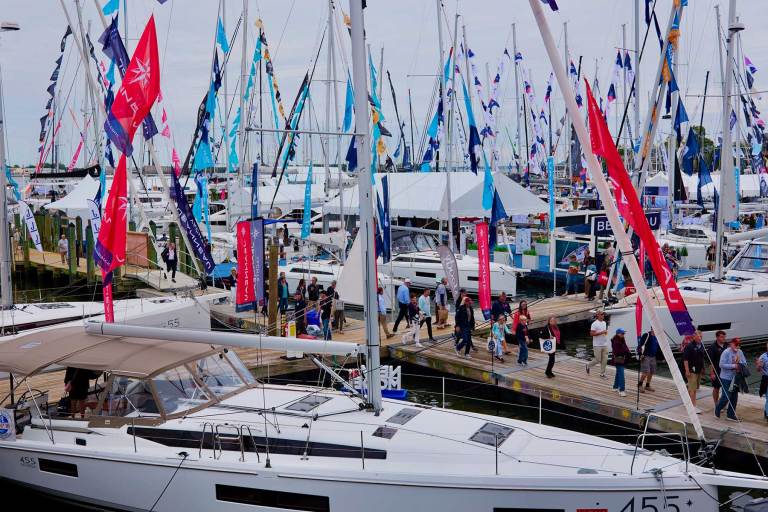
Today’s coastal Rhode Island weather — some sunshine and a high in the 70s — should make the opening day of the Newport International Boat Show a fine fall attraction, but the economic forecast for the autumn boat-selling season is clouded by rising consumer and bond market interest rates.
Stubborn inflation that left the Consumer Price Index and the Federal Reserve’s preferred Personal Consumption Expenditures Price Index a point and a half or more above the Fed’s 2% target prompted the central bank to raise a key interest rate Wednesday, while the 10-year Treasury yield edged above 5% again Wednesday before closing slightly lower.
Treasuries rallied today, and the yield on the 10-year retreated from the 5% mark, which until recently it had not breached since 2007. The 10-year Treasury is the global benchmark for long-term borrowing costs. Lenders use the yield as a reference in pricing business and consumer loans, including mortgages, car loans and boat loans.
Federal Reserve chairman Kevin Warsh argued Wednesday, after the central bank’s policymaking committee approved a quarter-point increase in its benchmark federal funds rate to combat inflation that is too high “and has been for too long,” that U.S. economic activity is nonetheless expanding at a solid pace and domestic spending has been resilient.
“Productivity growth is strong, and capital investment is robust,” Warsh told reporters at his post-meeting press conference. “Job gains have kept pace with the workforce, and the unemployment rate has changed little.
“But inflation remains elevated,” Warsh added. “Today’s policy action will support a timelier return to the committee’s 2% [inflation] goal. This committee will deliver price stability.”
Warsh said the Fed’s fresh rate decision “comes at a time when the American economy appears to be strengthening. New hiring, private-sector earnings, business capital investment — each of these markers has improved in recent months and is pointing in a good direction. Credit flows have been robust, particularly for businesses.
“And as I said at the policy symposium in Jackson Hole, I would be hard-pressed to describe broad financial conditions as restrictive,” he added. “This view was widely shared by the committee. So we removed a dose of accommodation.”
NMMA chief economist Shawn DuBravac told Trade Only Today that Warsh’s current assessment of the economy was his obvious justification for the rate increase, “and it’s presumably a view shared across the [Federal Open Market Committee], though the economic projections show only a 10th of a percentage point increase for each of 2026 and 2027.”
The vote to raise the federal funds rate by the 12-member committee of Fed governors was unanimous. Only three had supported an increase at the previous policy meeting, in late July, and Warsh was not one of them.
“I would call the economy resilient and uneven, rather than uniformly strong,” DuBravac added. “August’s gain of 162,000 jobs and an unchanged unemployment rate of 4.1% are encouraging. But job creation keeping pace with workforce growth is more consistent with a labor market maintaining its balance than one becoming progressively tighter. It supports the argument that the economy is holding up, and not an economy that needs additional restraint.
“The composition of growth also matters,” DuBravac added. “The Fed highlighted robust capital investment and strong productivity growth. Productivity improvements can allow the economy to grow faster without generating the same inflation pressure that would accompany growth driven entirely by greater competition for scarce workers and resources.
“Strong business investment also does not automatically translate into stronger household demand for discretionary purchases. A data center investment boom and a cautious boat buyer can exist in the same economy. I’m a little more sanguine about translating a stronger national outlook into an equally strong outlook for consumer industries.”
For the boating business, DuBravac said, “I am more concerned about the sustained rise in longer-term borrowing costs than today’s quarter-point increase in isolation. The 10-year Treasury yield trading around 5% reflects a broader financing environment that can remain challenging, even between Fed meetings. Five percent is not a magic threshold. What matters is how far borrowing costs have risen and how long they remain elevated.”
DuBravac explained that two different channels are at work.
“The Fed’s increase has a more immediate effect on floating-rate borrowing, including dealer inventory financing, where rates adjust with short-term benchmarks,” he said. “This raises the cost of carrying boats and may make dealers more cautious about placing new orders. The impact will vary based on financing agreements and any manufacturer support, but it reinforces the need to keep production and inventories aligned with retail demand.
“For the consumer, the broader level of longer-term rates is especially important,” he added. “The 10-year Treasury yield does not set every boat-loan rate directly, but higher longer-term rates can keep financing expensive, weigh on housing and financial-asset values, and make households less comfortable committing to major discretionary purchases.”
DuBravac said Wednesday’s Fed decision “might add incremental headwind,” but he does not believe it fundamentally changes the boating industry’s trajectory.
“The larger concern is the prospect of expensive financing persisting longer than buyers and businesses might anticipate,” he said. “The Fed’s new projections show no reduction in the median policy rate during 2027, although actual borrowing costs will also depend on bond markets and lending conditions. For boating, the duration of high borrowing costs is likely to matter more than today’s quarter-point move alone.”
Warsh told reporters he believes that bond market yields have risen because the U.S. economy has strengthened, competition for capital is increasing, and geopolitical events — an apparent reference to the Iran war, which also involves Israel and countries around the strait of Hormuz, as well as Russia’s war against Ukraine — are affecting national economies.
“There’s no hiding from hot spots around the world,” he said.
Chad Lyon, managing director, global inventory finance, at Wells Fargo, agreed with DuBravac that the broader interest-rate environment is generally more impactful than any single Fed rate decision.
“Boat purchases are significant investments for many consumers, so financing costs can influence affordability and purchasing decisions,” Lyon told Trade Only Today. “That said, the industry has shown resilience through a variety of market cycles. Dealers have become increasingly focused on inventory management, operational efficiency and aligning inventory with current demand.
“As we head into an important boat-show season, dealers are focused on connecting with customers, showcasing new products and building momentum for the year ahead,” Lyon added. “From our conversations with dealers, the emphasis remains on managing their businesses for long-term success while remaining flexible as market conditions evolve.”
Lyon said that what Wells Fargo is seeing in the recreational marine market “is a more measured operating environment. Dealers continue to focus on inventory discipline, customer demand and profitability. The labor market is remaining steady, and wages are still growing, so that helps keep a base level of consumer purchasing power in place.
“While conditions vary by region and segment, many dealers are approaching the market thoughtfully and making decisions based on the long-term health of their businesses, rather than short-term economic headlines,” he added.
Warsh said during his press conference that market participants and the press tend to wait breathlessly on a single data point, such as the latest inflation or retail sales information. He does not.
“Trends matter,” Warsh said. “Data points are noisy.”
DuBravac termed the Fed’s rate hike decision “defensible but not clearly necessary. The labor market is firm, but it is not showing obvious signs of overheating. There has also been progress on some measures of underlying inflation, although the picture is mixed: Annual core CPI slowed to 2.4% in August, while the Fed’s preferred PCE inflation measure remained substantially above target in July.
“The strongest argument for today’s increase is that it reinforces the Fed’s commitment to restoring price stability,” DuBravac said. “That signal is probably more consequential than the immediate economic impact of the quarter-point increase itself.
“My concern is that a small increase will do relatively little to slow strategically driven AI-infrastructure investment, while adding pressure to interest-sensitive purchases such as boats, vehicles and homes. That is the challenge of using an economywide tool when demand is much stronger in some sectors than others.”
Sixteen of the 19 Fed governors projected an additional 2026 rate increase on Wednesday. Twelve of them sit on the policy-making committee at any one time. Warsh did not offer a forecast because he does not believe in giving forward guidance.
The Fed’s next policy meeting is Oct. 27-28, and there will be another meeting in early December. DuBravac said another quarter-point increase before 2026 ends is more likely than not.
“December is probably more likely than October,” he said. “The Fed’s median projection is consistent with one additional increase this year. My preference would be to give the incoming data, and the recent rise in market interest rates, more time to show their effects. An October increase becomes more likely if inflation reaccelerates or price pressures broaden. Otherwise, December gives the committee more evidence on whether another move is warranted.”
Warsh said at his first meeting as Fed chairman, in June, that he believes the central bank can, if it does its job, “make strong growth, low prices and strong employment mutually compatible.”
Making a similar point Wednesday, he said the Fed can play a role in sustaining the country’s current economic progress and argued that Americans who are the least well off — who don’t have financial assets such as equity in a home or a 401(k) retirement investment plan — “have the most to gain from a durable expansion, a solid labor market and stable prices.”