
 PHOTO COURTESY ABYC
Early this November, more than 400 industry professionals tuned in to the seventh webinar in the Coast Guard’s Risk Mitigation Series: “New Technology in Electric, Fuel, Capacity and Flotation.” These free, online events, hosted twice a year by the American Boat & Yacht Council, cover Coast Guard updates, current developments in ABYC standards, and other safety topics within the field of recreational boating.
This particular webinar included updates in regulatory certification, shore charging stations, common flotation mistakes and even a peek at the upcoming webinar, “Risk Mitigation.” The event saw speakers from the Coast Guard, Foam Supplies and a few of ABYC’s very own, with Brian Goodwin, ABYC’s director of standards and compliance, serving as emcee.
David Broadbent, ABYC’s senior director of business development, started things off with a look at the upcoming Coast Guard Recreational Boat Regulations Certification course. The course will cover the Code of Federal Regulations and steps of a typical Coast Guard inspection at a boat manufacturer or dealer, providing successful exam participants with the title of Certified USCG Recreational Boat Regulatory Specialist. This on-demand class for boatbuilders is expected to be available this spring.
Broadbent then passed it to Jeff Ludwig of the Coast Guard, who explained that a regulatory specialist with this new certification, coupled with a detailed technical file, could potentially serve as an alternative compliance method to in-person inspections. While technical files are not currently required, Ludwig calls them a “best practice” that all manufacturers should follow.
Craig Scholten, ABYC’s vice president of standards and compliance, then discussed new attachment-point requirements in the 2024 revision of ABYC H-40. Testing a variety of devices led to two “activity type” attachment point categories: watersports and water toys. The key difference is that watersport towlines are held by the rider (such as wakeboarding), while water toy towlines are attached to an object towed by the boat (such as an inflatable tube). Watersport and water toy attachments points will have different requirements based on the boat’s maximum horsepower rating, so manufacturers should specify appropriate activities for each attachment point via warning labels and/or the boat’s owner manual.
From there, ABYC standards developer Maciej Rynkiewicz took over to look at current (get it?) developments in standards related to dockside charging stations. The main issue right now is one of scope and who does what: ABYC and ISO TC 188 standards only cover boatside systems; landside systems are addressed by other organizations, such as the National Fire Protection Association. These standards will have to work together to ensure compatibility between boat and shoreside systems.
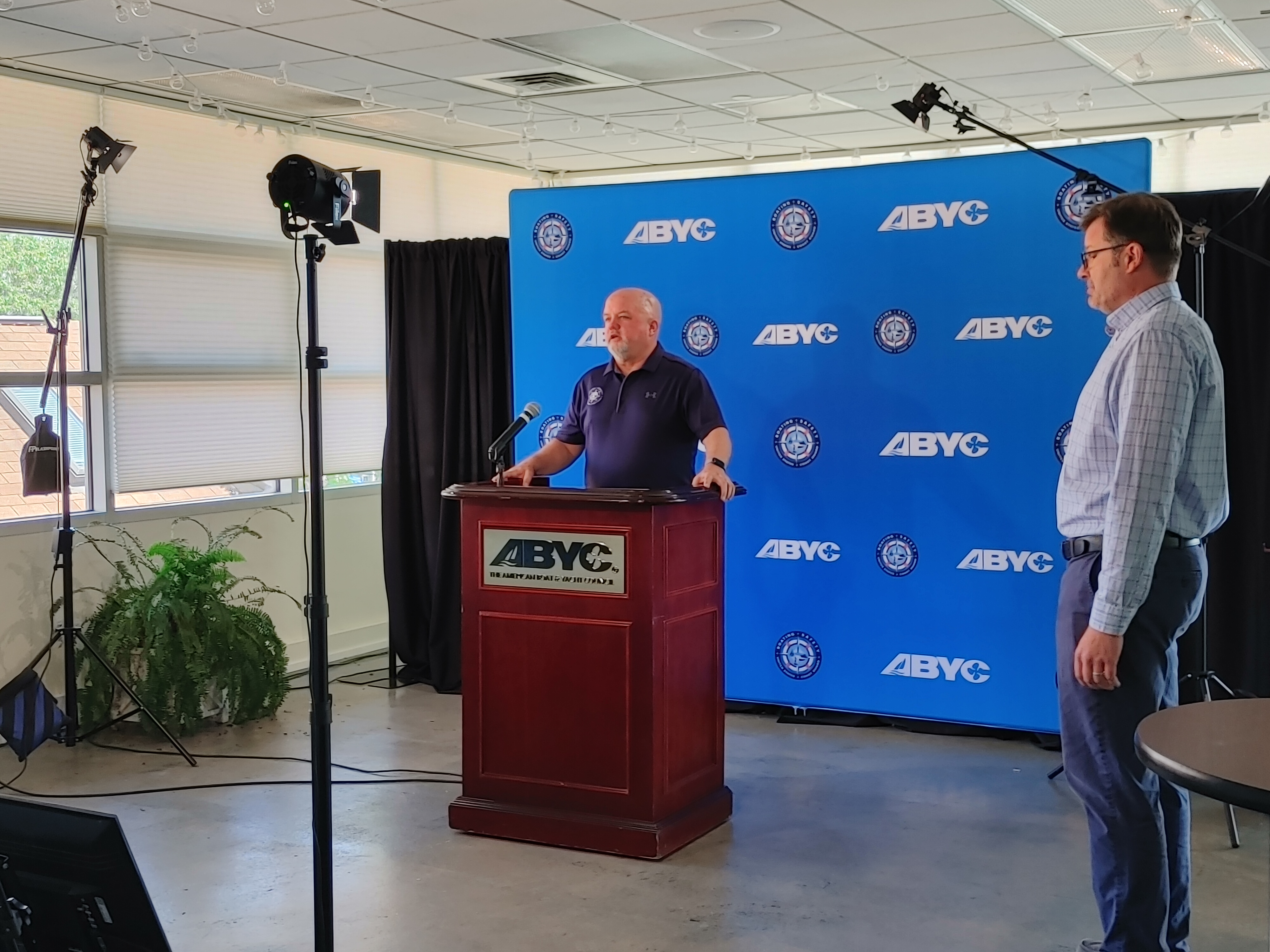 PHOTO COURTESY ABYC
The ABYC and ISO are looking to address communication between chargers and boat systems, fault protection and testing, among other considerations. NFPA is expected to include dockside charger installation requirements in a future revision of NFPA 70.
Scholten then returned, bringing with him Eric Johnson from the Coast Guard and Nate Barrett from Foam Supplies to share the most common flotation mistakes that cause boats to fail Coast Guard capacity and flotation testing.
Those mistakes are: not enough foam installed; failing to install the foam in the proper locations; failing to completely fill the installation locations; failing to use foam with the correct density; and failing to use foam that is resistant to gasoline, oil and bilge cleaner in the bilge.
Why does this matter? Because boats that fail Coast Guard flotation testing — 60% to 75% of the boats tested — lead to federal recalls. Maintaining a detailed technical file helps isolate the cause of the problem and track exactly which boats may be affected in the event of a recall. For more information on Coast Guard flotation testing, see the Coast Guard Test Procedure Manual available at safeafloat.com.
 IMAGE COURTESY ABYC
Scholten then addressed electric propulsion and capacity labels. The Coast Guard’s equivalency policy allows the agency to provide an equivalency for compliance or reference standards from other organizations for areas where regulations have fallen behind the technology. The policy currently in place requires electric boats under 20 feet to include “for electric propulsion” on the capacity label. But that isn’t the only capacity label update being considered. Proposed updates for the next edition, ABYC S-7, if approved, would replace much of the label text with symbols and help clarify requirements.
After that, Kevin Ferrie from the Coast Guard explained that while most accidents are due to human factors rather than machinery failures, in instances where an accident is caused by a machinery failure, such failures are far less likely to occur on boats that comply with ABYC standards.
Finally, Brian Goodwin gave a look at the next Risk Mitigation webinar, which will cover the new ABYC H-24 requirements for pump-in-tank fuel systems. The new version of H-24, expected in January, will add requirements for pumps farther than 12 inches from the engine. Most notably, fuel pump modules and pressure regulators must be located in the tank and marked with their working and proof pressures, and all hoses must use permanent end fittings or permanent quick connect fittings, pass the H-24 2.5 minute fire test at pressure, and be marked with their working pressure. After the standard is published, it will be possible via the Coast Guard’s equivalency policy to use ABYC’s pump location requirements in lieu of the Code of Federal Regulations.
To learn more about the topics, watch all previous Risk Mitigation webinars for free at abycinc.org/riskmitigation. Risk Mitigation Series 8 will be held online in May. Stay tuned for more information.
Emily Parks is standards and compliance coordinator for the American Boat & Yacht Council.