Right around the time humans started launching rudimentary watercraft made of trees and other plant materials into the water, they soon had to figure out how to get the craft out of the water. Brute strength and teamwork were probably the first tools employed, likely followed by natural-fiber rope bent around trees as a sort of basic block-and-tackle arrangement.
Several millennia later, most vessels larger than trailer-size ended up on railways, which had adjustable cradles that moved in and out of the water on a train-style track powered by one sort of engine or another. Gravity did the work of getting the vessel launched and floating again.
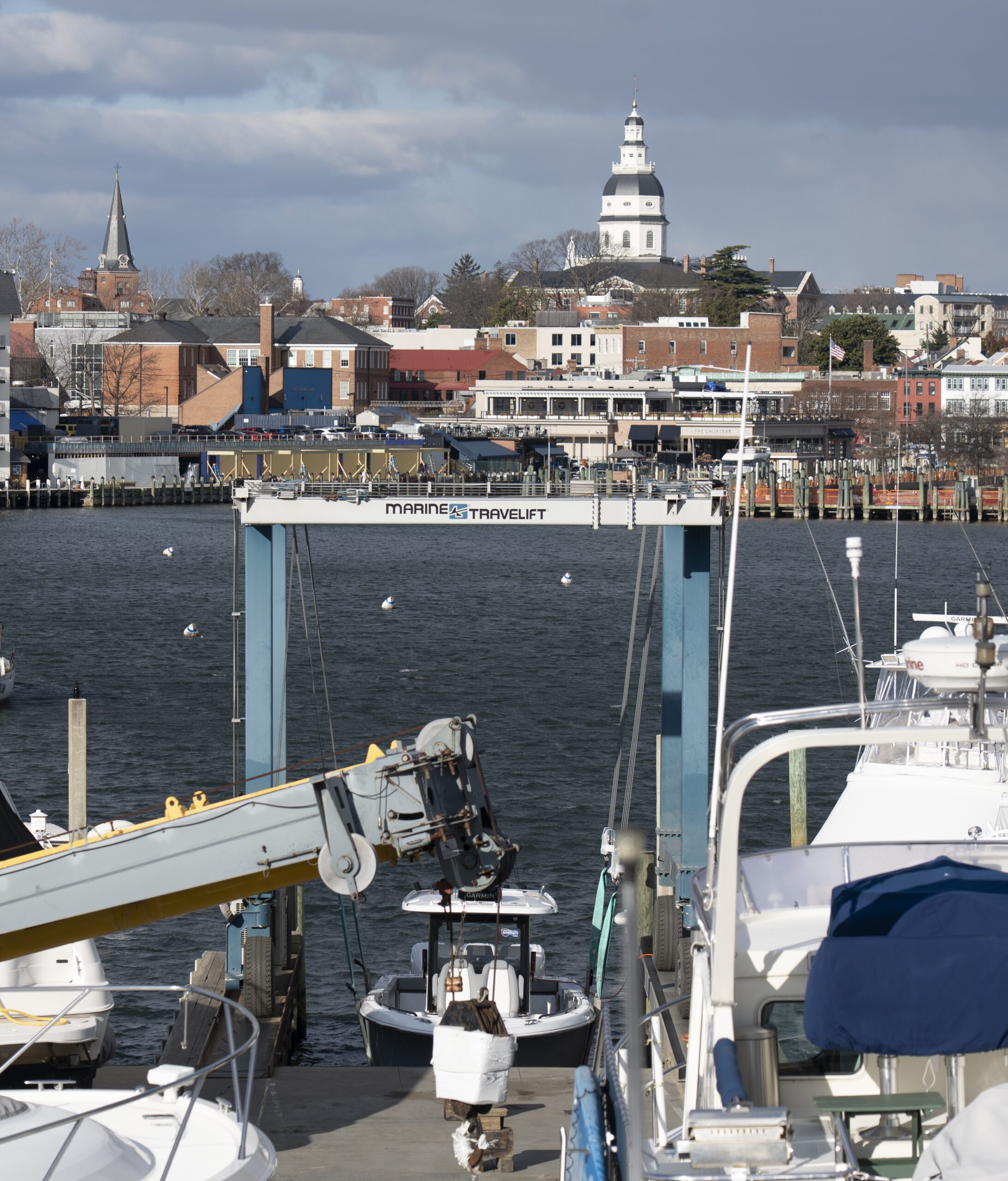
in Sturgeon Bay, Wis. GARY REICH PHOTO
In the 1940s, the boat-moving game changed forever. That’s when the first mobile boat hoist was designed and manufactured in Sturgeon Bay, Wis. The machine allowed a boat to be plucked from the water, moved around on land, and then launched back into the drink. The invention revolutionized the way marinas and boatyards evolved for the next 50 years.
Marine Travelift is the company that was formed in the ’50s to mass-produce these mobile hoists. Almost 70 years later, it has more than 4,500 lifts in circulation. And after decades in the boat-moving business, the name Travelift is as synonymous with boat lifts as Kleenex is with facial tissues. The company’s manufacturing facilities are still centered in Sturgeon Bay, in a vast industrial park about an hour’s drive north of Green Bay.
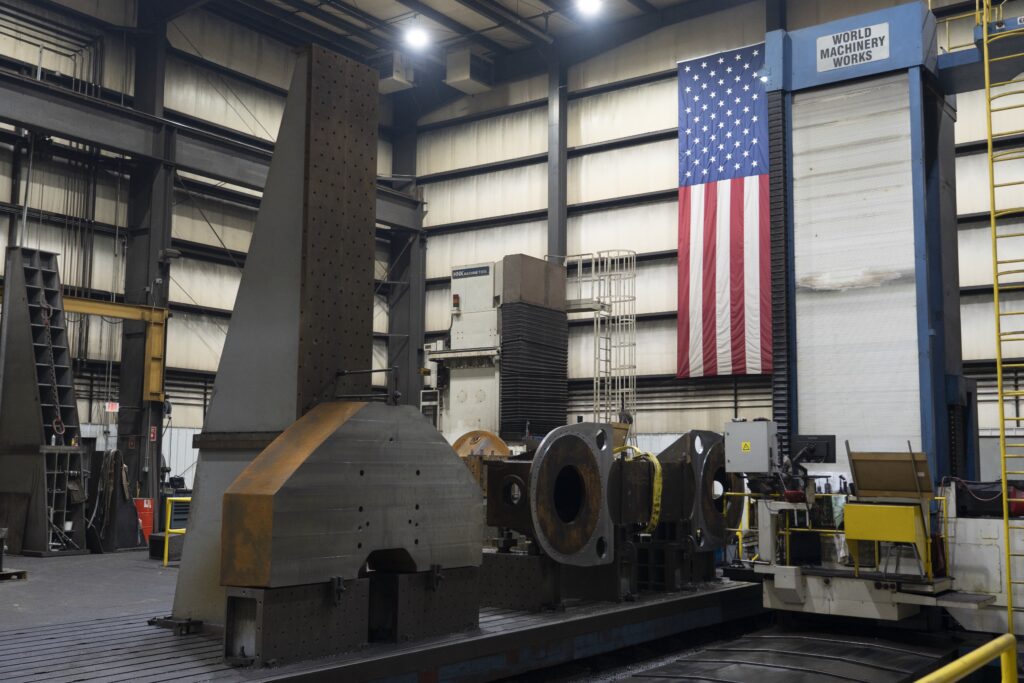
The Travelift buildings look innocuous from the outside as I arrive on site, but I soon find out that what happens inside is anything but boring. Senior director of sales Brock Rubens greets me. He got his start at the company 14 years ago in purchasing. We pile into his truck and motor about a half-mile down the road to Travelift subsidiary ExacTech, where the process of building boat hoists and other boat-moving equipment begins with sheets of raw steel. ExacTech also has a 20,000-square-foot facility in Crystal Falls, Mich., that supports Travelift’s manufacturing.
“ExacTech is where we bring in materials and begin to gather them for cutting, bending and assembly,” Rubens says. “We don’t warehouse any boat-lift equipment. Every order is spoken for, and we’re currently several months out on our order sheet.”
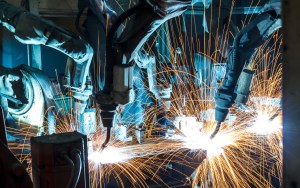
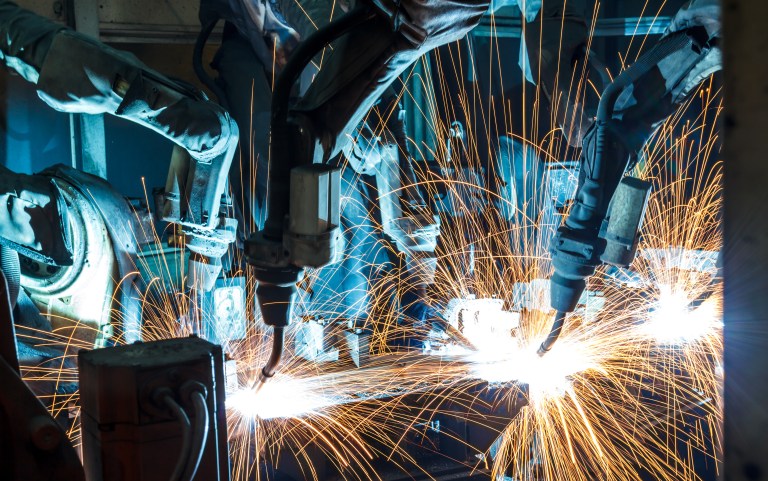
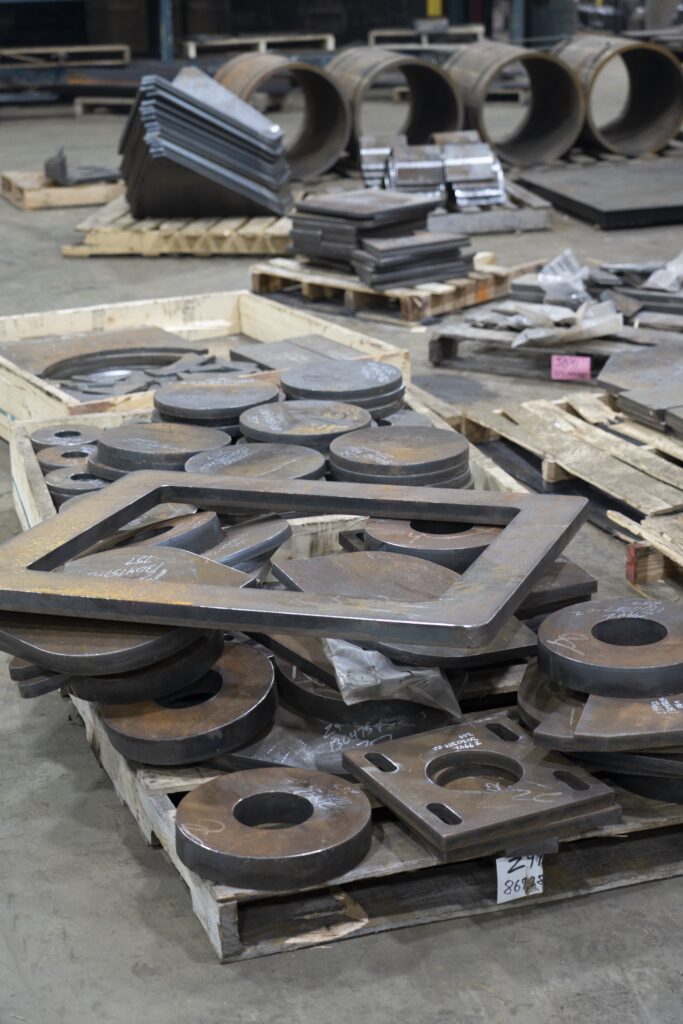
Once an order is initiated, American-made steel sheets, some several inches thick, are brought inside the 80,000-square-foot facility from an outside holding area for cutting. A computer-numerical-control oxy-fuel torch throws showers of sparks and makes quick work of slicing component shapes from the steel.
“It can cut through steel up to 10 inches thick,” Rubens says. “When we start building an order, it all starts at ExacTech. Once all the pieces for an order are ‘picked,’ they end up over at the Travelift building for assembly. That’s where we prep and finish the steel, assemble the frames, and then install hydraulics, power plants, wheels, and lifting slings and tackle.”
Travelift also builds forklifts for drystack operations, and adjustable hydraulic transporters for shuffling boats around. Those products also begin their lives at ExacTech.
The scale of the steel pieces being moved around the operation is difficult to soak in. Travelift’s largest model, the C-Series boat hoist, can lift up to 3.3 million pounds and stands several stories high. Steel pillars at each corner are several stories long. Wheels are several feet in diameter. Wire cabling in the hoist mechanisms is the diameter of a human arm. The lifting straps each weigh many hundreds of pounds.
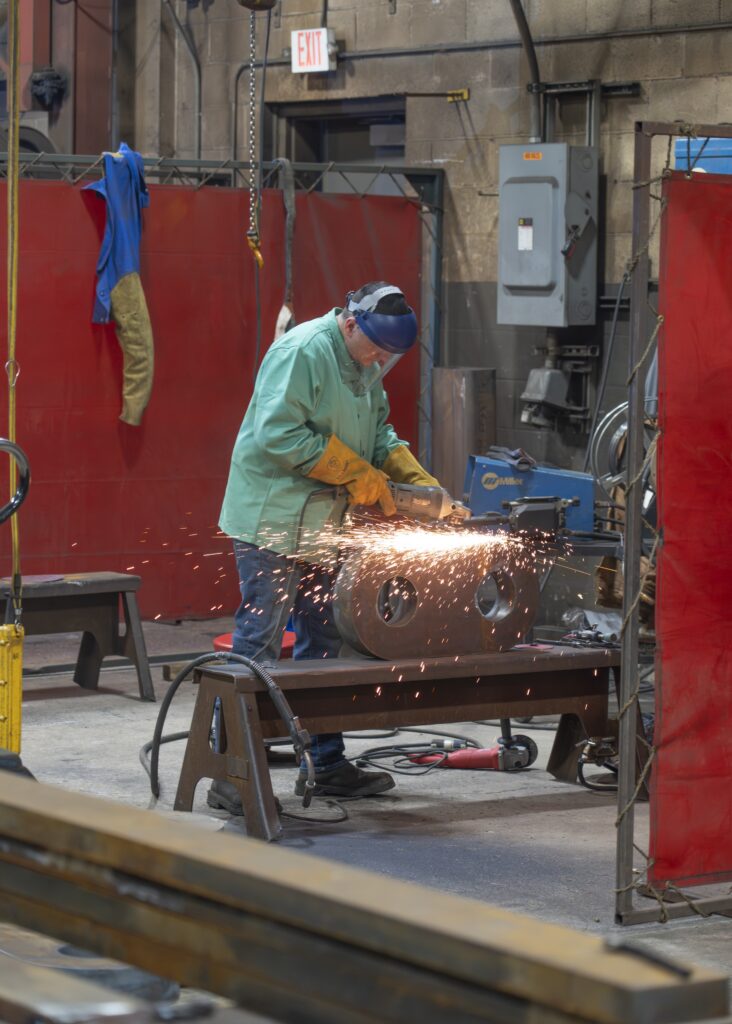
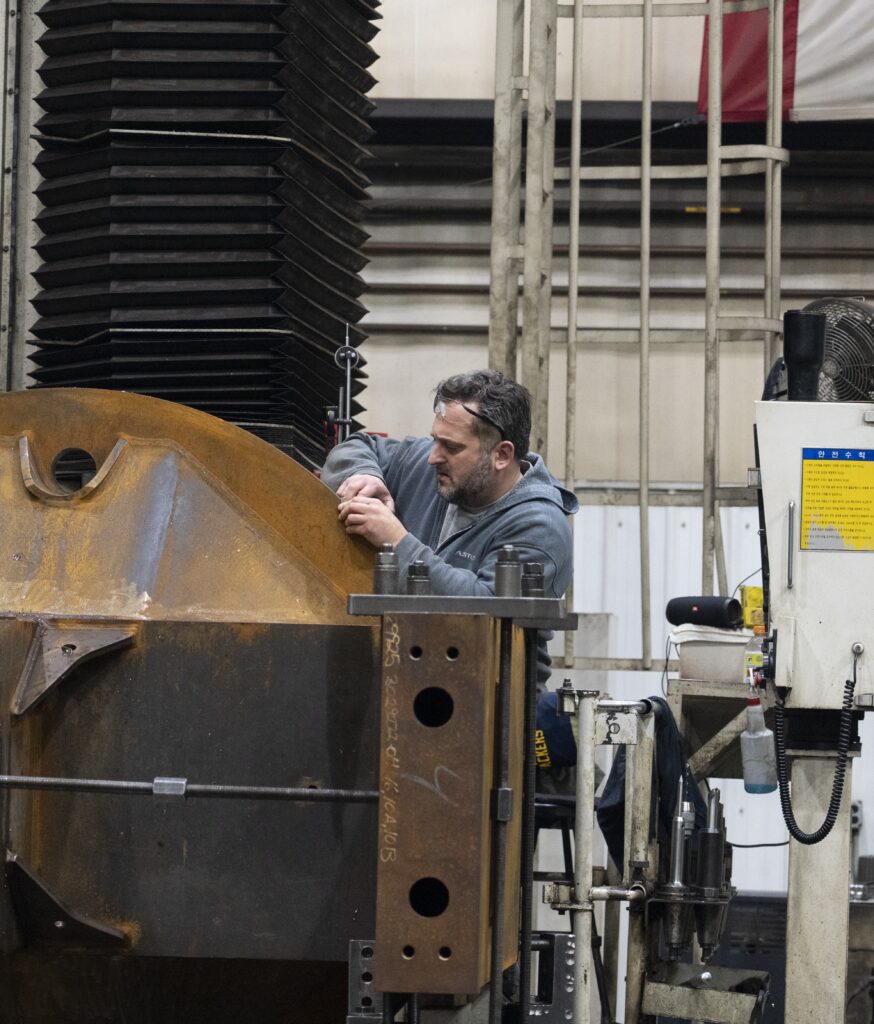
While the steel components are massive, almost all of the building processes still require skilled human hands. Peppered around the building are work stations where metalworkers do all sorts of jobs, from welding and bending steel to grinding and finishing metal parts. There’s a press, at least four stories high, in the middle of the work floor. It can bend steel several inches thick into square columns, with a human operating it.
“Our skilled people are critical to making this whole operation work,” Rubens says. “We’ve investigated robotics, but not as a replacement for our workers. We want to figure out ways to free them up to do other work, and make their jobs safer and easier, not lighten our workforce.”
Rubens says that Travelift partners with Northeast Wisconsin Technical College to place metalworkers in its operation, but that finding skilled people — as with many marine industry positions — can still be difficult. “We have an apprenticeship program that is fed by NWTC,” Rubens says, “but we’re consistently wanting for more people. It feels like it’s the same everywhere, whether it’s welders or fast-food workers. Still, we’re happy with the relationship we have with the technical college.”
Once the steel pieces are cut, bent, welded and gathered together by those workers at the ExacTech location, the components are moved across the industrial park to Travelift’s main assembly facility. One of the first steps after the steel arrives is blasting it with broken glass under high pressure to create “white steel.” And like everything at Travelift, it is done at huge scale. The steel parts are blasted free of corrosion in a standalone building large enough to house the metal beams, columns and other lift parts.
“The lifts spend their lives on and partially in the water, all day every day — and often it’s salt water,” Rubens says. “Preparing and coating the steel components is crucial to making sure each lift lasts for decades. After it is blasted with the broken glass, the steel gets a thick primer coat. Once that is cured, we layer on siloxane paint in our blue and white paint scheme.”
Rubens is not exaggerating when he says the company’s lifts last for decades. Marine Travelift’s boat hoists often survive through multiple owners. When one boatyard or marina outgrows a lift, it is often sold, disassembled and reassembled at another yard.
In the Chesapeake Bay region where I live, I’ve known one lift to have lived three separate lives during its 30-year lifespan. Last I checked, it’s still moving boats around an Eastern Shore boatyard. “There are less-expensive boat lifts on the market,” Rubens says, “but we always tell our customers that where they’ll likely get 10 to 12 years out of a competitor’s product, ours often outlive them by a decade or even longer.”
The assembly process of the component parts is complicated and fascinating. After painting, the steel is fastened together, while the hydraulics, power plants, blocks and cabling, wheels and tires, and other pieces move together on an organized assembly line.
Marine Travelift relies on engine manufacturers and other outside vendors for some items, but the company is vertically integrated enough to manufacture plenty of components from scratch. One such area is hydraulic components, which are now done in-house. Rubens points me toward a rigging jig with hydraulic metal piping on it.
“We had trouble getting these hydraulic components during Covid, which held up manufacturing quite a bit,” Rubens says. “So we decided to bring it in-house, and we do all of it ourselves now. That means we put more of the manufacturing process in our control, which smooths out production.”
Moving between buildings, I ask Rubens if there is any innovation left in the 70-plus-year boat hoist space. He leads me to a boat lift that’s plugged into the grid and charging. “This is our first electric boat lift,” Rubens says. “It’s a prototype and still undergoing testing, but it’s fully functional, run off a large internal battery bank. We developed it because some boatyards and marinas expressed an interest in being greener, while others are actually having to comply with new emissions regulations that make using fuel-burning engines difficult.”
Travelift president and CEO Erich Pfeifer tells me the company was the first to introduce the open-end boat lift and the first to produce a 250-ton lift, among other innovations. “But I think that the variable-width lift is probably the most important in the last 20 years,” he says. “It means boatyards and marinas can fit more boats in a tighter space and aren’t constrained by a fixed-width machine.”
Pfeifer shows me a video of one of the machines shrinking in width to fit a boat inside a building. He then queues up another video, this one of a boatyard lift adjusting in size to fit a fairly large boat in a relatively small space bordered by two other vessels. “We don’t sell many machines these days without that option,” he adds.
Because each yard, marina and boatbuilder are different, and there are so many options, just about every lift that leaves the factory is bespoke. I ask Pfeifer if this system leads to manufacturing delays and bottlenecks. “Every customer is going to select different options,” Pfeifer says. “We’re happy to make each unit to the customer’s specifications, and we’re good at customization. One yard may want the remote operating controls, while another might not need it. Sometimes we move control stations around. We’re nimble enough to accommodate pretty much any request.”
Travelift also has a separate line of industrial machines it markets under the Shuttlelift brand. The equipment, which resembles some of its Travelift cousins, is designed to move precast concrete beams, steel beams and other heavy-lift items around industrial operations.
The company operates Shuttlelift and Travelift around the world through a dealership model. Once an order is shipped — a feat in itself, given the size of each lift — the dealership and Travelift partner to arrange assembly. The customer can also handle this task on their own if desired. “Sometimes we need to arrange a crane, send in a crew — it’s all up to the customer,” Rubens says. “If they want a turnkey experience where the machine shows up and we do everything, they can have that. They can also get something in between. Our dealership partners and our support team here can customize delivery options in many ways.”
Of the approximately 200 employees working for Marine Travelift, eight are full-time support staff who help customers with anything they might need, be it troubleshooting, maintenance or anything in between. “We do our best to give the best ownership experience we can,” Rubens says. “Sometimes it can be a simple fix that gets a boatyard back in business quickly, while other times it might take a series of calls or even a service visit. The keys are keeping the machines running well and getting them back to work quickly when there’s a problem.”
Marine Travelift’s biggest market is the United States, specifically the Northeast and Southeast, followed by Europe and then Australia. “Our biggest competition in the market is the Italians,” Rubens says. “So it’s been difficult to penetrate the Mediterranean market as deep as we’d like. But we keep selling on build quality and overall durability and quality. Australia and Asia are big markets where we’re seeing some success. But we’ll always have our biggest market here in the States.”
Back out on the factory floor, Rubens discusses one of the machines as a John Deere diesel engine is installed on one of the lift frames. “The lifts look simple on the outside but are complicated machines,” Rubens says. “We partner with John Deere and Deutz for our power plants, and they have been good partners with reliable products. Some yards and marinas prefer Yanmar engines because they’re able to work on them.”
The sparks continue flying as Rubens and I exit the factory floor. And I feel certain that no matter what comes next in the boat-lift segment, Marine Travelift is well-positioned to lead the way.
This story originally appeared in the February, 2026 issue of Soundings Trade Only.