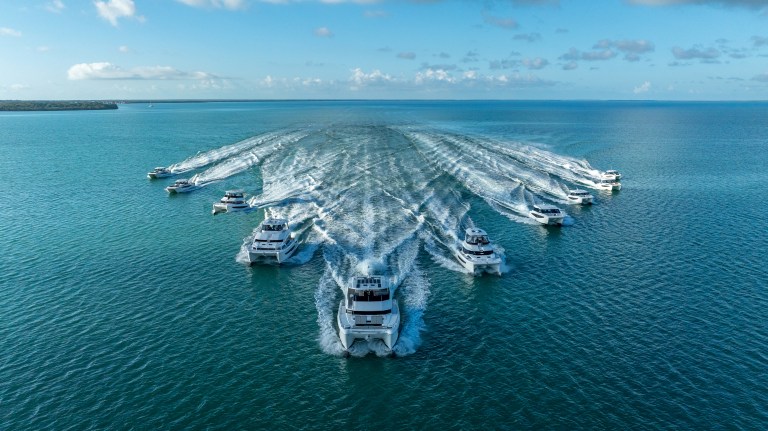
I am fresh back from the Miami International Boat Show, with sore feet and the need for a nap. Between sitting on the Miami Innovation Awards judging panel — which involves very little actual sitting — and running between press conferences on the show floor, I trekked 30 miles and approximately 75,000 steps over the five days. Phew.
This year’s show was hugely successful from an editorial perspective (you’ll be seeing more of the facility visits and company profiles you’ve asked for), and I gained a lot of perspective about how the industry is feeling as economic headwinds continue to pose challenges.
Our first day’s coverage featured this headline: “Miami 2026: A Difficult Environment.” The response to those words was less than positive, both in my inbox and on social media. The truth is that for every positive thing I heard on the show floor, I also listened to two or three grumpy-pants remarks. Folks expressing concern largely outweighed folks who were happy with the way things are going in the industry, although every one of those pessimistic folks declined to go on the record.
A person who was quotable on the record was National Marine Manufacturers Association president and CEO Frank Hugelmeyer, who delivered a State of the Industry address that was largely a mixed bag. “Like captains navigating an open sea, the marine industry doesn’t get to choose the conditions that surround us,” Hugelmeyer said. “But we do get to choose how we respond to the moment. For several years, we have been negotiating a complex, wait-and-see consumer environment. It’s been driven by some stronger-than-usual economic pain.”
Hugelmeyer also displayed a chart of economic indicators relevant to the marine industry. It showed just one category in the “good” column: fuel prices. In the “caution” category were interest rates, new housing starts, wholesale and retail credit availability, wages and employment, SUV and light-truck sales, and marine dealer and RV inventories. The “trouble” category had consumer confidence and sentiment, and consumer net worth and debt.
After hearing him speak, I looked through my notes to see which folks I spoke with at the show who were optimistic, and who felt negatively about the state of things in the industry. Overwhelmingly, premium boatbuilders were optimistic about the way things are going. High-end electronics and components manufacturers also were happy with sales overall.
But manufacturers of boats at the lower end of the price rainbow were less rosy. Many said tariffs were still affecting raw-material prices (think: smaller aluminum boats). Dealers who sell more “affordable” boats told me that writing loans for potential boat owners in the middle of the earning spectrum was challenging because of somewhat elevated interest rates and because some buyers are upside down in their trade-ins. It all left me wondering what the rest of 2026 will really look like for the recreational marine industry.
Thankfully, I came home to read contributing editor Kim Kavin’s reporting on the effect of interest rates on industry businesses, from small and large retail dealers to large lenders. Starting on Page 24, you can read her story, which is chock-full of analysis. The reports are more positive than I expected.
Another thing I asked dealers about at the show was how they’re doing with keeping skilled service technicians in their businesses. Overwhelmingly, the answer was: “It’s still difficult.”
Our industry is not alone in this regard. Since the RV industry generally mirrors the recreational boating industry, I asked senior editor David Conway to investigate how the RV folks are dealing with workforce issues. You can read his excellent reporting on Page 28, including details about how two RV service tech training centers are filling the worker pipeline in the United States.
The gorilla in the room at the Miami show was the subject of artificial intelligence. AI is being integrated into more and more products, with manufacturers hoping to improve the boating experience for boat owners, and to help ease tedious and repetitive tasks in their businesses.
Conway returned from the American Marina Industries Conference in February with intel about how AI is being used inside marinas and boatyards. Sessions there drew standing-room-only crowds. His story about AI implementation in these facilities begins on Page 32, with insights into the tech that can be used industrywide.
A hot soak and a couple of Advils later, and my feet are less weary this afternoon. I believe the boating industry is just as resilient. And that’s good news for all of us.
This story originally appeared in the March 2026 issue of Soundings Trade Only.