
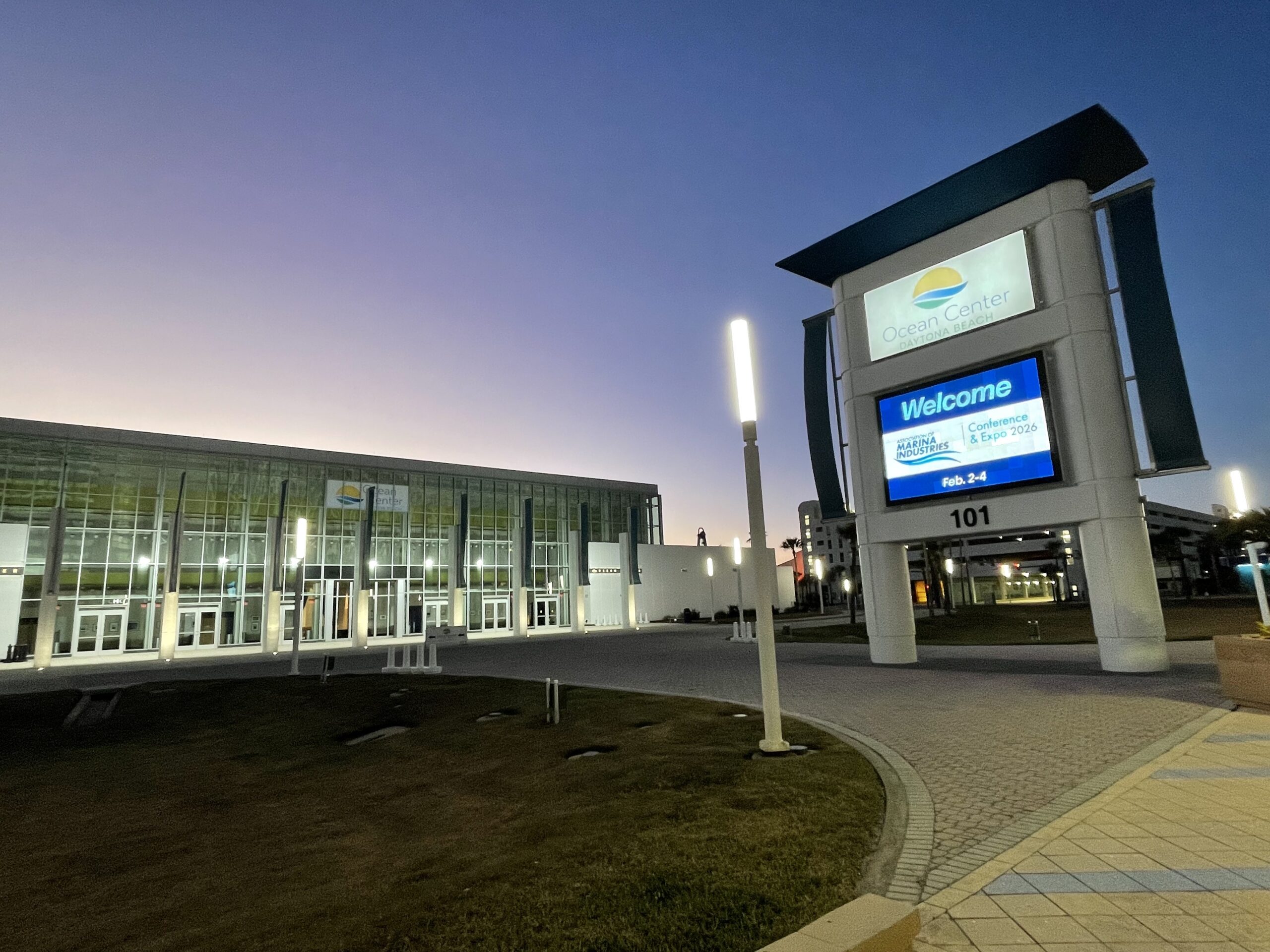
Artificial intelligence drew standing-room-only crowds at the Association of Marina Industries Conference & Expo in early February in Daytona Beach, Fla. Of the conference’s more than two dozen sessions on a variety of subjects, three separate sessions on AI were some of the most crowded sessions the conference has ever had, says show director Kayce Florio.
Marina owners and operators were looking for ways to put AI to use. Discussions centered around automation, data management, efficiency and customer service. Presenters emphasized that AI adoption in marinas is less about replacing people and more about reducing administrative workload, improving responsiveness and making better operational decisions.
For instance, with enhanced systems, AI can isolate routes within a marina where accidents have occurred and suggest a way to redirect traffic. AI can also analyze operational data to forecast slip occupancy, automate billing and improve compliance checks. Another use is generating marketing copy and campaigns, social media posts, standard operating procedures and FAQs.
Session leaders also said AI is changing how customers find businesses, by summarizing online reviews and influencing search results. This shift makes a marina’s online reputation and reviews more important than ever, with customers seeing the sum of reviews rather than the reviews themselves.
Speakers repeatedly stressed that successful AI adoption depends on preparation, particularly organizing business data and training employees to use new tools effectively. The goal, presenters said, is to free up time for more human interactions and better decision-making.

RV Parks and Marinas
Presenter Jamaine Campbell, CEO of Elite Dynamics, EliteMarinas Marina Management Software | EliteMarinas, sees AI as part of a larger shift toward integrated business-management systems in hospitality-style industries. He built software management systems for the RV park industry before he founded Elite Dynamics in 2015 to develop enterprise software for RV parks and marinas. The industries share many operational characteristics, including seasonal demand, reservations and service work. “We see them as having the same challenges in terms of managing customers, managing data, managing multiple revenue streams,” Campbell says.
The company’s centralized system can manage reservations, slip management, billing, maintenance, customer records and financial reporting. It uses Microsoft Copilot as an AI overlay, and data is maintained securely within a user’s Microsoft account. The setup can help to address challenges with multiple disconnected systems, Campbell says.
“In much of the industry, these private-equity-backed organizations have multiple locations,” he says. “Another trend in the industry: Marinas need to look at secondary, tertiary revenue, offering services, memberships, hotel stays and so on. Our solution will handle that as and when they’re ready.”
He stresses that having a data strategy is key: “If you don’t have a strategy, that’ll become a tactic, and tactics generally are short-lived benefits. If you’ve got a solid business strategy and a solid data strategy, that’s where you’ll get the best out of AI.”
Campbell says the marine industry historically has adopted technology more slowly than the RV sector, but AI could accelerate that shift as customers expect faster responses and more digital convenience.
AI for Communication
John Howie, co-founder of Admiral, discussed how AI tools can reduce administrative workload for marina managers by automating communication, documentation and compliance tasks. “Tech was supposed to help. It hasn’t,” Howie says. “Marina owners don’t have time to walk the docks. They’re behind the screens.”
An AI agent can ultimately know more about marina insurance than anyone in the world, he says, describing specialized systems that factor in complex regulatory and insurance requirements. “AI embedded into calls, emails, texts and computer systems can understand the nuances of every communication with your company, and can synthesize them for you,” he says. “All this data can be surfaced to you, about leasing, renting, sales queries, every single thing.”
In a single call, an AI agent can draft estimates of a lease, create the contract and prepare to send it with a single click. “AI can measure all of the metrics of your business and offer ways to improve them,” he says.
Howie emphasizes that these tools are intended to support marina staff rather than replace them. “If you haven’t figured out how to embed AI in your business, I think now is the time to start to make a plan,” he says.
Operational Gaps
Presenting alongside Howie, Colin Kiley, CEO of Alliance Marine, shared examples of how AI-enabled call-tracking systems have revealed operational problems across multiple marina locations. “It’s a little bit embarrassing, some of what we found. At a couple of our places, 30% of our calls were reporting to an answering machine,” Kiley said, adding that in one case, voicemail messages were not being checked because a manager did not know the password. “We weren’t even capturing any of those voicemails.”
After implementing AI call-management tools, Alliance Marine could automatically answer incoming calls and route them appropriately. The system also provided measurable insight into customer-response timing. “The calls that we get back to inside two hours, we’ve got a 60% close rate,” Kiley says. “Once we wait 24 hours, it drops to 40%. Three days go by, it drops again.”
The biggest challenge was making sure the customer experience was the same at all of the company’s properties. AI programs rolled out over the course of about two weeks allowed for improved data visibility, which in turn helped to solve problems. “We needed to have the data to drive the data to improve it, and now we have it,” Kiley says. “If you’re not doing this, you’re just going to get left behind.”
Conference sessions on AI also addressed risks, particularly around privacy and data security. Workshop leaders cautioned marina operators that information entered into some AI systems can be used to train external models, potentially exposing sensitive business data. Presenters encouraged marina operators to review privacy settings and avoid entering confidential financial or operational information into public AI tools. Business-focused systems such as Microsoft Copilot were discussed as examples of AI platforms designed to operate within a company’s internal data environment.
For marina operators, the message from the AMI conference was clear: Artificial intelligence is becoming another tool in the management toolbox — one that can help businesses operate more efficiently while keeping customer service at the center of the marina experience.
This story originally appeared in the March 2026 issue of Soundings Trade Only.