Data is one thing. Big-picture understanding is altogether different. And right now, even some of the most experienced people in the recreational marine industry say they can’t quite get a read on why the bulk of the market for new and used boats is doing what it’s doing.
Generally speaking, there’s agreement that higher-priced boats and yachts are selling, especially those larger than 80 feet. Industry data, builder reports, broker information and ear-to-the-ground reporting at recent boat shows are aligned in that regard. As just a couple of examples, Ferretti Group, whose Italian-built brands include numerous models in that larger size range, reported 2025 net revenue for new yachts up 5% compared with 2024, with order intake substantially in line with 2024. Fort Lauderdale, Fla.-based Denison Yachting, whose notable transactions last year included yachts from 164 to 182 feet, reported the highest median sale price in the firm’s 2020-25 data set and the lowest median time on market, at 277 days.
However, when it comes to boats smaller than about 80 feet, and especially below about 50 feet, the story is different. That story also changes — sometimes slightly, sometimes significantly — depending on whom you ask and when you ask them.
The latest data, taken by itself, clearly shows this size range facing challenges in the marketplace. The National Marine Manufacturers Association reports in this issue of Soundings Trade Only that new powerboat unit sales were down 10% in 2025 to levels not seen since just after the Great Recession, with less than 220,000 units sold. Data from Miami-based Info-Link similarly shows just shy of 217,000 registrations across all categories in 2025. That’s an 8.1% drop from 2024, according to Info-Link, and the fifth consecutive year-over-year decline for the industry.
What’s far less clear is how to address the compounding effect that numerous challenges are posing for smaller- and midrange-boat sales. Something that seems to work for a few weeks at a dealership or brokerage house can stop working altogether, experts say, with no discernible reason.
“It’s changing as fast as the temperature outside,” says Paul Flannery, who has more than 20 years of industry experience and currently serves as chief operating officer at the International Yacht Brokers Association. “One minute, one guy is red hot during a boat show, and four of his colleagues with similar product can’t find their rear end with both hands. There’s very little rhyme or reason to it. You could say it’s because of the economy or Iran or Greenland or who knows what, but nobody seems to be able to tag a reason to any of it.”
Jeff Stanley, a broker with Fort Lauderdale-based Gilman Yachts, who has been selling boats since 1980, also calls the market confusing, with consumers holding back not just on buying boats, but also on all kinds of discretionary purchases. “There’s no one thing,” he says. “Iran is new, but it’s not helping. Go look at car lots, luxury vehicles. There’s a lot of them waiting to be sold, too.”
Curtis Stokes, who founded his Fort Lauderdale-based brokerage firm almost 20 years ago and mostly sells 40- to 50-footers, says that in addition to continuing macroeconomic challenges and shifting world events, consumer behavior now seems to be driven primarily by high levels of stress. “I see it at the airport, on the highways, in the surveys. Everybody is just so wound up and lashing out and making very irrational decisions,” Stokes says. “I’m hearing it from other brokers, from yards. There’s a lot of frustration with the behavior that’s going on. Everybody’s shaking their heads and saying, ‘Was that really necessary?’ It’s just unsettled times.”
All these factors combined are resulting in a real fog around the marketplace for boats 50 feet and smaller, in particular. It’s easy to see that there’s a problem, but what precisely is causing it, and how to address it, are murky questions. “Nobody seems to have their finger on the market as far as what’s going on,” Stokes says. “It’s like a confused sea, and the waves are coming from all different directions. It’s not a bad storm like a recession, but it’s confused. It’s not traditional.”
Editors on the Docks
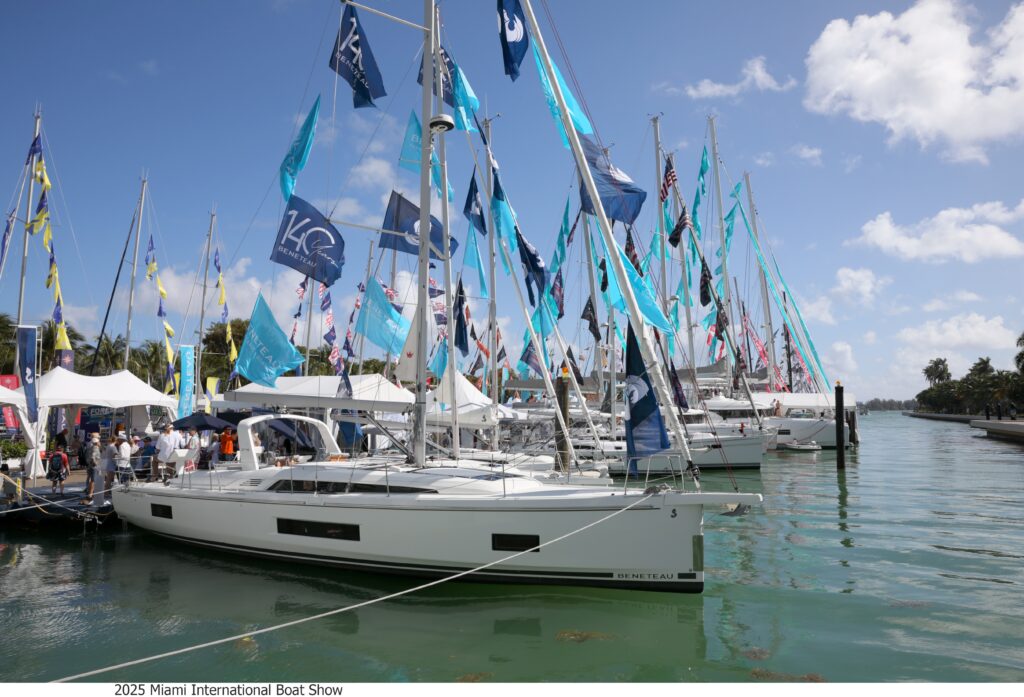
The Miami International Boat Show and most recent Trawlerfest event presented opportunities for longtime editors from multiple Firecrown Media magazines to gauge business trends. (Firecrown is the parent of Soundings Trade Only.) After days’ worth of conversations with builders, brokers and consumers, editors also reported a segmented marketplace — if not by length, by a boat’s asking price.

“Builders selling boats priced at a million dollars or more, particularly at the larger end of the market, were generally happy with sales and the prospective customers they talked to,” says Soundings Trade Only editor-in-chief Gary Reich. “Dealers selling to the middle of the market were less enthusiastic. Many said this segment is being squeezed because consumers seeking loans to buy boats end up unable to make the monthly payments work. Other dealers said that many prospective buyers with trades are upside down in boats they purchased at a premium during the Covid surge.”
Andrew Parkinson, editorial director for Cruising World, Sailing World and Sail, described what he saw in the sub-40-foot monohull sailboat spaces at the Miami show as a “very loud silence.” “If you weren’t a catamaran or a premium performance build, it felt like the market just didn’t show up,” Parkinson says. “The magic line seemed to be right around 45 feet. Anything north of that, especially in the multihull segment, was seeing transactional movement. Below 40 feet, the entry-level monohull has almost vanished from the docks.”
Patrick Sciacca, editorial director for Yachting, Power & Motoryacht, Boating, Soundings, Passagemaker and Wakeboarding, says he also heard from builders that yachts around 80 feet and larger are performing relatively well, with the under-50-foot powerboat segment facing overall challenges. But there are some bright spots, Sciacca adds: “I know of one builder specializing in the midsize market who sold several 50-plus-foot yachts during the show. Builders are working hard for every sale, but the buyers are out there.”
Daniel Harding Jr., editor-in-chief of Power & Motoryacht, also says he saw strain in certain areas compared with others. “As is often the case, larger builders — in terms of LOA and number of boats built per year — that continue to invest in new models seem to be weathering an uncertain market more easily,” Harding says. “Boutique builders that build fewer boats seem to be most impacted by economic uncertainty. Likewise, builders of lower-price-point models seem to be affected by softness in the brokerage market.”
Jeanne Craig, editor-in-chief of Soundings, says that with smaller powerboats in particular, she’s seeing a trend of builders offering at least some models with fewer options. That trend has continued since the pandemic’s supply-chain disruptions, and it includes offering fewer power packages. “I think limited propulsion allows the builder to guarantee good performance, and it might help with supply-chain issues, if those are still present for propulsion,” Craig says. “Builders of inboard boats also seem to be moving in this direction.”
Looking at the marketplace from the opposite angle, Parkinson says he sees numerous sailboat builders adding features to target only the higher-dollar buyers. “Builders like HH and Balance are clearly leaning into the premium ‘prosumer’ segment,” Parkinson says. “Balance, specifically with the 502, is doubling down on the buyer who wants carbon fiber, semicustom finishes and high-speed performance. They’ve essentially said, ‘We aren’t competing for the budget buyer.’ They’re hunting the younger, wealthy owner who views their boat as a high-performance remote office/adventure rig and is willing to pay for the semicustom label.”
Jeff Moser, editor-in-chief of Passagemaker, says he’s seeing the same trends play out in trawler-style and long-range cruising powerboats, sometimes with a single builder targeting both types of buyer. As an example, he notes a builder that sold two semicustom yachts at about $2.5 million each but that is also planning to launch a 52-footer that is almost purely a production model, with minimal options and set pricing.
“Even though they seem to be thriving at the price point north of $2 million,” Moser says, “the newer, less-expensive and less-custom model is aimed squarely at a younger clientele. Another builder that has been struggling as of late mentioned adding a smaller, less-expensive model to its lineup.”
Changing Consumer Behavior
Builders aiming at those specific types of buyers may also be considering what’s happening in the brokerage market, where later-model, more-expensive boats are generally selling better than older, less-expensive models. “The 2022, 2024 model product is selling more quickly than the 2018 or 2019 product,” Flannery says. “The reason that I think we’re seeing a lot of that is we have a lot of new, young money that’s showing up. Their first boat is 70 or 80 feet. There’s a lot of change in what we’ve known as a marketplace for 30 or 50 years. It used to be that older, seasoned buyers were buying the big stuff with a lot of wringing of hands and gnashing of teeth to make that decision. Now it’s 35-year-old buyers with 50-meters.”
Similarly, Stanley says that while 2025 was among his best years as a broker, it was a year when he happened to have two big deals to boost his bottom line overall, including one boat that delivered from a yard in Turkey. “I’m seeing this year start a little slower,” he says. “I think the smaller boats are in a state of flux where it’s not a good time to have inventory, especially about 50 feet and smaller.”
Stokes, who sells a lot of 40- to 50-footers that people buy to cruise the Great Loop, says he’s still seeing boats sell in that segment, but sometimes for amounts that are puzzling in the broader marketplace context. “I’m seeing a lot going on with the internet, a lot of people trying to sell their boats on Facebook,” Stokes says. “There was a 2004, 40-foot Mainship that was listed for $267,000 by the owner on Facebook, and somebody paid them full asking price. That’s $100,000 more than that boat was selling for prior to Covid. You get whiplash. At one minute, somebody’s selling low, and another person is selling crazy high like that. You can’t get consistent pricing to sell boats. It’s all over the place.”
With older brokerage boats, Stokes says, some sellers are taking less money to get deals done. “If they’re 20 years or older, we’re really struggling on insurance,” he says. “That’s across the board, and especially with the older sailboats. Most insurance companies want the rigging to be 10 years or newer, and to replace that rigging can be the same value as the boat itself. People say, ‘Forget it, I’m not doing it.’ So we’re selling them, but not for the prices we were getting years ago.”
He also says he’s concerned that prices attendees are paying for food and drinks and other basics at boat shows are hindering consumer confidence, adding to a generalized feeling that all kinds of things are just too expensive. “My wife and I, at the St. Pete boat show, we went down to the tent for two beers, and it was $34,” Stokes says. “We just sat there shaking our heads. I think people just get turned off by that at some point.”
Parkinson, looking at the whole of the sailboat market at the Miami show, says even higher-dollar buyers are looking to get everything they can for their money. “The buyers at the show have clearly accepted the new price reality, but they are voting with their wallets for value per square foot,” he says. “If a boat is priced at $400,000 but feels like a compromise, it may sit. Meanwhile, the $1.2 million cats were seeing contracts signed.”
All in all, Flannery says, the fact that there’s activity across market segments is a good sign, especially after so many challenging years. The industry is in a hole, as the data shows, but it appears to be crawling out, albeit slowly — and with brokers working and negotiating hard to get deals done. “The only thing that I’ve heard anybody say is that 2024 was tough, 2025 show[ed] promise, and hopefully 2026 will give us a stability,” Flannery says. “But that’s as much conjecture and philosophizing as it is fact. You’ve got to be an optimist if you’re going to be a salesperson.”
This story originally appeared in the April 2026 issue of Soundings Trade Only.