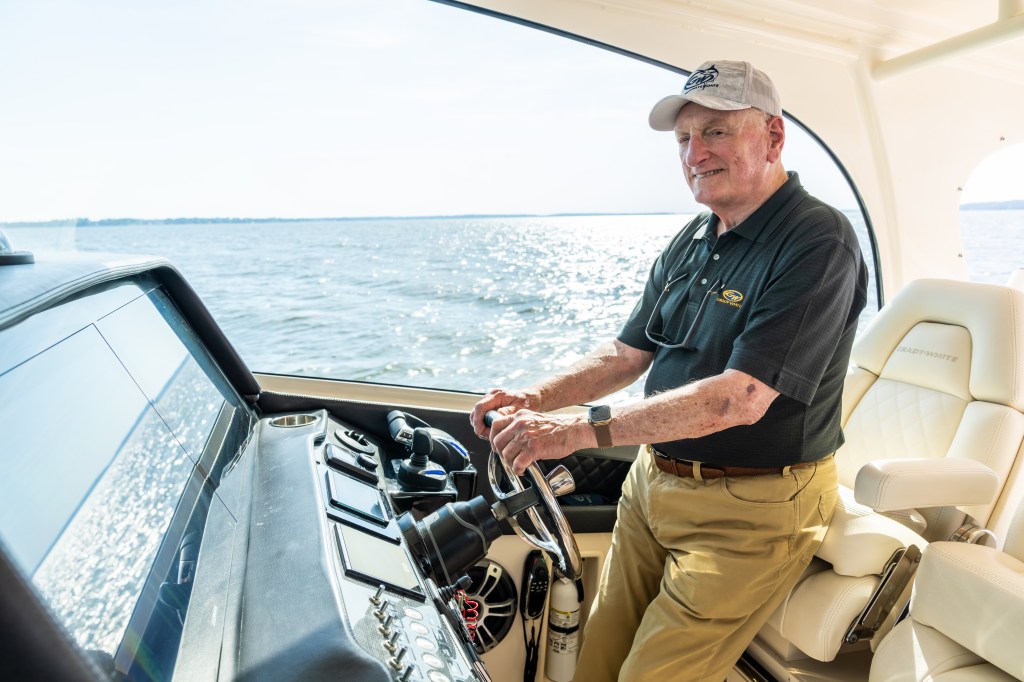
Eddie Smith has had a lot of time to make friends in the marine industry. He’s owned Grady-White Boats for 58 years, and he started out at a time when it was all entrepreneurial, mom-and-pop enterprises. One by one, he says, he has watched his fellow company owners end up frustrated.

“Lots of good friends, I watched them sell their companies, and when I talked to them after the fact, not a single one of them is happy about what happened to their company after they sold it,” Smith says.
Now 84, Smith says selling is the natural thing for most company owners to do. It’s something he considered doing with Grady-White, to the tune of hundreds of millions of dollars. But he realized that while the world sees founders scoring big payouts, a lot of them, at least among his friends, are also paying a huge price.
“They tried to pick owners that promised them to keep the company like it was, but it just hasn’t happened in a single case,” Smith says. “Each of their companies had cultures that they built over many years, and it just didn’t stay the same. The dealers were unhappy. Everyone was unhappy.”

Protecting the culture at Grady-White is a key reason Smith chose to create a purpose trust. It’s a first for the boating industry and the second-largest of its kind in the United States after the one outdoors retailer Patagonia created in 2022. Smith’s decision this past summer gives control of Grady-White to the trust, in addition to creating a nonprofit organization that will grant company profits to charities.
“We had gone through the process of selling the company, and that was even before Eddie was thinking about the purpose trust. We were thinking about what to do with Grady-White for the long term after Eddie had passed,” says Kris Carroll, who is CEO, president and chairwoman of the board at the North Carolina builder. “If we were to sell to private equity or to a public buyer, they’re going to be focused on the profitability and not all these processes and systems that make a difference in all kinds of people’s lives. This allows us to keep doing that forever and ever and ever.”

Carroll, who has been at Grady-White for decades, is one of three people who will serve on the Purpose Trust Committee. She will sit alongside Joey Weller, who worked for many years at Grady-White before retiring, and Sam Soliman, who worked with Smith directly for a long time. Committee members get to choose their successors and are entrusted to run the company in accordance with the values and principles in the trust’s bylaws. Those bylaws took an enormous amount of work to create, Smith says. He had an inside team working on the documents for a year, in addition to outside lawyers and accountants.
“It was very difficult to make a lot of the decisions,” Smith says. “What if this comes up? What do you want management to do? Do you want them to defer to the board? Does the board have to be unanimous? I was able to even dictate that unless there was an extreme emergency, Grady-White will remain debt-free, as we have been for 45 or 50 years. That has helped us go through the oil embargo and a lot of downturns that took a lot of people out of our industry because they had too much debt to get across the ditch.”
Natalie Reitman-White, principal at the Purpose Owned consultancy, says people in Smith’s position can put whatever matters to them in a trust agreement. The committee they appoint is then responsible for sticking to that agreement. Some company founders, she says, make stipulations about certain products and services. Others include requirements for benefits and taking care of employees.
“I worked with a company that made education products for kindergarten through university,” she says. “They put in their trust that the company could grow and do all kinds of things as long as it still promoted science literacy. That’s what the founders cared about.”
Smith says he sees the Grady-White purpose trust as a way to control the company’s management even after he’s long gone from this world. “Once that document was nailed down and I felt good about it, it’s really a celebration,” he says, adding that when he announced the decision to Grady-White’s staff, there were cheers and tears of joy. “It’s a real blessing to be in a position to do it and to see all the good things it’s already doing. Our dealers knew they would never get treated the same way they’d been treated in the past, so they were relieved. And the response from the general public has been overwhelming. I didn’t expect it to go viral, but by God, it’s gone viral.”
A lot of people figure Smith must be getting an impressive tax break by creating the trust, but he says that’s absolutely not true: “Monetarily, it’s unbeneficial to me. I’m going to have to pay millions of dollars in gift tax for the portion of the stock that I give to the trust.” The biggest benefit to him, he says, is knowing the future is secure for the company he spent his life building.
“Grady-White is never, ever going to get sold,” Smith says. “It’s in that trust in perpetuity. I’m sleeping great.”
This article first appeared in the October 2026 issue of Soundings Trade Only.