
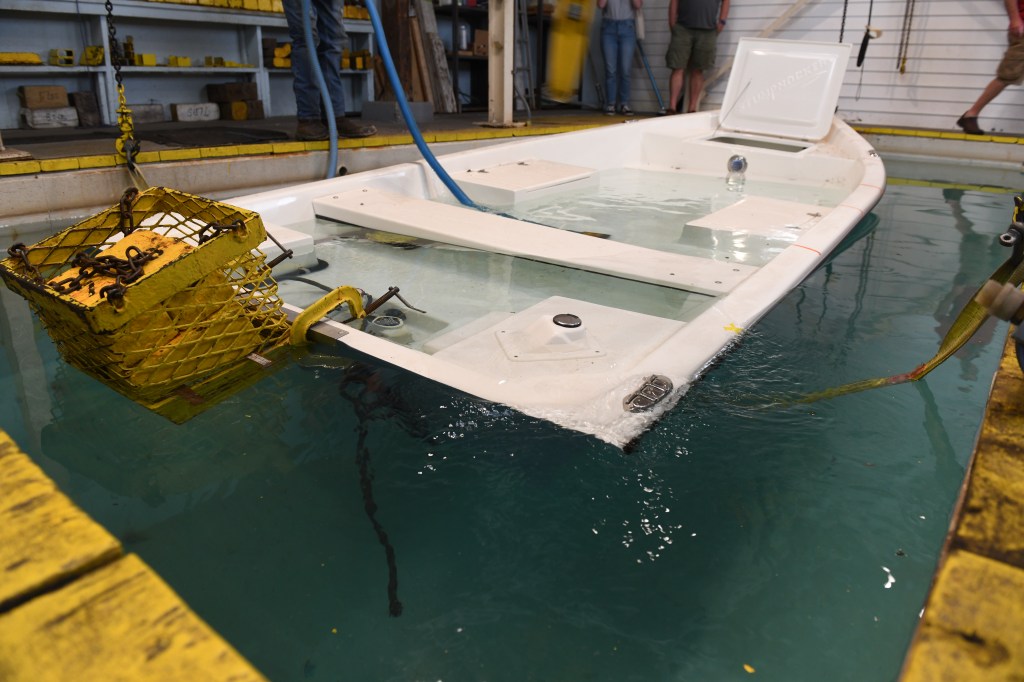
The guy who inspects small boats for the Coast Guard has a spidey sense. He can look at a boat for sale and, with remarkable accuracy, decide whether it deserves the tank test.
“The Coast Guard purchases boats on the open market for testing and inspection, and of the boats tested, the USCG reports a failure rate of between 60% and 75%,” reads one passage from the new USCG Recreational Boat Regulations Certification Study Guide. “Most failures are related to flotation, capacity and safe-powering requirements. Of the flotation failures, most of these result from an insufficient amount of flotation” or other related issues.
When it comes to complying with federal regulations, the stakes are high. Congress authorizes the Coast Guard to establish minimum safety standards and to procure recreational vessels for testing. Failing a flotation test could mean defect notices, nationwide recalls and extraordinarily high costs to the boatbuilder. It’s much better to know the regulations before bringing a new boat to market.
That was the rationale that led to the USCG Recreational Boat Regulations Certification. Introduced in August, it’s a collaboration between the Coast Guard’s Product Assurance Branch and the American Boat & Yacht Council. Boatbuilders and contractors who conduct Coast Guard inspections also helped develop the course.
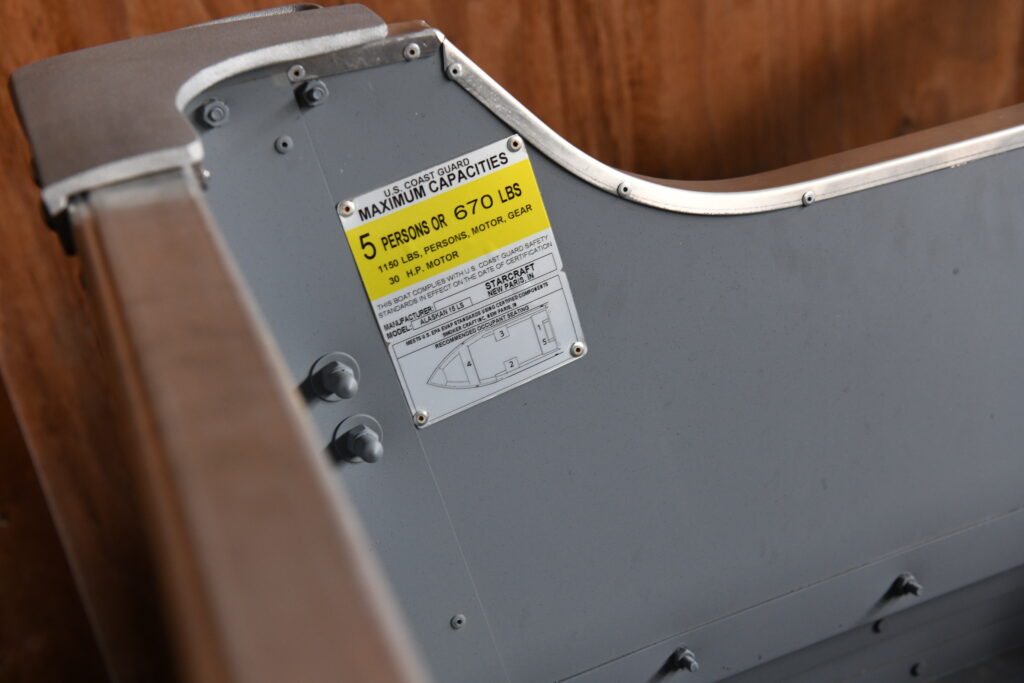
The course guides participants through a typical Coast Guard inspection at a boat manufacturer or dealer, providing practical guidance for compliance. Topics include certification labeling, hull identification numbers, capacity and loading requirements, flotation, electrical and ventilation systems, marine sanitation devices, engine cutoff switches, start-in-gear protection, navigation lights and backfire flame arrestors.
Try a sample question. In 2023, a manufacturer is made aware of a defect in its 2012 model-year boats. That manufacturer:
A. must notify all listed title holders of the boat
B. must notify the boat’s first purchaser within 30 days
C. is not obligated to do anything
D. must notify the Coast Guard within 30 days
Both B and D would be the right answer if the boat were newer. In fact, the correct answer is C, because boatbuilders are obligated for 10 years to keep first-purchaser records and notify them of any defect.
Here’s another one. Gear weight includes:
A. fuel tanks
B. batteries
C. engine controls
D. anchors
Because the Coast Guard excludes humans, as well as engines, controls, batteries and fuel tanks from its definition of gear weight, the correct answer is D.
The course takes students through displacement calculations using Simpson’s rule, based on a series of linear measurements. It explains how to calculate persons capacity and horsepower ratings. It examines the requirements for boats with electrical systems or navigation lights. It discusses fuel systems, including recommended pressure tests for fuel tanks.
Course content was also created by Craig Scholten, who for decades was a boatbuilder responsible for compliance before becoming the ABYC’s vice president of standards and compliance, as well as chair of the International Organization for Standardization Technical Committee 188 Small Craft. He brought that experience into the course content, including exam questions, a print study guide and an online, on-demand course. In March, he delivered an online live
version of the course to some three dozen compliance specialists from boatbuilding and equipment-manufacturing companies, as well as insurers. Feedback helped shape the on-demand course that’s available today.
“Compliance with federal regulations is essential for safety, and we are pleased to announce the availability of this new course,” said Jeff Ludwig, chief of the recreational boating product assurance branch at the Coast Guard. “Anyone involved in the manufacture of recreational boats should strongly consider taking it to ensure that they have the knowledge to build boats that are compliant with U.S. Coast Guard requirements.”
For more information about the USCG Recreational Boat Regulation Certification, visit abycinc.org/events/certification-courses/uscgrecreational-boat-regulatory-certification.
Some compliance specialists may be eligible for partial reimbursement of the course fee under a Coast Guard grant. For more information, contact education@abycinc.org.
Tim Murphy is ABYC education director.