
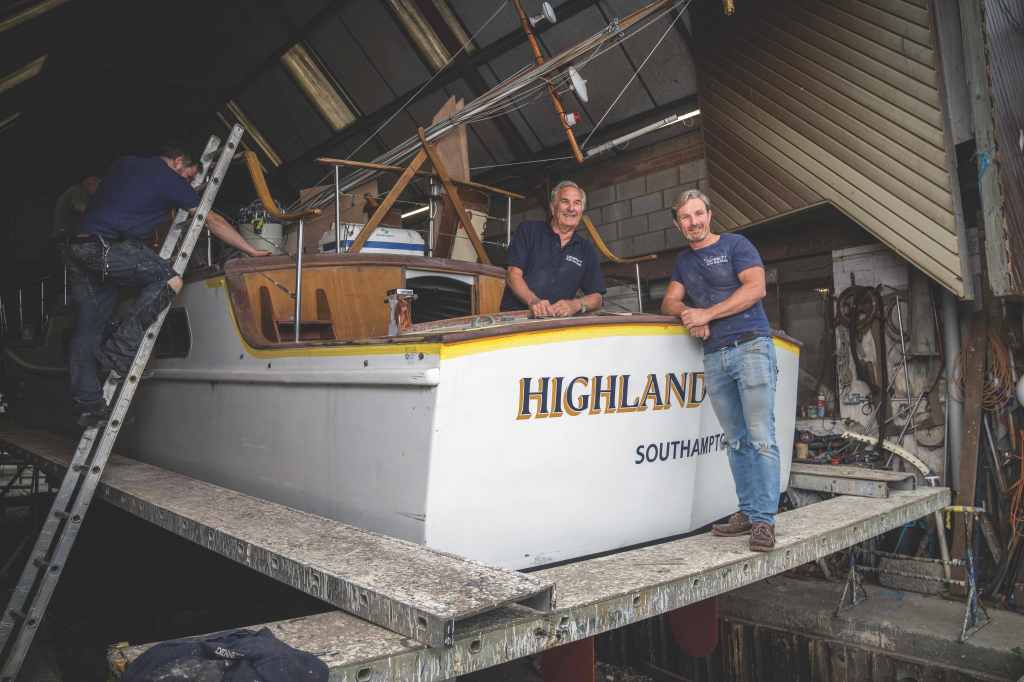
It’s a strange part of the world, in the heart of England’s overpopulated southeast and just a few miles from Heathrow’s kerosene-cooked runways, yet it has the feel of a remote backwater. Hard to get to but easy to find, Michael Dennett Boat Builders lies at the end of a single-lane road just downstream of Penton Hook, on the Surrey bank of the River Thames.
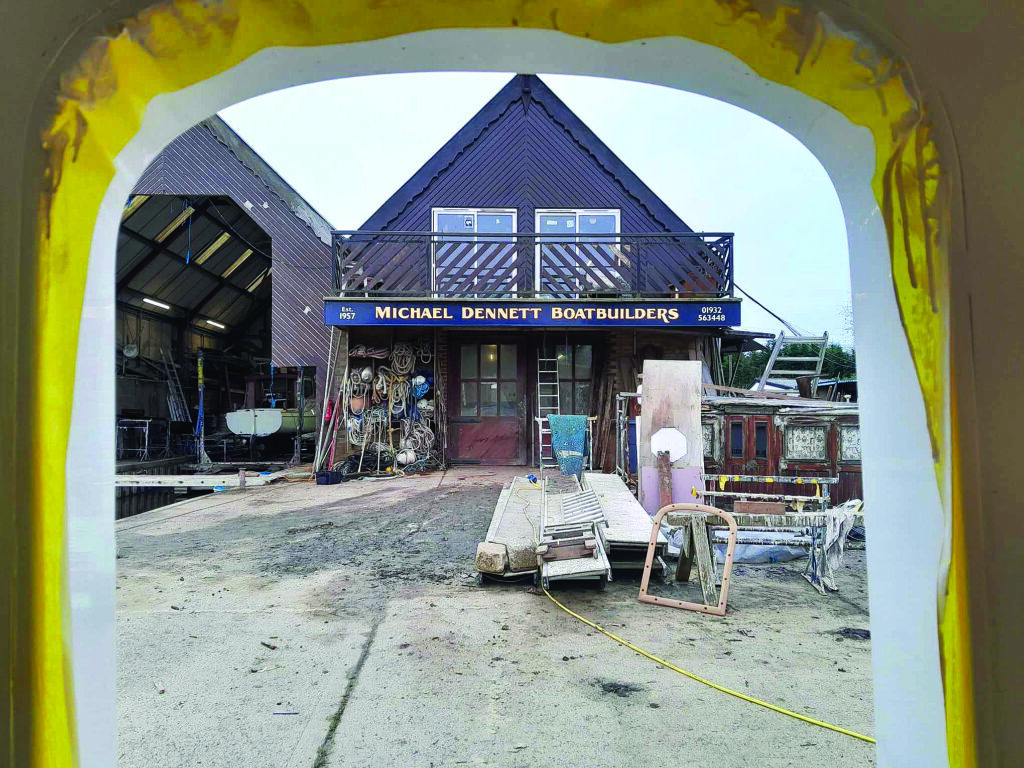
We are a long way from the sea — the five canal locks and 16 miles down to London’s tidal waterway represent a half-day’s cruising at river speeds. If you head upstream — or uphill, as the numerous locks will remind you — it’s about eight hours to Henley, another 12 to Oxford, and if you have a boat that is small enough, you might make it to the head of the navigable Thames in two or three days. By car? An hour and a half, tops.
You can’t rush things on the river, although no one seems to have said that to Stephen Dennett, a compact, wiry, human dynamo, who at 56 seems to have the energy of a hyper-active teenager. “Right, I’ll give you the 20-minute tour,” he says, as I look for somewhere to leave the car among the old boats, engines and pallets of timber. “Come on, keep up,” he says, and before I’ve had time even to glance around, we embark on a brisk inspection of five or six projects in the yard, climbing ladders, peering into half-built cabins and carefully picking our way along encumbered side decks while keeping one eye on the concrete floor 12 feet below.
It is a busy time for the yard. Refits and restorations are Dennett’s stock in trade, and during spring especially, everyone wants their boats yesterday. The place is full, and the past is a constant presence. The names of long-dead British boatyards live on in the sheds and under tarps: Thornycroft, Brookes, Bates, Staniland, Gibbs. There is an electric canoe of double-skinned construction — mahogany over teak — that dates to 1907. Alongside sits a beaver-stern launch from the Taylor & Bates yard in Chertsey, just a stone’s throw away. Of that other classic Thames design from the Edwardian era, the Andrews slipper launch, there are numerous relics.
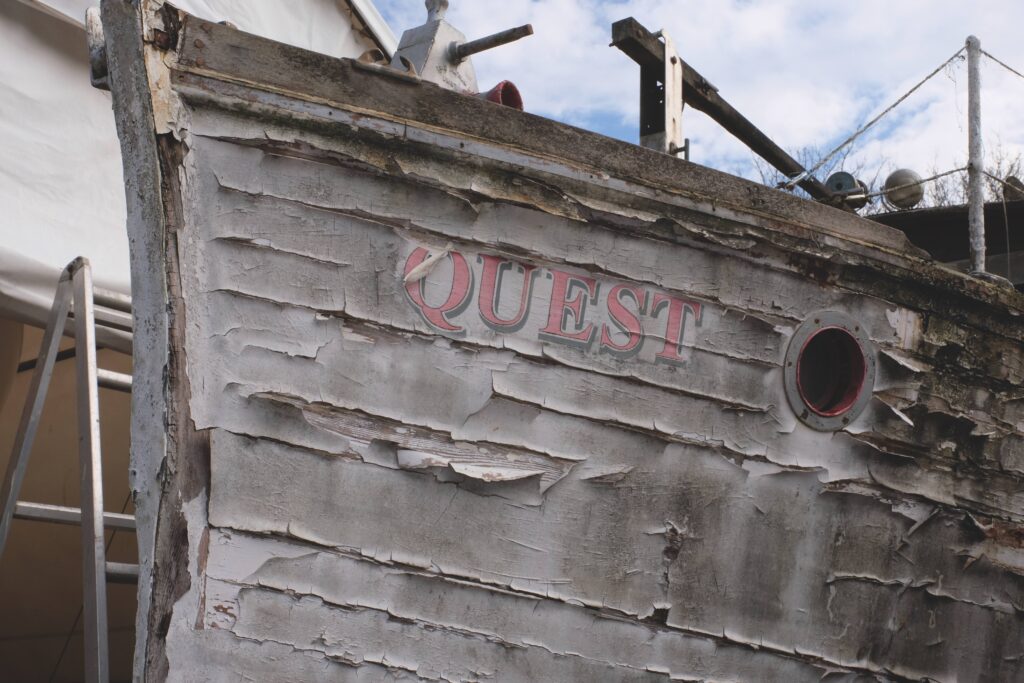
Along the waterfront, yachts are moored two deep. Some have just arrived, while others are being finished as craftsmen, electricians and engineers sort out the last snags before their owners take them to moor at the bottom of immaculate riverfront gardens. Many of these boats are well-known at the yard.
There is Janthea awaiting her turn on the slipway, an unusually elegant gentleman’s motoryacht, as they’re known around these parts, and a regular customer at Dennett’s. Measuring 45 feet, she was built by the Suffolk yard of Whisstocks in 1938. Taking up most of the quay at the front of the yard is the 77-foot steel classic Llanthony, from perhaps the most famous yard of all, Camper & Nicholsons. She dates to 1934, but Dennett’s has just completed a restoration and rebuild, inside and out. With her fresh paintwork, brass and varnish sparkling in the sunlight, she looks brand new.
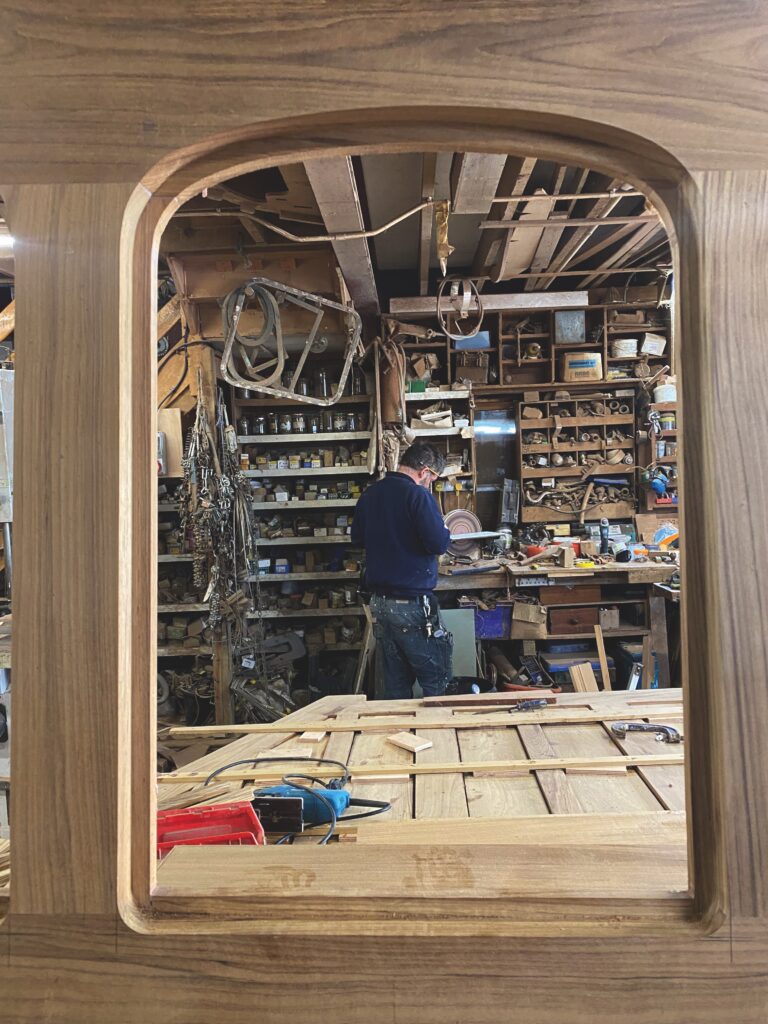
Dennett is a natural engineer, as people who work with wood so often become, having gained an appreciation of their chosen material’s strengths, weaknesses, properties and capabilities. Given time, decision-making and problem-solving become almost instinctive. But there is nothing old-fashioned about it. New technologies have their place.
Pointing to the graceful, curved strake along the side of Janthea, capped by a brass rubrail, he says: “That’s glued on. Bolt holes are weak points, and weak points are where the water gets in. It’s where the rot starts.” He invites me to take a closer look. I see no signs of weakness, no cracking, no splitting, no water ingress. “We put that on 27 years ago,” he says.
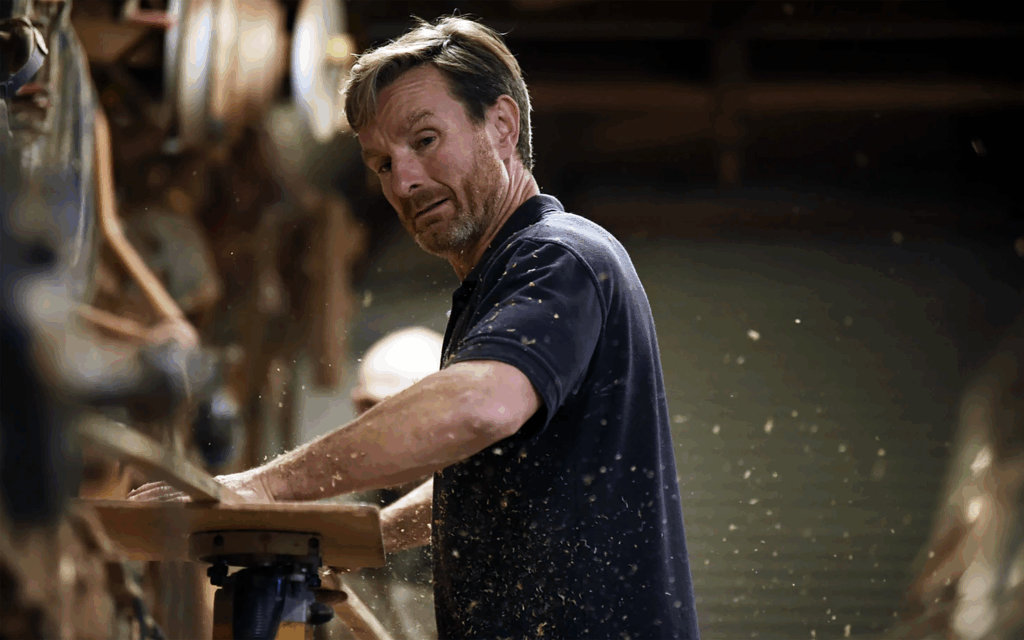
Dennett has worked at the yard that bears his father’s name since he was a teenager. He took the reins about 15 years ago, but his father never quite got around to retiring. Michael Dennett, who is 82, was born during World War II and left school at 15, with no qualifications and little idea of what he wanted to do. “I saw an advert for a general assistant in a boatyard, and it sounded better than working in a factory,” he says. “I loved it from the start. They saw my potential.”
It was Horace Clarke’s Boatyard, a short duck’s paddle from where we are sitting, among sawdust and varnish in a loft overlooking the quay. Michael Dennett built a reputation along the river as a young apprentice and learned how to work quickly. “I was on bonus work,” he says. “So I was fast. That’s the secret.” It’s a lesson that his son seems to have taken to heart — today, some 60 boats a year pass through the yard.
Michael Dennett worked out of a van for years, often on high-profile projects in prestigious waterfront neighborhoods. He established a permanent base for himself at the age of 30 when he rented a shed in 1973. He might still be there, save for a wealthy customer who had other ideas. “He set me up with my own boatyard,” Dennett recalls. “He bought the land, and I planned the buildings and designed the slipway. He was in construction, so he knew everybody.”
Michael Dennett Boat Builders launched in 1988. After renting the yard for five years, his benefactor offered it to him at cost price. “It took 12 years to pay off the loan,” Dennett says. “Best thing I ever did.” He still comes to the yard five days a week.
The third member of the trio who runs the yard — Stephen Dennett’s wife, Heather, who is 40 — arrived comparatively recently, but she came with her own classic. Gay Venture was her family’s 45-foot motoryacht, built by Watercraft on the south coast in 1938. “She had got a bit tired and needed a lot of work when my parents split up,” Heather Dennett recalls. She was 18 at the time, but an inheritance from her grandmother allowed her to take on the boat, which arrived at the Dennett yard in 2004 for a complete restoration.
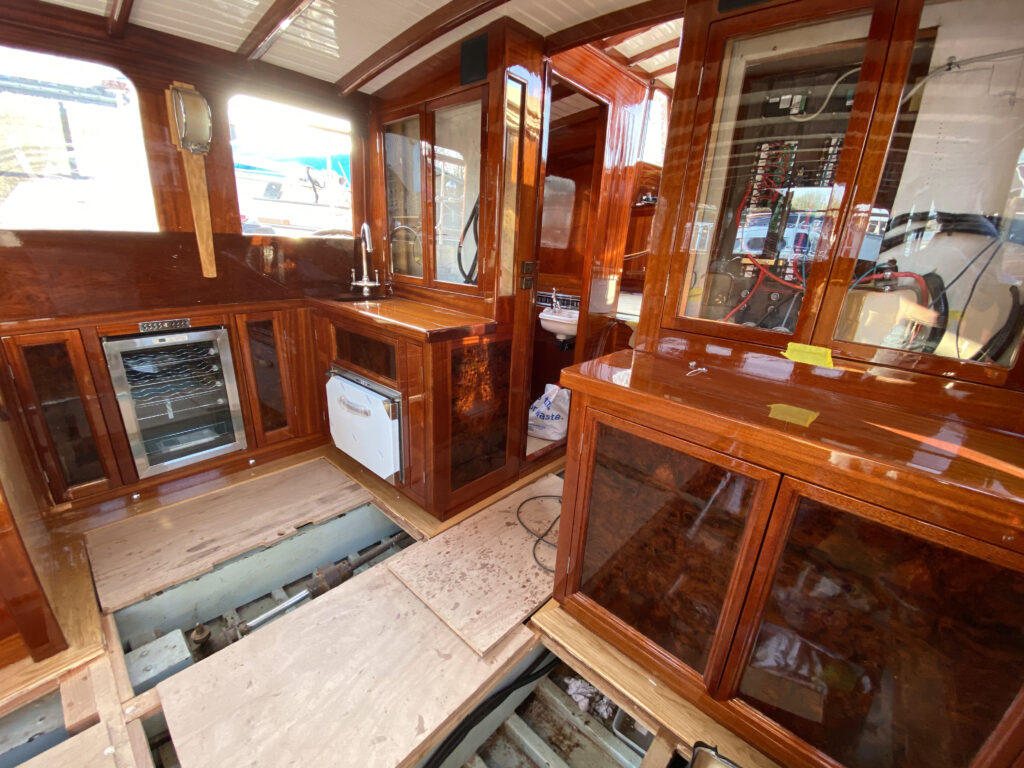
Gay Venture was reborn, and in 2010 Heather Dinler became Heather Dennett. She swapped fashion for interior design and now runs that side of the business, offering fresh ideas for owners who want to update their venerable yachts’ interiors.
Many of the boats at Dennett’s wear a discreet brass plaque that reads: “Dunkirk 1940.” It’s another reason the yard is so busy. The Association of Dunkirk Little Ships stages a return to the beaches every five years to commemorate the evacuation of more than 338,000 Allied soldiers from Dunkirk, in the north of France, during WWII. This year was the 85th anniversary of Operation Dynamo.
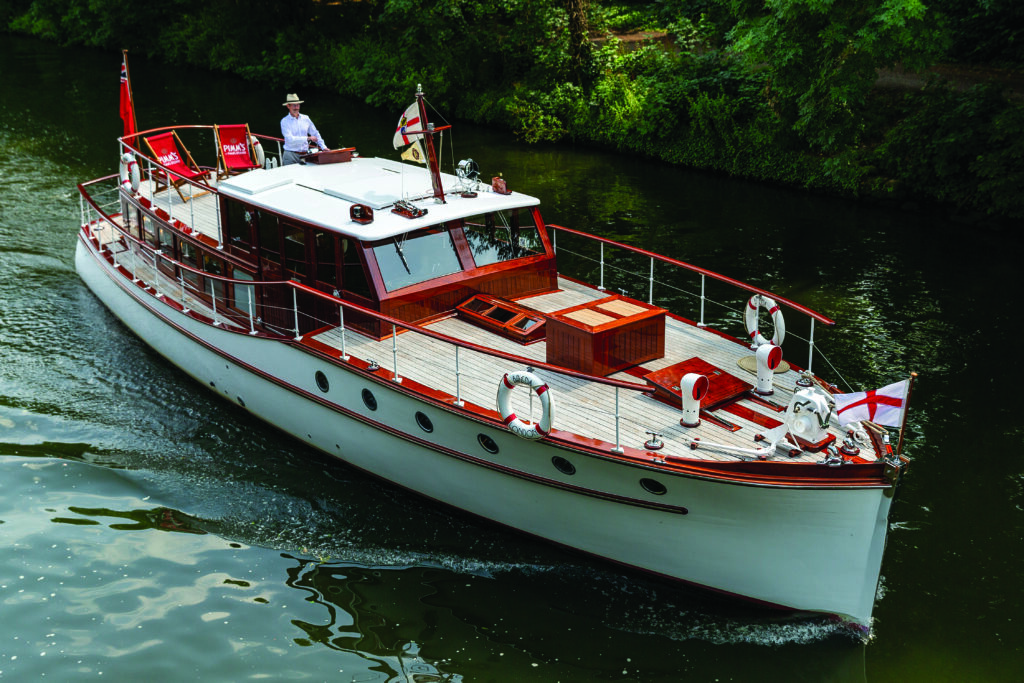
Boatyards up and down the river worked frantically to enable owners to take their boats to the grand occasion, and Dennett’s probably had more than most: Gay Venture is one of these fabled vessels, as are Llanthony and Janthea and many others that have passed through Dennett hands over the years.
The Dunkirk story still has the power to amaze, with its ragtag armada of civilian vessels that included several hundred motoryachts requisitioned by the Royal Navy and sent to do their duty. Some of the yachts were helmed by their owners, but the majority were crewed by reservists and young naval ratings, and although most of the soldiers were rescued from Dunkirk’s dock walls by British destroyers — six of which were sunk — the contribution of the Little Ships was enormous. Of the British and French troops rescued over nine days, some 98,000 were taken from the beaches.
Newspaper headlines switched from disaster to triumph once news of the “miracle of Dunkirk” was released. It was as if a great battle had been won. Winston Churchill, however, felt obliged to remind the country that “wars are not won by evacuations.” In London, Motor Boat & Yachting gave its “Dunkirk Regatta” story seven pages, but the editor distanced the magazine from some of the more sensational accounts of the evacuation: “The part they played has been exaggerated in some quarters. There was no need for this; it was great enough without any such exaggeration.”
And it’s probably not much of an exaggeration to say that the Dennett yard performed its own miracle of Dunkirk this past spring, getting those historic yachts ready for their big day.