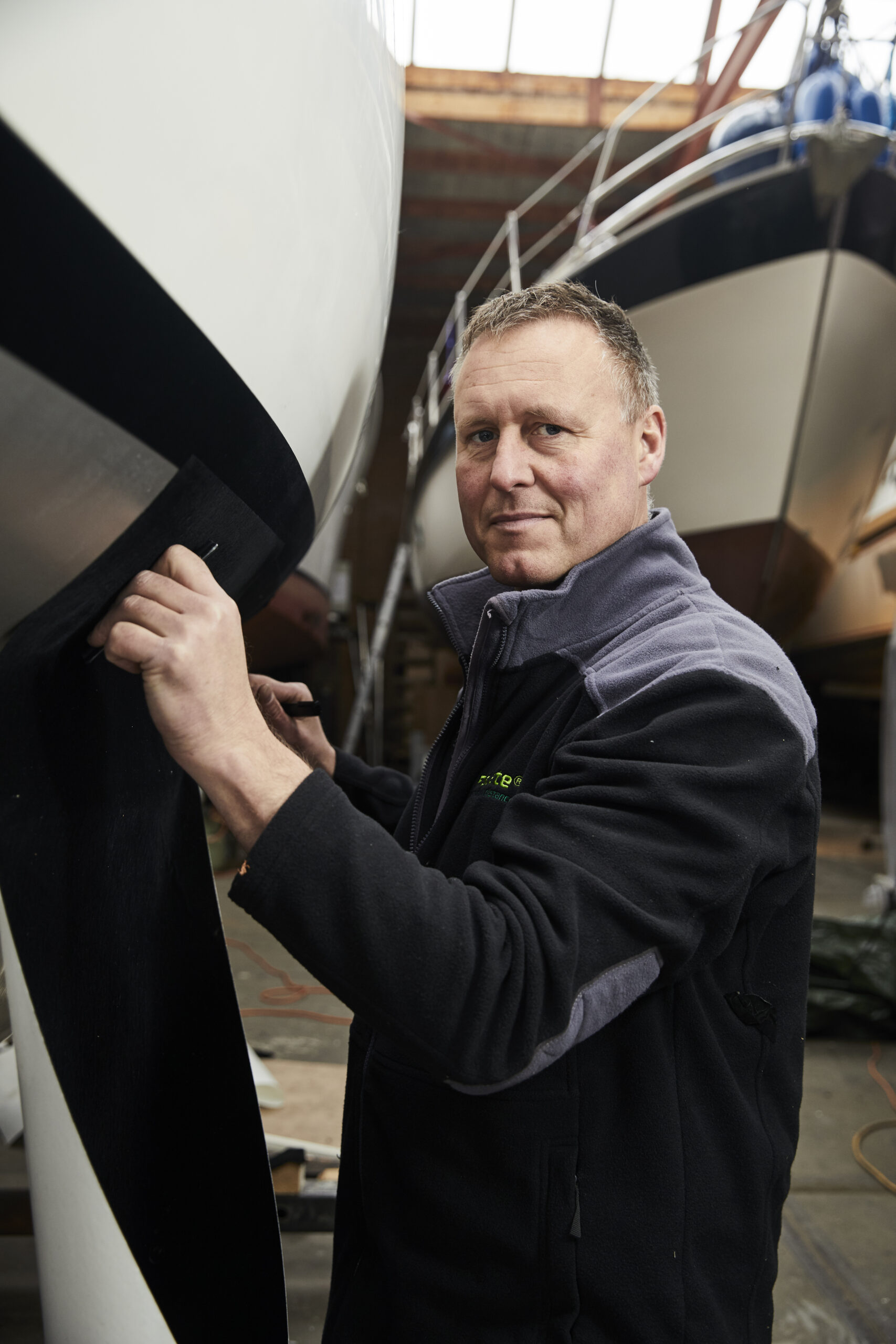
When Dutch materials scientist Rik Breur examined how sea urchins, otters and other marine organisms stay clean, he saw the blueprint for a radical shift in antifouling. Instead of poisoning marine life with toxic coatings, he envisioned a mechanical deterrent — a hull covering that prevents fouling while leaving the water untouched by biocides. Finsulate is what he invented.
“Finsulate is based on biomimicry, which says, look at how nature does it and try to copy it,” Breur tells Soundings Trade Only. “Spines and hairs are a typical example of a protection mechanism for many species, ranging from sea urchins to sea otters. We were able to mimic these structures in the form of a self-adhesive hull wrap that keeps marine growth at a distance without releasing toxins.” The result is a durable, textured film that mimics nature’s defense systems to keep hulls clean for years without chemicals or paint.
While the new generation of silicone-based, foul-release coatings has reduced pollutants compared with traditional biocidal paints, even some of these bring their own set of environmental risks — particularly around leached oils/additives, polymer shedding and PFAS. “And for the traditional paints,” Breur says, “it’s not just the biocides. The polymer-based binders pose a big threat; they dissolve in the water as microplastic particles and harmful chemicals.”

From Lab Research to Launch Pad
Breur’s path to Finsulate began at TU Delft in the Netherlands, where he earned a Ph.D. in materials science focused on antifouling and biological corrosion. Understanding larval settlement mechanics and boundary-layer flow was central knowledge obtained during his doctoral work.
“Years of lab and field work showed that a textured, compliant surface could interrupt settlement without chemical intervention,” he says. “That, combined with frustration about toxicity and repaint cycles, sanding bans in marinas and the environmental cost of biocides, pushed me to pursue a fiber-based system seriously.”
Designing Finsulate was as much about engineering as biology. “We iterated fiber length, density and stiffness to find a sweet spot that deters attachment yet preserves hydrodynamics and cleanability,” Breur says. “Early prototypes taught us what not to do. Fibers that were too soft collapsed under shear, overly stiff piles trapped silt, and adhesives not tuned for immersed service were great in the lab but unforgiving in real marinas.”
The lessons paid off in a refined system that’s flexible, durable, and performs under tough marine conditions. “The current construction — backing, adhesive and fiber geometry — is much more robust,” he says. By 2013, Finsulate had entered the commercial marine market, and by 2017, it was established as a separate entity focused on the yachting sector — now its most important market.
A Mechanical, Not Chemical Solution
Unlike biocidal paints, which ultimately dissolve in the water, Finsulate’s vertical fiber field disrupts the way larvae probe the surface. It reduces their ability to secrete adhesive, and it keeps any early biofilm from maturing.
Routine maintenance is simple but critical. “With regular use or a quick in-water brush, the weakly attached film is shed before it becomes a problem. No toxins, no polishing, no sacrificial layers,” Breur says.
That simplicity is one of the keys to its appeal, says Bernard Hidier, who founded Finsulate USA from his base in Maine. “Finsulate’s range of self-adhesive, durable and recyclable wraps has now reached the 10-year mark of life duration for its first adopters,” Hidier says.
“With traditional paints,” he says, “you must exert extreme pressure to remove hard fouling — for example, with divers scraping cockles, mussels and barnacles with knives. In doing so, they also remove the antifouling paint the shells are attached to and end up weakening the underlying epoxy anti-corrosion barrier. With Finsulate, even after a long period of inactivity, hard fouling can be removed easily with a brush, manually or mechanically, as it has not been able to adhere fully to the dense fiber texture.”
Breur emphasizes that durability and consistency were crucial goals from the start. “We combined controlled lab settlement and hydrodynamic experiments with long- duration field trials in salt, brackish and fresh water — North Sea marinas, the Mediterranean, the Baltic, warm Florida, California and Mexican waters, and European lakes,” he says. “We track performance on both active and low-use boats because idle periods are the hardest test. The headline outcome: multiseason protection with light periodic maintenance instead of annual recoating.”
The best product validation, Hidier says, is the 900-plus wrapped boats so far. The company has seen, he adds, the need for owner-operators to monitor fouling closely in waters with high nitrogen content, sun exposure or warm water. Much of which is common-sense boat management.
Finsulate wraps don’t just deter fouling, Hidier and Breur say — they extend hull protection. “Finsulate wraps provide an additional layer of corrosion barrier, are easy to clean out and in water, without releasing any chemical or plastic pollution,” Hidier says. “When they reach their end of life — yet to be determined — they can be easily removed, replaced and recycled.”
Hidier adds that the product’s adaptability extends across vessel types and water conditions. “Finsulate can be applied on any kind of boat — wooden, aluminum, steel, fiberglass,” he says. “Different length and density of fiber are used to adjust to the type of fouling in these different environments.
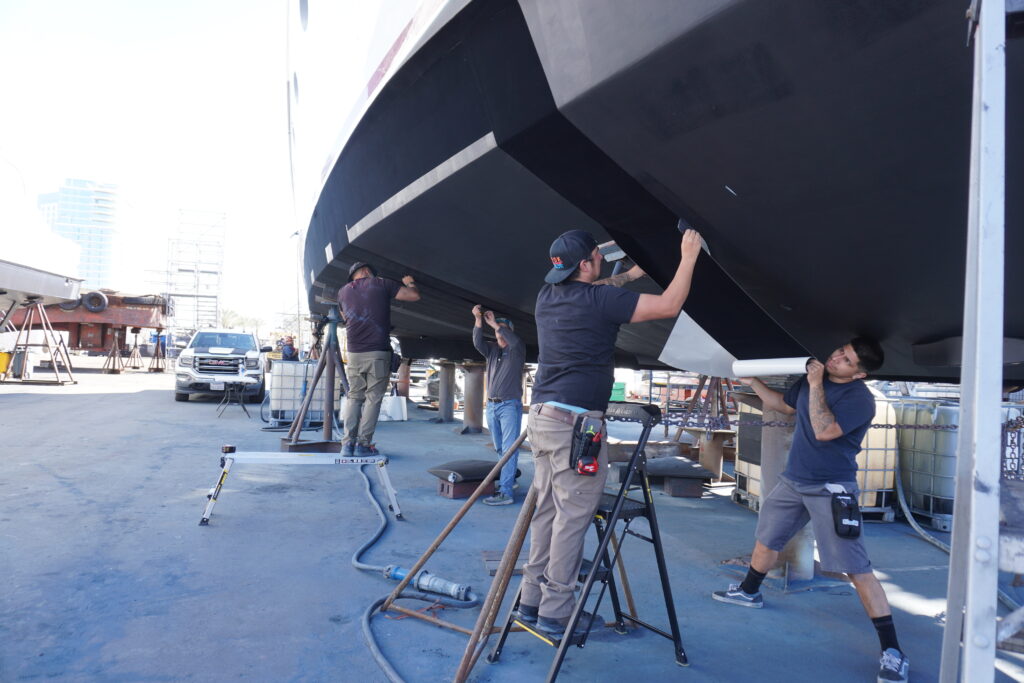
“We train boatyard, shipyard, marina staff — usually their coating teams — and wrapping contractors — usually their team already doing vinyl wraps above the waterline for aesthetic purpose — at their request to become Finsulate-certified installers,” Hidier says, “as they want to be able to offer more sustainable solutions to customers who are looking to follow clean boating higher standards. Our experience is that once you put the wrap in their hands and let them have a feel for how the product behaves when unpeeled and start understanding the flexibility/elasticity granted by the 20-micron back membrane, they get the gist very quickly.
“They definitely appreciate not having to put on all the protective gear to avoid the toxic fumes and VOCs released when spraying or paint brushing antifouling,” he adds.
For now, Finsulate is manufactured in Europe, in Italy and Germany, but it has always been their target to bring manufacturing to North America as “soon as we reach critical size in terms of the market here,” Hidier says.
Environmental Motivation
Both Breur and Hidier view Finsulate as an answer to the marine industry’s growing environmental consciousness — and to stricter regulations around toxic coatings. “Three strong drivers are tighter controls on copper and booster biocides under the EU Biocidal Products Directive, crackdowns on sanding/overspray and microplastic emission in marinas and yards, and port- and city-level sustainability policies tied to water quality,” Breur says. “These pressures are increasing, and they all favor durable, non-leaching solutions that reduce yard emissions and annual waste. And we are already progressing with initiatives to use recycled raw materials for fibers and film, so we are way ahead of paints that need to be disposed of as chemical waste.”
Finsulate’s adoption has grown through partnerships with builders, refit yards and sustainability-minded shipyards. “We work with builders and refit yards to promote Finsulate,” Breur says. “The best moment to apply Finsulate is on a new-built yacht. That way, the sanding and scraping is completely prevented.”
Collaborations now include some of Europe’s top shipyards. “A good example is our partnership with MB92, one of the major refit yards for superyachts,” Breur says. “This yard has a seven-step plan towards superyacht sustainability, and Finsulate is a logical step in this plan to reduce impact on marine life.”
Hidier sees similar opportunities in the U.S. market. “As a new Mainer, having joined the New England Ocean Cluster and discovering the rich local marine industry tradition, from fisheries and aquaculture to recreational and sailing and new offshore energy, I contacted Rik, and we agreed this would be a perfect launchpad for Finsulate in North America,” he says.
“Finsulate USA only serves the U.S. market and has been growing its sales over the last three years thanks to a series of recognitions and awards,” Hidier notes. “Over the last three years, we’ve attended numerous shows, including the New Orleans Workboat show, FLIBS, Newport International Boat Show, Rockland Maritime Heritage Festival and the Reuters Offshore Wind.”
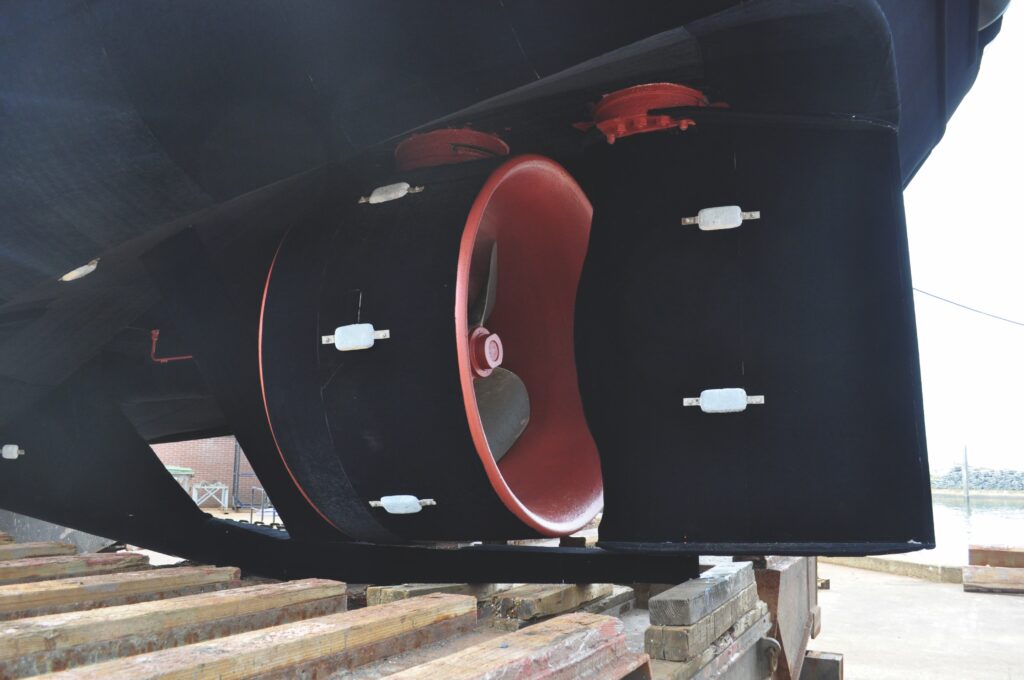
The Superyacht Sustainability Trend
Breur says the superyacht sector is now leading the sustainability wave. “An important development in the past few years is the growing awareness for sustainability in superyachting,” he says. “These superyacht owners are under a lot of scrutiny and want to adapt, as well. Finsulate is one of the easy changes they can make to improve their sustainability, and they even gain from reduced docking costs, as well as lower fuel consumption. We have already done several 100-foot yachts, and based on their performance, we know we are ready for the next step, to 200 feet and over.”
Breur says research continues. “From our original product that works well for bigger and bulkier-shaped vessels, we have gradually moved towards softer variants for yachts that perform really well, both from an antifouling point of view as well as regarding hydrodynamics,” he says. “We are still looking for materials that work better for small planing hulls, but with the textured surfaces of shark skin and sea otter skins in mind, it is a matter of time before we also have the perfect product for those markets.”
For now, the company says it focuses on yachts larger than 40 feet and on commercial vessels, as well as offshore wind installations. Boat owners who can skip the annual haul-sand-paint ritual become big advocates, Breur says, with the company’s long-term focus intended to satisfy regulators.
The goal now, both in Europe and the U.S., is to expand awareness and access. “We started where the regulations are heading.” Breur says, “zero biocides, no leachates, long life. We’re already where legislation wants to go.”