
Be the change you want to see in the world. It’s a saying that most people have heard, that many have repeated, but that far fewer actually embody. Effecting real change is hard. It doesn’t happen overnight, and it certainly doesn’t come without the will to overcome resistance from all kinds of entrenched interests. Doing anything big in a successful way takes purposeful intent and serious grit.
The boating industry includes not just a handful, but a strong number of notable companies that are actively engaged in being the change they want to see. From leadership in environmental stewardship and workforce development to disrupting whole product categories with technological innovations, the winners of the inaugural Soundings Trade Only EPIC Awards are shaping the future of the marine industry through bold leadership, purposeful innovation and a commitment to positive impact.
Judges included Soundings Trade Only Group vice president and general manager Michelle Goldsmith; Soundings Trade Only editor-in-chief Gary Reich; Paxson St. Clair of DuraTek Boat Lifts (and previously Cobalt Boats); and Dave Connolly of Thomas H. Connolly and Sons, America’s first and longest-standing marine manufacturers’ sales agency. We congratulate all of this year’s winning companies and look forward to everything their teams will help bring to the industry and the world next.
WINNERS
Dometic
Dometic’s 7,000 employees operate at 23 factories worldwide, with about 100 overall locations, including offices and distribution centers. Dometic provides branded solutions for mobile living in the areas of food and beverage, climate, power and control, safety and security, and hygiene and sanitation.
Dometic has long been known for innovations. This year, the company launched what it calls its most innovative and impactful product in many years, marking its entrance into another sector of the global boating market: stabilization.
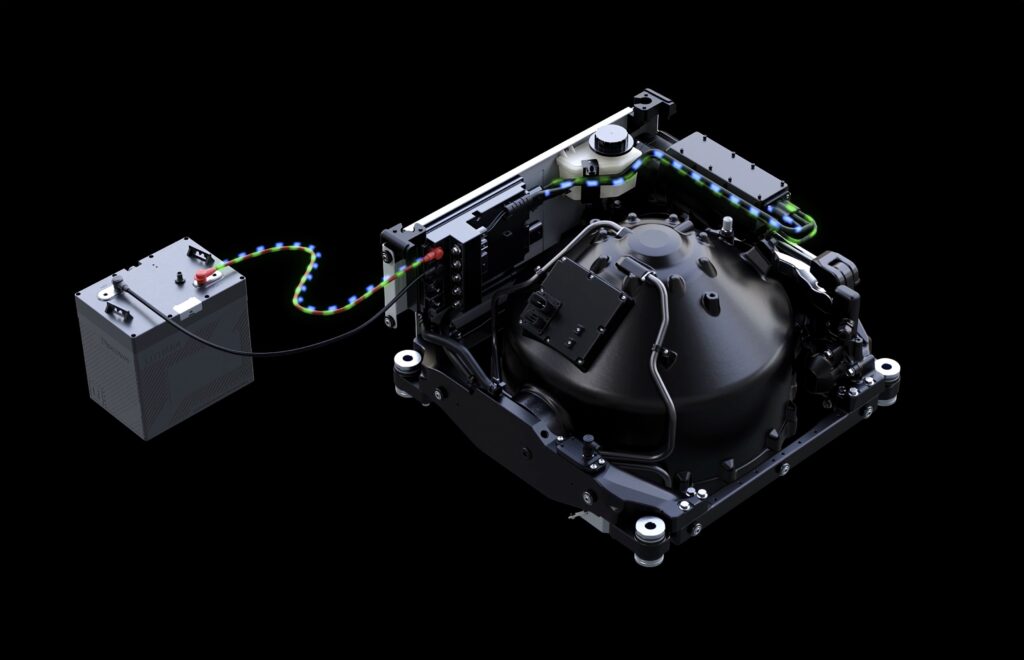
The Dometic DG3 gyroscopic stabilizer made its world debut early this year at the Miami International Boat Show, winning a National Marine Manufacturers Association Innovation Award. At the core of this product is Dometic’s inverted roller screw technology to actively control the flywheel’s precession, enabling true dynamic control of roll stabilization, in a way that’s especially effective in small to moderate seas where other gyro stabilizers can struggle to provide benefit. The roller screw design also eliminates the need for hydraulics, which Dometic says waste energy, reduce performance, and are a source of potential leaks and maintenance costs.
Dometic’s custom motor controller also recaptures energy during spin-down to recharge the system’s dedicated 48-volt lithium battery (used for faster spin-up) and to provide electric power for the system, amounting to greatly reduced energy consumption. The company says its larger, heavier flywheel with better mass placement can generate the necessary energy at a lower RPM than than other gyro stabilizers, allowing for faster spin-up and spin-down times, longer bearing life, less maintenance downtime and lower cost of ownership.
“A ready-to-stabilize time of 10½ minutes and full spin-up speed time of only 16 minutes versus a typical 50 minutes means that boaters don’t have to delay their day on the water to wait for their gyro to be up to speed,” the company says. “Even more remarkable, DG3’s spin-down time at the end of the day is less than 20 minutes, compared to multiple hours — up to eight or more — for competitors. This is up to 15 times faster.”
Goldsmith says Dometic’s DG3 is what put the company over the top with the EPIC Awards judges. “They came out with a stabilization gyro, which they’ve never done before, and they turned the category on its head,” Goldsmith says. “It’s disruptive in the way it performs and the way it can be serviced. It’s such a departure for Dometic, a real risk. This was already a great company that went above and beyond in pushing tech in a different way, and in the way it integrates with their other products.”
Garmin
Garmin, Goldsmith says, “hit every single aspect that we talk about in a company being great: sustainability, workforce, culture, product innovation, use of technology. They blew everybody away as an overall company.”
Most people in the marine industry are familiar with Garmin’s many product advancements, but the company also devotes significant time to altruism and social awareness. Garmin has important investments in STEM initiatives that educate and inspire students to pursue careers within the science, technology, engineering and mathematics fields. Each year, it hosts an Engineering Day Camp at its U.S. headquarters, where incoming high school freshmen and sophomores get hands-on electrical, mechanical and software engineering experience working alongside Garmin professionals and team members on a variety of projects.
Garmin employees are also mentor teams participating in FIRST (For Inspiration and Recognition of Science and Technology) competitions. The company hosts a series of events each year in Olathe, Kan., and Salem, Ore., aimed at educating and supporting students pursuing aviation careers during Women of Aviation Week.
Globally, the Garmin Asia office collaborates with the Kao Family Foundation for the HomeRun National Science Competition, where nearly 800 middle- and high-school students and teachers take part. The event works to include students from remote, underserved and disadvantaged areas to support educational equality among interested participants.
“For Garmin employees, our corporate values are more than words on a page,” the company says. “It is a mindset that guides not only how we treat our customers and fellow associates, but also how we care for our communities.”
All of that is in addition to Garmin’s product rollouts. The company is incorporating solar charging Power Glass and Power Sapphire technology across a growing number of product families. For example, the Instinct 3 Solar smartwatch offers unlimited battery life in smartwatch mode.
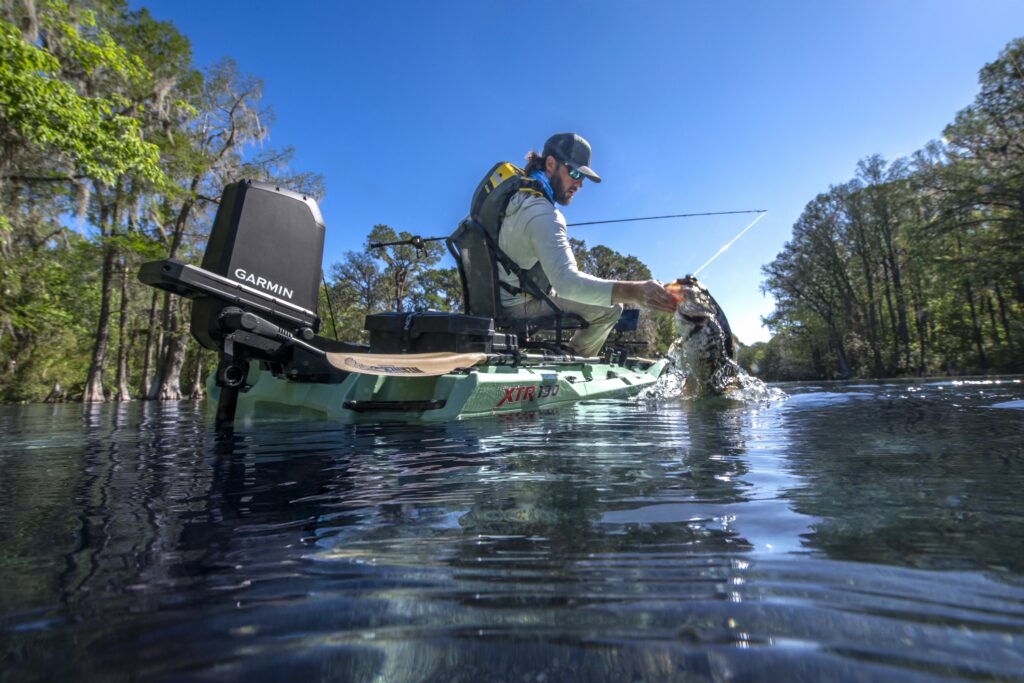
The Force Current brings the performance of Force trolling motors to kayaks. Garmin’s Echomap Ultra 2 16-inch plotter has keyed assist, a full high-definition in-plane switching display and an HDMI output so users can stream live sonar on a television or external display. The GPSMap 1543xsv ultrawide plotter has a 15-inch edge-to-edge glass format, making it 74% wider with more pixels than a standard 9-inch plotter, Garmin says. The plotter fits a wide range of dash configurations so boaters can have the advantages of dual screens without two separate units.
“Our culture is built on a foundation of strong core values, commitment, service and accountability,” the company says. “It’s where ideas are big, and egos are small. It’s where leaders are accessible, and employees know there’s no problem too big or too small to solve.”
Brunswick Corp.
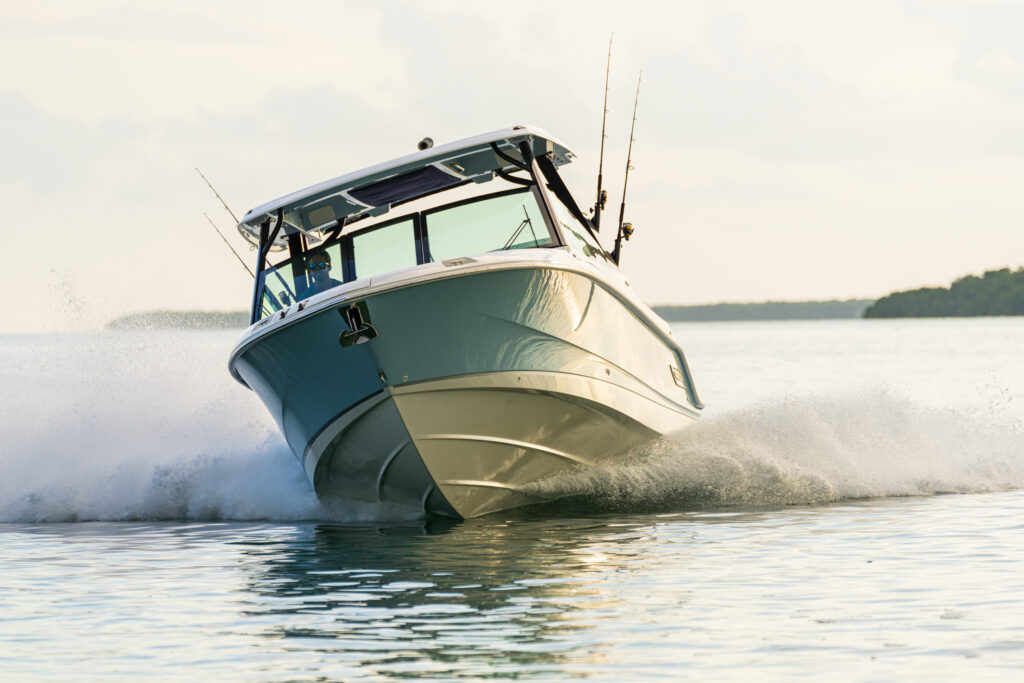
Brunswick controls a portfolio of more than 60 industry-leading brands. The company has a lot of opportunities to do a lot of things right across a lot of marine segments. From such boat brands as Boston Whaler and Sea Ray to technology from Mercury Marine and Simrad, Brunswick has the broadest portfolio serving OEMs, dealers and the aftermarket.
In the past year, Brunswick not only introduced a record number of groundbreaking products, but also earned an unprecedented number of national awards recognizing its efforts in diversity, mental well-being and workplace excellence. New products included the Lowrance Elite FS 10, Lowrance Ghost X, Lenco Pro Control, Attwood Latitude Evolve, Simrad NSS 4, B&G Zeus S Ultrawide, RELiON Elite and ProMariner battery combiner.
More than 100 Brunswick Boat Group product launches during this time included the Sea Ray, Boston Whaler and Princecraft brands, as well as major launches from Lowe, Lund, Crestliner, Harris and Rayglass. Mercury Racing introduced 150R and 200R V-6 outboards, in addition to Avator 75e and 110e electric outboards. There also were the new 425-hp, V-10 Verado and the performance-enhanced 350-hp V-10 Verado.
“Our innovation strategy is anchored in the ACES framework — autonomy/ assistance, connectivity, electrification and shared access — guiding our investments and product development,” the company says. “But as we evolve, we recognize that innovation isn’t always about doing more. It’s about doing what matters most. That means embracing ‘good enough’ where it counts: simplifying complexity, focusing on what truly enhances the boating experience, and delivering value without unnecessary layers or cost.”
Brunswick adds that while its ACES framework provides a foundation, the company has entered a new phase of protecting and growing the marine industry in a down market. Challenges persist with high interest rates, inflation, tariffs, supply-chain concerns and more. But where others pull back, Brunswick is pushing forward. “A recent example is Boating Intelligence, our initiative to integrate AI into products for simpler, safer, smarter and more sustainable boating,” the company says. “This includes our autonomous docking system, launched at IBEX, which transforms the most stressful aspects of boating into seamless, automated experiences.”
Brunswick’s advancements in autonomy, electrification and digital integration also continue to attract top-tier talent from the automotive, aerospace and advanced manufacturing sectors, letting the company infuse cross-industry expertise into marine innovation. In the past year, Brunswick brought in leaders and engineers from Fortune 500 companies, accelerating product development cycles and technology transfer.
Correct Craft

The motto at Correct Craft is “Making Life Better.” The company is celebrating its centennial in ways that make life better not only on the water for boaters, but also for people of all kinds through service trips.
This summer, more than 100 Correct Craft employees spent two weeks traveling to Little Mountain, S.C., the hometown of the company’s Pleasurecraft Engines subsidiary, to volunteer in the community. They partnered with the nonprofit Screaming Eagles Special Needs Athletic, working on demolition and construction as well as flooring and landscaping to help build a dedicated special-needs sports complex known as “The Nest.”
“This massive volunteer effort not only accelerated progress on the future athletic facility, but also strengthened bonds with the local community,” according to the company. “It exemplified Correct Craft’s motto of Making Life Better through service, as employees directly contributed time and labor to uplift others in PCM’s hometown.”
Goldsmith says this type of project is what made Correct Craft a standout among the EPIC Awards judges. “It’s the culture, the DNA, the way they give back and value the employees,” she says.
Of course, Correct Craft also works every day to make people’s lives better on their boats. The company launched the new pontoon brand Revel Boats in April. The premium pontoons are intended to elevate the segment with superior handling, performance, and fit and finish. The Revel Steptoon hull with RTS (Revel Tracking System) reportedly reduces drag and enhances maneuverability. Two 25-foot models — the RS25 and RS25L — made their debuts, the latter with a telescoping tower, a full windshield and a standard 300-hp engine.
Perhaps the coolest project Correct Craft worked on this year was the re-creation of a World War II storm boat. As part of the company’s centennial celebration, a volunteer team of employees led by Aaron Marohl restored the 1945 assault boat using original plans from the company archives. The effort shined a light on the way Correct Craft answered Gen. Dwight Eisenhower’s call for 400 more assault boats in just 30 days.
The rebuilt storm boat was completed in early 2025 and unveiled to the public at the Sunnyland Antique Boat Festival, where thousands of enthusiasts viewed it. The project reinforced the idea that innovation isn’t confined to new products, but also means preserving and learning from the past to inspire the future.
Volvo Penta

Volvo Penta is a leading force in hybrid and electric propulsion, as well as renewable fuels and reduced-emission technologies. Its goal is to deliver systems that are not only powerful and reliable, but also responsible, helping to ensure that waterways remain vibrant for generations to come.
All the while, the company is also leading on technological innovations such as IPS, assisted docking, joystick control and the Twin Forward Drive. In September 2024, Volvo Penta and Azimut Yachts unveiled the world’s first yacht combining Volvo Penta IPS propulsion with a fully integrated hybrid-electric system, debuting on the new Seadeck 7 at the Cannes Yachting Festival. The system pairs twin D13 IPS1350 drives with a 160-kW electric motor and batteries, enabling silent cruising up to 11 knots, zero-emissions anchoring for up to 12 hours, and seamless transitions between electric, diesel or hybrid modes — with no generator required.
That’s in addition to features such as Joystick Docking in electric mode, integration with Volvo Penta’s Electronic Vessel Control, and compatibility with battery and propulsion technology that helps reduce carbon-dioxide emissions by up to 40% compared with conventional yachts of similar size, according to the company. Delivery of the Volvo Penta D13 IPS hybrid-electric package began this year, too, with the system available for boats and commercial vessels.
At the same time, in the water-sports market, Volvo Penta unveiled Joystick Surfing at IBEX in 2024. The company partnered with Chris-Craft to install the tech on a Launch 35 GT. Joystick Surfing is an evolution of Volvo Penta’s Joystick Driving feature, tailored for wakeboats equipped with Twin Forward Drive propulsion. Integrated with the Watersports Control display in Surf Mode, the system lets boaters control steering, throttle and gear with a single joystick while towing riders. This technology, Volvo Penta says, significantly simplifies the wake-sports experience. It enables precise, single-handed control at lower speeds for surfing, and the flexibility to cruise with conventional throttle and gear control at higher speeds.
And Volvo Penta made its assisted docking feature available to more boaters as of October 2024. The company expanded availability to DPI Aquamatic sterndrive boats, giving those owners a way to compensate for wind and current in close-quarters situations.
“Volvo Penta is pushing innovation,” Goldsmith says. “Its special projects the past few years have included Sanlorenzo and Siemens, with fuel cells that are super-interesting. This company is pushing innovation in a way that has great culture attached to it.”
Sharrow Marine
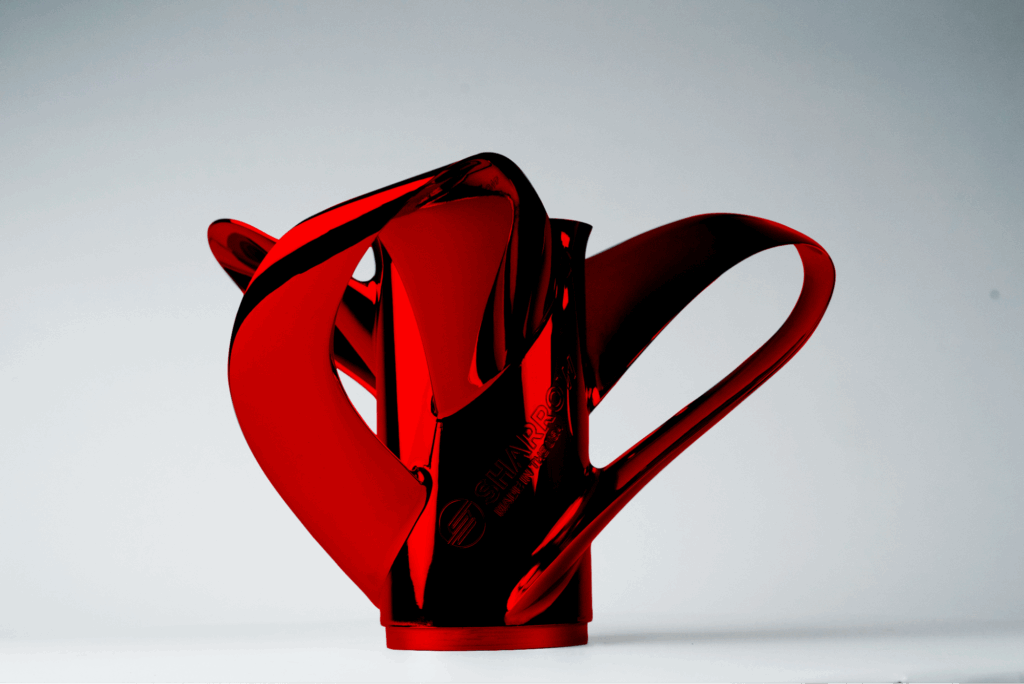
Sharrow Marine is refining the definition of propellers. That’s a heck of a thing to achieve, with Greg Sharrow’s eponymous company producing the first major advancement in propeller design since the 1830s. The Sharrow prop eliminates tip cavitation and vortices to deliver up to 30% greater fuel efficiency, 80% less noise, smoother handling and reduced environmental impact, according to the company.
The technological advances are possible because of proprietary software that determines the optimal geometry for each Sharrow propeller. The company also has a four-stage production process that’s designed to yield a propeller that’s more than 10 times more blueprint-accurate than the industry standard.
The MX-A is Sharrow’s first aluminum prop, machined from billet alloy on five-axis CNC routers — reportedly an industry first — and fully anodized for corrosion protection. It’s designed for use with engines from 40 to 200 hp, expanding Sharrow’s offerings to smaller boats.
Sharrow’s patented loop-blade technology had been available primarily in stainless-steel models for larger engines. This technology is trickling down and becoming more available to the greater boating community. And Sharrow is working with partners in other ways. For instance, it is an approved supplier through ADS, a company that facilitates rapid procurement by U.S. military branches, including the Navy and Coast Guard.
Sharrow also partners with Anduril, with Sharrow props integrated into Anduril’s autonomous undersea vehicles and munitions-grade torpedoes. The partnership puts Sharrow products into complex, GPS-denied underwater environments, enabling next-generation defense systems with enhanced autonomy, performance and cost-effectiveness.
The Sharrow team is achieving all of this from locations that include a new manufacturing facility at Eastland Commerce Center, a 60,000-square-foot space that triples its manufacturing footprint in the Detroit area. A new R&D division, Sharrow Labs, is based at Michigan Central — an innovation hub in Detroit — with a focus on extending technology into aerospace, defense and energy applications. The move formalizes the company’s long-term investment in American innovation and deepens its commitment to the revitalization of Detroit.
“By continuing to challenge outdated assumptions in marine propulsion,” the company says, “we are not only helping boaters enjoy a better experience — we are reshaping how the entire industry moves forward.”
Boatyard
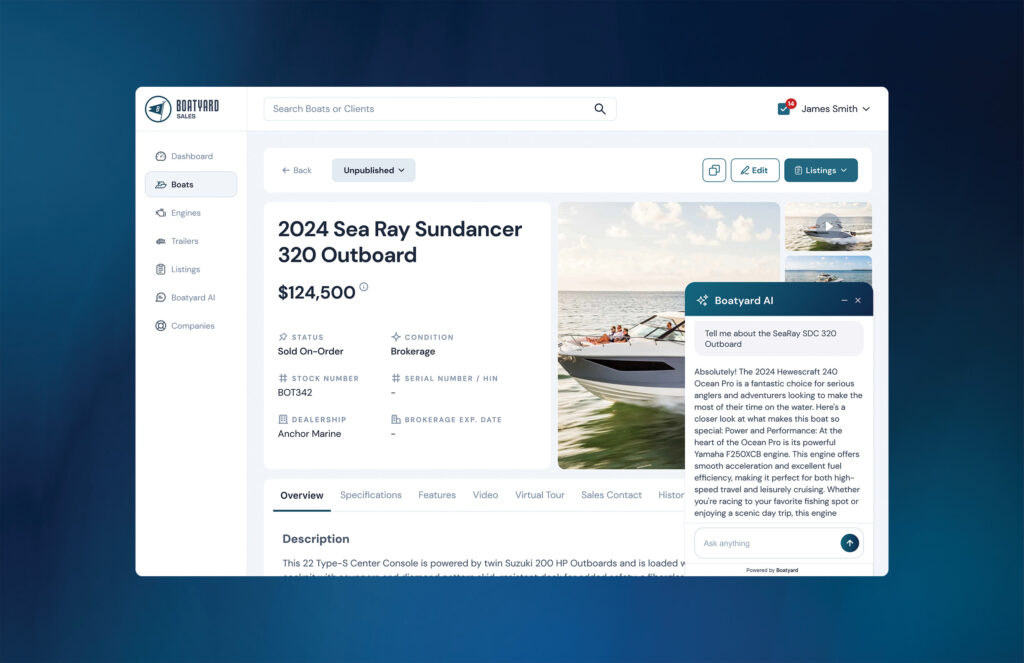
Boatyard produces service and sales software. According to Boatyard, some $400 million in service work has been logged by companies as big as MarineMax. And the software keeps improving: In the past year, Boatyard has released 108 new features or major updates, averaging nine per month.
The pace of rolling out improvements, Boatyard says, places the company in the DORA “high performer” band. DORA measures such core factors as deployment frequency, lead time for changes, change failure rate and mean time to restore. Roughly 25% of software teams worldwide achieve placement in the high performer band, Boatyard says.
Among Boatyard’s 108 new features and updates, five stand out. The first is AI-powered digital inspection reports. This is a custom, guided inspection process in the Boatyard Pro app that include photo and video documentation. With one click, AI summarizes the boat’s overall condition and transforms technician notes into a professionally designed, digital report for the owner. Customers can instantly add recommended repairs to their work order, driving a reported 13% higher average order value without the service team having to do any additional work or upselling.
Second is AI-powered inventory management. Boatyard for Sales is a boat, engine and trailer inventory management system designed to help sales teams respond faster, track leads and focus on high-impact opportunities. A built-in AI assistant adds inventory data, and analyzes product mix and listing performance, to help dealerships sell more boats and sell them faster.
Third is AI sales assistants. These always-on AI assistants can engage dealer website visitors in a friendly, approachable way, turning browsers into qualified leads. Boaters can get real-time answers to questions and be guided to boats and services that match their needs, while dealers gain insight into buyer preferences and decision factors. This feature is included with Boatyard’s custom websites, without added cost or workload.
Fourth is AI parts lookup integration, which aggregates live cost, manufacturer’s suggested retail price and inventory data from more than 180 vendors into one view. It instantly updates prices, calculates margins and adds parts to work orders so service advisers can make informed, immediate sourcing decisions that protect margins and ensure reliability.
And fifth is job activity feeds, which bring the energy of social media and Slack into the service department. Team members can tag one another in real-time updates about service jobs, ensuring the right people are instantly informed of important changes.
Tiara Yachts
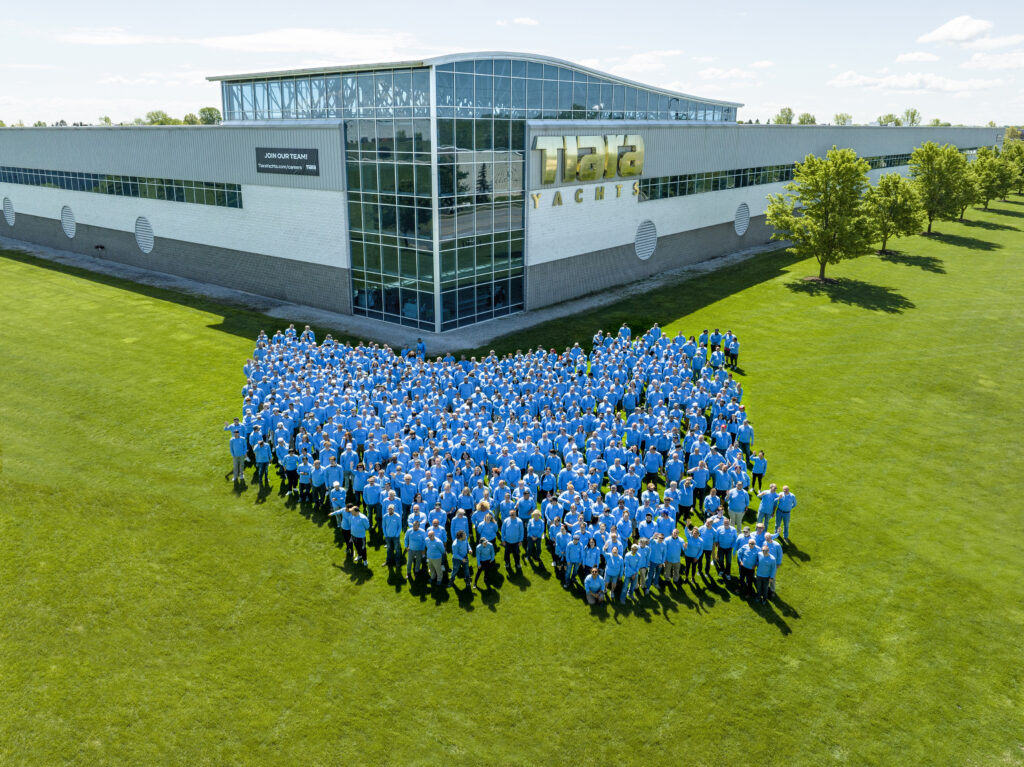
Tiara is moving “future-forward” by transitioning to closed molding for all composite parts and implementing an automated “cut and grind” process. PHOTO COURTESY TIARA YACHTS
Tiara Yachts has had a good year when it comes to introducing and improving on manufacturing processes and design. “They went future-forward in the past year in the way they’re manufacturing their boats,” Goldsmith says. “It’s like they bought a 1970s house and rehabbed it as a smart house.”
Tiara is transitioning to 100% closed molding for all composite parts, including large structural components and smaller elements. This includes the use of the vacuum infusion and light resin transfer modeling. Currently, 100% of Tiara hulls, decks, structural grids and hardtops are infused. Seven of the 11 current models have 100% of their composite parts close-molded. All new product introductions are designed with this commitment in place from the start.
Tiara also implemented an automated “cut and grind” process. It’s a system that includes five CNC/robotic work centers to automate what previously was a labor-intensive process. The new system processes 80% of Tiara’s current product line. It’s integrated with automated storage and retrieval systems for part fixtures, utilizing a barcode system.
The builder also has an on-site 3D-printing department with expanded capabilities that include 15 filament printers and three resin printers, producing more than 50 unique parts. “This technology is leveraged to create robust, elegant and space-optimizing components like armrests and HVAC plenums, which were previously constrained by traditional manufacturing methods,” the company says.
There’s also what Tiara calls “super unit” interior construction, where the entire yacht interior, referred to as the super unit, is constructed outside the hull. This method incorporates an automated storage system for CNC equipment, and a precise tab-and-slot system for assembly. It allows for pretesting of all electrical, plumbing and mechanical systems before the unit is installed in the hull.
“We empower our engineers and team members to be creative problem-solvers,” the company says. “When off-the-shelf products do not meet our exacting standards, our policy is to create them. The expansion of our 3D printing capabilities is a prime example of this philosophy. Seeing the potential of the technology, our engineers quickly moved to apply it to key product families, which were previously limited by traditional design and manufacturing constraints.”
The closed-molding process also represents a significant advancement for the industry, Tiara says. It promotes cleaner, safer and more efficient production with reduced styrene emissions, contributing to a healthier environment in and out of the plant.
American Boat & Yacht Council
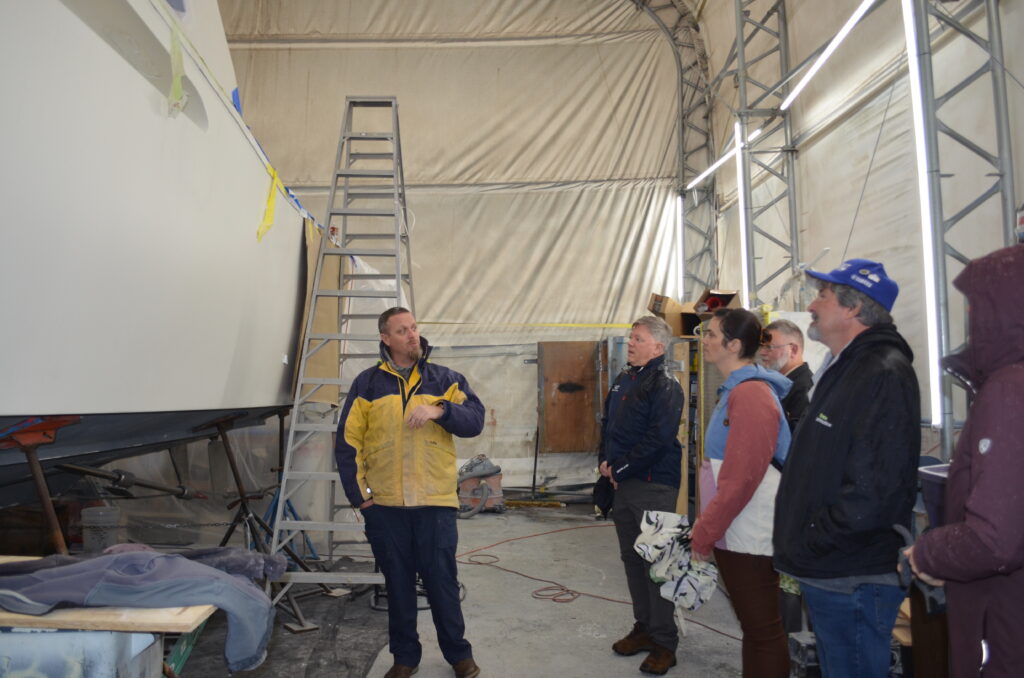
The American Boat & Yacht Council aims to be the essential source of technical information for the international marine industry. Its team develops product safety standards, credentialing, education, training and other tools to equip ABYC members to be successful and make boating safer.
In the past year, the ABYC’s online forums have brought together marine educators to discuss challenges, updates and techniques in a candid way. Topics have included a roundtable with the top four outboard manufacturers (Yamaha, Mercury, Suzuki and Honda) so they could hear from these educators; a session with the president of SkillsUSA; hands-on advice; how to communicate effectively with an industry Program Advisory Committee; and how to set up a school shop.
Also in the past year, ABYC introduced a Marine Trades School Directory, which is the only such directory available to the public. It’s online, and marine schools are invited to post information for free.
ABYC also launched monthly webinars in the past year. These are free for members and $49 for non-members, and they cover such topics as corrosion, composite repair for service technicians, and insurance. Also online is ABYC Summer School, which launched this year on YouTube. It’s built around weekly, free, 20-minute training snippets pulled from longer courses on topics that include wiring terminations and basic electrical components.
There’s also the Marine Trades Accreditation Program. Since August 2024, MTAP — the only accreditation of its kind for marine technology programs at secondary and post-secondary schools — has accredited four schools, including a high school. “The ABYC is developing curriculums for others, filling a dire need within the industry,” Goldsmith says. “There was a deficit of 31,000 technicians, and the ABYC is building curriculums with trade schools and other schools to mainstream marine-tech curriculum where it didn’t necessarily used to be.”
The concepts for these kinds of programs come from the open-door policy that ABYC maintains when it comes to new ideas and making decisions. “As an organization, all team members have a voice, assuring that the various departments work together to maintain a high level of training and workforce development while cultivating an environment of open communication,” ABYC says.
The results speak for themselves, with 300 to 850 registrants for monthly member webinars, about 2,000 views overall for the Summer School Series, about 60 schools now in the Marine Trades School Directory, and nearly 100 educators and members of the trades participating in the educator forums.
Scout Boats
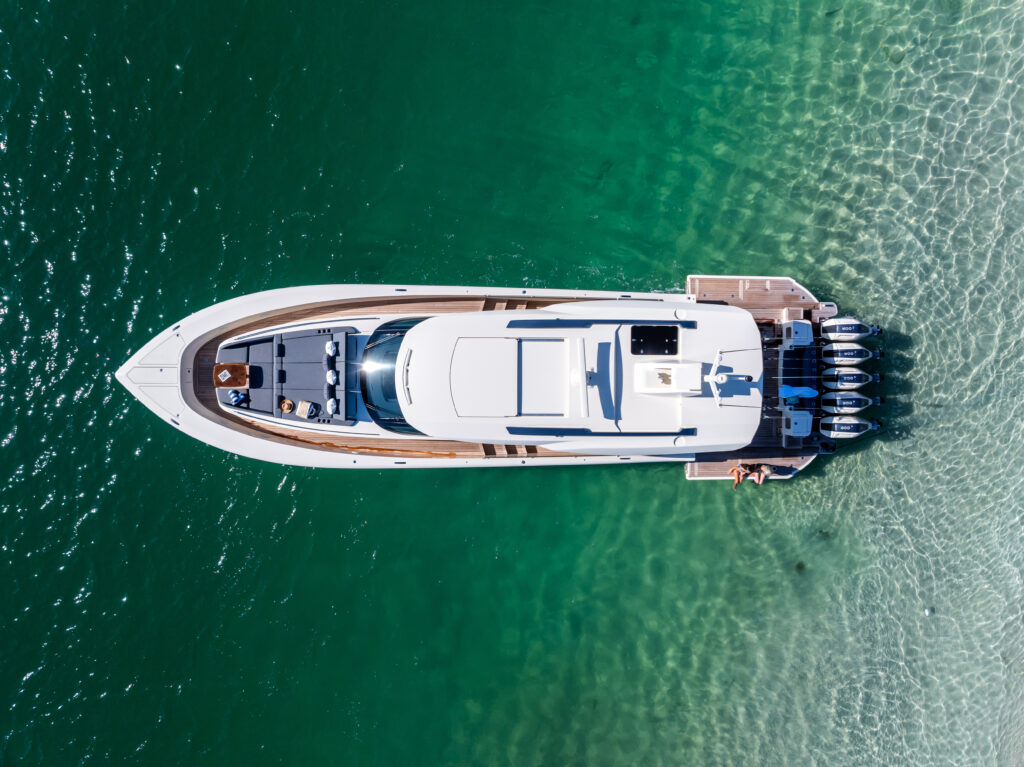
Scout Boats this year decided to go big or go home. The builder’s boats now range from 17 to 67 feet, with the introduction of the world’s largest outboard model, the 670 LXS. “They built a 67. Think about what that takes from a systems standpoint and a manufacturing standpoint,” Goldsmith says. “It’s a complex shift that changed the history of the industry. They created a category that nobody had ever done before.”
Scout unveiled the 670 LXS in January at an invitation-only event, with the public premiere at the Palm Beach International Boat Show. The model, known as Project Everest within the company, is produced with epoxy infusion, carbon fiber and e-glass.
The team at Scout could’ve said introducing the 670 was enough for one year, but it was simultaneously developing additional new models to bolster the lineup. Scout introduced a 400 LXF lithium-ion model that eliminates the need for a generator; a 261 XSS bay boat and 288 LXF center console; and a 188 Sportfish center console.
Scout also premiered an additional three models during its dealer meeting in September: a 188 Sport Dorado dual console, 220 XSF center console and 220 Dorado dual console. Including the 670 LXS, that’s eight new models in the past 12 to 13 months. They’re all designed to appeal to what Scout sees as a much savvier customer than in years past.
“The industry has suffered over the decades because of its inherent perception of lack of innovations brought to the marketplace, compared to the automotive and aerospace industries,” the company says. “The customer wants to find the same conveniences they have in their vehicles and at home in their new-boat purchase.”
Innovations, to Scout’s way of thinking, can only improve the industry, spurring competition that is crucial to moving forward. “Our entire company is built on the importance of innovation — in our models, in our processes and how we manage our team,” the company says. “Being first-to-market with countless industry-changing innovations has been something we’ve garnered a reputation for, and one we’re proud of. When we introduce a new model, we frequently have competitors in our booth reviewing what we’ve introduced, and then we see these innovations make their way into their designs shortly after. We’re trendsetting, and we have no plans to slow that down.”
Suzuki Marine
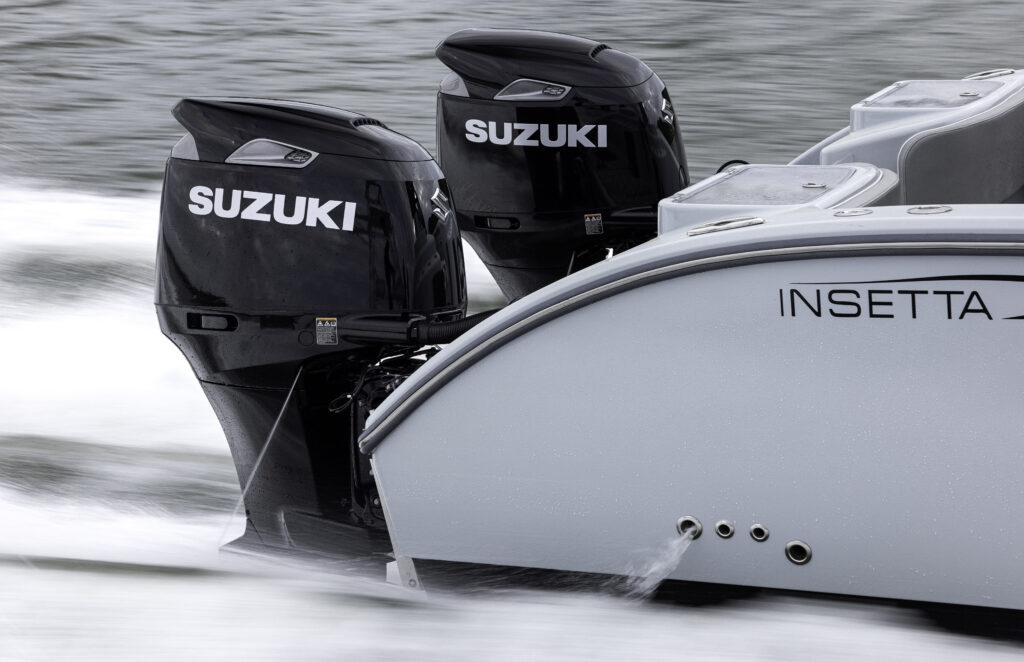
Suzuki launched the global Clean Ocean Project in 2020 and continues to expand it year after year. As technology and ideas evolve to eliminate waste — especially single-use plastics — in everything from daily business operations to the packaging and shipping of products, Suzuki is responding with new additions to the environmental project.
“Every choice we face is an opportunity to improve how we’ve done it before and do something better for the environment,” says vice president of sales and marketing Brandon Cerka. “In this way, the Clean Ocean Project has made Suzuki a better company. Clean Ocean Project will never be completed or be good enough, because we are always looking for ways to do more.”
The Clean Ocean Project includes such technological innovations as the micro-plastic collecting device. A Suzuki exclusive, it’s installed in the cooling systems of all versions of the 115- and 140-hp outboards — with plans to expand the technology to additional engines.
Suzuki is also reducing waste and increasing sustainability by using plant-based alternatives to plastic packing foam and plastic sheeting; using bamboo crates and packaging straps instead of plastic; choosing plant-based inks and recycled materials wherever possible in day-to-day operations; and using paper for the shipping and packaging of parts.
The way people work at Suzuki also embodies the company’s leadership in sustainability. Plastic water bottles are banned at all facilities, with employees receiving alternative paper-carton waters. Suzuki also stocks alternative water containers for distribution at boat shows and events, and works with subsidiaries and distributors to make sure they follow the same sustainability directives as it does.
Suzuki teams also take to the beaches and other waterways after major events, such as the International BoatBuilders’ Exhibition and Conference, the Fort Lauderdale International Boat Show and the Miami International Boat Show, to organize coastal cleanups. And the company organizes cleanups with big-league partners, including the National Football League’s Tampa Bay Buccaneers. Partnering with Major League Fishing, Team Suzuki and Suzuki-sponsored pro anglers held a Clean Ocean Project cleanup along the shores of Lake Guntersville, Ala., during bass fishing’s National Championship.
Cerka deserves a shoutout for being the face of the company at key Clean Ocean Project events. He is the driving force behind Suzuki’s push for sustainability in all aspects of business.
CATEGORY WINNERS
Development and Technology: Dometic
Dometic’s DG3 gyro stabilizer “delivers levels of energy efficiency never seen before in any gyro stabilizer system — a very important thing given the energy demands on today’s tech-laden boats.”
Work Culture: Garmin
Garmin invests heavily in its future workforce. In 2025, the company hired more than 330 summer interns spanning 17 U.S. locations so students could gain experience and perhaps choose Garmin when they start their careers.
Altruism: Correct Craft
Correct Craft says many of the participants in its annual service trips describe the experience as “life-changing,” with one saying it was “the best week of my life.” That kind of experience often translates into a desire to stay with the company long term.
Manufacturing Process: Tiara
The automation of Tiara’s “cut and grind” system addresses a longstanding challenge for a labor-intensive process. With a tightening labor market and a commitment to employee safety, Tiara took on this challenge and succeeded.
Development and Technology: Scout
Consumers have responded to Scout’s advancements with the outboard-powered 670 in droves, with more than 55,000 people tuning in to a livestream of the VIP unveiling, and a later posted video generating 27.1 million engagements.
Sustainability: Suzuki
Jason Stimmel, head of Suzuki’s U.S. Technical Center in Panama City, Fla., has played a key role working with the NMMA to promote sustainable fuels and support the long-range goal of decarbonizing the boating industry.
Training: AkzoNobel
AkzoNobel’s virtual-reality system helped save gallons and gallons of paint while training technicians to achieve better results. “Watching paint dry is boring,” Goldsmith says. “They made it interesting.”
Training (honorable mention):
ABYC
ABYC’s training and education initiatives help students review schools, give graduating students the skills they need to build a boating career, and provide the industry with easy, affordable access to continuing education.
HONORABLE MENTION
Groupe Beneteau

Groupe Beneteau had a staggering 19 new models and 14 world premieres at September’s Cannes Yachting Festival, making it one of the biggest players at Europe’s biggest boat show. And if that sounds like a lot, the company is planning for 66 models by 2027 — 50% more than the previous development cycle. “Their volume of production, the amount of innovations and debuts, that’s what the judges responded to,” Goldsmith says.
Building at Groupe Beneteau’s volume also allows synergies that can reduce costs across brands. The company sees this as improving accessibility to boating through price, but without compromising quality or innovation. Five of this year’s new models — the Sun Odyssey 415, Oceanis 47, Oceanis 52, Lagoon 38 and Trawler 37 — are being offered at 10% to 15% less than their predecessors.
“Our mission is clear — to focus on what we call the right proposition for every customer: meaningful boating,” says CEO Gianguido Girotti. “It means designing and innovating for the right willingness to pay. It means making boating accessible to as many people as possible without compromising on quality.
“But the right proposition for each client is not limited to price,” he adds. “It is also about creating real value for our customers, designing experiences that matter, and integrating sustainability at the heart of everything we do.”
To that end, this year’s debuts include the Sealoft range for the Jeanneau brand. The premiere model is the Sealoft 480, which is designed as a floating loft. It has modular living spaces that promote circulation, simplified maneuvers and a 30% to 50% reduction in carbon-dioxide emissions compared with conventional boats, according to Groupe Beneteau.
All of that innovation and new-product rollout is happening despite the continually challenging economic headwinds that that are plaguing much of the marine industry worldwide. Groupe Beneteau has not been immune to the downturn; its boat division reported revenues of €1.03 billion ($1.2 billion) in 2024, down 29.4% compared with 2023. Dealers reduced stock levels, contributing to about 23% of the business decrease.
Even so, Beneteau maintained its collaborative environment where teams across design, engineering and manufacturing work together. The company’s innovation culture places a strong emphasis on meeting customer needs, a deep commitment to environmental responsibility, and the strategic adoption of technologies to improve efficiency, product quality and the overall boating experience.
Wavve
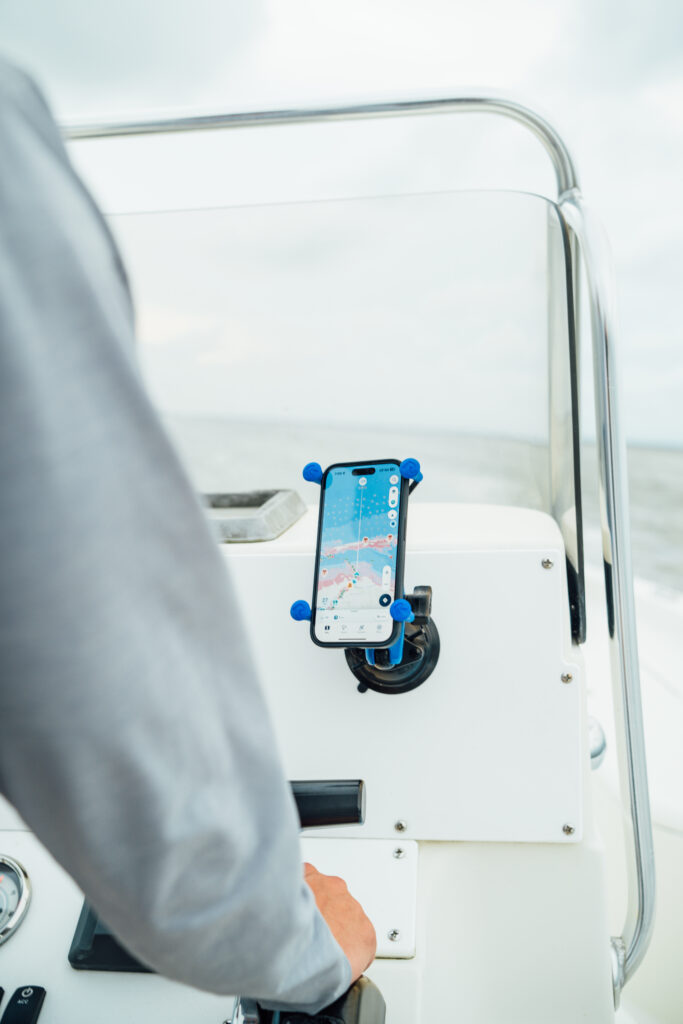
Wavve is a Canadian tech company with just nine employees. In the past year, key updates to the Wavve app include smarter auto-routing, real-time no-wake zone alerts, a refreshed point-of-interest discovery feature, and the launch of a web-based chart viewer.
The company says its most impactful advancement in the past year is Dynamic Depths, a charting tool that provides real-time and forecasted water-level intelligence directly on a mobile device. By connecting to more than 5,700 tidal and water-level stations across North America, the tool dynamically adjusts charted depths to reflect actual conditions, helping boaters navigate shallow or unfamiliar waters safely, even with the impact of tides, seasonal changes or environmental fluctuations.
The tech is advancing within a culture of innovation. Wavve’s decision-making processes are grounded in boater feedback gathered through interviews, behavioral data and the on-water experience. Dynamic Depths, as an example, was born out of insights from Freedom Boat Club training captains, who highlighted how confusing traditional tide tables can be for new boaters. By combining this field research with internal design, development and data expertise, Wavve created a solution that is intuitive and technically robust.
“As part of a continued effort to keep ideas flowing, we run an annual companywide hackathon where engineers, designers and marketers sprint for two days to build and pitch new product features or internal tools,” the company says. “Some of our most impactful innovations have come out of those sessions. It’s a little chaotic, often hilarious and consistently productive — a great reflection of how Wavve blends creativity, data and execution to move boating forward.”
Dynamic Depths may help with groundings that Wavve notes account for 12% of TowBoatUS emergency assistance calls annually. Combined with enhanced auto-routing and no-wake zone alerts, Wavve can simplify trip planning and make boating more approachable for first-timers.
“The real-world impact is substantial,” the company says. “Smarter navigation reduces costly damage, such as the estimated 2.5 million propellers replaced each year in the U.S. due to underwater strikes. More importantly, it builds confidence. Wavve users take an average of six trips per month, which is twice the national average reported by the Recreational Boating and Fishing Foundation. This increased activity drives measurable value across the marine industry, including marinas, fuel docks, marine service providers and OEMs.
“At a time when the industry faces serious retention challenges — such as the reported 42% churn rate among first-time boaters within five years — Wavve’s intuitive, data-driven tools help reverse that trend,” the company adds.
Roswell Marine
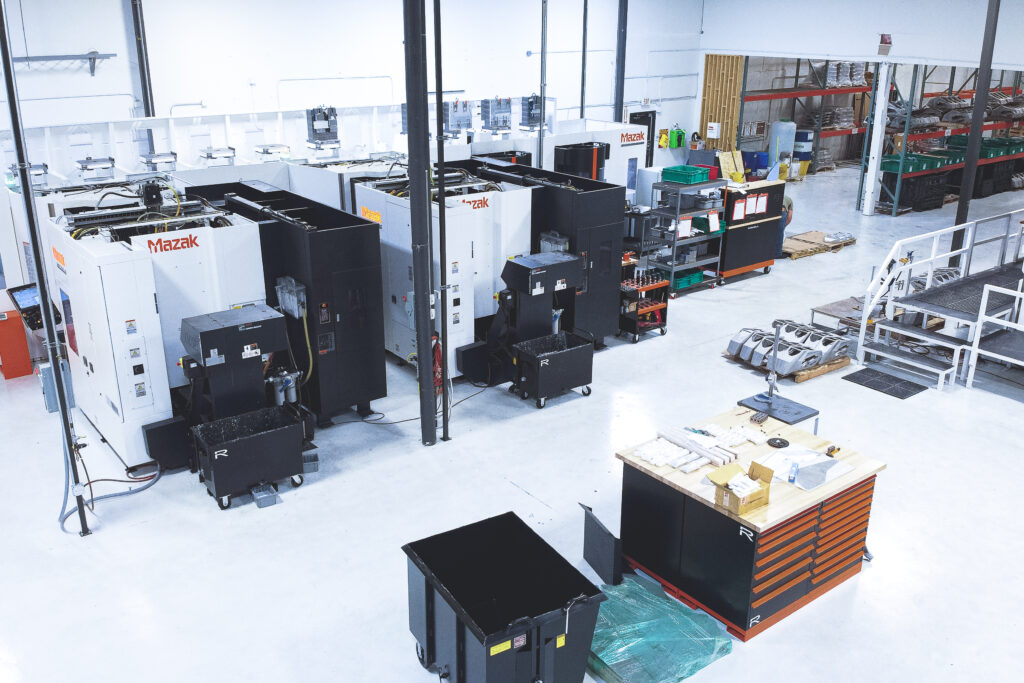
Roswell Marine has spent 25 years bringing new ideas and technology to market. “While navigating uncharted territory is never easy,” says founder and CEO Robert Oswell, “it’s a part of who we are, and the result is always worth it.”
In the past year, Roswell’s team rolled out a half-dozen notable product innovations. The Triton Foil Rack is a storage solution for performance foil boards, addressing weight, leverage and shape challenges. The Nautique Foil Rack is an OEM-specific adaptation of the storage technology. The Revel Pontoon telescoping tower and Bimini expands the company’s telescoping technology into the pontoon segment. Custom audio solutions for Alera pontoons are tailored for the newly launched brand, while custom audio packages for Forest River Marine are integrated across Trifecta, South Bay and Berkshire pontoons. Roswell also expanded accessories and branded lifestyle products that diversify the company’s direct-to-consumer offerings.
Roswell Marine also had a number of manufacturing and operational innovations in the past year. It brought its facility fully online in Merritt Island, Fla., enhancing warehousing, fulfillment, customer service and audio production. The company also expanded its Rockledge, Fla., headquarters, and adopted new machining, paint and fabrication equipment and processes to improve quality, efficiency and capability.
All of this stems from a philosophy that is rooted in challenging the status quo about how boats work, and the experiences that boaters have on the water. “This mindset has led us to develop a robust process for vetting and refining ideas, where concepts are rigorously tested against real-world conditions before they ever reach the market,” the company says. “Our cross-functional teams work closely together, blending insights from design, engineering and manufacturing to ensure that our innovations are not only groundbreaking, but also practical and reliable.”
The company also gives back. Through Roswell Reach Initiatives, the business supports charitable organizations — all while seeing cumulative lifetime sales surpass $300 million, up from $250 million a year earlier.
While equipment and other segments have seen modest global growth, Roswell says it outpaced the broader marine industry by capturing new customers in pontoon and center console markets, emphasizing differentiated innovation and customer engagement. Direct-to-consumer sales increased 27% year-over-year, thanks in part to the expansion of Roswell’s accessories and branded lifestyle product portfolio. This, the Roswell team says, underscores how brand innovation directly drives consumer engagement and revenue.
Integrated Dealer Systems
IDS Marine is a software provider that aims to empower dealerships with innovative, reliable and integrated management solutions. In the past year, IDS Marine developed business intelligence tools that give dealers access to what the company says are the most detailed, in-depth metrics available in the market.
One tool is the IDS Industry Insights Sales Dashboard. It lets dealers compare their sales performance against regional and national averages from within the IDS ecosystem. The dashboard is designed to help dealers make smarter, data-driven decisions by providing benchmarking across a range of critical sales metrics, including average financed deal structures, finance and insurance performance, average deliveries per lot, gross margin, and finance penetration.
IDS also expanded the capabilities of its Leadership Insights financial reports to include year-over-year comparisons. This allows comparison of sales and expenses across multiple years and months, broken down by individual departments, to help spot trends and highlight areas for improvement. With Goal Tracker, a company can track goals by department for the full year, to compare current performance against year-to-date goals, forecast progress against goals and make data-driven adjustments. There’s also team member reports with three new dynamic views that allow dealers to monitor progress on a monthly, weekly and daily basis.
The Key Insights Report provides a concise executive summary so stakeholders can see a high-level view of their dealership’s performance across all departments — sent to their inbox weekly for review.
With F&I Manager Review, users can evaluate finance performance, product penetration and F&I percentages over time, to spot opportunities and create accurate forecasts. The tool lets users drill down by F&I manager, location or salesperson for deeper insights.
Service Writer Review lets users monitor service department performance, including monthly sales, work order counts, repair event cycle times, labor rates and hours sold, to maximize efficiency and service revenue. Users also can access author and location for deeper insights.
“We believe dealers deserve more than just a system; they need a dedicated partner who provides transparent, expert guidance,” the company says. “To deliver on that promise, IDS Marine draws on strong ties with manufacturers, leading dealerships and industry associations; builds one-on-one client relationships; and employs a team of industry veterans who understand dealership needs. We also heavily emphasize customer education to help clients grow their software and business expertise, plan years ahead to ensure long-term stability and comfort, and provide valuable insights on industry trends and future developments.”