Each year, I look forward to late summer changing into fall. Not because of a shift in weather or because school starts again for the kids. No, for me the excitement comes from boat show and awards season.
This year, I helped judge the National Marine Electronics Association’s awards. I also chaired the National Marine Manufacturers Association’s Innovation Awards at IBEX, and I served on the jury of the DAME Design Awards at Metstrade. These three programs provide an excellent opportunity to see what the boating industry is cooking up, and what we all have to look forward to in the near future.
In a year of economic uncertainty, trade wars and a chaotic political environment, I didn’t know what to expect. Would we see fewer entries? Would the quality of the entries be as high as I’ve come to expect? The answer was that the IBEX Innovation Awards and DAME Design Awards had record-breaking numbers of entries, with quality to match.
The Innovation Awards and DAME Design Awards each consider practicality, value, environmental impact and more. Viewing the industry’s newest products through the lenses of innovation and design offers me a lot of time to reflect on what our industry produces. Naturally, I also look for trends. This year, the two major trends that struck me were the reach of artificial intelligence, and a strong showing for product refinement.
AI everywhere
The bigger and more obvious trend is the race to embrace AI, especially in autonomous vessel operations. For a half-dozen years or more, we have seen previews of autonomy in docking, congested waterways and open water. This year at IBEX, Brunswick’s Navico Group demonstrated the Simrad AutoCaptain autonomous boating system directly alongside Avikus’ Neuboat Navi with Control.

Also at IBEX, companies like Avikus, GOST, Lookout, Sea.AI and Viam all demonstrated AI image processing, but in wildly different applications. Avikus, Lookout and Sea.AI systems can identify objects around a boat and either act or alert an operator. GOST systems identify individuals on a boat and determine if their presence is a security threat.
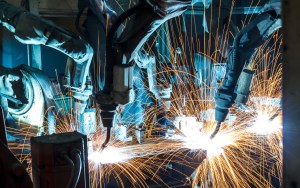
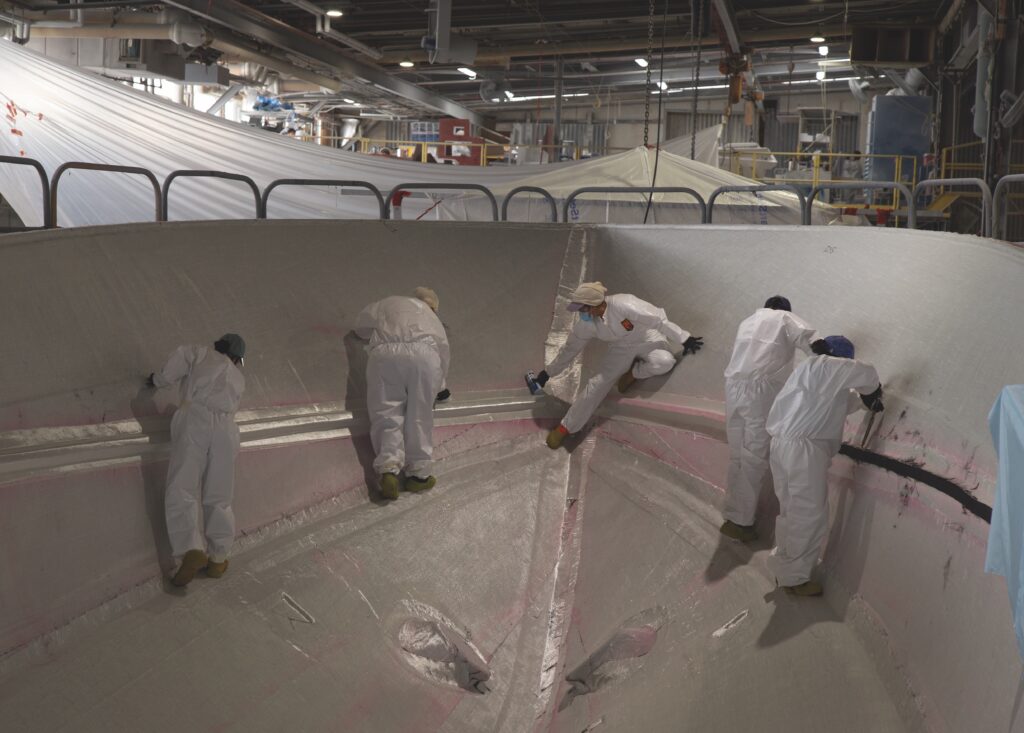
Viam is building a full robotics and AI platform with potential for many phases of boatbuilding and operations. At IBEX, in addition to using its robots to pour beverages in one of the show lounges, Viam demonstrated how the robots are already performing sanding tasks that often leave builders struggling to find skilled human labor. The demonstration at IBEX focused on Viking Yachts’ use of Viam’s system to block-sand fiberglass. Viking marks areas to be sanded with a blue coating. The system uses computer vision technology to detect the coating and sand the marked areas.
Walking the show floor, I saw AI and its impact in many more products. Digital Yacht’s NjordLink uploads data from a boat’s NMEA 2000 data to the cloud for real-time monitoring and historical analysis with AI. For the Metstrade show, Safiery planned to demonstrate a Range Master AI system that estimates the range of electric propulsion systems more accurately.
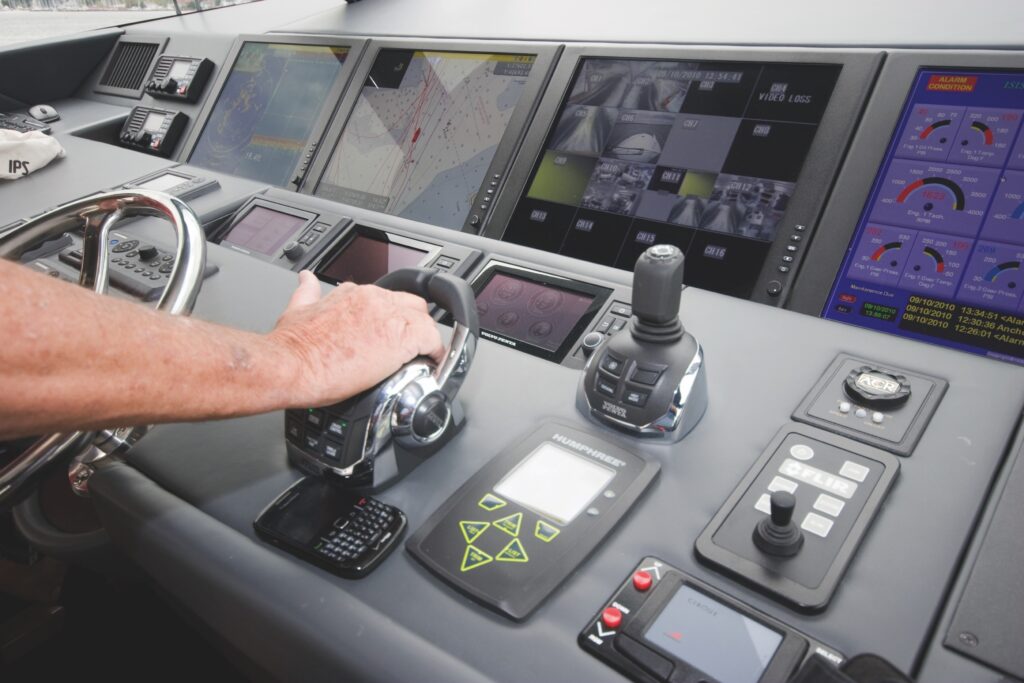
Although the highly complex systems grab attention, I believe the average boater may see more AI impact in some of the simpler systems. We are in the early stages of seeing AI’s ability to analyze and detect patterns in lots of data on our boats.
This year, Digital Yacht introduced Bilge iQ and took home the NMEA’s Best New Product Award. Bilge iQ is an intelligent monitoring system that connects float switches and bilge pumps with the NMEA 2000 network and Wi-Fi. Today, Bilge iQ notifies the skipper when a bilge pump’s operations are out of range for expected current draw or run duration. However, I think the real power of Bilge iQ could be unlocked in the future by feeding bilge pump data to AI. That data has the power to report on pump operation problems, changes in pump run time and frequency, and more. AI can learn from this data to the point that it not only can alert a boat owner to an issue, but also suggest likely causes and remedies.
Refinements Everywhere
The other overarching theme I saw this year is refinement, especially in products like snaps, hinges, heads, winches, flooring, wall coverings and more.
One of the opportunities I have while judging is to talk to the people who live and breathe these products. Don’t think for a moment that people who improve marine sanitation are any less passionate about their products than those delivering the shiniest new autonomy systems. When I realize the thought, energy and dedication that is poured into all kinds of products, it makes me appreciate things that many of us take for granted.
Each year, there is a product so simple and clever that, as judges, we are shocked no one has come up with it before. Often, it is the small, simple products that stick with me the most. Many of these products are the result of an individual’s passion to solve a problem they’ve faced. Seeing those products become a solution for our industry is one of my favorite parts of participating in these contests.
Awards programs are an opportunity not only to celebrate the latest technology, largest systems and most expensive products, but also to honor the small companies and passionate creators. So the next time you see a press release announcing the nominees, honorable and special mentions, and winners, give it more than just a glance. Give it a good read. There’s a lot of hard work and great ideas behind the news in there.