
I get tired of reading comments by commercial fisherman that recreational anglers ignore the law and overfish their share of popular species. However, an arrest by the Florida Wildlife Conservation Commission puts the shoe on the other foot.
Two commercial fishermen in Florida were jailed last week for possessing an illegal haul after a Monroe County Sheriff’s deputy stopped their van for speeding and following too closely in the Keys. As the Miami Herald’s Gwen Filosa reported, the deputy “smelled something fishy.”
Indeed, there was.
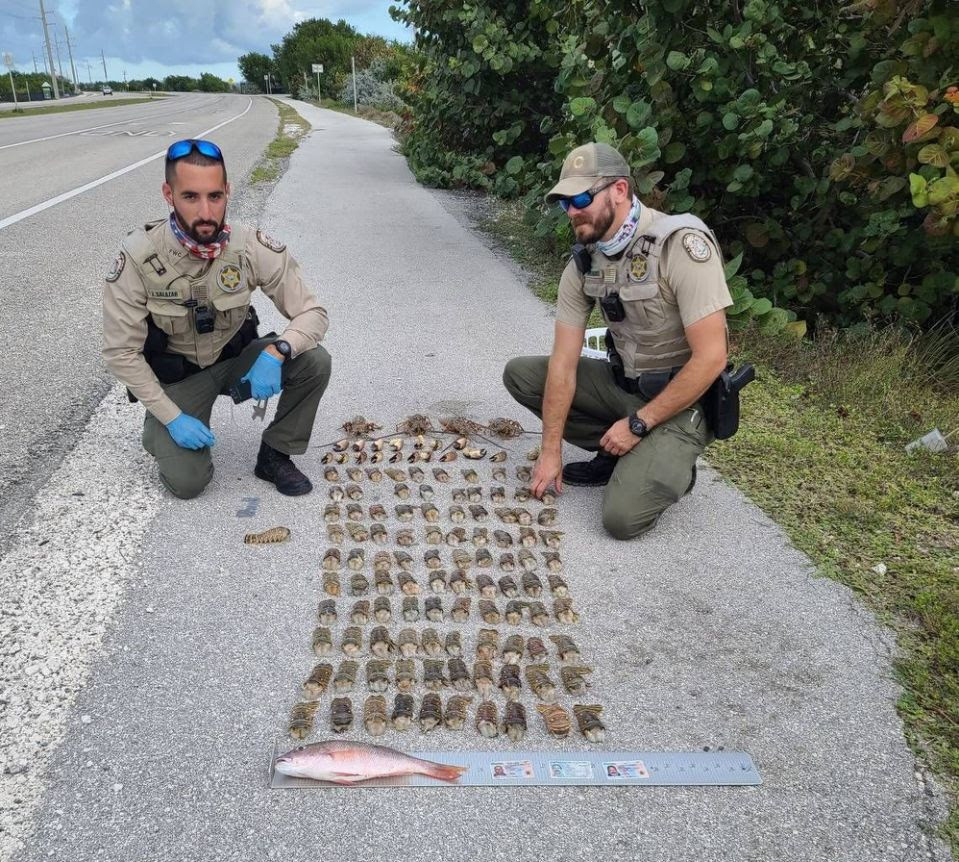
The deputy reported that he could smell fish as he approached the van and called in officers from FWC. They discovered a haul of illegal seafood that started with 100 undersized wring lobster tails.
It didn’t end there. The illegal officers also found 17 undersized stone crab claws, four undersized whole lobsters, and an undersized mutton snapper.
“Anything over 100 is a felony,” said FWC officer Bobby Dube. “This is a great bust. It’s been a while since we’ve seen numbers so high like this.”
Osvaldo Hernandez, 65, of Fort Lauderdale and Vladimir Medina Martin, 43, of Miami were charged with the felony of taking 100 or more undersized lobsters.
“The investigation is ongoing, and additional charges are pending,” Dube said.
Illegal fishing, regardless of the species, should never be tolerated, commercial or recreational. Hat’s off to the FWC.
More Good Fishing News
The National Fish and Wildlife Foundation and NOAA are doling out $4.1 million in grants to modernize fisheries data management systems and support the implementation of electronic monitoring and reporting projects in 14 states and Puerto Rico. The grants will generate $4.8 million in matching contributions for a total conservation impact of $8.9 million.
The funds are to drive innovation in fisheries monitoring, data collection and data management systems that are critical to sustainable fisheries management. They will improve the timeliness and quality of data available in fisheries and will directly benefit both the recreational and commercial anglers.
More specifically, projects supported by 16 grants are initiating flexible electronic monitoring systems in small vessel fisheries, and engaging anglers and commercial fishers through outreach on electronic technologies. The grants also support the large-scale implementation of electronic monitoring. Data collection efforts are being enhanced in federal and state fisheries in Alabama, Alaska, California, Florida, Maine, Maryland, Massachusetts, New Hampshire, New York, Oregon, Rhode Island, Texas, Virginia, Washington and Puerto Rico.
For recreational fishing interests, programs like this will lead to more accurate, expanded and timely management decisions regarding fisheries improvement and management, something our marine industry has long been calling for. And that’s good for our angling customers.