
Yamaha is working toward having the first hydrogen-powered outboard for recreational boats. The company unveiled a prototype based on the belief that if the industry is to achieve carbon neutrality, batteries and electric propulsion are not going to be enough.
“If we continue to use combustion engines, we’re going to need to use fuels that are more sustainable in some way as we get to carbon neutral, and one of those is hydrogen,” says Martin Peters, director of external affairs for Yamaha U.S. Marine Business Unit. “Hydrogen has been around as a fuel for a really long time. It’s been used in lots of applications, and it’s something that we need to explore because it can be produced as green hydrogen. It can be fully carbon neutral, and it can be burned in an internal combustion engine, so we’re pursuing it.”
Hydrogen has more energy density than batteries and gasoline. Just 2.2 pounds of hydrogen contain as much energy as 6.2 pounds of gasoline. Hydrogen also produces 142 megajoules of energy per kilogram compared to 1.8 per kilogram in a lithium battery. Hydrogen-powered vessels can get up on plane and stay there, Peters says.
The challenge is storing and delivering the hydrogen. Yamaha worked with Roush CleanTech on a fuel system engineered to create an engine that looks physically similar to the Yamaha XTO 450. The prototype is installed on a modified Regulator 26XO center console hull that carries three tanks. Each tank holds the hydrogen equivalent of 25 gallons of gasoline, but the tanks are built differently than typical fuel tanks. They are Type-4 pressure vessels, made of carbon fiber with an inner liner to store hydrogen at a measurement equivalent to 10,000 PSI.
“It’s a pretty high-pressure system,” says Matt Van Benschoten, vice president of advanced engineering at Roush, whose history of working with hydrogen includes land-speed-record vehicles and spacecraft.
Joan Maxwell, president of Regulator Marine, says the builder participated in the prototype project because innovation starts with asking questions. “It creates a little angst, but at the end of the day good stuff comes out of innovation,” Maxwell says. “In the future, as we design boats, if this proves what we think it will, it could be very possible that we are designing hulls around these hydrogen fuel tanks.”
One of the biggest challenges with hydrogen will be designing a boat with the space to carry enough fuel to provide the range a recreational boater or angler would want. It’s similar to the uphill battle electrically powered boats face.
“Certainly, it’s less than this boat delivers with gasoline, with about a 100-gallon fuel tank, so significantly less —you’ll see the challenge there,” said Van Benschoten. “The system requires and extremely high-pressure for storage.”
It’s so much pressure in fact — 51,000 pounds of lifting force — that for many boaters, the question of the relative safety of the use of these outboards seems to be among the most pertinent. And while Yamaha reminds fairly tight lipped about the topic, it is steadfast that the safety testing that has gone into this prototype is exhaustive.
The Regulator prototype has a range of around 50 nautical miles. The team is working on extending that, along with the infrastructure needed for hydrogen refueling of recreational boats. Peters says he sees the latter challenge as part of a bigger-picture shift.
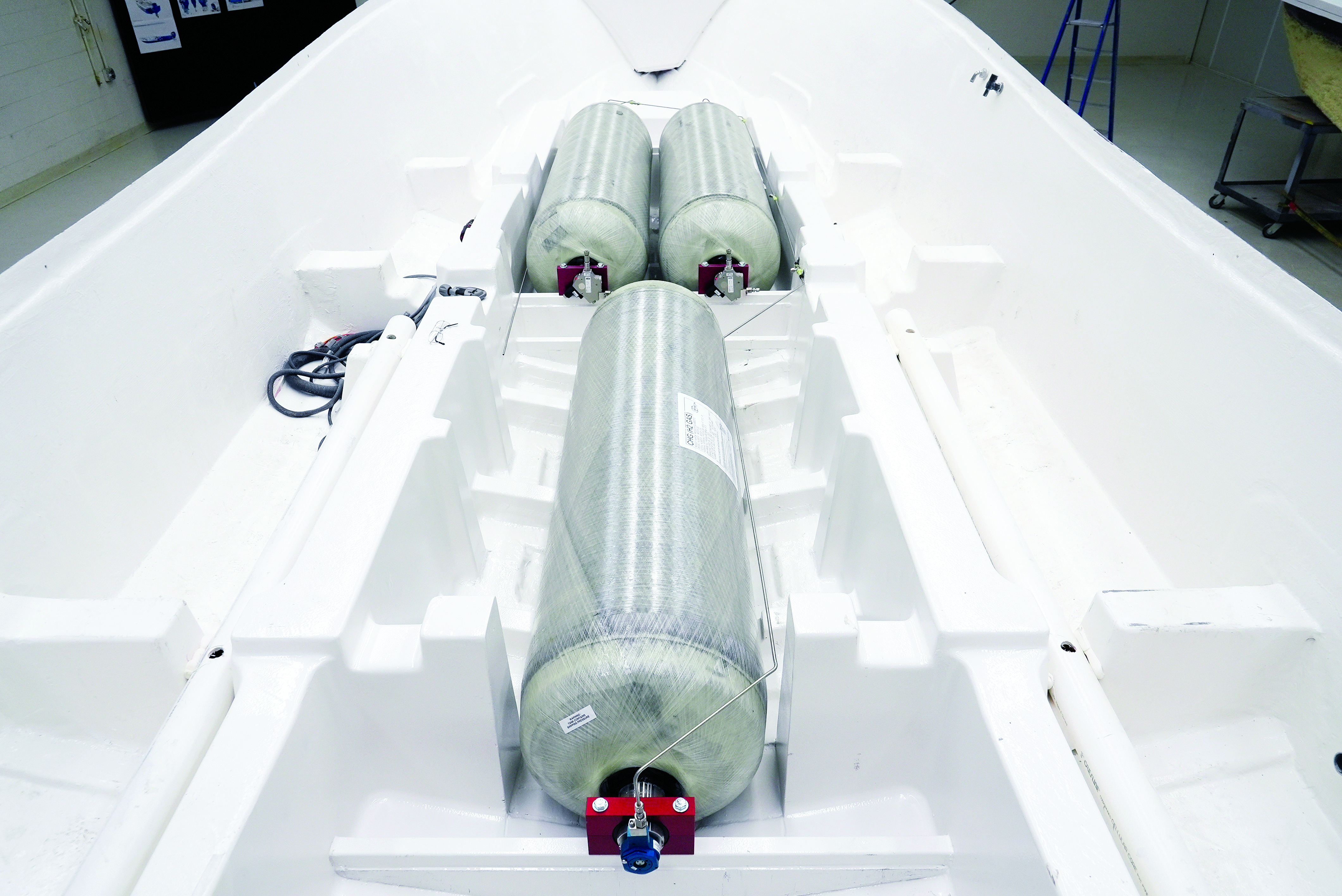 COURTESY YAMAHA
“If you think about the commercial ports for shipping goods, it’s pretty clear that they want to have hydrogen not to power large vessels, but the vehicles that haul freight in and out of those port facilities,” Peters says. “So, you get to the point where you’re not only considering the carbon created by the product you produce but also the carbon created by moving it from place to place and moving the materials and supplies that are necessary. It gets to be about decarbonizing the supply chain.”
In Europe, similar thinking is taking hold. Zaha Hadid Architects and NatPower H are two companies that are investing more than $100 million to build hydrogen boat-refueling stations at 25 Italian marinas and ports within the next six years. The first station, at the Marina Sant’Elena in Venice, was expected to open in late May or early June.
There currently are no projects underway to build hydrogen refueling stations for boats in the United States, but mobile hydrogen trailers will be available dockside for Yamaha’s testing. Peters says offshore fueling vessels are also a possibility.
Concurrently with the hydrogen research, Yamaha is moving ahead with electrification, having acquired the electric outboard company Torqeedo. Yamaha also continues to promote the use of sustainable fuels within internal combustion outboard engines.
This article was originally published in the July 2024 issue.