Bad news: The population of qualified marine technicians is aging, and younger techs are not replacing experienced ones at the same rate. Good news: Education is available, and yard owners and managers prefer to hire graduates of one of the vocational schools that train students for the marine trades. There are many such schools, especially on the East Coast, according to the American Boat & Yacht Council.
As of September 2025, ABYC had inspected and accredited 16 schools through its Marine Trades Accreditation Program. A few are private vocational schools, some are community colleges, and one is a public high school. Their curricula match the requirements and standards of the ABYC. Graduates of MTAP-accredited schools get one year’s credit toward the ABYC requirement for technician, which requires two years of work in the appropriate field. Students take exams at the school and become ABYC advisors first; once they get another year of experience, they can become certified technicians.
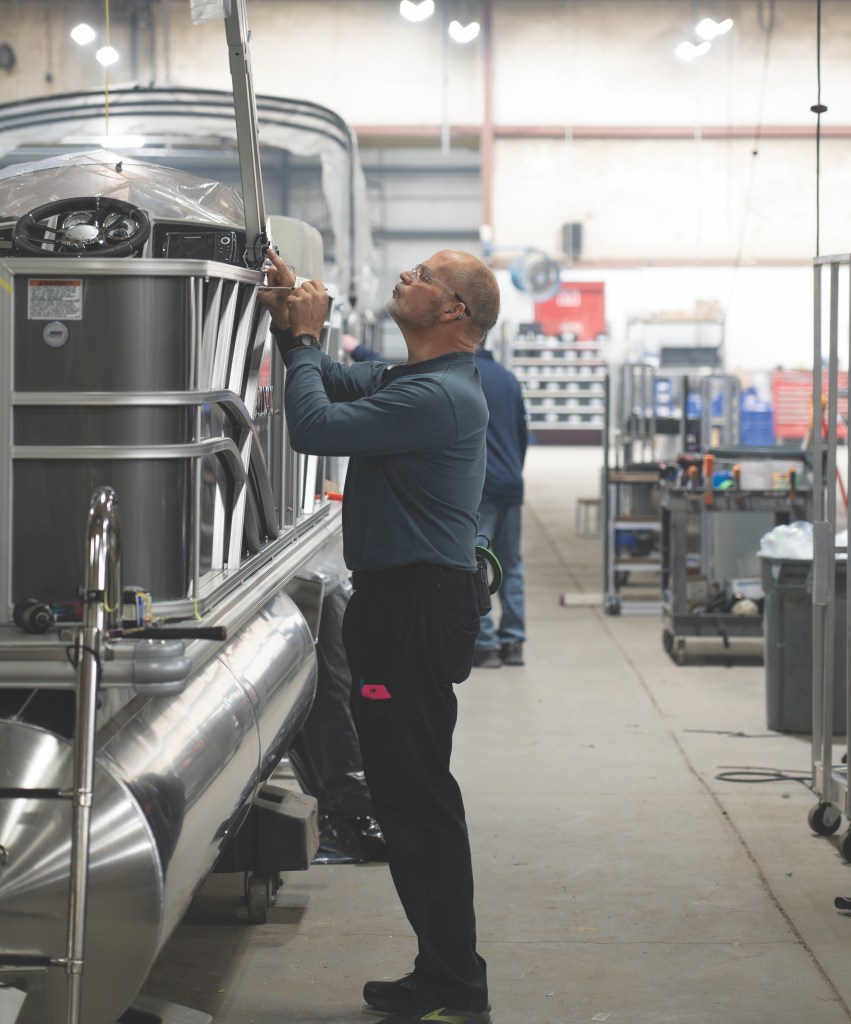
The Landing School in Arundel, Maine, is MTAP-accredited, and graduates are in high demand from boatyards all over the country. [Editor’s note: The Landing School announced its closure in May 2026, after this story went to press. See the Trade Only Today story here.] The school trains not only marine technicians, but also yacht designers and boatbuilders in wood and composites. Each program runs for one academic year, from early September to mid-May. The Marine Systems program began in 2000, and has enrolled recent high school grads, retired military veterans, career-changers and folks preparing to sail off over the horizon. Graduates have ranged from 18 to 70 years old; the average age of the 2025-26 class is 31. Four students are women.
The marine-tech course covers engines and other mechanicals, electrical systems and plumbing, taught through lectures and hands-on work. “Every year we have an assortment of project boats for the students to work on,” says Landing School senior marine systems instructor Zachary Volpicelli. “This year we’re doing a full restoration of a 1970s 21-foot Mako. Full transom, new decks, repower, paint job, et cetera. We also have a 20-foot Shamrock that struck a rock, two Tripp Angler 22s that need some wiring and engine work, and an LS 26 sailboat built by the school in the early 2000s that needs a minor refit.”
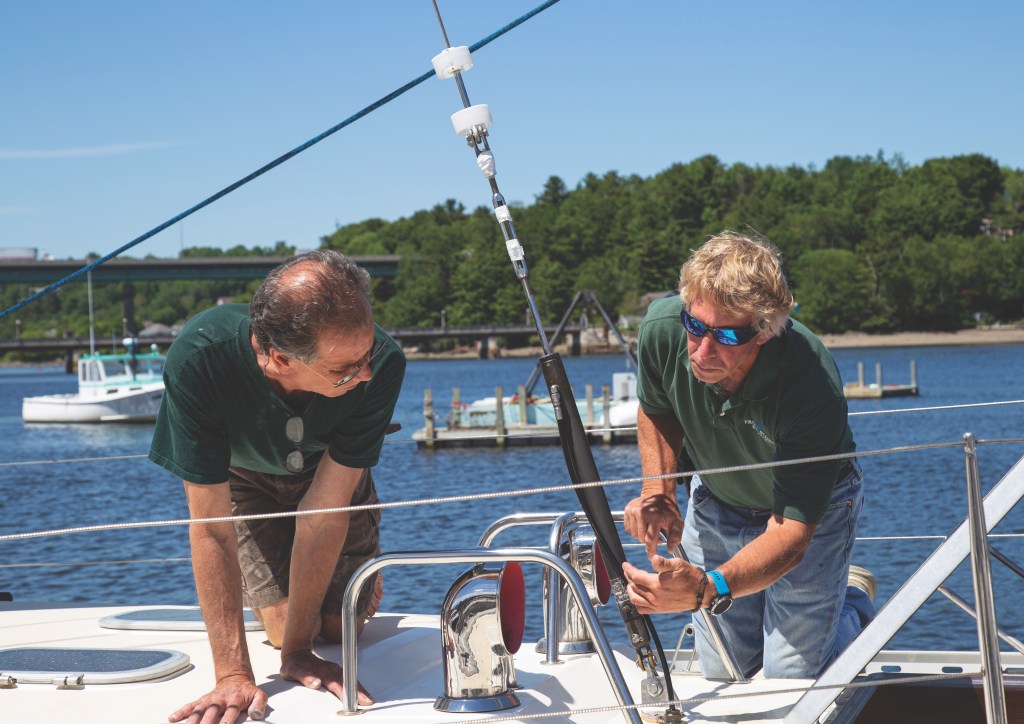
Volpicelli says the school has 100% placement for graduates, although not all of them are looking for jobs. Some have other plans. Still, he notes, “a student who wants a job will leave with a job.”
There are other MTAP-accredited schools in New England. The IYRS School of Technology and Trades in Newport, R.I., started out in 1993 as a yacht-restoration school, adding a Marine Systems program in 2006. IYRS developed its curriculum in partnership with the ABYC. The school has since added programs in Composites Technology and in Digital Modeling and Fabrication. Classes last six months, with admissions in September and March.
High school students in New Bedford, Dartmouth or Fairhaven, Mass., can apply to the Marine Technology program at the Greater New Bedford Regional Vocational Technical High School. It’s a four-year course providing education in all areas of marine maintenance and technology, along with some boat handling and business management. Graduating students will have several ABYC and other certifications, and be ready to pursue a job or go on to further education. As of September 2025, this school is the only high school with MTAP accreditation.
Out West
Skagit Valley College in Mount Vernon, Wash., is in the heart of Pacific Northwest boating country. The Marine Maintenance Technology program focuses on mechanics and electrical systems, and offers a one-year certificate in either area, or an Associate of Applied Science degree for students who study both areas over two academic years. Students completing the course earn credentials with the ABYC, the National Marine Electronics Association, the Occupational Safety and Health Administration and the Environmental Protection Agency, as well as a Washington state license to drive a forklift. That program began in 1968.
“We typically matriculate about 30 new students each year, and graduate 20 to 30 each year with either a degree or certificate,” says Matt Mardesich, co-department chair of marine maintenance technology and an instructor in engines and mechanical systems. “Roughly half of our students are from Skagit County, while the rest come from across the region, out of state and even from abroad. We’ve welcomed students from Canada, Japan, Korea, India, Russia, Ukraine, Mexico and elsewhere.”
Mardesich adds that while some students enroll to learn to work on their own boats, others have little interest in boats at all. They want to work on campers, RVs and other off-grid systems, which are similar in many ways to marine systems. “RV repair shops frequently reach out to us looking for trained workers,” he says.
Skagit Valley College’s Marine Technology graduates are also able to find jobs, usually right away. “Many local marine service businesses rely on our graduates as their top technicians,” Mardesich says. “Other graduates find work elsewhere in the Pacific Northwest, return to their home states or pursue opportunities in warmer locations, including the Caribbean.”
Money Matters
Costs to become a marine technician vary widely, from basically nothing for a high-school program to very little at most community colleges to quite a bit at the private vocational schools. Housing is rarely included.
IYRS lists the tuition for its six-month Marine Systems program at $23,100, plus another $6,465, give or take, in additional fees. That includes $1,500 for tools and books that the student will use after graduation. It also includes ABYC and NMEA certifications, and Yamaha certifications for smaller outboards.
The Landing School lists tuition, fees and tools at $32,020 for the current school year, and estimates the student’s living expenses at $18,275, including housing, food, transportation and personal expenses. Skagit Valley College charges different amounts per credit for different-level classes and for in-state and out-of-state students. The school estimates an average cost at $15,672 for the academic year, though Washington residents pay much less.
That kind of investment in education, according to yard managers and owners from northern Maine to the Gulf Coast, can translate into a starting salary for a marine technician between $22 and $25 per hour, usually with an increase after a fairly short time. Schools predict higher earnings: between $28 and $32 per hour according to The Landing School, and $25 to $35 per hour from Skagit Valley College. Workers can move ahead quickly when they prove they can do the work. For people who like boats and have the skills, it’s a pretty good job.
This story originally appeared in the June 2026 issue of Soundings Trade Only.