Hesperia, a city of around 99,000 people, is situated in what people call the “high desert” of California. It’s approximately 3,200 feet above sea level and around an hour and a half drive from the busy San Bernardino Valley of Los Angeles. Joshua trees, cactus and sparse, parched undergrowth surround the place as far as the eye can see, right up to the foothills of the surrounding mountains that bowl up hot air and often swell temperatures past 110 degrees.
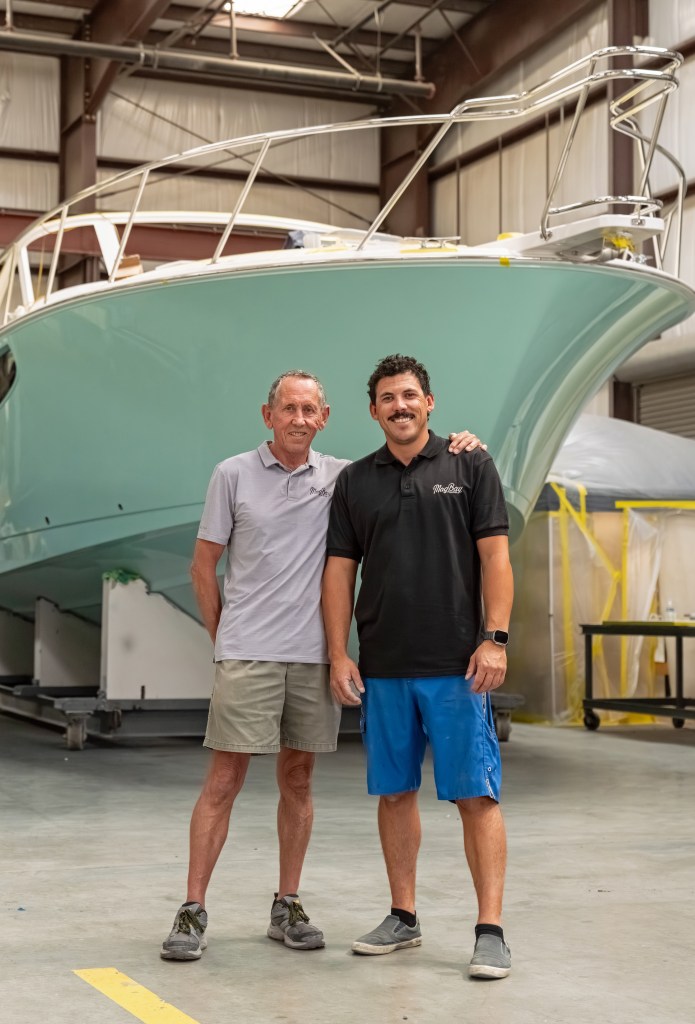
Not only are the weather and landscape here inhospitable, but it’s also the last place you’d expect to find a thriving boatbuilding operation. Yet it’s here where father-son team Mike and Barrett Howarth operate Mag Bay Yachts, a builder of high-end center console and express boats. The boats are renowned for their performance and fishability, and are built with a fit-and-finish that pushes beyond traditional perfectionism, taking years of experience to achieve.
“I always liked woodshop, and when I attended Western High School in Anaheim, I won some awards in school competitions,” says Mike Howarth, whose backstory begins all these years after woodshop class in Southern California. “When I was around 17, my father mentioned a boat company in Westminster called Harbor Yachts. They built houseboats, and I started working there for $2 an hour. Six months later, they made me foreman of the woodshop.”
At one point during his time there, the company president left to work for sailboat builder Islander Yachts and asked Mike to go with him. “I left with him, and at that point I’m making big money, $4.50 an hour,” he says with a grin. “They put me in the woodshop. About a month later, they put me in the tooling department with a half-dozen other guys.
“This was before CNC machines, and the molds were all handcrafted,” he adds. “We lofted everything on the shop floor and set up section framing and battens before we glassed it all up. Then it was high-build primer and hours of sanding — endless sanding. The first boat I built tooling for was for the Islander 36, which turned out to be a very popular sailboat.”
Mike says that at some point, a bunch of boat molds showed up next door as a new boatbuilding operation set up shop. That company became Pacific Trawlers, and the man who owned it hired everyone on the Islander Yachts floor … except him. “That’s when my father talked me into working for him at his machinery-moving business, and that lasted about two weeks,” Mike says, chuckling. “The guys from Islander, who were now at Pacific Trawlers, talked [to ownership] and managed to get me working there. They eventually made me plant manager.”
Mike remembers the company hiring an engineer for the outfit who would play a big part in his life, both personally and professionally. “His name was Henry Mohrschladt,” he says. “After we’d been working together for a while, he comes up to me one day and rolls out this blueprint for a 25-foot sailboat.” He recalls Mohrschladt saying: “I’ve been saving my money. We could build this.”
At the time, Mike was 25. He quit his job at Pacific Trawlers to build Mohrschladt’s design in his father’s mechanical shop. “I started working crazy hours,” he recalls. “Thanksgiving, Christmas, New Year’s … I didn’t take a day off. I was working 16-hour days.”
That boat, an Orion 25, was the beginning of Pacific Seacraft, which built some of the highest-regarded cruising sailboats on the market at the time. The two would go on to build hundreds of boats before they sold the business to Singapore-based Singmarine in 1988 with a one-year work contract and five-year noncompete in sailboats.
“Henry and I always wanted to build a sportfishing boat, and we left Pacific Seacraft after the year was up,” Mike says. “We started Cat Harbor Boats and began to look for a place to build them. Unfortunately, because of all the regulations, we’d never get a permit to do fiberglass work in Orange County.”
In the meantime, Mike and Mohrschladt asked Bill Crealock, who had designed many of the Pacific Seacraft hulls, to draw up a 35-foot sportfish. Mohrschladt tuned up Crealock’s design, and the duo were eager to start building it, but they still needed a place to set up shop.
“At some point, an associate of ours who was in the HVAC business asked us if we’d considered moving up to the high desert,” Mike recalls. “So we checked out this town called Adelanto, found a spot in an industrial park with all the right utilities, and then put down a deposit on a 5-acre piece of land and with plans to build a 12,000-square-foot, concrete, tilt-up building.”
While construction was underway, Mike and Mohrschladt rented a building behind a Mexican restaurant where they could begin making tooling for the 35-foot sportfish they dreamed of building. “While we were building the tooling for that boat, the owner of a small center console boatbuilder called Cabo calls me up,” Mike says. “They were out in Corona, and I learned they were going out of business.
We immediately wanted to take over the whole thing. I think we paid him $100,000, hauled the molds up to Adelanto, and changed the name of our company to Cabo, which we liked better than Cat Harbor.”
Unfortunately, Mike and Mohrschladt did not know — nor did the seller tell them — that there were liens on the Cabo molds. The bank soon came knocking to take back its assets. While the two ended up losing those molds, the company name was theirs. And with that, Cabo Yachts was born. The builder’s 35 was an unabashed success, along with other models that would follow before Brunswick Corp. bought the company in 2006, taking over operations for its 540 employees.
Brunswick, he says, changed the way that Cabo boats were built — in ways he didn’t like. So in 2014, Mike hatched the idea of starting a boat company with his son, Barrett. “I have this kid who’s crazy about boats and fishing, and we decide we’re going to do this,” Mike recalls. “Remember when I told you I lasted two weeks working with my dad? Let me tell you, it ain’t easy being in business with your kid.”
Barrett seemingly inherited the craftsmanship gene from his father. He describes growing up around the boat shop with the factory employees, making things with his hands and learning how to use power tools. “My crib was a boat, and my first memories as a child were being in the shop,” Barrett says. “When I was around 6 or 7 years old, my dad would take me into work on Saturdays. He often asked an employee to build things with me in the mill, and I’d learn how to use tools like the band saw, drill press and table saws. I look back at that time today and realize I was really learning the trade from some amazing craftsmen.
“Right after high school, I bought a 16-foot Boston Whaler and spent that summer rebuilding it in the shop, and used that a lot for fishing,” he says. “After that, I bought a Chris-Craft Sea Hawk and spent a year redoing that. I knew at that point that working on and building boats was what I wanted to do.”
But Mike had hoped Barrett would do something with his life other than build boats. “I was in college, and I wanted to quit to work on boats,” Barrett says. “But my dad made me finish. I absolutely hated college — totally hated it — but in the end I was the first in my family to finish college.
“What really broke my dad’s back was when I quit my job after graduating college to redo a 13-foot Boston Whaler with a 12-year-old kid at the request of his father,” Barrett recalls. “When we rolled it out, I remember my dad coming over and looking at what we had done. I could tell he was impressed. He said, ‘Is this really what you want to do?’ Of course, I told him yes.”
Around 2012, Mike and Barrett landed on the idea of building a center console fishing boat, as that market segment was beginning a near-vertical ramp-up in popularity. They decided to call the company Mag Bay Yachts, inspired by the renowned fishing waters of Magdalena Bay in Baja, Mexico.
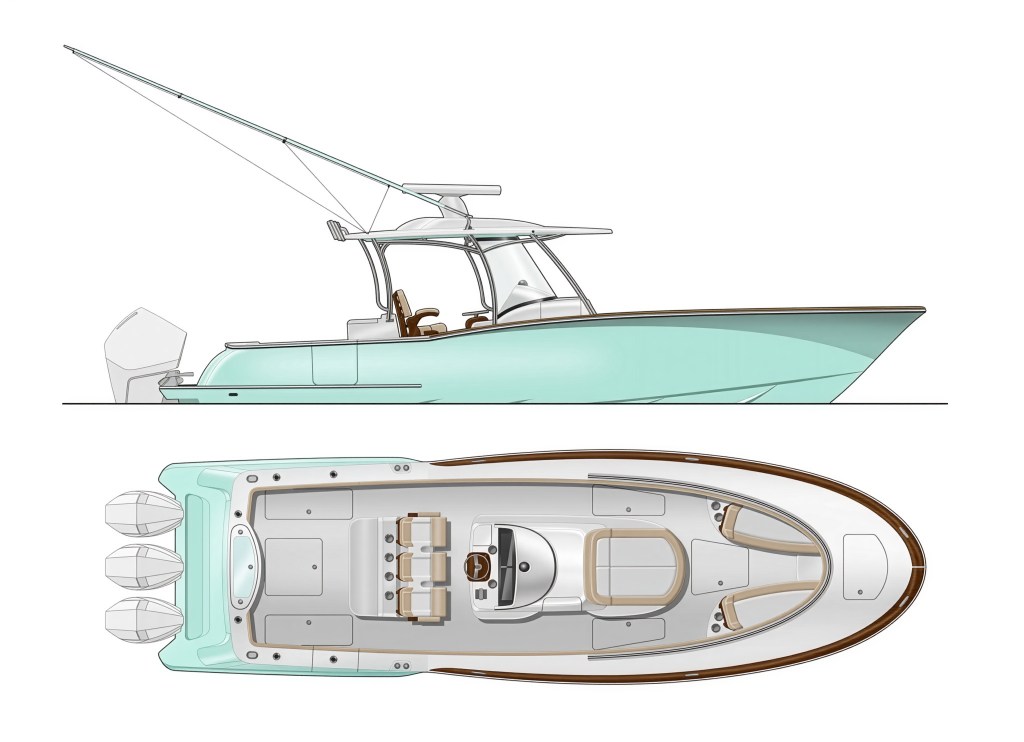
Mike and Barrett commissioned Michael Peters to design the first hull, a 33-foot center console. It utilized Peters’ stepped-V, ventilated-tunnel hull, which channels water aft to eliminate “sliding out” in turns, a common problem with early stepped-hull designs. “We started our tooling process for the 33 center console on June 1, 2014,” Barrett says, “and we put that first boat in the water on May 11, 2015. Then came the 42 express, the 43 center console and, finally, the 38 center console.”
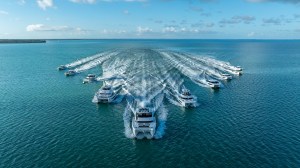
During the past 12 years, the company has splashed more than 100 hulls. It now has the capacity to build around 20 boats a year from a four-model lineup. The boats have a reputation for their seakeeping, thoughtful design, performance and high-level attention to craftsmanship and detail.
I toured the Mag Bay facility in late June. As I pulled into the factory parking lot, I noticed a small sailboat up on stands behind the barbed-wire fence that surrounds the site. I thought, What in the world is that thing doing here? Turns out it was that first 25-footer that Mike and Mohrschladt built together, the beginning of the Pacific Seacraft brand and the long relationship between the two builders.
Waiting for Mike in the facility’s conference room, seated at a table made from a massive tree plank, I was struck by the perfectly varnished surface. Not an imperfection, nary a brush stroke and no dust specks embedded anywhere. Unbeknownst to me, I was looking at an example of Mike’s impeccable craftsmanship.
“Mike made this,” sales manager Mark Barish tells me. “The funny thing is that Mike is not a boater. If you gave him the keys to a boat and asked him to move it from one place to another, he couldn’t do it. But when it comes to building things, he is an absolute perfectionist. So is Barrett.”
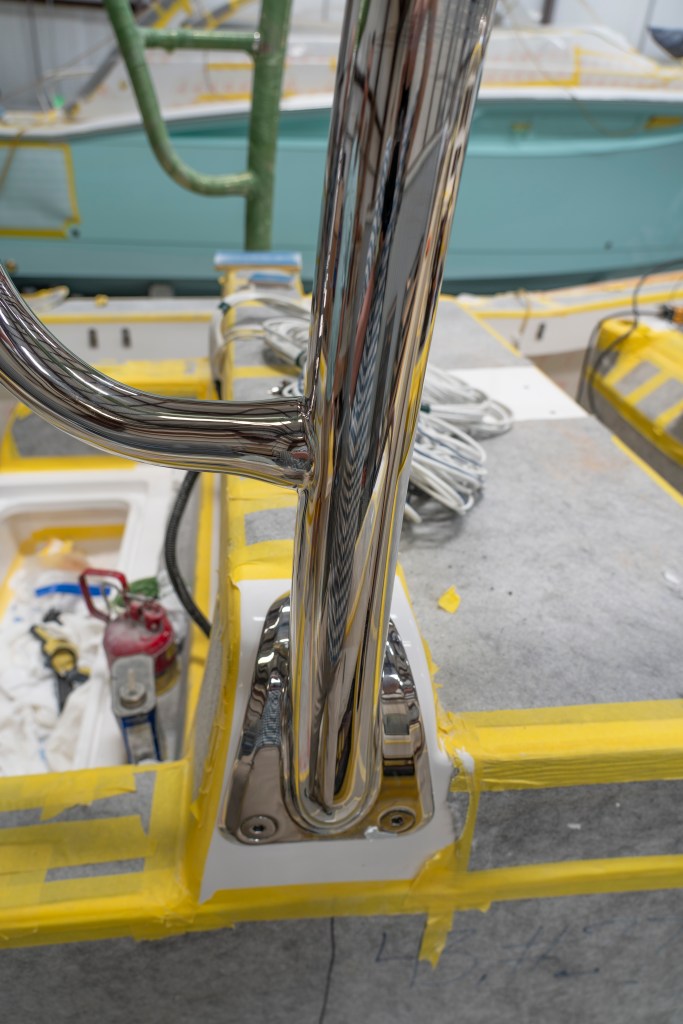
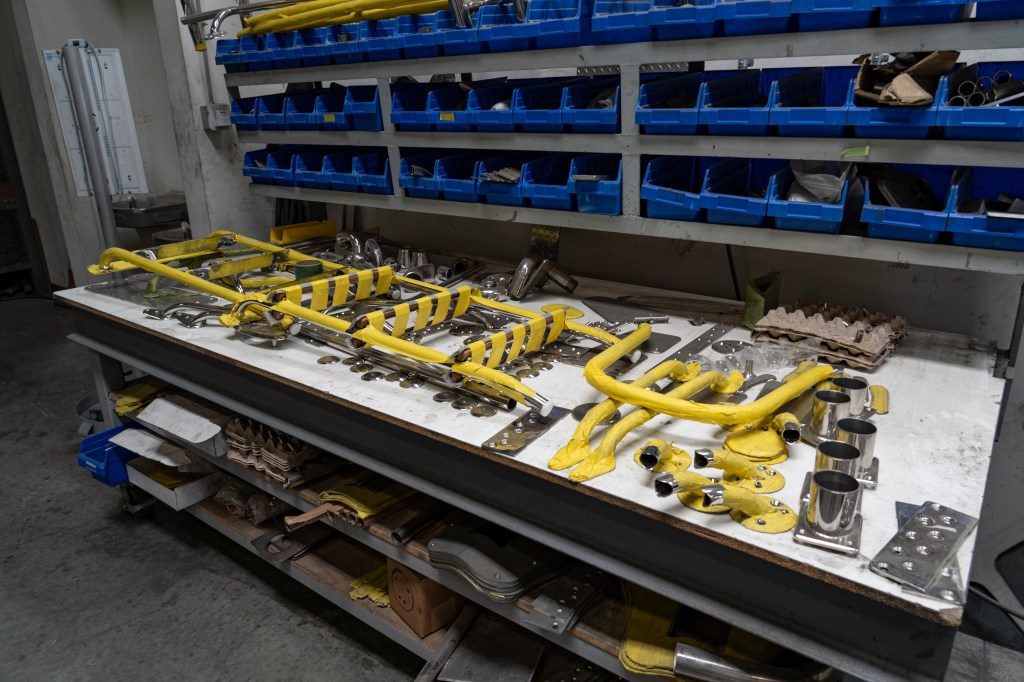
Mag Bay boats share a market segment with some serious competition: Valhalla Boatworks, SeaVee, Scout, Intrepid, Regulator and others. Hence the attention to detail. “We do all of our metalwork in-house, and it is jewelry quality,” Barish says. “We use only stainless-steel on our T-top framing, and you can’t see any of the welding seams. Every single junction point is filled and polished. We don’t use powder-coated aluminum; it simply doesn’t last. The stainless-steel is heavier than the aluminum, but the longevity and looks are worth it.”
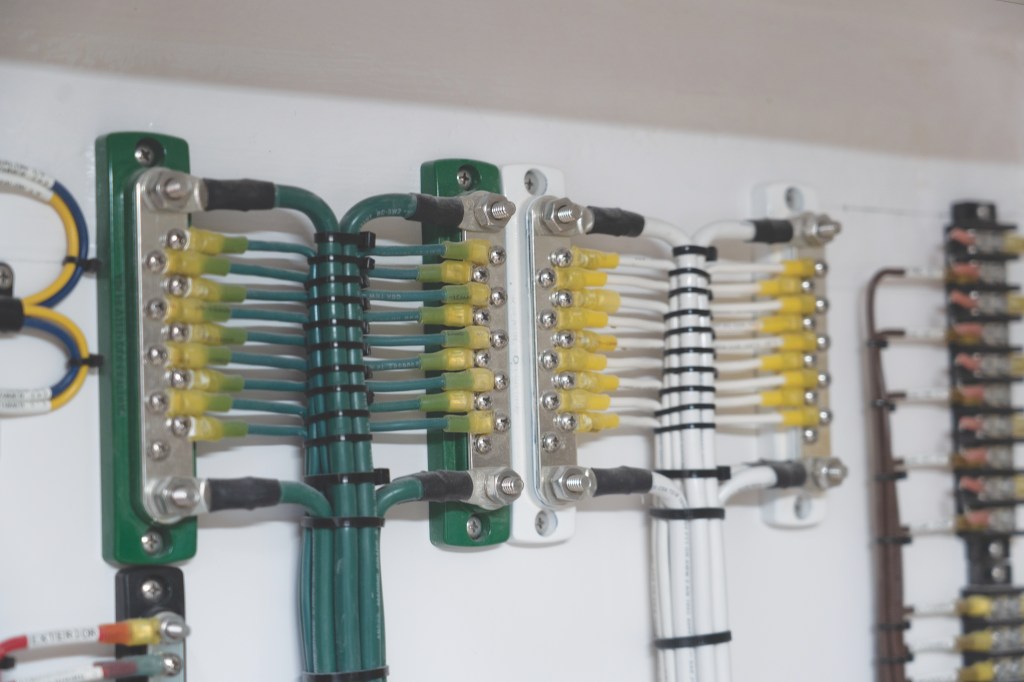
Mike says Mag Bay also fabricates many hardware items that other builders farm out to components manufacturers. “The hinges on our dive doors and in some of the hatches — we make those ourselves, along with many other components,” Mike says. “Our wiring is labeled and secured and routed perfectly. You won’t find a speck of dust on any of the wire looms because of the way we build the structural grid and the timing of when we put the deck on. Those are just a few of the details.”
Mike says many of the 70-plus craftsmen on-site once worked for him at Cabo. “Those guys are like family to us,” he says. “They are so important to what we do, and they all have the same drive to build the best boats out there, just like Barrett and I do.”
As we walk into the first of several shop buildings, Barish points out three men working on the tooling for what will be Mag Bay’s newest model: a 32-foot center console designed by Steve Matthews of Ocean Yacht Design. Set to debut at the Fort Lauderdale International Boat Show later this year, it will replace Mag Bay’s existing 33.
“The hull is stepped, but differently than Michael Peters’ ventilated design,” Barrett says. “Steve took that variable deadrise hull and actually used the transitions in the hull to transform those into a longitudinal step. Everything, from the entry aft, is ventilated, not just from the step to the transom. The 33 will ventilate throughout the entire hull surface.”
Transitioning into the glass shop, where two hulls are under construction, I notice a conspicuous lack of the tubes, pumps and plastic-wrap bags used in the resin-infusion process that is in widespread use among boatbuilders. “So far, we haven’t needed it,” Mike says. “If you know what you’re doing — and our guys do — it’s unnecessary. Our lamination schedules are precise, and we’d prefer to build a boat that’s a little heavier and stronger — and ultimately, one that will last virtually forever.”
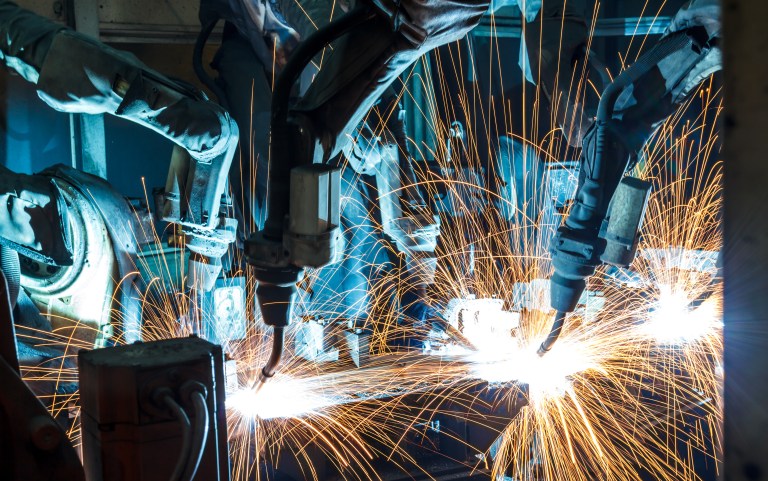
The metal shop takes up a large amount of space in the overall factory footprint. It’s abuzz with activity as sparks fly and polishing wheels spin. Mike shows me the two-step welding process that results in a seamless transition between pieces of stainless tubing. “Days and days of polishing is what it takes once the welds are in,” Mike says. “It’s a dirty, meticulous job, but the metalwork is one of the hallmarks of quality in a Mag Bay.”
Barish walks us toward the final assembly area, where I get a look at the mechanical, electrical and plumbing systems that go into each boat. Wires are routed, individually labeled and secured with precision. Hoses are thoughtfully placed and mounted with caps on the hose clamp band ends with plastic boots. Mounting screws are turned so the head of each one is situated to match the one next to it. Taken as a whole, the systems look like something you’d see in the engineering bay of a jet airliner.
“I have terrible OCD and take things to another level,” Barrett says. “When we first started out, when we were buying machine screws, if they were stamped with the stainless-steel grade, I’d put them all in the lathe and shave out the 316 numerals so it would be a flat, perfectly polished screw. I learned you can’t do that forever, so I diverted that attention to detail to more important things.”
In the far corner of the shop, a seafoam 42 Express has its hull and deck mated, with the mechanical systems going in. “This boat is for Mike and the family, and it’s the last 42 Express we’ll make,” Barish says. “There are too many details inside to describe in less than a few minutes, but it’s totally custom.”
Barish tells me the boat will be named Carlo, a social- media handle Barrett’s mom used to keep an eye on what her kids were doing online without them knowing it was her. He also tells me that at boat shows and other events, her name tag is jokingly printed as “Carlo.” We all chuckle.
The next day, Barish meets me in Newport Beach, Calif., to run a customer’s 42 Express out on the Pacific. A quick tour of the boat reveals the same level of precision and fit-and-finish I saw in the Hesperia factory. Screws turned in unison, perfect fiberglass work and an engine room you could probably perform surgery inside.
We fired up the Volvo Penta D13 diesels and coasted out of the slip, dodging a fleet of Optimist sailboats along the way. Allowed to romp, the boat cruised comfortably at 30 knots past the mansion-lined hills of Newport Beach that stretch straight down to the sea. A southerly swell topped with a moderate chop were easy work for the Peters-designed hull, and I took some video while we were underway, sending it to a friend back home to brag about my current situation in Southern California. “Quiet, smooth and beautiful,” is how my friend replied. And he was right.
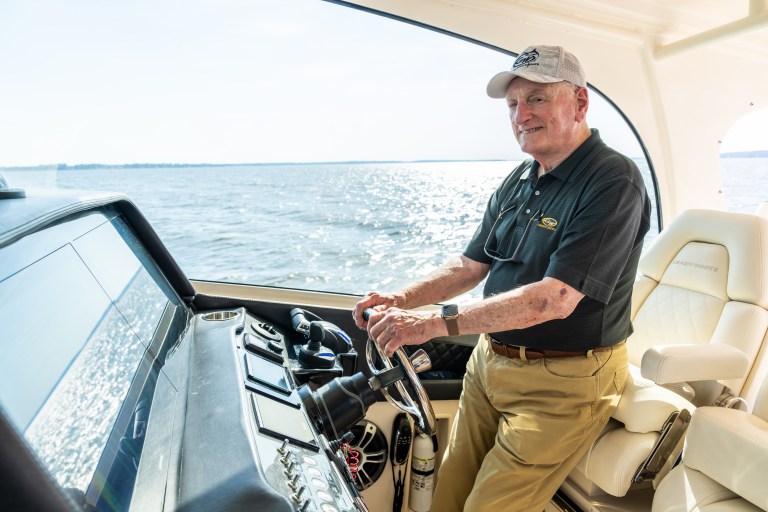
Fifty-eight years after woodshop class, it’s clear Mike still has an obsession with perfection, and his son is working right beside him with the same mindset.
This story originally appeared in the August 2026 issue of Soundings Trade Only.