
For boatbuilders and component manufacturers, electrical systems are progressing faster than they have in decades. Boats now have larger electrical loads, sophisticated battery banks, networked hardware and complex power-management systems. That opens up huge opportunities, but it also creates a practical problem: How do you design safely when technology moves faster than the standards that govern it?
High Voltage
Until recently, high voltage on boats almost always meant electric propulsion. That’s no longer the case. High-voltage DC systems now run heavy house loads, large solar arrays and high-capacity energy storage designed to replace traditional generators. Stepping up the system voltage reduces current for a given power demand, which keeps conductor size, weight and cable routing manageable.
Higher voltage also brings different hazards. Safety requirements written strictly for electric propulsion don’t always fit other components tied to a high-voltage bus that might have its own specific safety requirements. The American Boat & Yacht Council is reviewing such electrical standards as E-30, Electric Propulsion Systems, while the 2025 update to E-13, Lithium Ion Batteries, included additional information for high-voltage battery systems. Internationally, ISO/TC 188 is restructuring small-craft electrical standards into a multipart document under ISO 13297, with Part 2 dedicated to high-voltage DC systems.
Dockside Charging
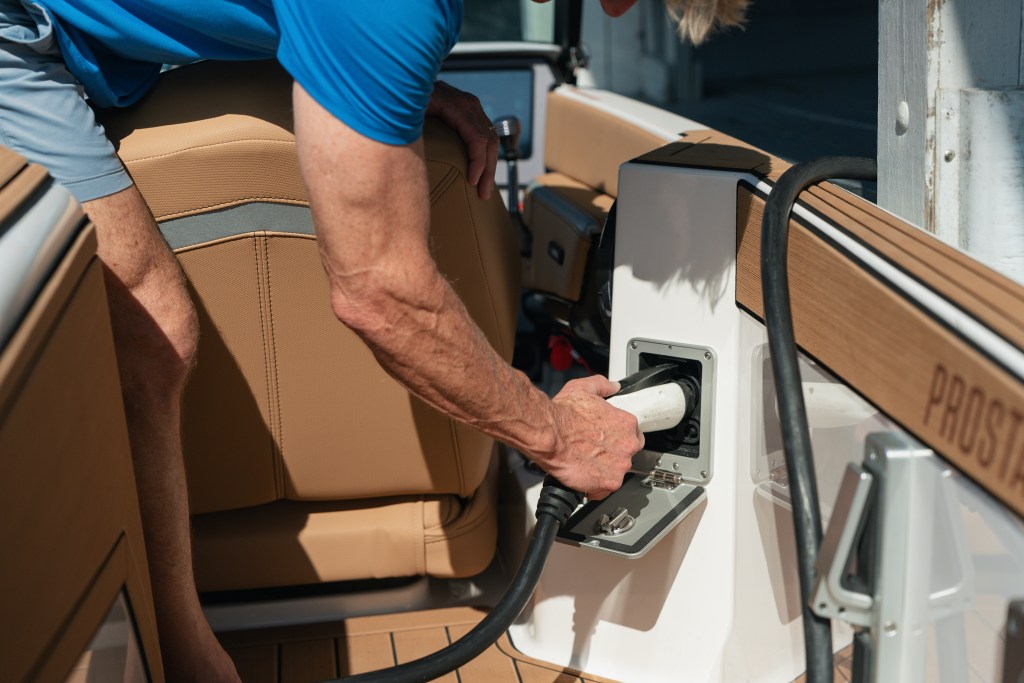
On boats that carry high-voltage battery banks, charging becomes an immediate challenge. It’s tempting to look at the automotive world’s charging network and assume marinas can just drop the same charging station onto the dock. There is one important difference: Cars generally do not float in water.
The marine environment changes the risk profile. Moisture, corrosion, movement, grounding paths, isolation and leakage current all become critical safety points to consider. A setup that works fine in a parking lot needs entirely different protection when tied to a floating boat.
ISO, the International Organization for Standardization, is addressing this through ISO/CD TS 13297-3 (off-board electrical connections for small craft). ABYC has also brought shore charging for lithium-ion systems into active industry discussions and is working on a similar technical information report. If you’re building electric or hybrid platforms, dockside charging needs to be treated as an integrated part of the system.
Network Cables, Smaller Conductors
In addition to electrical systems, boats are now significantly more networked. Digital switching and electronic-control modules tie together equipment that once ran on isolated circuits. Many communication backbones run small conductors that carry low-level power alongside data. For years, this created friction with U.S. regulations: 33 CFR called for a minimum 18 AWG conductor in multiconductor sheaths, while standard networks like some NMEA 2000 systems rely on smaller wire.
The Coast Guard resolved this through Policy Letter 25-02 (CG-BSX-23), which formally allows conductors as small as 22 AWG for communication backbones to power conductors under 5 amps. For wire smaller than 18 AWG, overcurrent protection must not exceed 3 amps for 22 AWG and 5 amps for 20 AWG. It’s a great example of the Coast Guard Office of Auxiliary and Boating Safety stepping in proactively when older regulations no longer fit modern technology.
Digital power distribution and overcurrent protection ran into a similar bottleneck. Older standards assumed the use of mechanical fuses and breakers; solid-state switches and power distribution modules didn’t fit the language. The 2025 revision of ABYC E-11, AC and DC Electrical Systems on Boats, resolved this by adding specific requirements for solid-state overcurrent protection and power distribution assemblies.
Getting Involved
The takeaway here is simple: Technology will continue advancing forward, and standards will have to adapt to those changes. Builders and suppliers can wait for new standards to get published and react after the fact, or help shape them while they’re being developed and drafted.
ABYC’s standards process is consensus-based and open to everyone affected by the standards. Builders, component manufacturers, techs and surveyors can join ABYC’s Project Technical Committees, attend meetings and comment on proposed drafts. More than 400 volunteer industry experts participate, and many standards, including E-30, are under review. Getting involved isn’t just about compliance; it ensures the rules reflect actual industry realities, installation hurdles and real-world applications.
ABYC Standards Week 2027 is scheduled for Jan.11-15 in San Antonio, Texas (virtual options available). PTC participation is free. If you want to help shape upcoming standards and meet other people involved in the process, email tech@abycinc.org. n
Maciej Rynkiewicz is a standards developer at the American Boat & Yacht Council.
This article first appeared in the October 2026 issue of Soundings Trade Only.