
David Pietrocola, CEO and co-founder of Cohesive Robotics, has witnessed the revolution in robotics, AI and 3D printing on factory floors firsthand. Pietrocola grew up around fabrication, cutting and welding steel in his family’s ornamental metals business in New York. He says that upbringing left him with a deep appreciation for the craftsmen and artisans whose skills keep high-mix, custom industries running.
After more than 15 years in the robotics industry, much of it supporting automotive and oil and gas companies, Pietrocola founded Cohesive Robotics in 2022. Robotics, he realized, had barely reached the broader manufacturing world, marine included. “We saw marine was especially lagging in robotics adoption,” Pietrocola says. “And it’s really only in the past few years where the technology capability, the infrastructure requirements and the return on investment has started to make more sense for truly high-mix operations, such as in marine.”
Cohesive Robotics is a newer name in marine, but it’s far from alone in thinking big about the forces reshaping factory work. Brunswick Corp., Viking Yachts and other longtime industry leaders are testing various systems and processes that involve 3D printing, robotics, artificial intelligence and more. All of it is pushing the boundaries of what used to be possible, and opening up minds to what might be doable in the future.
“The pace of adoption for robotics and 3D printing, both at Brunswick and across the marine industry, will depend on where these technologies can deliver meaningful value while maintaining the quality, performance and cost expectations customers demand,” says Jeffrey Reifsnyder, Brunswick’s director of advanced technology. “Each application must demonstrate a clear business case.”
A case in point, Pietrocola says, is traditional automation, which has struggled with tasks where part variability is high. That’s particularly true for the most dangerous and dirty jobs, such as sanding, welding and polishing. “These are tough jobs that people don’t want, or don’t last in after a few months,” Pietrocola says. “Instead of doing sanding or welding themselves, the worker might be overseeing one or more robotic work cells and finishing off the delicate, ultra-precise, last 10% of a job for that human touch. And they stay in the workforce longer because their body isn’t dealing with the same physical demands day in and day out.”
Across the industry, that same idea keeps surfacing: Automation is being layered in to support skilled workers, not to replace them.
Argus OS Platform
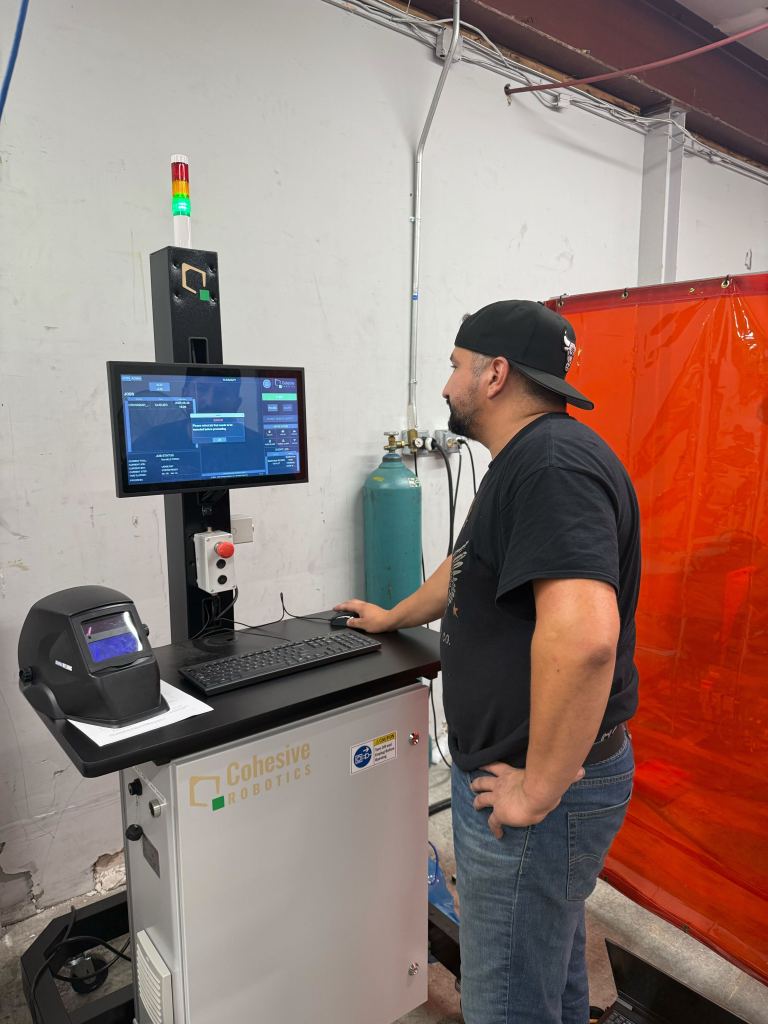
Cohesive Robotics offers turnkey robotic work cells built around its proprietary Argus OS, a vision-based software platform paired with industrial hardware. Pietrocola calls it a one-stop shopping experience. In a boatbuilding environment, that might mean one work cell sanding parts in a small-parts department, and a differently configured cell running the same Argus OS interface while surface-treating something as large as a hull.
That consistency, he says, is what lets clients cross-train workers between cells. “There’s a ton of opportunity in the factory environment still, and that’s a more structured environment where I see current growth,” he says. “In five years, I think we’ll be seeing more of these capabilities expand to sustainment and maintenance in dry docks and beyond.”
Artificial intelligence is beginning to change how those systems operate, too, moving into vision and quality inspection, adaptive path-planning and other areas long handled by preprogrammed robotics. “Today we see the most applicability for AI on the vision and quality-inspection side,” Pietrocola says. “Things are evolving quickly, and we see motion planning and other areas ripe for improvements leveraging AI.”
3D printing also is making its way into the company’s offerings, particularly metal printing using welding technology that Pietrocola says reduces the heat buildup and distortion that have long limited additive manufacturing. Combined with polymer or metal printing, the company now supports so-called convergent manufacturing: A robot 3D-prints a part, and Argus OS scans the as-built result, automatically changes tools and post-processes it, whether that means sanding, polishing, deburring or something else.
Brunswick’s Advanced Tech Operations
Reifsnyder, who oversees Brunswick’s work on technologies, often collaborates with the company’s Boating Intelligence DesignLab on projects that explore innovative uses of the technologies. “Robotics and 3D printing are being used across several Brunswick businesses, although the level of adoption varies by brand and facility,” Reifsnyder says.
Within Navico Group, plants in Mexico, Northern Ireland and Lowell, Mich., already run robotics on their manufacturing lines, along with a smaller amount of 3D printing, Reifsnyder says. Other Navico sites use the technologies on a lighter scale.
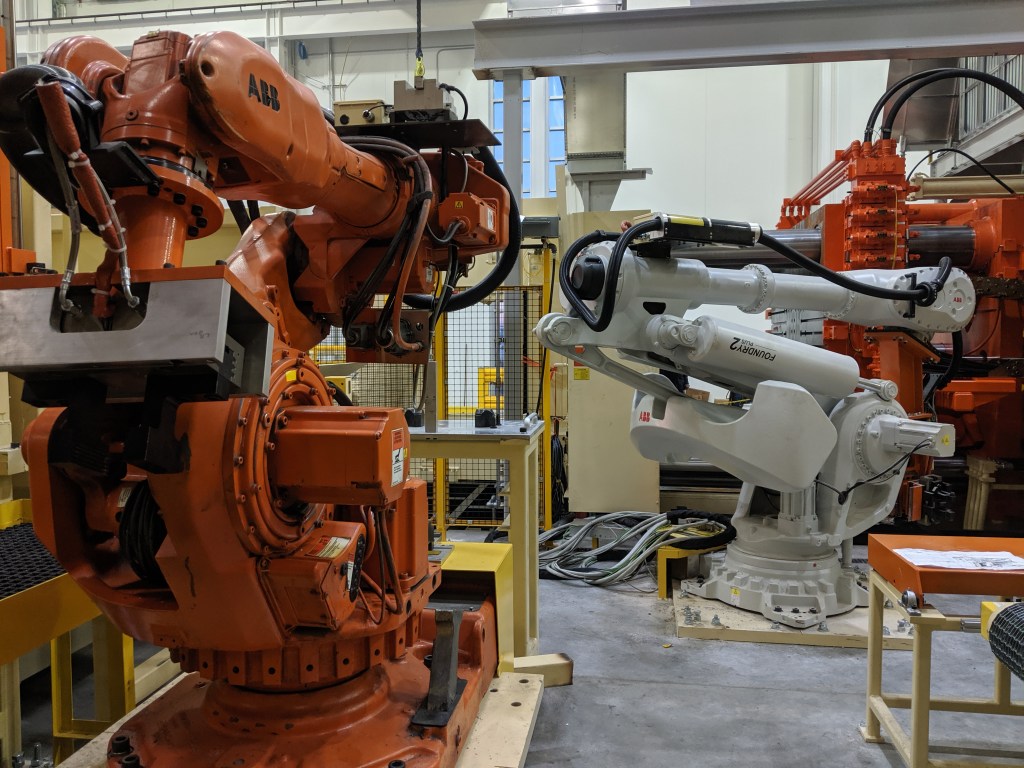
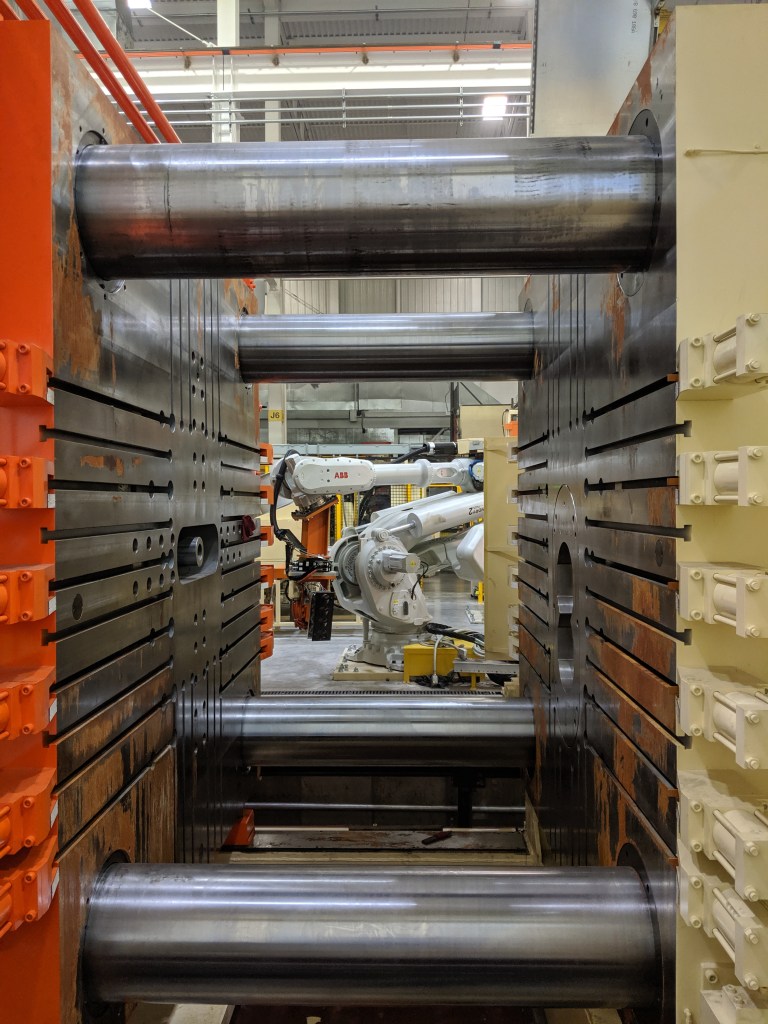
Mercury Marine’s use runs deeper, he says: “Mercury Marine has one of the most extensive robotics footprints within Brunswick. Several hundred industrial robots are deployed across its operations and support a wide range of manufacturing processes on a daily basis.”
Navico’s robots handle welding and electronics assembly. Mercury’s handle casting, painting, machine tending and inspection, aided by automated, guided vehicles that have moved materials between stations for years.
3D printing at Brunswick is still weighted toward prototyping and tooling rather than production itself. Mercury’s most notable use, Reifsnyder says, is 3D-printed sand molds for engine-component prototypes, which can cut development lead times “from the traditional 12 to 16 weeks down to approximately three to four weeks.” Brunswick prefers to frame automation not as cutting head count, but instead as a way to take over demanding or repetitive work, and to free employees for higher-value tasks.
AI remains an earlier-stage effort: Navico has tested tools for robot-path generation and fixture recognition without yet finding enough benefit to expand them, while Mercury Marine is focused on pairing computer vision with its existing robots for quality inspection and defect detection. Long-term, Reifsnyder says, Brunswick doesn’t envision a fully automated factory floor, but instead a partnership between people and technology — automation adding precision while engineers, designers and boatbuilders remain essential to the finished product.
Viking’s New Systems
Viking Yachts in New Gretna, N.J., a leading builder of semicustom sportfishers, has a long history of bringing new design and manufacturing technology into the company. “That technology has to serve a purpose, help our boatbuilders, improve the process and ultimately improve the boat. It does not replace craftsmanship,” says Chris Landry, director of marketing and communications.
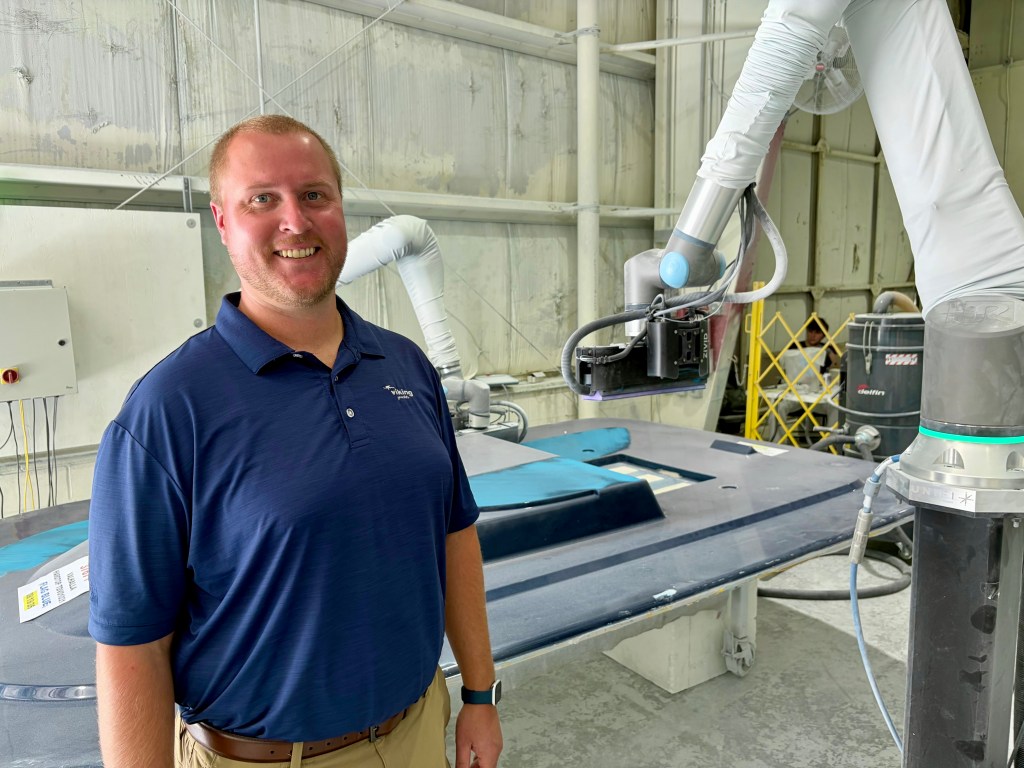
Viking and Viam, a robotics and software infrastructure company, are moving a robotic block-sanding project from development toward production use. The current system is used on molded fiberglass hardtops.
Block sanding is traditionally done by hand to fair the boat’s surface before refinishing. Viking’s Viam system scans the actual part, develops a tool path from its geometry, and uses a block-sanding tool that follows the same back-and-forth motion a boatbuilder uses. Viking employees then inspect the surface and finish areas that the robot cannot reach or that need additional attention.
That ability to work from the actual part is important. Molded fiberglass can vary slightly from its CAD geometry and from one part to another, according to Daniel Thompson-Rhodes, Viking’s operations engineering manager, and Winston Zeberlein, advanced manufacturing manager. Conventional robotic systems generally require each part to be programmed separately. Viam’s system adapts to the surface it scans, making it better-suited to Viking’s low-volume production and wide range of parts. Viam also developed true block sanding rather than conventional rotary or random-orbital sanding, the Viking managers say.
The cell has been used on production hardtops for about 11 months, with its efficiency improving over that period. Thompson-Rhodes and Zeberlein estimate it has worked on 30 to 40 hardtops. The system has changed considerably during that time as Viam refined the hardware, software and sanding process. Because of that, Viking does not yet have reliable numbers for cycle time, labor savings, rework, finish quality or ergonomic benefits.
Select Viking production employees are being trained to operate the system and help determine where it works best. Boatbuilders are the priority. The robot is another tool in their toolbox, one that can take on part of a repetitive sanding process while employees remain responsible for inspection, touch-up and final finish. A separate Viam system is planned for block sanding engine-room ceilings. Applying the technology to larger parts, including hulls, is a longer-term goal.
At Cohesive Robotics, Pietrocola says he sees that same dividing line — between what robots are ready to take on and what still belongs to people — running through the rest of the marine industry. “We encourage manufacturers to think of today’s AI-enabled robots as productivity superchargers for their core, skilled staff,” he says.
Tasks that are monotonous but still involve part variability in a high-mix environment make the best entry points for automation, Pietrocola says, freeing skilled labor for higher-value work. A smart work cell can handle non-directional, uniform sanding for paint adhesion, as one example, letting a welder focus on the most challenging joints without risking expensive parts. “Robots are still a long way off from handling highly dexterous, fine-touch tasks, especially in a manufacturing setting,” he says.
Labor shortages and hiring costs matter, Pietrocola adds, but he argues the bigger case for automation is broader: increased throughput, a safer workplace, consistent quality and the data-logging benefits of digital transformation.
“When you look at the aging workforce across manufacturing, keeping the status quo isn’t going to be a viable option for a lot of places,” he says. “So we need to look at technology as an enabler for getting the production work done. But we also need to look at workforce development and make sure we have the maintenance technicians, manufacturing engineers and designers needed to leverage these new technologies on the shop floor.”
Case Study: 3D Printing at Viking Yachts
Viking’s use of 3D printing is well-established, says Winston Zeberlein, advanced manufacturing manager. Over about seven years, it has grown from one printer used mainly for prototypes and installation templates into a five-printer operation supporting thousands of end-use parts and hundreds of fiberglass tools, molds and mold inserts.
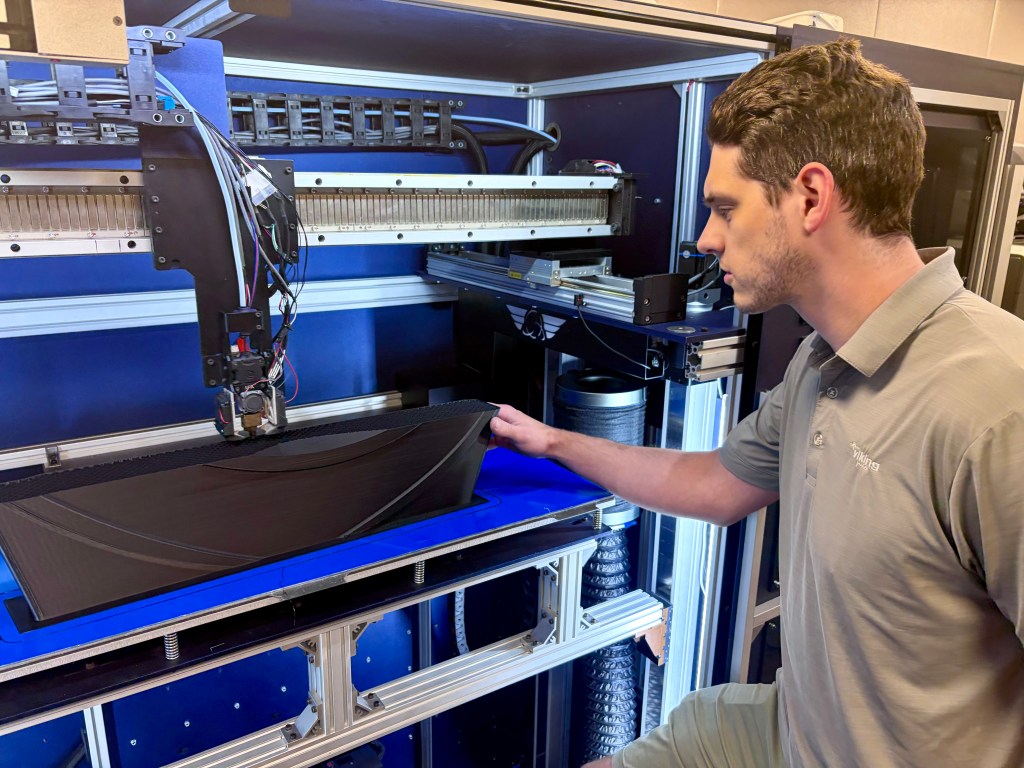
3D printing fits boatbuilding because production volumes are relatively low, and parts, options and installations vary, Zeberlein says. Work often takes place on curved surfaces and in tight spaces. Having the capability in-house lets Viking test-fit, revise a design and produce small quantities without immediately committing to permanent tooling or a long outside-vendor process.
“Current applications include prototypes, electronics mounts and bezels, helm components, A/C plenums and vents, templates, drill guides, locating fixtures, fiberglass tooling and mold inserts,” he says. “Some printed parts are sanded, painted, wrapped or upholstered before they are installed in the boat. Others stay on the production floor, where they help improve fit, placement and repeatability.”
Fiberglass tooling is another important use. Printed tools, small molds and mold inserts can build a detail into the molded part instead of requiring employees to cut and patch the finished fiberglass afterward. This is not about printing everything or finding a cheaper way to make a part, Zeberlein says. “It is about using the technology in our commitment to building a better boat every day.”
Viking is also evaluating larger-format, additive manufacturing for tooling and molds, though that work remains in development.
As with robotics, the people building the boats remain central. 3D printing is another tool that helps Viking boatbuilders improve fit, repeatability and tooling while maintaining the hands-on skills and judgment that go into every boat. “The focus is how it supports our boatbuilders and improves the finished product,” says director of communications and marketing Chris Landry.
This article first appeared in the October 2026 issue of Soundings Trade Only.