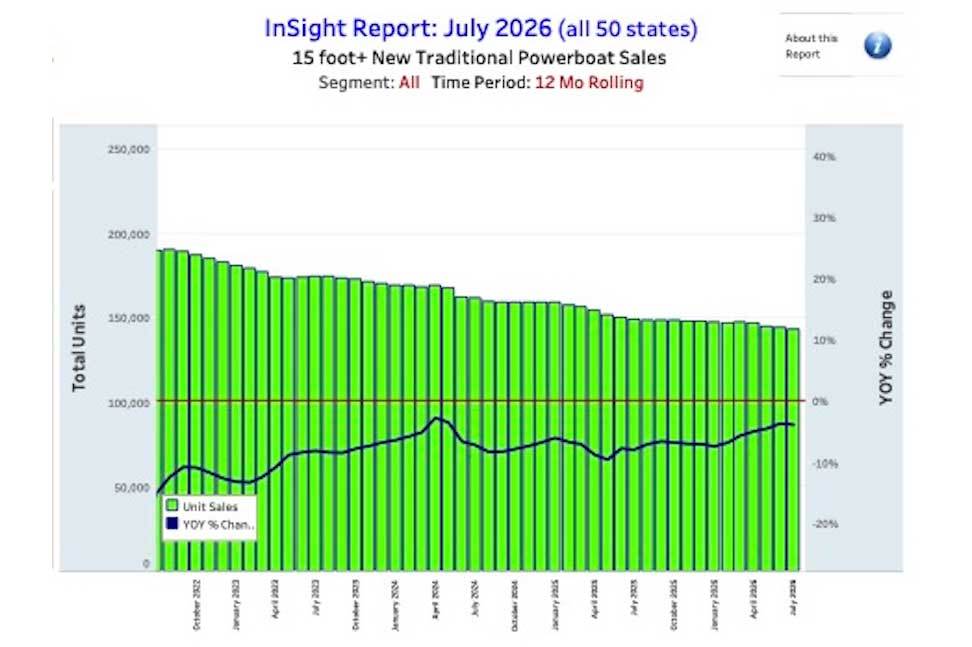
Registration numbers for the 15-foot-and-over U.S. powerboat market through July were down 3.8% relative to the 12-month rolling average. Registrations across all segments totaled 211,459.
The data for new-boat registrations was provided by Info-Link, a Florida-based company that compiles registration numbers from the Coast Guard and individual states.
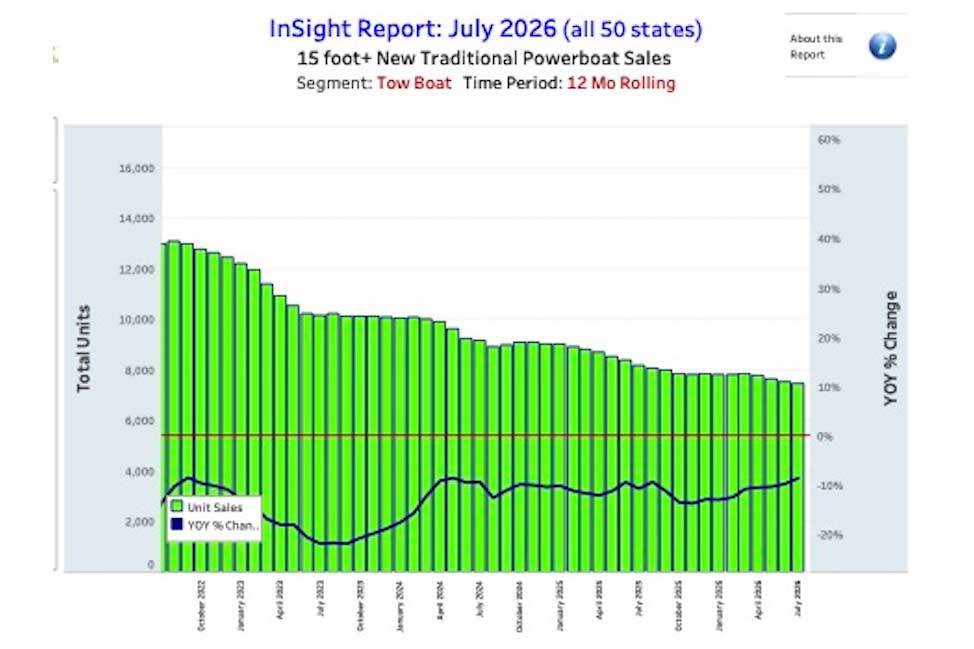
Towboats were down 8.7% for a running total of 7,457 units sold. Runabouts were down 15.1%, with a total of 12,546 units sold, and pontoons were 7.3% off their 12-month average, with 46,167 units.
The freshwater fishboat category gained 1% on its 12-month average, with a total of 55,094 units sold, another increase in the category’s 12-month running average of units. The only other category to show improvement relative to its 12-month average was unclassified/other, which includes houseboats, fliteboards, airboats and other watersports vehicles. That category showed an 8.2% increase on its 12-month average with 5,422 units sold.
Saltwater fishboat sales were off 3.2% from their 12-month averages, for a total of 21,293 units sold. The cruiser/yacht category was down 8.5% from its 12-month total with 4,408 units. PWC sales were 6% under their 12-month rolling average with a total units figure of 59,072.
“Based on dealer inventory payoffs and turnover rates, the overall market has performed better than it did in the 2024 and 2025 model years,” said Russell Baqir, senior vice president of business development at Northpoint Commercial Finance. “Inventory turns improved over this period, while the share of aging inventory declined to approximately 20%, compared with a higher percentage in 2025. Although the market is contracting and less new inventory is in the field, dealer performance is improving.
“Freshwater fishing continues to outperform the other segments with inventory turn at two times,” he added. “Towboat has also been a bright spot, with inventory turn remaining at 1.7 times. In both categories, aging is below 15% over 12 months.”
In September, Nadeau’s Marine in Maine declared bankruptcy. Previously, Baqir said dealer bankruptcies and acquisitions are part of this phase of the boat market cycle. “The dealer trend through the 2026 model year has been a decline in defaults and business failures, both of which peaked in 2024 and 2025,” he said. “Most dealers that exited the market did so without defaulting and successfully liquidated their inventory. The market has also experienced dealer consolidations and acquisitions. Overall, the dealer footprint continues to contract, bringing inventory levels more closely in line with consumer demand.”
Among the bigger state markets, Florida was 5% below its 12-month average for 27,384 units yearly. Texas was down 2% with 15,935 units. Michigan was also below its 12-month average by 2% for 11,419 units, while North Carolina was down 2% with 9,509 units.
Southeast states continue to show strength, with Arkansas, Mississippi and Georgia all increasing. Georgia showed a 2% increase in its 12-month average with 7,904 units for the year. Mississippi rose 22% with 2,823 units yearly. Arkansas was up 4% with 3,745 boats sold on the yearly average.
In the market overall, Baqir said, timing of recent interest-rate increases is more favorable in the third and fourth quarters than in the first and second quarters. Although consumer lending rates are not driven solely by the federal funds rate, he said, changes in that rate can affect consumer confidence. This timing, he notes, allows consumers to adjust their expectations before the boat-show and primary selling seasons.
“The initial impact of higher rates will likely be felt by dealers carrying non-current and used inventory, as well as by OEMs providing interest-rate assistance during the fall and winter months,” he said.
“The contraction in new-boat inventory is not the only barometer of the overall marine market. Tracking growth in boat-club membership and used-boat sales would provide a clearer picture of whether consumers are leaving boating altogether or simply finding more affordable ways to stay on the water without taking on the higher cost of boat ownership.”