
 PHOTO: COURTESY SCARBOROUGH BOATWORKS
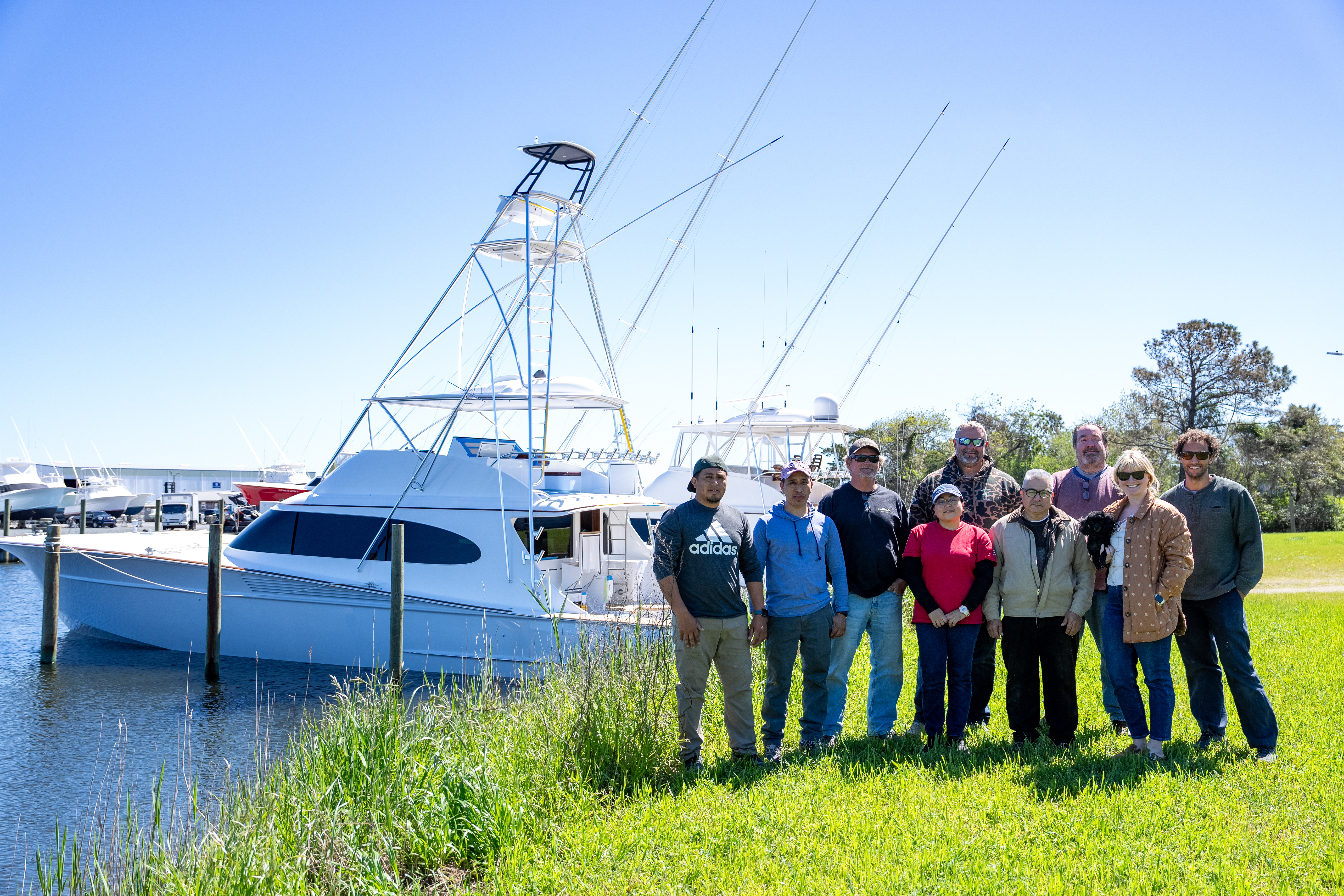
Wanchese, N.C., a pine-shaded peninsula at the bottom of Roanoke Island with a population of around 2,000, has somehow managed to become the center of the custom sportfish-building universe. It’s the home of master builder Ricky Scarborough Jr. and his company, Scarborough Boatworks, as well as the operations of John Bayliss, Paul Spencer, Craig Blackwell and Ritchie Howell. The population brims with craftspeople, engine-smiths, composite experts, metalworkers and charter operators. While Dare County’s top economic engine is tourism, boatbuilding is second, largely because of Wanchese.
When most folks think of the Outer Banks, they conjure the razor-thin sliver of shifting sand that runs for more than 175 miles from the Virginia border down to North Carolina’s Cape Lookout. That sliver protects a vast realm of sound, island and marsh from the Atlantic. Archaeological records indicate that humans have been along the Outer Banks as far back as 10,000 years. The Algonquian population survived by hunting and fishing from dugout canoes built on the same land where boatbuilders today work with juniper, foam and epoxy.
The ancient shoreline was thick with oysters, and waters teemed with bass, blue crabs, shrimp and every kind of aquatic protein a human could need. Roanoke Island’s last ruling chiefs were Manteo, who lorded over Roanoke Island’s northern tribe, and Wanchese, who controlled the south.

Author Bethany Bradshear and captain-turned-historian Charles Perry just released the book Big Fish Better Boats: The History of Sportfishing and Boatbuilding on the Outer Banks. Perry, 77, grew up surfing Outer Banks breaks and fishing under the tutelage of Wanchese’s Omie Tillett and Manteo’s Warren O’Neal. He says area fishermen first cast from the beaches and worked sound waters for mullet and shad with hand-woven nets from rowing skiffs and small “moth” sailboats (named for their moth-like sails). If a spring shad catch was good, a responsible fishermen could fund the family until the following spring.
There were also flounder, drum, red snapper, channel bass, shrimp and caviar-filled sturgeon on the shoulder seasons. Folks fished when the weather cooperated, Perry says, “and then you either built a boat, built a house or you didn’t do anything. There just weren’t many jobs.”
Post-War Evolution
After World War II, Perry says, local fishermen stayed fairly close to shore, not realizing the bounty of gamefish that lay along the boundary where the cold Labrador Current met the warm Gulf Stream. The rough-and-tumble Hatteras and Oregon inlets, which a storm created in 1846, were a blessing and a curse. Tillett, during a 2014 fishermen’s roundtable, said he fished from a 50-footer with his dad. “Our boats had one motor,” he said. “Didn’t have radios or anything. It weren’t easy.”
Sunny Briggs, 81, recalls heading out to fish offshore when he was 12. “We had a bar buoy and stakes that stuck out on the sandbars to mark the channel, but that inlet was a moving thing,” he says. “Every time we had a nor’easter, we had a different inlet. And everybody who has fished out of Oregon Inlet, if they tell you they haven’t run aground, they didn’t fish it. We navigated with a flashlight and a compass. That’s nothing when the rollers are 10, 12 feet tall. And it’s dark. It was bad news.”
In the later 1940s, landings of billfish, tuna, wahoo and mahi led a handful of fishermen to launch Outer Banks sportfishing operations. There was no Oregon Inlet Fishing Center, so boats moored farther up the sound before making the hair-raising inlet crossing.
“Charles Perry’s daddy, Charlie, and his uncle, Herbert, were the first two charter boats to ever go into Oregon Inlet to dock there,” Briggs says.
In 1954, Omie’s uncle, Toby Tillett, was awarded a concession by the National Park Service to operate the Oregon Inlet Fishing Center, which would become reachable by a paved road instead of sand ruts. Then a photojournalist named Aycock Brown documented the fishermen, boatbuilders and daily catches — often posed alongside pretty girls — with photos sent to hundreds of newspapers around the country. “He did so much for this county,” Perry says. “It’s just amazing.”
The building of the Outer Banks’ first fishing boats wasn’t initially restricted to Wanchese or Manteo. “There was a guy named Taylor who built over in Kill Devil Hills,” Perry says. “He built a really nice boat. He had some kind of cancer and passed at an early age, but he built a few boats, and they’re still in circulation. Boats were being built over in Manns Harbor, too. Still are.”
Manteo’s Buddy Cannady and Warren O’Neal worked from what became a local business model. “Buddy worked with Capt. Warren, and then Buddy went out on his own,” Perry says. “His idea was building one boat a year to have a new boat to fish every summer for his charters. And then he’d sell it at the end of the summer.”
Perry says that while the boats had pretty lines, Cannady “didn’t do the finish work on the insides and that sort of thing, but his boats were solid, good sea boats. But he learned how to build a boat in a short period of time. And the people that were buying his boat after the season were getting a hell of a deal because he had already fished it for the whole season. He’d worked out all the kinks.”
Bring on the Beauty
Perry, Briggs and Bayliss all say O’Neal was the first fisherman to build boats to a true artisan’s level of fit and finish. In 1959, O’Neal built the Pearl II. Considered the first real “Carolina” boat, it had a flared bow and deep-vee hull for pounding through short- and long-period swells, and for shedding the spray those swells generated.
“I started putting vee into the hulls of bigger boats because it just seemed to me like they needed it,” O’Neal once said. “I had been running boats all my life, and I know what it takes to make them run.”
Briggs says O’Neal also attended Duke University. “This is before we even had a bridge to Manteo,” he says. “When he graduated, he went to the Chicago Institute of Design. That’s the other side of the world from Manteo. When he came back, he started putting everything on paper, documenting everything. There was no rock of the eye. Everything was pregamed before he actually built it.”
In 1960, Tillett needed a boat. He and O’Neal traveled to Virginia to check out a Rybovich and came home brimming with ideas. The result was a collaboration between Tillett, O’Neal and Perry’s cousin on a build called Sportsman. “When he got the idea of building himself a new sportfish, he wanted Warren to build it,” Briggs says, “because anything Warren did, it was like Rembrandt did it.”
Eventually, a wealthy Virginian named John Woods commissioned O’Neal to build the first in a series of charter boats that would be christened Olivee. “He had the Olivee 1, 2, 3, 4, 5,” Briggs says. “They were what really changed the mode of boatbuilding in Dare County.”
Tillett continued to work with O’Neal for better than a decade before starting his own Manteo-based line in 1973. Tillett’s Sportsman Boatworks turned out a number of classic sportfishers, including Skylark and Brother’s Pride (a 54-footer that Bayliss recently restored), before an epoxy allergy sidelined him. He continued to fish and offered daily radio blessings of the Oregon Inlet fleet, becoming a kind of spiritual father of Outer Banks sportfishing.

“If people really studied the building of sportfishing boats, then they realized that the people that were building the boats here were people that were also fishing the boats,” Perry says. “They were finding something, a little tweak somewhere — tweak here, tweak there — that they could make the next better boat. They built that boat. They could see a chance to make it a little bit better the next time by changing the sheerline or changing the design in the running bottom. Little changes, but it meant a lot over a period of time.”
Modern Marvels
There was also a commercial side, Perry says, led by the rise of the Wanchese Fish Co., whose fleet became one of the largest commercial seafood operations in the United States. By the 1980s, as Ricky Scarborough Sr.’s reputation was building, the state of North Carolina created the Wanchese Seafood Industrial Park right outside of Briggs’ and Davis’ operation.

“The feds say they’re gonna dredge Oregon Inlet,” Bayliss says. “So the state’s dream is to make Wanchese the seafood hub for the East Coast. We’re gonna have deep-draft trawlers and long-liners, seafood processing, supplies, fish houses, all that.”
Instead, a full-scale deepening and stabilization of Oregon Inlet never materialized, and fisheries regulations became increasingly stringent. “Commercial fishing moved north,” Briggs says. “Now, New Bedford, that area’s way more fishing-oriented as far as the trawl boats.”
Even still, the state was open to builders and other businesses, Bayliss says. As the 1990s progressed into the 2000s, the land where Ricky Scarborough Jr. used to hunt doves filled up with engine shops, fabricators, suppliers, charter operators and builders. They collaborated, bringing innovations with every boat.
First, it was jigs and cold molding. Then a newfangled technology called CNC for cutting jig forms — an innovation sparked by Briggs’ wife, Dee, who suggested computer-cutting jigs with an engineer at North Carolina’s Applied Concepts. “It’s something that’s never been done,” Briggs says. “It used to take five or six weeks to get a jig freehand. Now you were talking about three weeks.”
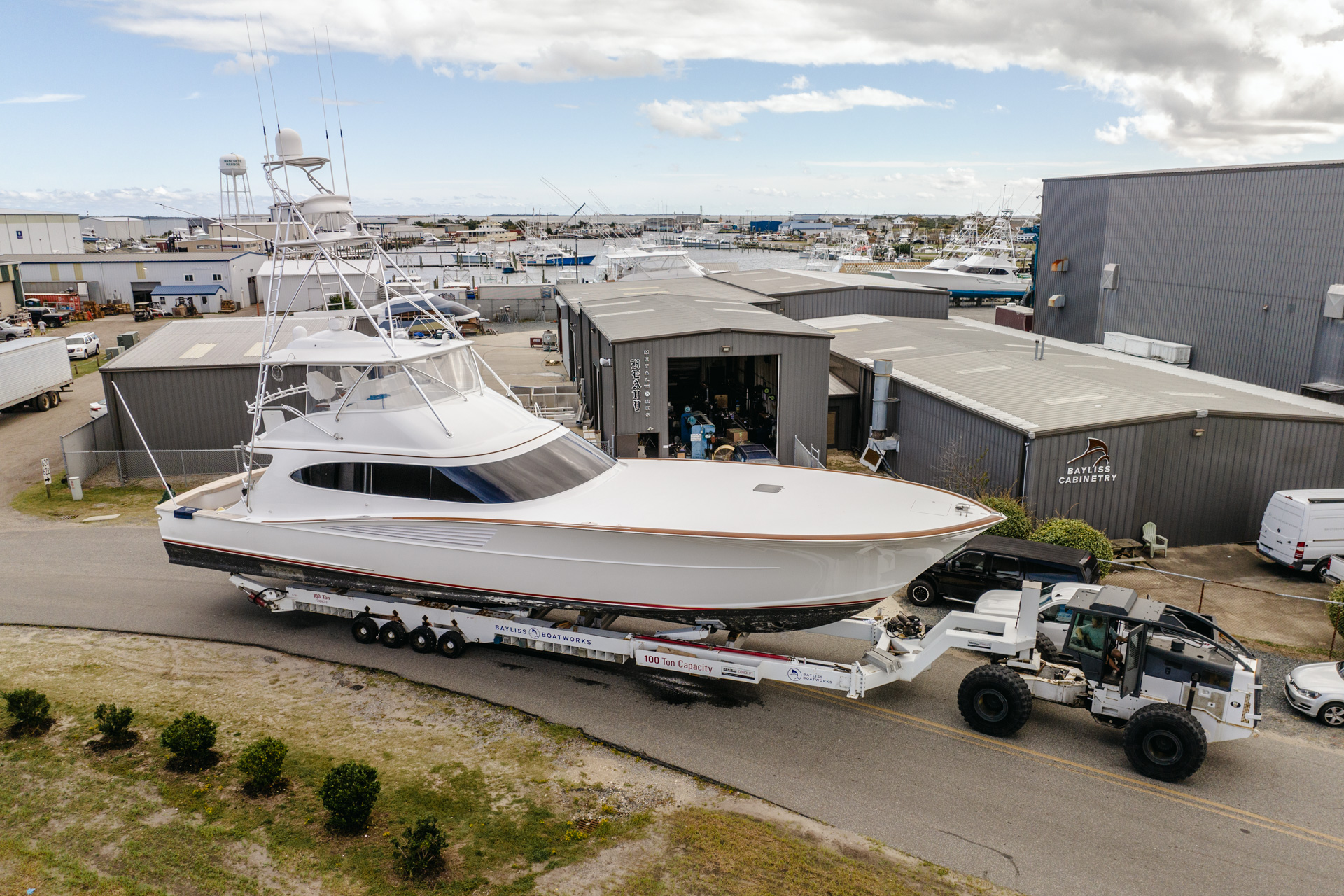 PHOTO: COURTESY BAYLISS BOATWORKS
Bayliss opened shop in 2002. He, along with Briggs, Ricky Scarborough Sr. and Spencer, would become forces in the sportfisher realm.
Spencer was an experienced Oregon Inlet Fishing Center captain. When he was 23, he needed a new boat but couldn’t afford one. He and his wife mortgaged their house and built a twin-engine 58-footer called Sizzler in a tin-roof shed. “And then I found out my passion was as much building the boats as it was the fish,” Spencer says.
He ultimately outgrew the shed and opened a second facility on the eastern side of Wanchese, where today he finishes out his 70- to 80-footers alongside his wife, Shelly, and five children.
In 2021, Sunny Briggs retired, though he’s still hand-building 20-plus-footers behind his Manteo house. Briggs’ waterfront real estate, situated right next to Bayliss’ Wanchese operation, was prime waterfront land. “We could have sold our business to another person in the area that wanted it bad,” he says, “but then Ricky Jr. approached me on it. Dee and I talked about it. And we just said, you know what? Who better than Junior to take over the shop? We could have made more money, but we made enough to satisfy ourselves.”
In 2022, Safe Harbor Marinas acquired OBX Marina in Wanchese, adding to its portfolio of facilities that encourages boaters of all kinds to hop from location to location up and down the Eastern Seaboard.
 PHOTO: COURTESY SCARBOROUGH BOATWORKS
“The one thing that I think is really important is that it all came from fishing,” Bayliss says. “And it was the same for the people before, when they started building shad boats that were sail-powered. But even back then, they were competitive with each other. It wasn’t just, like, slap some wood together and get from point A to point B and hold as many fish as you could. There was style involved. And I remember distinctly hearing guys like Omie pointing out certain things on certain boats that were really pretty at the time. That inspired builders to keep getting better and keep evolving — and that’s been carried on all this time. It’s really crazy that it started like that, and that it still continues now.”