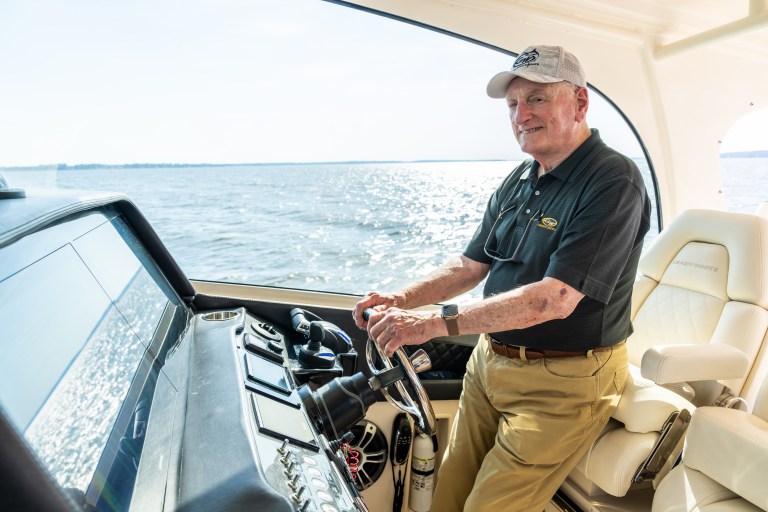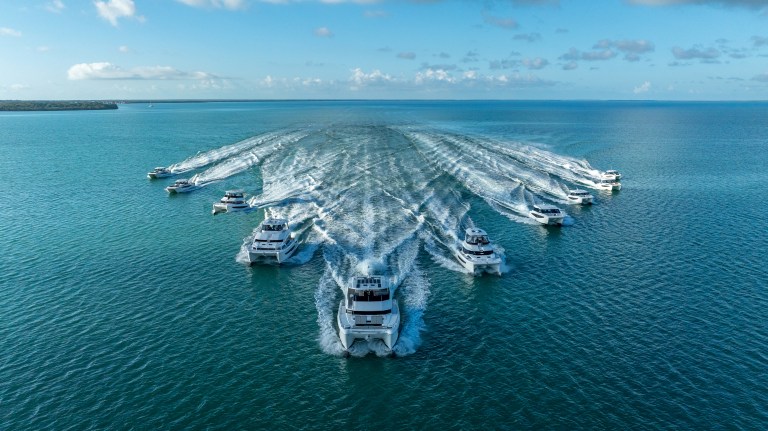
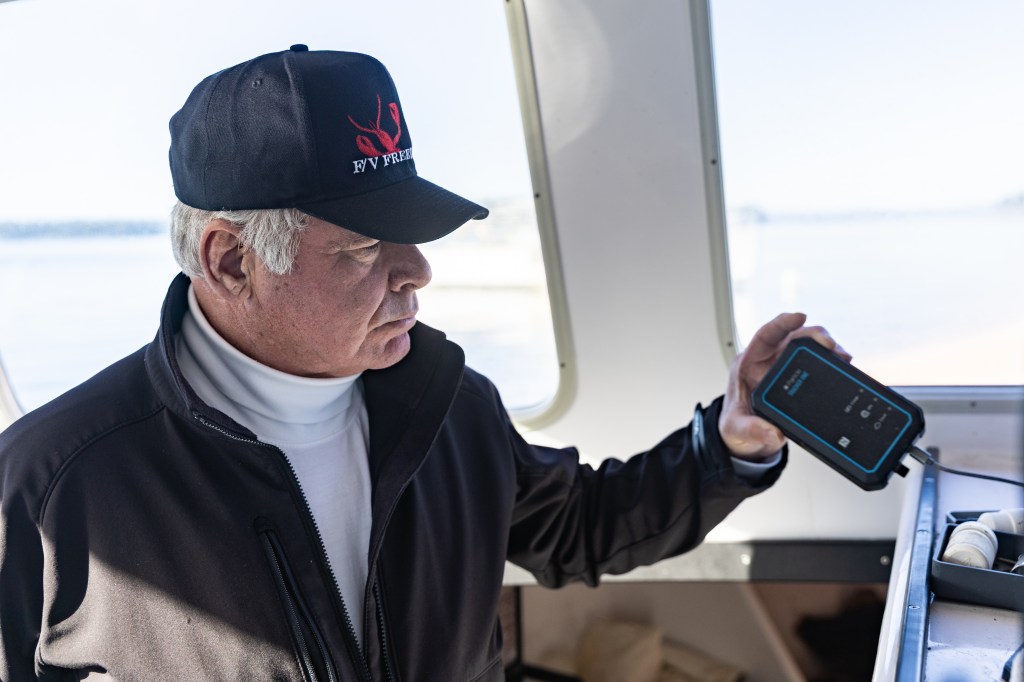
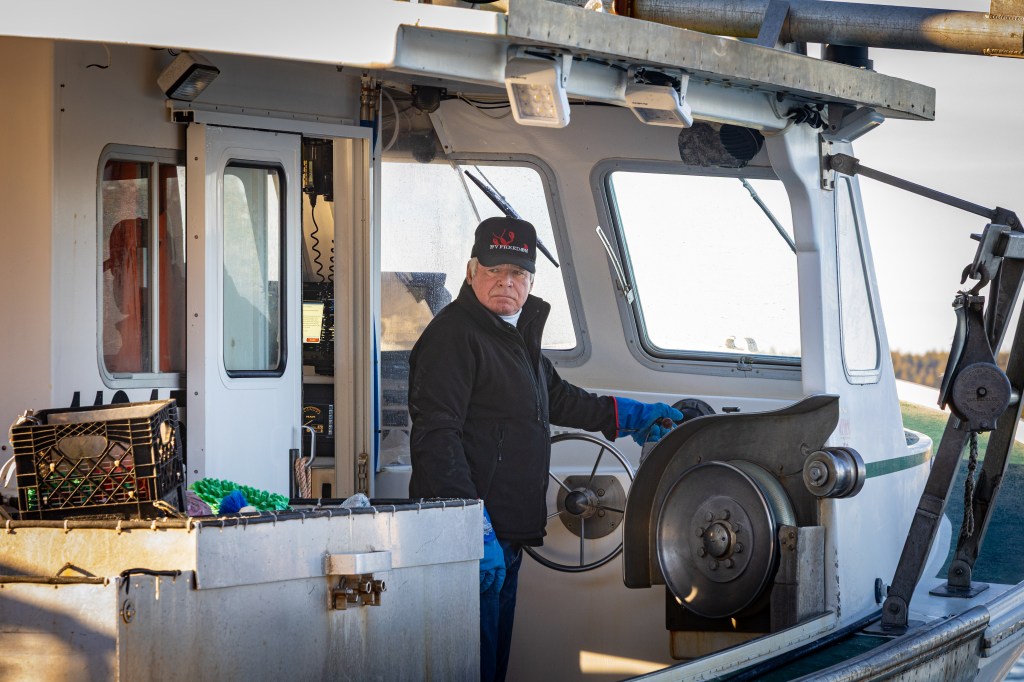
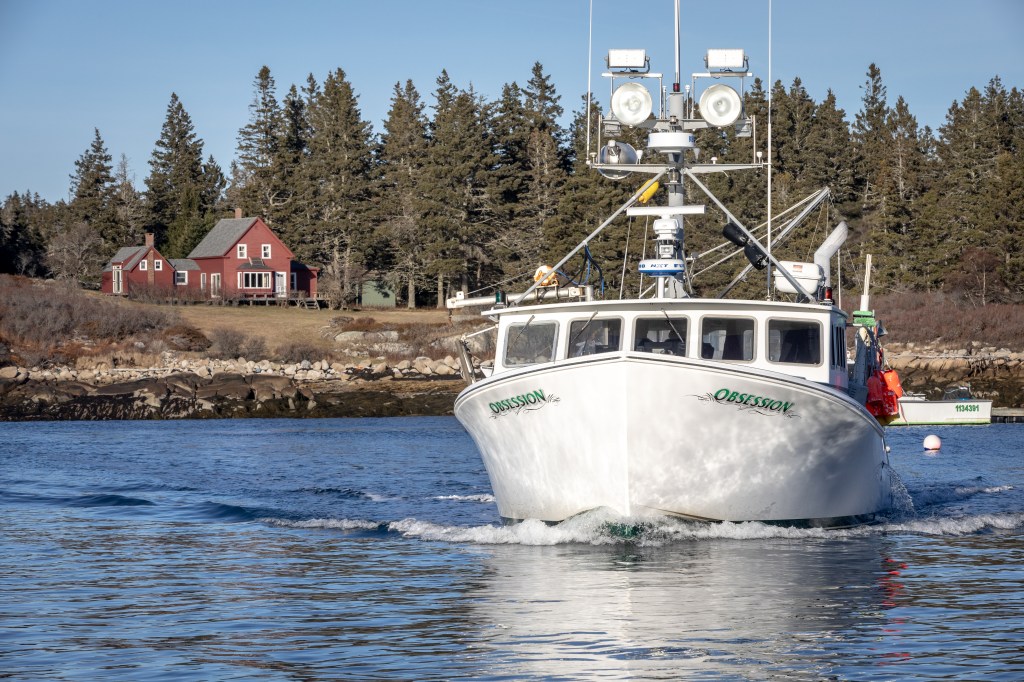
Fifth-generation Maine lobsterman Frank Thompson runs a 50-foot Wesmac, along with a 48-foot Duffy. Like a lot of long-time lobstermen, he’s had to work hard to keep his business going amid all kinds of changes, from shifting weather patterns to an increasing number of regulations that many say are overly burdensome.
One rule in particular has Thompson so frustrated that he’s asking the U.S. Supreme Court to step in on the grounds that it violates his constitutional rights. In 2023, the Atlantic States Marine Fisheries Commission, which covers Atlantic coast states from Maine to Florida, required all federally licensed lobster boats to install and continuously operate GPS trackers that send the vessel’s location to the government at least once per minute. Under this mandate, the tracker must remain active whenever the boat is in the water, even when being used recreationally.
At the time, the Massachusetts Division of Marine Fisheries described the mandate by writing that “one of the biggest blind spots in the assessment and management of commercial fisheries will be resolved. Precise location of lobster fishing effort, especially in federal waters, has been absent from the collection of statistics for this important fishery. Over the past two decades nearly all other important offshore commercial fisheries (such as scallops, groundfish and surf clams) have been required under federal regulations to deploy vessel monitoring systems that reveal and archive fishing locations. A new coastwide requirement for tracking devices to be placed on lobster vessels operating in federal waters will soon address this deficiency.”
Thompson’s U.S. Supreme Court petition argues that the constant-monitoring requirement violates Fourth Amendment protections against unreasonable government searches and seizures. A district court dismissed Thompson’s initial lawsuit that challenged the mandate, claiming a Fourth Amendment exception that allows the government to engage in warrantless surveillance within a closely regulated industry like lobstering.
Thompson has now filed a petition, with pro bono assistance from Pacific Legal Foundation, asking the U.S. Supreme Court to step in and hear his challenge. Attorney Matt Gilliam, with Pacific Legal Foundation’s environment and natural resources practice group, told Soundings Trade Only the principles underlying Thompson’s case apply to far more than just tracking lobster boats.
“We point out in our petition, and we have amicus curiae who filed briefs in support of granting our petition, that this can go much further beyond lobstering and the fishing industry,” Gilliam says. “What the First Circuit essentially did here was say it doesn’t matter that Frank Thompson and these lobstermen are being tracked outside of commercial areas and hours. They can still be tracked. So any business owner with property they are using during business and outside of business is capable of falling into this trap where they’re subject to surveillance.”
To that point, the petition requesting U.S. Supreme Court action, filed in March, states: “Today, almost all businesses are heavily regulated. Thus, many individuals and small business owners are susceptible to being considered part of ‘closely regulated industries,’ meaning they too can be subjected to 24/7 surveillance — even when they are not using their property for commercial purposes.”
Gilliam says “many industries could fall under this just because someone deems them to be highly regulated. Specifically with respect to boating, I think if a ruling like this is allowed to stand, it will just spread.”
The petition states that what’s happening with lobster boats is part of a “larger trend of the government trying to impose warrantless GPS tracking on fishing vessel owners. A similar GPS tracking requirement was struck down by the Fifth Circuit in the context of charter fishing.”
It adds separately: “Attaching a tracker is not a one-time intrusion but a continuous search of a person’s movements. This shows not only that the unlawful harm Mr. Thompson suffers because of a continual warrantless search will remain, but also the recurring nature of warrantless trespassory searches on private property.”
The mandated tracker, Gilliam adds, is a specific model that’s made in China, that’s Bluetooth and Wi-Fi capable, and that can collect audio on board.
This GPS tracking battle is happening at the same time the marine industry has seen intense opposition to proposed East Coast speed-restriction rules that the National Oceanic and Atmospheric Administration says are needed to protect North Atlantic right whales from vessel strikes. That proposed rulemaking resulted in a flood of opposition, as well as congressional testimony, an industry task force and continuing advocacy on Capitol Hill.
The Atlantic States Marine Fisheries Commission similarly described the requirement for GPS tracking devices on lobster boats as being needed, in part, to “identify areas where lobster fishing effort might present a risk to endangered North Atlantic right whales.” Gilliam says the lobster industry’s response to that claim has mirrored the boating industry’s response to the speed-restriction claim.
“Lobstermen who have been doing this for decades said they’d never even seen a whale,” Gilliam says, adding that government entities also gave other reasons for the tracking devices. “In Maine, they justified it based on a need for harvesting data. The lobstermen were self-reporting that data, but they said they wanted higher resolution.”
The petition, Gilliam explains, asks the U.S. Supreme Court to consider the lobster-tracking situation in the context of its decision in a case called United States v. Jones. “The Supreme Court held in the criminal context that to place a tracking device on a vehicle, and then to surveil that vehicle 24/7, is a trespassory search. You need to have a warrant or you violate the Fourth Amendment,” he says.
“Any business owner with property they are using during business and outside of business is capable of falling into this trap where they’re subject to surveillance.”

Attorney Matt Gilliam
Pacific Legal FoundationSurveillance and trespass are separate things, Gilliam adds. He says the 24/7 surveillance is a violation of the Fourth Amendment beyond the trespass violation. “The case law that applies to the non-criminal context says that the same protections apply,” Gilliam says. “People don’t surrender all of their Fourth Amendment protections just because they’re in an administrative context. The same law should apply.”
The petition filed with the U.S. Supreme Court notes that Thompson “does not argue that all trespassory searches are categorically unreasonable, but only that a continuous, non-consensual, warrantless, license-conditioned trespass on private property used for non-commercial purposes cannot be justified under the administrative-search doctrine.”
Those non-commercial uses of lobster boats, Gilliam says, include all kinds of things, such as emergency search-and-rescue operations. “There’s a story in our petition about how Frank Thompson took his daughter-in-law to the mainland to give birth to his granddaughter,” Gilliam says.
There’s no certainty about a timeline for the U.S. Supreme Court to respond to the petition, but Gilliam says he hopes to hear something by early or midsummer about whether the court will hear the case. He adds that Pacific Legal Foundation’s purpose with this case, and with all its cases, goes well beyond the marine industry. The foundation exists to challenge overzealous regulations and mandates in all kinds of industries.
On social media, the foundation’s self- description is: “We sue the government — and we win,” with a note that its attorneys have an 18-2 record before the U.S. Supreme Court. “That’s what Pacific Legal Foundation is trying to fight,” Gilliam says. “We’re here to defend Americans from government overreach and abuse.”
Editor’s note: Pacific Legal Foundation previously represented freelance writer Kim Kavin pro bono in a case against U.S. Labor Department rulemaking about independent contractors.
This story originally appeared in the June 2026 issue of Soundings Trade Only.