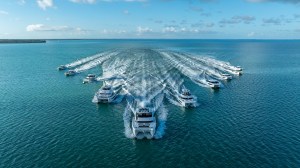

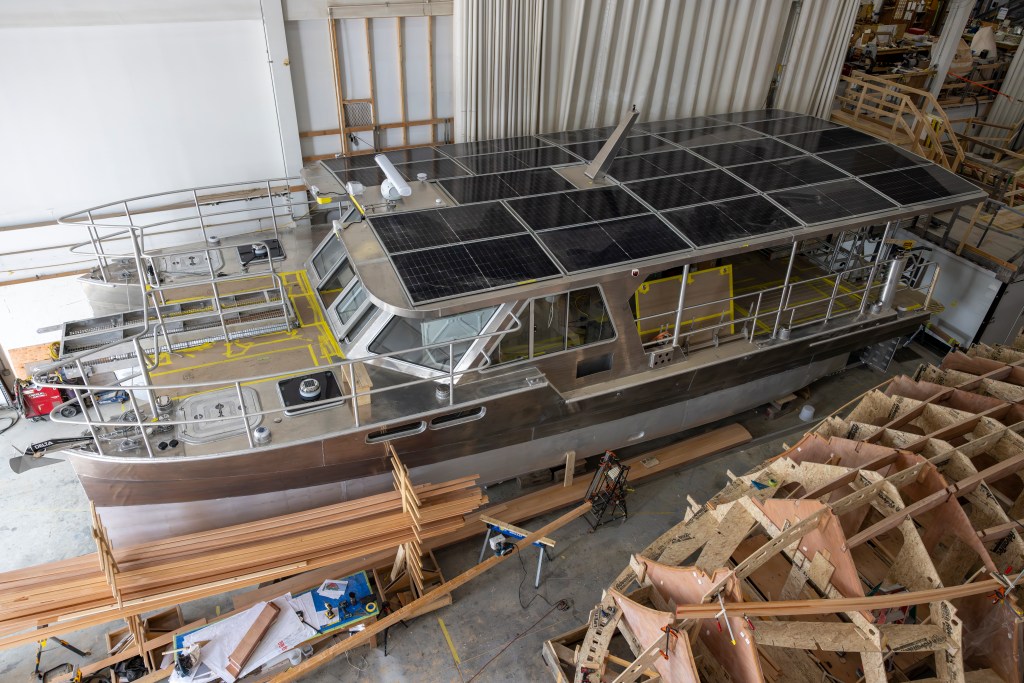
Lyman-Morse is best known for yachts like the new C.W. Hood Lyman-Morse 42, but in August, the builder launched Firefly, a 49-foot passenger cat that Upstream Alliance commissioned as the first vessel of its kind.
Upstream Alliance is a nonprofit organization that provides on-water experiences for conservation leaders who can improve public access, clean water and coastal resilience. Firefly, which is all-electric and solar-powered, is a Dave Gerr design that will be used as a working and teaching platform for Upstream Alliance’s education project in Camden, N.J.
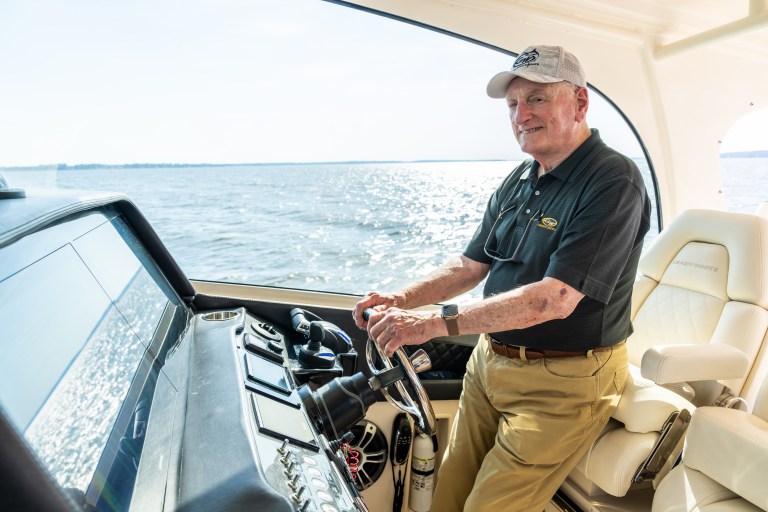
It’s the first boat certified by the Coast Guard with a bank of lithium-iron-phosphate batteries, an achievement by a team that Upstream Alliance president and founder Don Baugh assembled back in 2021. “We did not want any fossil fuels on the boat,” Baugh says. “We wanted it to be powered by the sun only. We think that technology is the future. It’s also technology we wanted the kids to learn about so they could think about the careers they might be going into.”
Upstream Alliance bid out the build to several yards; Baugh called Lyman-Morse “always like a stretch for us” given its reputation as a yacht builder. “They came in with what we thought was a very competitive price,” Baugh says. “Throughout the process, I couldn’t say more good things about Lyman-Morse and the people they have.”
Lyman-Morse at Work
The build went to LM Workboats, the commercial and government vessel division of the nearly 50-year-old Maine boatbuilder, which operates across facilities in Thomaston, Rockland and Camden. “We’re one yard with multiple areas of specialization, not separate companies,” says Jonathan Egan, division manager of LM Workboats.
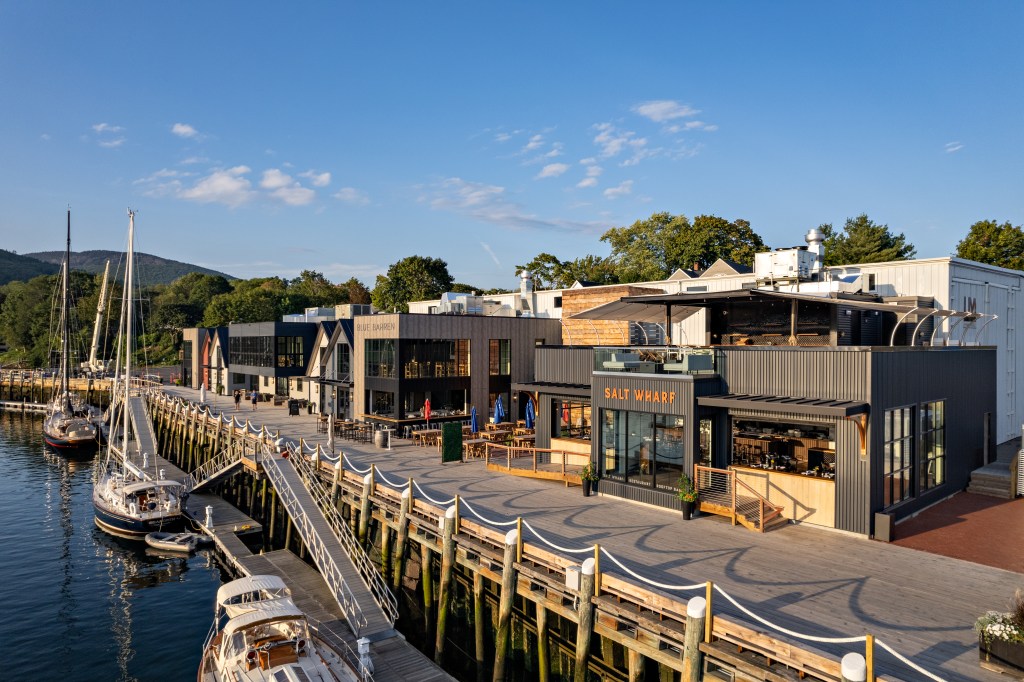
Lyman-Morse’s operation is organized into four divisions: LM Boatbuilding, which handles custom yachts; LM Workboats; LM Technologies, focused on R&D and advanced composites; and LM Service, which covers storage and transient customers. Firefly drew on more than one of them. “It was primarily an LM Workboats build, with real support from Boatbuilding’s outfitting team,” Egan says, adding that Lance Buchanan, who heads LM Boatbuilding, served as lead project manager on Firefly throughout.
Firefly has a pair of Electric Yacht QuietTorque 48V motors. Each supplies 50 kW (about 66 hp) with roughly 400 kWh stored across 48 Lithionics 51V lithium-iron-phosphate batteries, according to Buchanan. That configuration gives the boat about 80 nautical miles of range at 6 knots, or 41 nautical miles at 11 knots, with shore charging running through five 50-amp cords.
On the canopy, a 10,320-watt solar array spread across 24 panels covers roughly 12% of the boat’s day-to-day power needs, Egan says, with the rest coming from the battery bank topped up via shore power. “There’s no other on-board power source,” he says. “Firefly is fully electric.”
The Batteries
As a Coast Guard Subchapter T vessel, Firefly requires an approved fire suppression system. The battery certification process was the biggest technical challenge, according to Egan and Buchanan. The prevalence of lithium batteries is forcing the Coast Guard to adapt its guidance to incorporate appropriate safety systems and regulation, Buchanan says, adding: “The Firefly project has been on the leading edge of this development.”
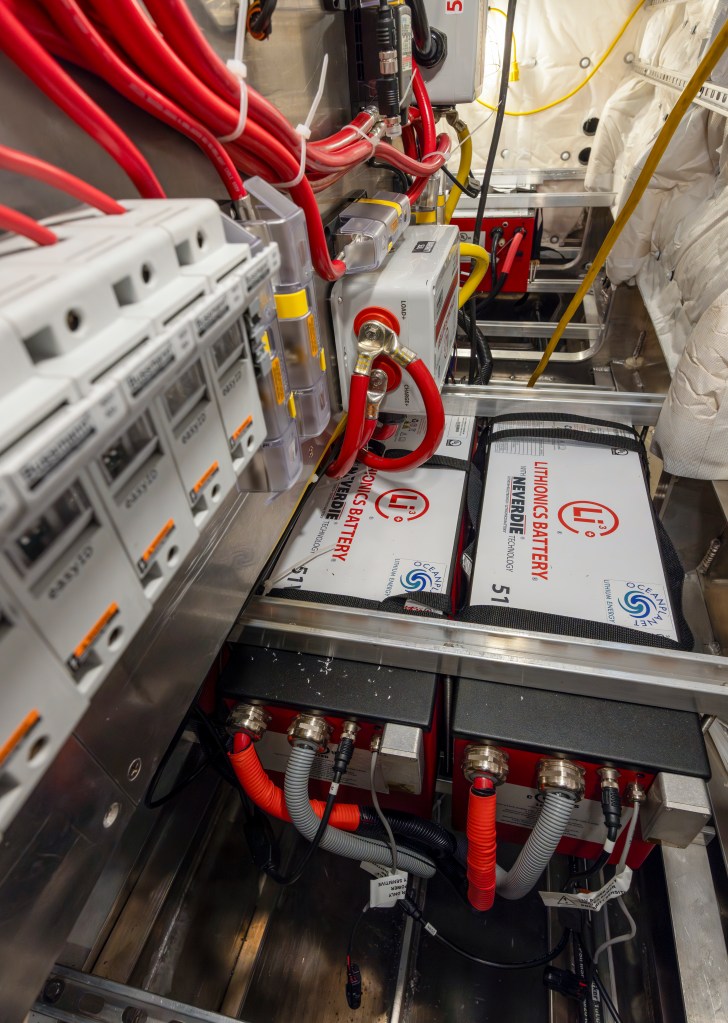
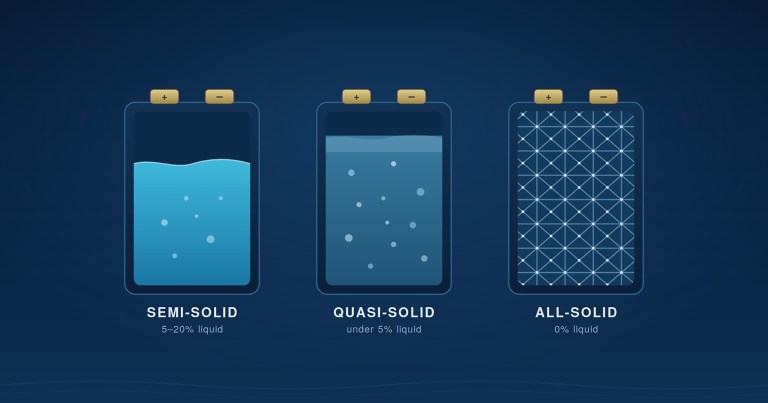
Baugh adds: “The very critical function here is that with lithium-iron-phosphate, you don’t have the energy that you have like an array of lithium-ion battery. It’s much safer because the cells don’t propagate from cell to cell, from battery to battery. So you don’t have the thermal runaway events that you’re going to have with the lithium-ion battery — hugely important on any boat, particularly a school boat.”
Baugh brought in battery expert Roberto Melendez, trained at Massachusetts Institute of Technology and still rooted there, which is why MIT was the first stop on Firefly’s delivery voyage this summer. “Roberto Melendez was extremely essential at understanding what these batteries are, what they can do, how to treat them, and also helping with the Coast Guard to explain what these batteries are,” Baugh says.
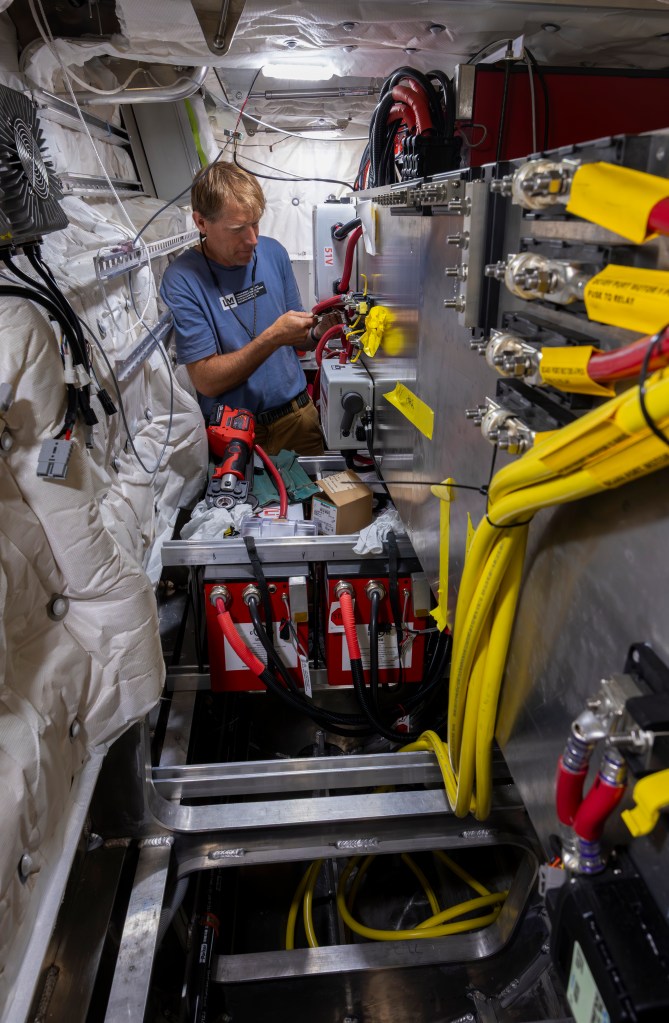
Upstream Alliance ran a fundraising campaign for the battery bank, letting donors buy a half or full battery and have their name placed on the boat. “We raised nearly $240,000 to do that, for half of the bank of batteries in the boat,” Baugh says.
Lyman-Morse teams also worked closely with the Coast Guard Marine Safety Center in Washington, D.C., through the design and build, securing plan approval at each stage before production, Buchanan added.
Innovative Tech
Beyond Firefly, Lyman-Morse continues to invest in advanced manufacturing, Egan says. “The 3D metal printer wasn’t used on Firefly itself, but it speaks to the broader capability behind the company. Our advanced composites and manufacturing center runs a 3D metal additive printer and three large, five-axis CNC mills, and does work for the Department of Defense building projects for the Navy. That’s the kind of in-house advanced manufacturing depth that’s increasingly supporting builds across all Lyman-Morse divisions.”
Egan says Firefly draws on two of the company’s core strengths. The hull and the canopy grid carrying the solar array rely on the same aluminum fabrication expertise behind Lyman-Morse’s workboat fleet, “just optimized here for weight and efficiency rather than raw durability,” he says.
On the electrical side, Firefly’s battery bank is the largest the company has installed, building on experience from the Navier foiling electric yacht and the Halevai high-speed composite pontoon boat. “Not many builders our size can put that combination of aluminum fabrication and electrical systems integration together under one roof the way Firefly required,” Egan says.
Lyman-Morse is now building three fully electric aluminum catamaran water taxis for Merrimack Valley, Mass. They have high-voltage systems that Egan says extend Firefly’s experience to a larger program.
Looking ahead, Egan says, electric propulsion is gaining traction across the recreational and commercial markets. “Firefly put us right at the front edge of how the Coast Guard is adapting its guidance around large lithium battery banks, and that experience carries directly into every electric passenger boat we build next,” he says.
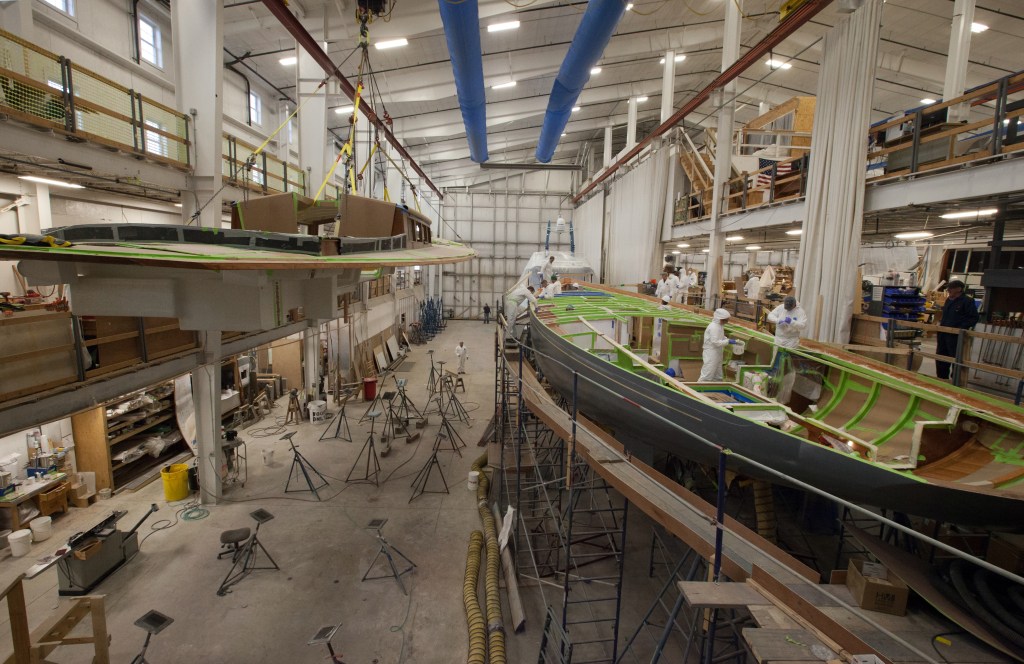
Lyman-Morse is also hosting the first Electric Watercraft Forum at its Camden, Maine, facility, bringing together industry leaders and vendors. “That combination of electric propulsion experience, regulatory know-how, industry convening and in-house advanced manufacturing is really what will define where Lyman-Morse goes next,” Egan says.
Firefly Launch
Firefly launched Aug. 3, followed by a Coast Guard mechanical inspection and four more Coast Guard inspections during the following weeks. Baugh was planning to captain the boat on its roughly 22-day delivery trip down the coast to Camden, alongside Upstream Alliance’s program and communications director Olivia Liu, handling communications and social media. A Lyman-Morse representative was expected to be on board the entire way, and the electrical/battery-management lead for the first 10 days. “It’s almost like one great big sea trial,” Baugh says.
Baugh says interest in the boat extends well beyond conservation circles. “I think you’re going to see it not just in ecological [organizations]. I think you’re going to see it in people that carry passengers at least, and well beyond that,” he says. “But in terms of boats that look like this, it’s being watched very carefully among our partner organizations.
“It’s a boat of the future,” he adds, “and second, it’s also a boat that we run with two people. And when you’re in the conservation education business, the people — that’s what eats you up in your budget.”
Building More Boats
Baugh says Upstream Alliance’s board is discussing building 10 similar boats to operate up and down the East Coast. “We also have an interest in promoting this boat if it works,” he says. “I think this is the beginning of something bigger.”
He notes that Firefly isn’t the first lithium-battery-certified passenger boat — that distinction belongs to Squid, a Key West, Fla., tour boat that, after early technical struggles, reverted to gas power. “That was a real lesson to me, which is partly why I wanted to get the best team in the country behind us, including the best builder,” Baugh says. “I feel like we’re the second wave of this. I call Squid the sacrificial anode, and we’re trying to do everything we can not to be a sacrificial anode. And the Coast Guard is helping to get it right the first time so that it’ll be the forbearer of boats in the future.”
Upstream Alliance: Reconnecting People With the Water
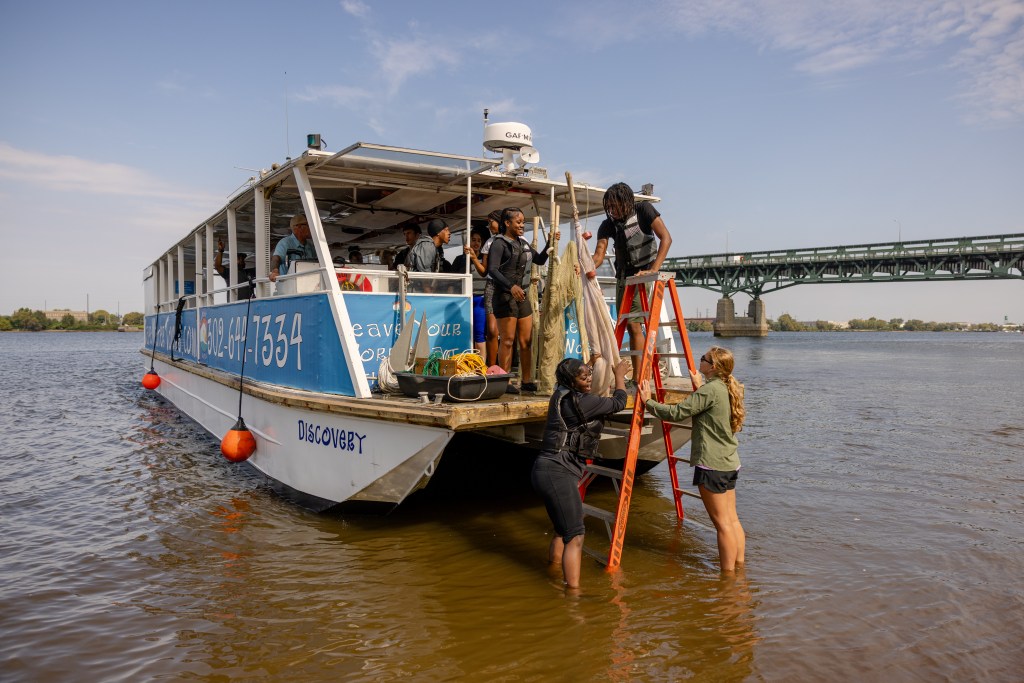
Upstream Alliance is a nonprofit conservation organization whose mission centers on three areas: clean water, public access and coastal resilience. It partners with organizations that champion these issues, and provides on-water experiences and networking to help those partners advance their work. The organization is based in Annapolis, Md., and was founded about 10 years ago.
The alliance works from New York City to Chesapeake Bay, with about 90% of its current effort focused on the Delaware River, particularly in Camden, N.J. Known historically as a “city of water,” Camden evolved into a major industrial powerhouse — home to the New York Shipbuilding Corp. and RCA Victor. But over time, people lost access to the water, and with that, they also lost many of the benefits a river can provide to a community.
The Firefly project grew out of Upstream Alliance’s three-part Camden strategy: reclaiming brownfield waterfront sites into an 8-mile linear park; building a 15.5-mile water trail; and running educational programs.
“If we could take every schoolkid on the water, and if we could do it three times between K to 12, and if we could do it integrated with the classroom curriculum so that it’s not just a one-day, fun-in-the-sun event, but that it’s part of a learning pathway, over time that would change the city, and it would change how the people react to the water,” president and founder Don Baugh says.
They believe that over five, 10, or 20 years, this repeated, structured exposure to Camden’s waterways will fundamentally change how Camden’s population relates to the river and allow residents to benefit from the Delaware once again. “Firefly is designed to immerse students in the Delaware River as a living classroom,” says Olivia Liu, Upstream Alliance’s communications director.
Upstream Alliance relies on corporate, foundation and individual support. Key supporters include the American Water Charitable Foundation, Subaru of America, private donors and the William Penn Foundation, along with operational backing from the Hamilton Family Foundation.
Through Firefly and its broader Camden initiatives, Upstream Alliance is positioning itself as both a catalyst for urban river revitalization and a standard-bearer for climate forward, educational passenger vessels — using technology, access and hands-on science to reconnect an underserved city with its river and with future green careers.
This story originally appeared in the September 2026 issue of Soundings Trade Only.