Natural teak has long remained the default choice for decking on premium yachts and superyachts, but new materials are displacing its dominance. A combination of supply-chain disruptions, sustainability pressures, rising costs and high-performance alternatives is steadily broadening the ideas about materials for a proper ship’s deck.
“Every vessel, every owner and every project has different priorities,” says Richard Strauss, CEO of Teakdecking Systems, a Sarasota, Fla.-based company that has been around for decades. “Some clients are focused on authenticity and tradition, while others prioritize sustainability, reduced maintenance, heat reduction or long-term durability. Our role is to provide the right solution for the application.”
The raw-material landscape surrounding teak has shifted dramatically in recent years. Sanctions on Myanmar — historically one of the most important sources of high-grade teak — combined with growing scrutiny of sourcing practices and tightening global supply chains have forced adaptation. Teakdecking Systems responded by strengthening sourcing oversight and diversifying its offerings, including adopting laminated teak from plantation-grown stock.
“As for the ultra-high end of superyachts, the default is still teak for the most part,” Strauss says. “We are seeing some movement toward laminated teak — still teak, though, as it comes from 30-year-old trees, which are too young to produce a quality vertical-grain teak, which is used in decking for superyachts. The laminated teak — we use Green Teak out of Thailand — is sliced into veneers and then glued and pressed in a proprietary method that produces a vertical grain appearance and is very stable, with all of the same characteristics of traditional vertical-grain teak.”
Even so, Strauss points to yachts such as the 361-foot Oceanco Leviathan, launched with composite decking, as a signal that non-teak solutions are no longer confined to production boats. “The composite is becoming a consideration,” he says, “but the mainstream is still teak in some variant.”
Approximately 20% of Teakdecking Systems’ projects involve alternative materials, including composites and cork-based products. Builders and shipyards are increasingly seeking materials that streamline maintenance and align with sustainability initiatives, Strauss says, while many boat owners are becoming more conscious of life-cycle costs, environmental impact and long-term upkeep. In some cases, owners are specifically requesting alternative materials from the beginning of the design process, even among traditionally conservative buyers.
Synthetics on Deck
A company that’s making a determined case for synthetic alternatives is Sweden-based Flexiteek, which opened a U.S. base in Florida less than two years ago and now counts more than 200 boatbuilders globally among its clients. Chad Adams, Flexiteek America’s managing director, says he sees the market as not quite at a tipping point but clearly moving.
In November 2024, Flexiteek launched its third-generation product, Flexiteek 3, built around a bio-attributed PVC that replaces fossil-fuel-based plastics with tall oil derived from sustainably managed timber in the United States and Europe. According to Adams, the switch has reduced greenhouse gas emissions by more than 80% compared with conventional PVC formulations, moving the needle with European OEMs.
“The U.S. market is still heavily reliant on teak, but a shift is starting to happen,” Adams says. In 2025, Flexiteek introduced Tritone, described as the first continuous changing-grain synthetic teak. It uses a proprietary manufacturing technique to vary color tone within individual planks. It’s available in three styles — teak, scrubbed and ash — and it directly targets the teak loyalist who has always found synthetic products too uniform and artificial-looking.
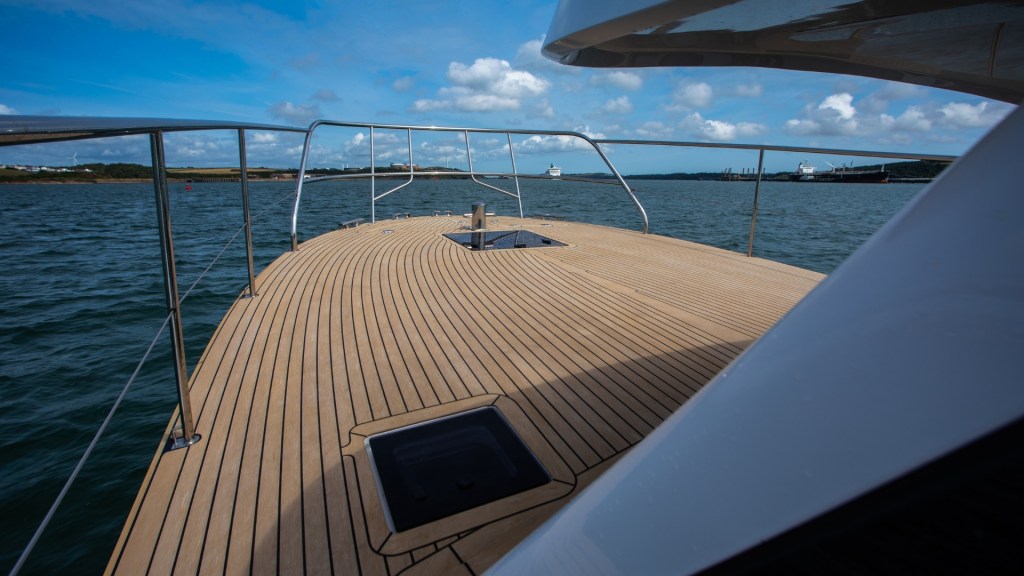
Durability, UV stability and easy cleaning are the product’s core commercial arguments. “One of the most important things boat owners tell us all the time is their need to reduce the amount of time they spend on teak maintenance,” Adams says. “Flexiteek 3 has significantly reduced the time it takes to keep a deck looking like new. This alone is proving to be a game-changer for boat owners.”
Adams notes one remaining gap among products: heat underfoot. He says Flexiteek 3 reduces surface temperature relative to earlier generations, an acknowledgment that this remains a genuine point of differentiation for natural and cork-based competitors.
Still, Flexiteek is growing. In May, the company acquired its Danish distributor, adding a fourth fabrication hub. “It means we are now best placed to produce, fabricate and install Flexiteek anywhere, offering an end-to-end service for boat owners and OEMs looking for a trusted decking partner,” Adams says.
Cork Makes Its Case
Amorim Cork Solutions, a Portuguese company with offices in Trevor, Wis., makes the marine brand Navicork. It’s the vehicle through which Amorim is positioning cork as a full-system decking platform rather than a niche material.
For several years, Amorim Cork Solutions has had a solid business in primary cork decking, says Udo Kleinitz, business development director for marine. “We have supplied granules and sheets to external decking companies, who then transformed them into final marine decking solutions,” he says. “However, this business was largely reactive. The decision to launch a dedicated brand through Navicork came from a clear strategic reading of the market: Marine was becoming a priority segment with real scale-up potential.”
One reason is buyers and builders who care about sustainability. “We have OEMs approaching Amorim Cork Solutions specifically because of cork’s sustainability performance,” Kleinitz adds.
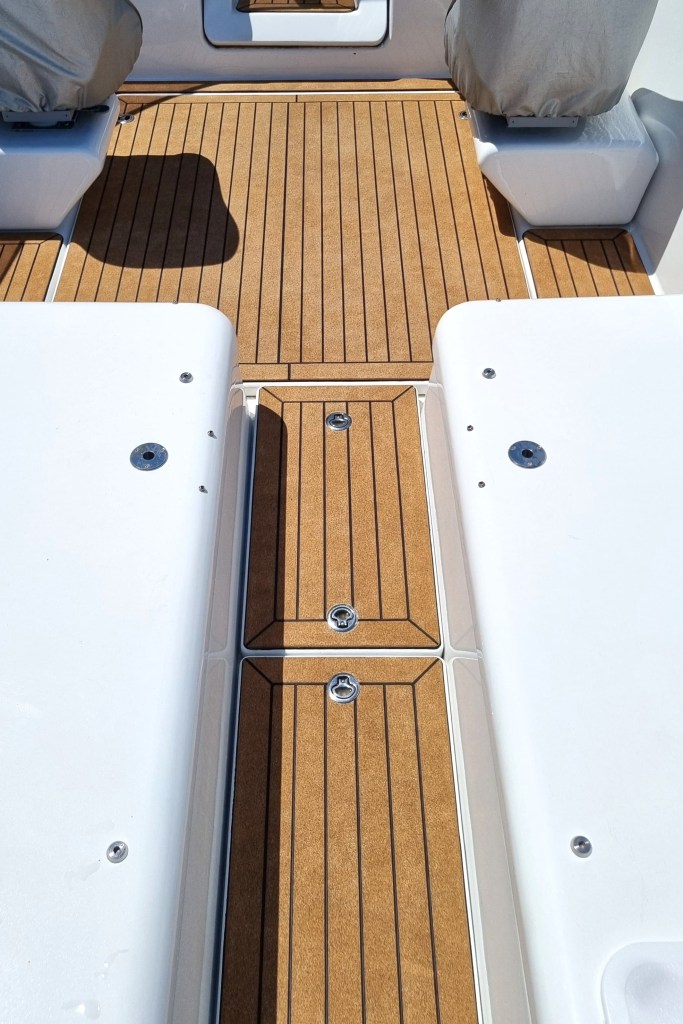
Cork bark is harvested without felling the tree. A cork oak can be stripped roughly every nine years for more than a century, and the harvested material actively sequesters carbon. And, Kleinitz says, it’s a good product. “We would not have the client base we have today if the product did not also perform well and make sense commercially,” he says. “Performance, price, installation efficiency and production fit are still decisive factors.”
The company’s FD01 remains the premium, most natural cork decking product, especially for surface temperature, touch and carbon-dioxide performance. The newer FD02 “gives us a more cost-effective and scalable option for a broader market,” Kleinitz says. FD02 is a peel-and-stick option, drawing on Amorim’s automotive industry know-how that will compete closer to EVA foam decking.
“Together, they allow Navicork to move from a niche material proposal to a full decking offer for different customer needs, price points and production realities,” he says.
One OEM has reported improved abrasion test results on coated decks, he says. Moisture management — ensuring dimensional stability through humidity cycling — has also required engineering attention so that once a deck is fully bonded and installed, movement is minimal and does not create meaningful stress on the substrate, Kleinitz says.
Treading Slowly
Representatives from all three companies say patience is needed for the marine industry to change materials. New products must earn trust from a daisy chain of stakeholders: owners, designers, engineers, shipyards and the craftsmen who install decking by hand.
“The biggest barrier is not technical performance. It is familiarity,” Kleinitz says. For cork, the challenge includes overcoming an outdated perception, that cork means pinboards and wine stoppers rather than aerospace components and automotive interiors. “Education is therefore a critical part of the process. In the marine sector, we are working to demonstrate cork as a premium performance material rather than simply a sustainable alternative.”
Navicork’s approach focuses on three pillars: generating data that allows OEMs to validate the product through their own testing protocols; shifting the perception of cork from rustic novelty to engineered material; and building a visible track record of successful installations. “Nothing builds confidence like seeing successful applications in the market,” Kleinitz says.
Adams says Flexiteek’s installations and its roster of more than 200 boatbuilders are the most durable competitive advantage the company has. “It’s taken us 26 years to build this level of relationship and trust,” he says.
Next Market Moves
The experts’ best assessment for this market moving forward is that natural teak will hold in the superyacht sector and for boat owners who prize authenticity. Synthetics will expand in production boatbuilding and among owners who are tired of maintenance regimens. Cork use will grow among sustainability-conscious OEMs and buyers who want a natural material without sourcing complications.

“The future is not one material replacing another,” Strauss says. “It’s about giving clients more choices than ever before.”
Kleinitz says cork composites will occupy a stronger and more visible position in the market within five years as builders, yards and owners look “for a better balance between comfort, sustainability, performance and process efficiency.”
For now, teak still reigns as the quintessential decking material, even as the market continues to diversify.