
The most interesting marine technology does not always begin with a broad ambition to transform the industry. Often, it starts with an operational problem: a boat that cannot safely access certain waters, a marina relying on a weather forecast that does not reflect conditions inside its own basin, a race committee spending hours positioning marks manually.
At Yachting Ventures, we work with early and growth-stage companies addressing these kinds of problems across the marine industry. Increasingly, we are seeing founders take technologies such as autonomy, artificial intelligence and electrification, and apply them to practical challenges around safety, efficiency and access. Three such companies worth watching are Keraunos, Benchmark Labs and Robobuoy.
Keraunos
Electric propulsion is becoming increasingly relevant across United States’ inland and protected waters, but the team at Keraunos says replacing an internal-combustion engine with an electric motor addresses only part of the problem. The Utah-based startup is developing the Odyss-E, a 15-foot inflatable electric trimaran with no propeller, skeg or lower unit protruding below the hull. Instead, twin ducted electric water jets provide propulsion, with differential thrust allowing the boat to steer, rotate in place and hold a heading without an anchor.
The design is aimed at waters where conventionally powered craft face restrictions. Electric-only and no-wake zones are expanding, while exposed propellers and lower units create safety concerns around swimmers, divers and marine mammals. By removing those components, Keraunos is building around access and safety as much as electrification.
The second challenge is charging. A 400-watt solar canopy and pedal generators feed the same battery system as the electric drives, allowing the boat to generate energy while operating. For rental fleets, parks and concessionaires working away from established marina infrastructure, that setup could remove one of the practical barriers to adopting electric craft.
Keraunos has built and tested three prototypes, with another two pilot units in production. In June, the company completed a multiday unsupported transit of Utah’s Desolation Canyon using harvested energy alone, without fuel, shore power or a support vessel.
The company has also filed a U.S. provisional patent application covering elements of its propulsion, station-keeping and energy-management systems. It also completed an independent American Boat & Yacht Council design review and is operating as a Coast Guard-registered boat manufacturer.
During the next 12 months, the company will shift focus toward production engineering and commercial deployment, particularly among rental operators and public-land concessionaires. Keraunos is also exploring government and defense applications for its shallow-draft, propeller-free platform.
Benchmark Labs
Weather forecasting has become extraordinarily sophisticated at the global level, but that does not necessarily mean a marina operator knows what conditions will be like at a particular fuel dock, quay wall or entrance channel.
Benchmark Labs is trying to close that gap. The company develops point-specific, operational weather intelligence for industries including marine, construction, energy and agriculture. Its marine product, WaveCast, connects with weather stations and smart buoys already installed at a site and combines their data with global weather models to produce forecasts calibrated to the precise location of each sensor.
That distinction matters in coastal environments. Global numerical weather models typically work across grid areas measured in kilometers, which can smooth out the effects of breakwaters, harbor geometry, shoreline topography and local land-water temperature differences. Conditions at the entrance to a marina can differ materially from those experienced inside the basin.
For marina operators, better local forecasting has implications beyond deciding whether it will rain. Wind spikes and storm surges can affect vessel and dock safety, while weather windows influence fuel-dock operations, haul-outs, maintenance, lifting operations and charter departures.
Benchmark Labs’ approach is also designed to work with infrastructure that operators already own. Rather than requiring marinas to replace existing weather stations or Internet of Things sensors, the platform ingests non-proprietary sensor data and applies location-specific machine-learning models to it.
The technology has already been commercially deployed in sectors including agriculture and land-based asset management. The New York City Economic Development Corp. selected Benchmark Labs to pilot its forecasting technology at Pier 4, and the company has worked within an offshore wind cohort led by Equinor and British Petroleum in collaboration with Urban Future Lab and the National Offshore Wind Research & Development Consortium.
More recently, the company was accepted into StartBlue, the ocean-focused accelerator that’s with the University of California San Diego’s Scripps Institution of Oceanography and Rady School of Management. Benchmark Labs has also secured strategic investment from Cultivate Next and follow-on investment from NextView Ventures.
In the coming year, Benchmark Labs plans to expand its models across marinas, coastal waterways and offshore transportation corridors, while building application programming interface integrations with dock-management platforms, port operations systems and marine IoT hardware. The aim is to bring localized alerts directly into the software that operators already use.
Robobuoy
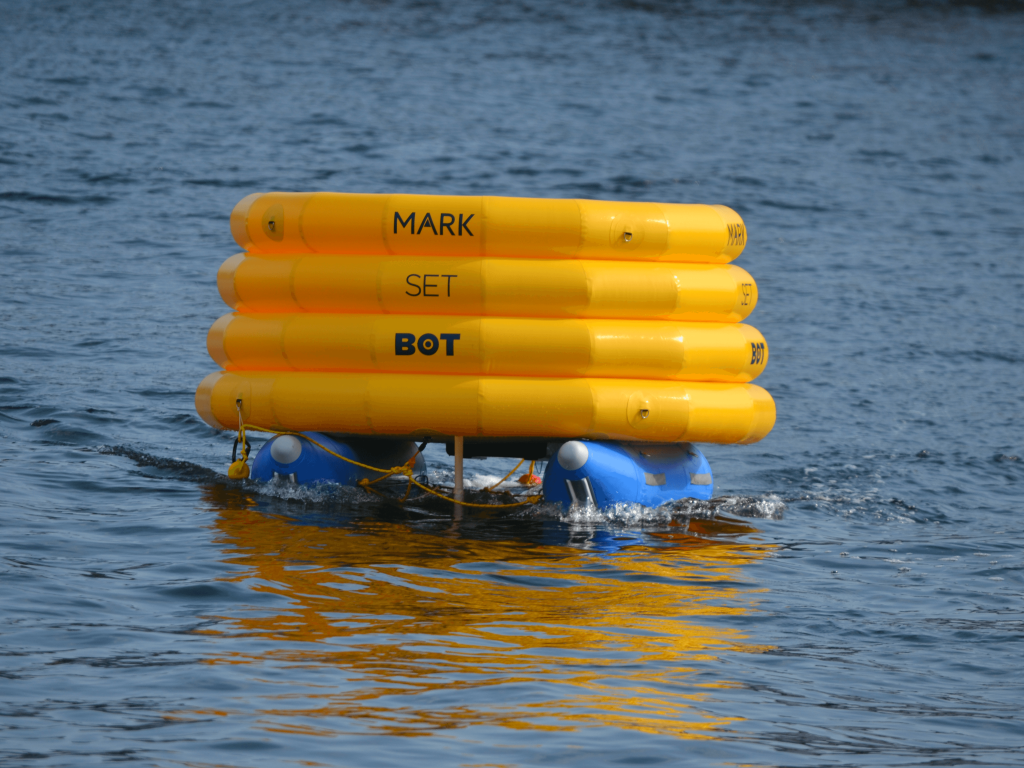
Autonomy is another technology moving rapidly from experimentation toward practical marine applications, and Robobuoy provides an interesting example of how one core platform can address several markets. The company has developed a patented, cloud-connected, autonomous marine platform that can navigate to GPS coordinates, hold position without an anchor and move on command through an app.
Its technology currently sits behind three brands. MarkSetBot automates the positioning of marks for sailboat racing; GolfShotBot creates movable floating targets for waterfront golf entertainment; and NavalBot adapts the same underlying platform for defense, aerospace and scientific applications.
The common thread is replacing anchored, labor-intensive or purpose-built solutions with a mobile autonomous platform. In sailing, that approach can reduce the number of volunteers and support boats required to set and reposition a racecourse while avoiding repeated anchoring.
The numbers suggest the technology has moved well beyond the prototype stage. More than 240 organizations across 40 countries have used Robobuoy’s technology, accumulating more than 78,000 Bot-days. MarkSetBot has been deployed at events including the America’s Cup and Pan American Games, while GolfShotBot has been used in conjunction with the U.S. Golf Association, PGA Senior Tour Championship and Ryder Cup. The company has also adapted its platform for aerospace and defense projects, and completed a $1.07 million Regulation Crowdfunding raise at a $10 million valuation.
Robobuoy entered this year with sales exceeding its full-year 2025 performance and is targeting approximately 30% annual growth. Its next phase is focused on scaling the business across multiple markets while continuing to develop the autonomy, communications, software and payload capabilities underpinning the platform.
Important Ties
What links these three companies is not the technology itself. One company is rethinking small electric craft, another is applying machine learning to weather intelligence, and the third is building autonomous marine platforms. But they share a focus on identifiable operational problems and a pathway toward commercial adoption.
At Yachting Ventures, our role is to help promising marine startups make those connections with the customers, industry partners and investors who can help them move from early traction to meaningful scale.If you are building a startup for the marine industry and looking for support, industry connections or investment, we would be glad to hear from you. Equally, if you are an investor looking for opportunities across the marine and blue economy startup ecosystem, get in touch with Yachting Ventures to learn more about the companies in our network.
Gabriella Richardson is the founder of Yachting Ventures.
This article first appeared in the October 2026 issue of Soundings Trade Only.