
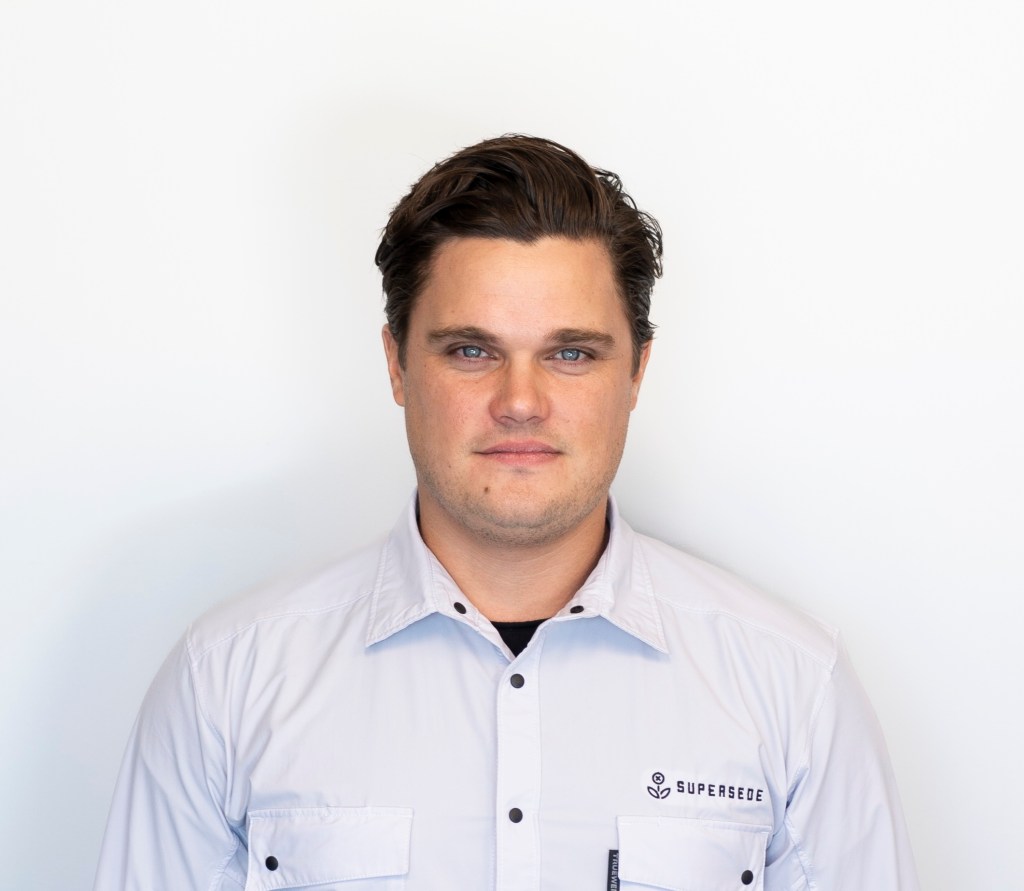
Sean Petterson grew up on Long Island, N.Y., boating, spearfishing and spending time at the docks. His first job was as a dockmaster at a local marina. He soon started flipping boats, which meant learning how to fix and build them from the inside out. That hands-on experience gave him a foundation he still draws on today.
After graduating from the Rochester Institute of Technology in 2012, he held multiple roles, including creating StrongArm Technologies. In 2024, he co-founded Phoenix-based Supersede. The company’s goal is to replace conventional wood-based building materials with products that transform the lumber supply chain and apply automotive engineering principles. (This interview has been lightly edited for length and clarity.)
Before founding Supersede, you built and sold StrongArm Technologies. Tell us the story of that company.
StrongArm came from a very personal place. I grew up watching my father work in construction, and I lost him to an accident on the job. When I looked around at the world of product design and innovation, I saw entire teams creating consumer products, but virtually nobody building products to protect the people doing the hardest physical work. That gap felt wrong to me, and I decided to do something about it.
StrongArm started with exoskeletons, wearable devices designed to support proper posture and reduce strain on industrial workers during physically demanding shifts. But as we deployed those early products, we realized that hardware alone was not enough. The real opportunity was data. We built out a safety science platform using wearable sensors and AI-driven analysis to collect, assess and predict injury risk in real time, giving employers the insight to adjust workflows before people got hurt. The mission was simple: Keep industrial workers proud, productive and protected.
We were the only company offering real-time safety and productivity data for the manual workforce at that level. We eventually sold the company in 2023, and I am proud of what the team built and the impact we had on workers’ lives.
What did running that company teach you that you applied to launching Supersede?
Running StrongArm taught me that the most important thing you can do when you are trying to introduce something new into a legacy industry is to remove every possible reason for someone to say no.
Industrial employers were resistant to new technology because adoption felt risky and complicated. The moment we made the technology feel familiar and frictionless, the conversations changed entirely. I carried that lesson directly into Supersede. We engineered the Marine Board from day one to install using the same tools, the same methods and the same workflows builders already use. We did not ask anyone to change how they work; we just made what they were already doing better, and as a result, we were able to gain significant traction.
StrongArm also taught me the power of data in making a case. We built a rigorous evidence base to quantify our technology’s performance, and partners really appreciated the ability to see how impactful the solutions were, not just at a theoretical level but with hard numbers. At Supersede, we took the same approach. Before we ever reached out to a production builder, we built an extensive benchmark catalog that characterized performance across every existing marine board on the market, including all the natural variation in wood products. That gave us a foundation for commercial conversations that was grounded in evidence rather than claims.
StrongArm also taught me something important about mission. I started that company because I had seen firsthand what the cost of preventable harm looks like. At Supersede, my co-founders Jordan [Darling], Shane [Kenyon] and I are driven by a similar conviction: that the industries we grew up around deserve better materials, and that doing right by the environment and doing right by your customer do not have to be in conflict.
When did you decide that your next project would be in the marine industry?
The goal is simply better building materials. The three of us grew up loving the outdoors and shared a genuine connection to the environments our products would ultimately serve. When we came together, the pieces clicked quickly. Jordan and Shane had worked in the powersports and EV industry, working with tier-one suppliers. We all saw the same problem: a massive, entrenched industry still dependent on a material with well-documented failure modes, a volatile supply chain and real environmental costs. Marine was the natural place to start proving we could build something better.
How did the idea for a recycled plastic plywood replacement come about?
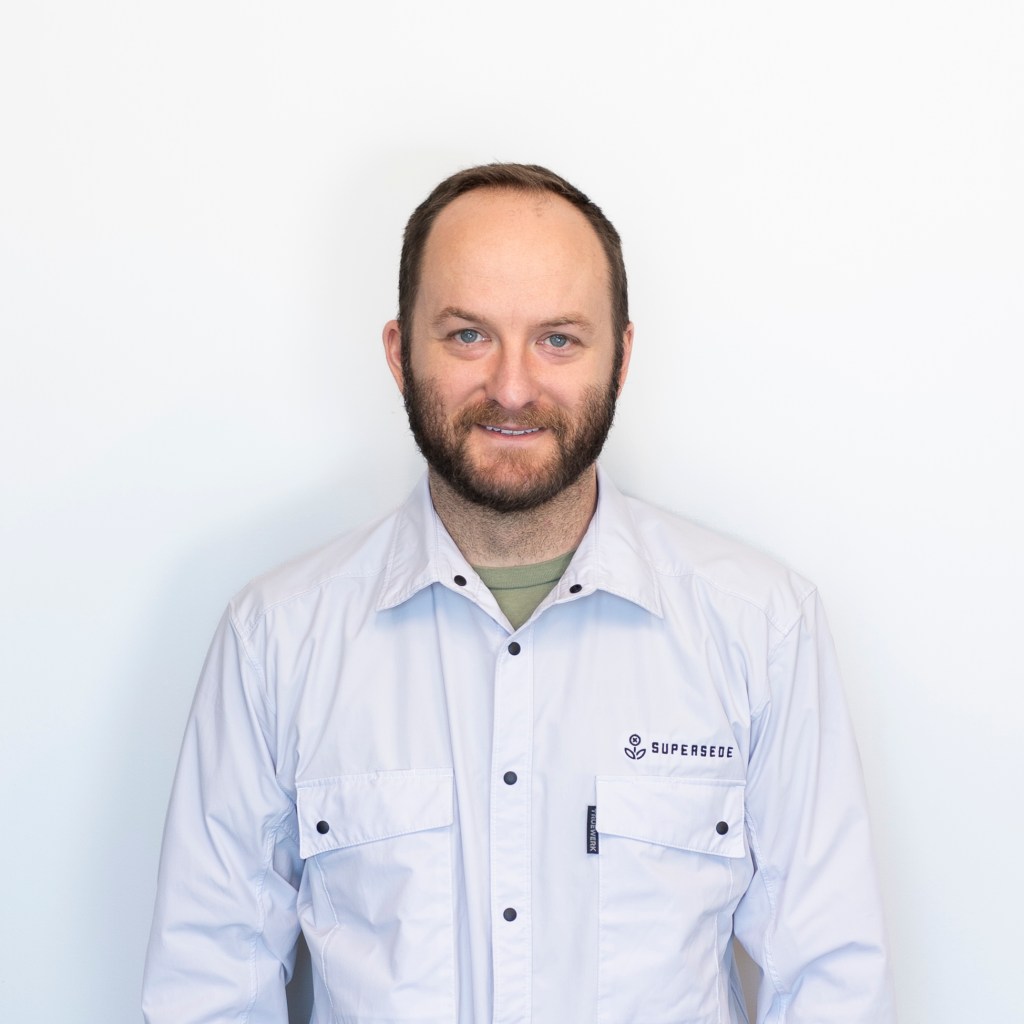
After Jordan exited his company, he pulled Shane, who was still working in the EV industry at the time. The two of them spent a year writing patents and determining the best path to building the production samples, which is not easy because this isn’t something you can prototype on a bench; it needs to be full-scale. I was brought in after they figured out it was possible to replace plywood with something entirely different.

Jordan’s experience manufacturing watercraft from plastic at Free Form Factory was a critical piece of the puzzle. It demonstrated that plastic could perform structurally in demanding marine environments, and it gave us a foundation to ask a different question: What if you could engineer a material that matched plywood’s geometry and price point exactly, but outperformed it on every metric that actually matters to builders while giving recycled plastic a long-lasting, high-performance second life?
That combination, deep construction and marine experience, firsthand knowledge of plastic as a structural material, a visceral understanding of the plastic pollution problem, and a clear picture of everything wrong with the incumbent product, is what pointed us toward the Marine Board. The final piece was Shane. His background as a mechanical design engineer, having led teams at Tesla, NIO and Nikola Motor Company, gave us the technical rigor to ask whether we could actually pull it off. When he came back and said it was possible, that it could be done without compromising on any of the constraints we had set, we knew we had something worth building.
What is Supersede Marine Board at a technical level? What is it made from? How is it manufactured?
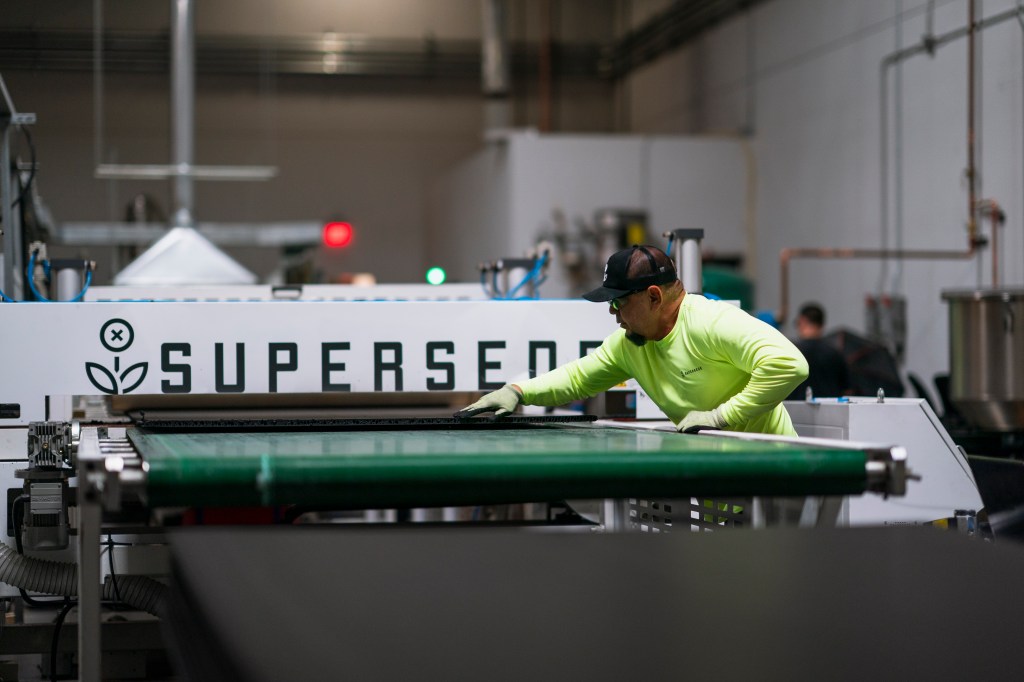
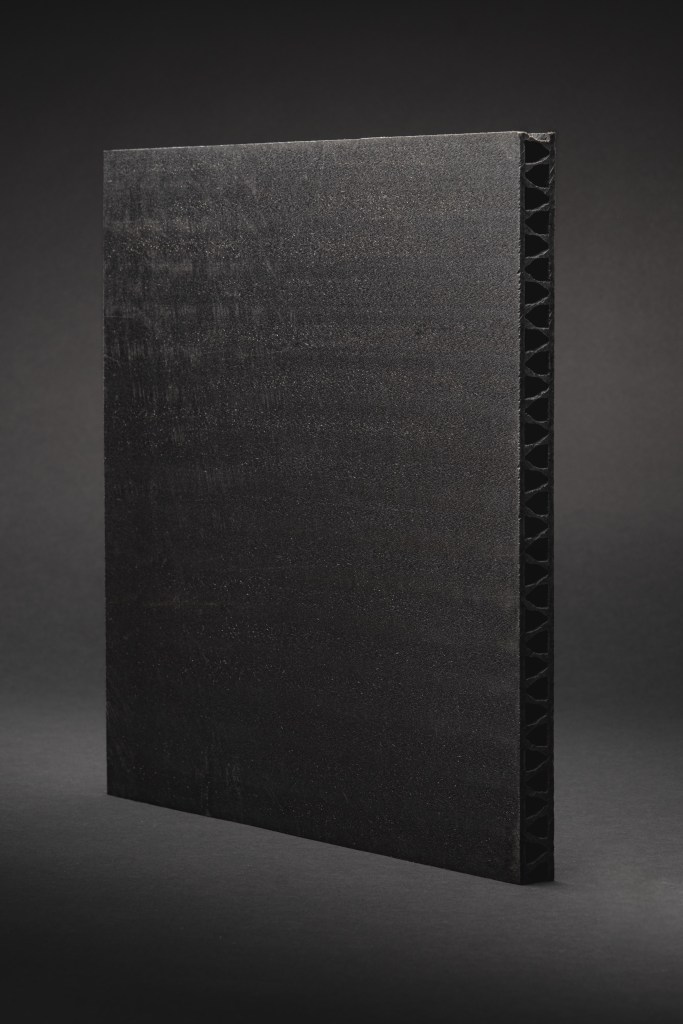
Supersede Marine Board is an engineered structural panel extruded from recycled polypropylene, enhanced with proprietary additives calibrated to meet specific performance benchmarks. The extrusion process allows for precise control over density, geometry and surface finish, producing panels that are dimensionally consistent in every batch. For every 100 sheets of three-quarter-inch Marine Board, approximately 2,500 pounds of recycled polypropylene are used, sourced from post-industrial suppliers and the company’s own reprocessed offcuts.
Structural comparability to marine-grade plywood was engineered through a rigorous process. Every engineering decision was run through a constant feedback loop of CAD design, finite element analysis simulation, manufacturing feasibility review, and costing exercises. The result is a panel that matches or exceeds marine-grade plywood across the metrics that matter most to builders: compressive strength, rigidity, fastener retention and dimensional stability. It is 100% waterproof without chemical treatment, rot-proof, mold-proof, and free from formaldehyde and CCAs. The extrusion process also enables custom lengths, widths and thicknesses, and allows for dual-material extrusion to meet specialized customer requirements. Structurally, it is a true one-to-one replacement, designed to slot directly into existing workflows without modification.
Where does that feedstock come from, and how do you ensure consistency with recycled plastic?
Supersede sources post-industrial recycled polypropylene from local and U.S.-based manufacturers and brokers. We address variability with proprietary additives to calibrate the recycled base material to specific performance standards, effectively normalizing variation in the incoming feedstock and ensuring that the finished panel meets the same structural benchmarks regardless of which batch of polypropylene was used. This is part of what makes Supersede’s manufacturing process meaningfully different from simply extruding recycled plastic; the engineering layer on top of the recycled base is what delivers consistency.
We also reprocess all offcuts and trimmings from our own manufacturing operations, feeding them back into production. Our buyback program extends this further, allowing OEM partners to return their own offcuts and end-of-life material for reprocessing.

You’ve mentioned eliminating VOCs, adhesives, sanding, sealing and drying from the manufacturing process. What does that mean practically for a boatbuilder or RV maker on the factory floor?
Traditional marine-grade plywood arrives requiring preparation. It needs sanding for smoothness, sealing to manage moisture ingress at cut edges and fastener penetrations, and, in many cases, drying time that introduces scheduling constraints on the production line. Supersede Marine Board arrives at the factory floor ready to install. The surface is smooth and consistent, requiring no sanding.
The elimination of VOCs and toxic chemical treatments has additional practical implications. Wood treated with CCAs and formaldehyde-based binders generates hazardous dust when cut or machined, creating air quality and safety obligations for manufacturers. Cutting Supersede produces plastic chips that can simply be swept or vacuumed away, reducing both the health risk and the compliance burden.
Do you lead with performance and let the sustainability story follow, or is the environmental case a selling point on its own?
Performance leads, always. The marine and RV manufacturing industries are built on pragmatism. Builders are running production lines, managing labor costs and fielding warranty claims. They need materials that perform consistently, install reliably and do not create problems downstream. Sustainability is a welcome attribute, but it does not close deals on its own. What closes deals is a product that outperforms what it replaces, at a comparable price point, without disrupting existing workflows.
That said, the sustainability aspect matters increasingly to the OEMs’ own customers, the end consumers buying boats and RVs, who are more aware of material health and environmental impact than they were a decade ago. It matters to insurers, who have long experience with the costs of plywood failure. And it matters in conversations with investors and prospective partners who are evaluating Supersede’s long-term market position. The more accurate framing, and the one embedded in Supersede’s messaging, is that sustainability is a consequence of better design and manufacturing, not a separate value proposition layered on top.
The broader context strengthens the case further. Polypropylene that enters Supersede’s supply chain does not end up in a landfill or ocean. Marine-grade plywood that is not purchased is formaldehyde and CCA that is not introduced into a marine environment. These are direct, calculable consequences of each unit sold. The key is leading with performance data and letting the environmental figures reinforce a story that has already been established on commercial terms.
The use of Supersede by Brunswick Boat Group’s Thunder Jet brand was a significant early win.
Thunder Jet represents exactly the kind of customer validation that the marine industry requires before moving. Production builders at that scale are not typically early adopters; they carry significant liability exposure, run tight production schedules and cannot afford materials failures on delivered boats. Convincing Thunder Jet required demonstrating that Supersede could perform as a true one-to-one replacement under production conditions.
The 2026 model year adoption across flooring, kickboards and transom boards across all Thunder Jet models — and Thunder Jet’s participation in our offcut buyback program, enabling zero waste — reflects the outcome of that process: a manufacturer that was persuaded by evidence, not marketing. That credibility now becomes part of Supersede’s story in every subsequent OEM conversation.
What is the most common objection you hear from builders, and how do you address it?
The most common objection is that we are a fairly new company offering an innovative replacement for a legacy product. Marine-grade plywood has been the industry standard for decades, and builders carrying liability for their products are understandably cautious about adopting a material with a shorter deployment history, regardless of how compelling the technical data is. To the extent there has been objection, it has been a reasonable concern about switching to a new material after using conventional wood-based products for so long.
We address this concern directly. The benchmark catalog built during R&D provides quantified performance comparisons across every relevant metric. Awards we’ve won — like the IBEX Innovation Award for Boatbuilding Methods and Materials, the Fast Company World Changing Ideas award, and the CleanTech Breakthrough Green Manufacturing Company of the Year award — add independent validation.
Beyond the data, Supersede’s approach to customer onboarding is designed to reduce the perceived risk of adoption. There is no workflow disruption, no retraining requirement and no need for through-bolting or additional processes. The concern prospective customers sometimes have is a legitimate one, and the honest answer is that it resolves over time as deployments accumulate and performance data from real-world use continues to build.
Traditional marine-grade plywood prices are still roughly a third above 2019 levels, and tariffs are pushing them higher. Does that pricing pressure make your value proposition more compelling right now?
Yes, Supersede was designed to be price-competitive with marine-grade plywood. The persistent post-pandemic price elevation, combined with the current tariff environment and supply-chain disruptions caused by geopolitical conflict, creating new pressure on imported lumber, means Supersede’s cost position is now more favorable than it was when the product launched.
The more important dynamic, however, is supply-chain predictability. Volatile lumber markets affect more than just price; they affect planning. When material costs are unpredictable and lead times fluctuate, production schedules become harder to manage, and margin assumptions become unreliable. Supersede offers something that tariff-exposed plywood suppliers cannot: consistent pricing and reliable availability regardless of what is happening in global lumber markets.
There are other alternative materials in the marine space — cork composites, synthetic teak, wood-polymer blends. How do you think about Supersede’s position relative to those?
There is no alternative beyond Supersede that doesn’t come with concessions including cost, fastener retention, and workability and ease-of-install. Supersede is the only one that checks all the boxes and is truly a one-to-one drop-in replacement.
The emergence of alternative materials in the marine space is a net positive for Supersede’s market position, not a threat. Any material that moves builders’ thinking away from the assumption that plywood is the only viable option makes the broader conversation easier. The industry’s conservatism around material adoption means that the first challenge is often simply getting buyers to consider alternatives at all. Other companies doing that work, even with different products, helps open the market.
Supersede recently closed a $10 million seed round with Closed Loop Partners and a major U.S. building products distributor. How is that capital being deployed?
The seed round capital is being deployed primarily to build out manufacturing capacity and validate commercial traction at scale. The Phoenix facility established Supersede’s initial production base and provided the operational foundation for the rigorous real-world testing that underpinned our initial OEM relationships.
The next phase of growth is defined by the new Midwest manufacturing facility, set to launch this fall, which will extend Supersede’s geographic footprint beyond Arizona, reducing logistics costs and lead times for customers in the markets concentrated in that region.
Closed Loop Partners’ continued investment across two separate fund strategies, first through their Ventures group in the seed round, then through Catalytic Capital for the facility expansion, reflects a sustained conviction in Supersede’s trajectory. Commercially, the next phase is about deepening OEM relationships in marine and RV while establishing the production capacity and market presence to support meaningful entry into construction and modular housing, where the addressable opportunity is substantially larger.
How do you sequence expansion beyond marine without losing focus on the market where you’ve built your reputation?
We chose marine as the initial proving ground precisely because it is one of the most demanding environments for structural materials. A product that performs reliably in high-stress, high-moisture marine applications, and earns adoption from production builders with significant liability exposure, has demonstrated something that matters across every adjacent market: It works under pressure, literally and commercially.
RV runs largely in parallel with marine because the structural requirements overlap significantly and the OEM buyer profile is similar. Both markets involve production builders integrating structural sheathing into manufacturing lines at volume, making the commercial motion and the technical validation process comparable.
Construction and modular housing represent the larger long-term opportunity, but they require a different commercial infrastructure: broader distribution, relationships with architects and general contractors, and, in some cases, code and certification pathways that do not exist in marine. Supersede is building toward those markets deliberately, establishing the production capacity with the Midwest facility that would be required to serve them at meaningful scale while deepening marine and RV relationships.
Marine-grade plywood is a $12 billion market. What share of that do you realistically think a company like Supersede can capture, and on what timeline?
To clarify, Supersede’s total addressable market extends well beyond marine-grade plywood. The full opportunity, spanning plywood, OSB, roofing, decking and architectural cladding, represents a $95 billion global market. In the U.S. alone, the serviceable available market is $11.5 billion. The immediate focus, however, is the serviceable obtainable market: U.S. water-resistant sheathing and marine-grade plywood at OEM boat and RV builders, a $1 billion opportunity that Supersede is actively displacing today.
What does Supersede look like in five years in terms of revenue, facilities, product range and market presence?
In five years, Supersede is a multifacility U.S. manufacturer with production infrastructure serving marine, RV, construction, modular-housing and specialty-vehicle markets. Production capacity will have scaled to match an OEM customer base that extends well beyond the initial marine and RV relationships, with named partnerships across multiple industries that collectively validate the platform’s cross-market applicability.
The product line will have expanded beyond the Marine Board to include a broader range of laminated options, surface finishes and application-specific configurations. Dual extrusion capabilities will have been deployed at commercial scale, offering OEM partners custom color and material combinations that further reduce their own production steps.
The offcut buyback and recycling infrastructure will grow in parallel with customer volume, reinforcing the closed-loop model at a scale that makes it a genuine competitive differentiator rather than a program feature.
What advice would you give to other entrepreneurs trying to build sustainable materials companies?
First, build your validation process before your sales process. In conservative industries like marine and boatbuilding, the credibility of your data matters as much as the data itself.
Supersede built an intensive benchmark catalog characterizing performance across existing products, which gave the team a foundation for commercial conversations that did not depend on asking customers to trust a new company. Independent validation, whether through awards like the IBEX Innovation Award in 2024 that we won at our launch, third-party testing or reference customers, compounds that credibility over time.
Additionally, design for frictionless adoption. If your product needs different tools, different processes or different training, you are asking customers to take on operational risk in addition to material risk. Supersede was engineered from the start to install using the same methods and equipment as plywood. That is a fundamental design requirement that was built into the engineering process from day one.
And finally, lead with performance. Sustainable materials companies that position environmental impact as the primary value proposition will always face an uphill battle in industries where buyers are managing liability, production schedules and margin pressure.
The environmental case is real and increasingly important, but it rarely closes the deal on its own. If the material does not outperform what it replaces on the metrics that buyers actually care about, sustainability becomes a reason to pay more for something that works the same, and most buyers will not do that at scale.