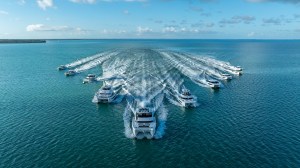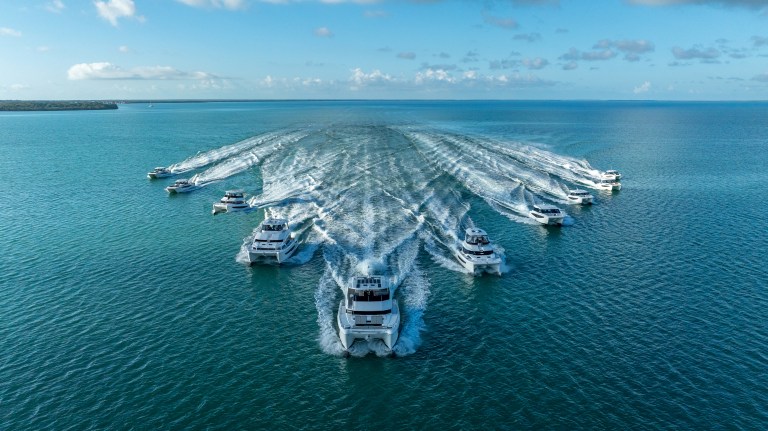
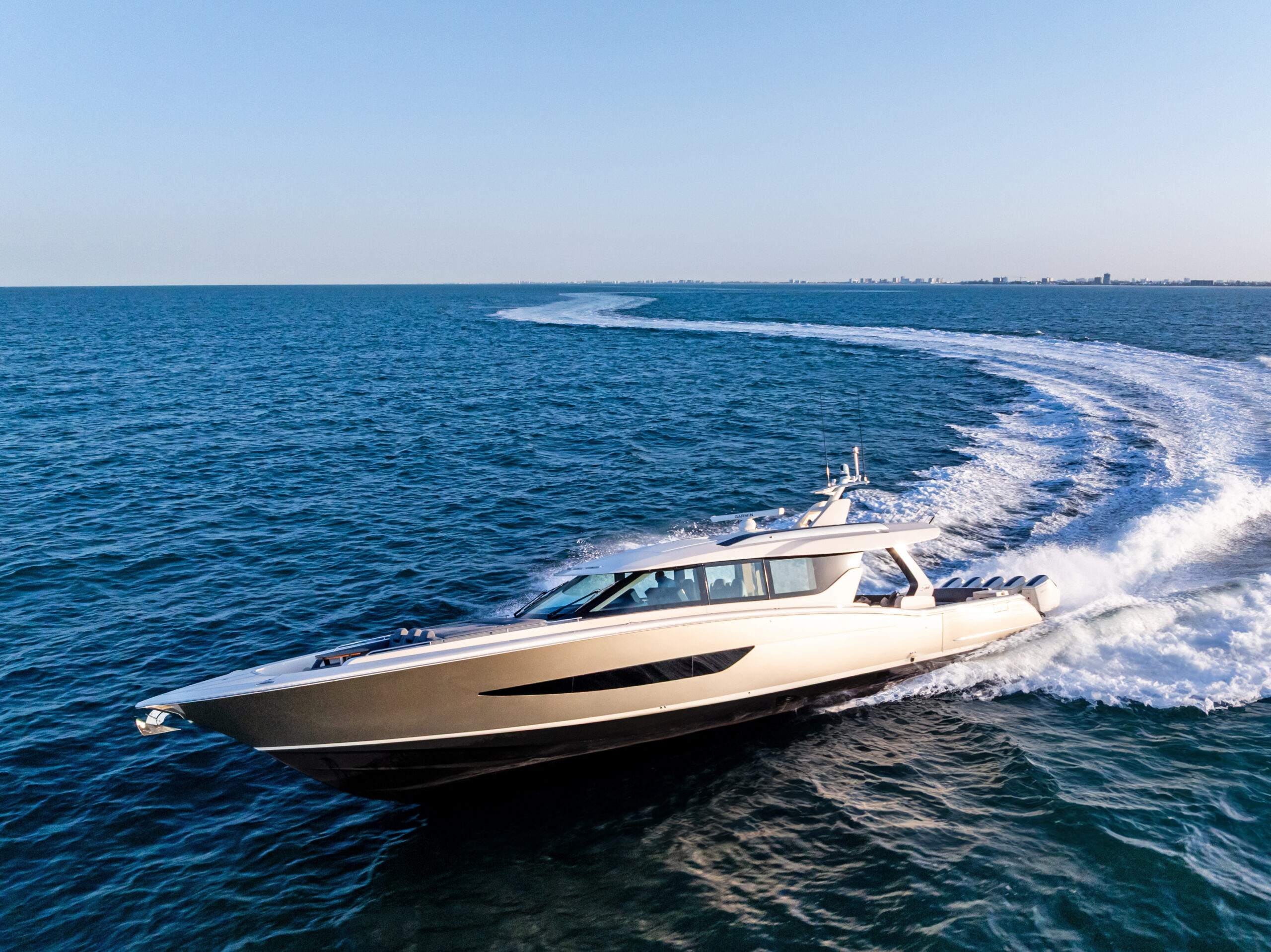
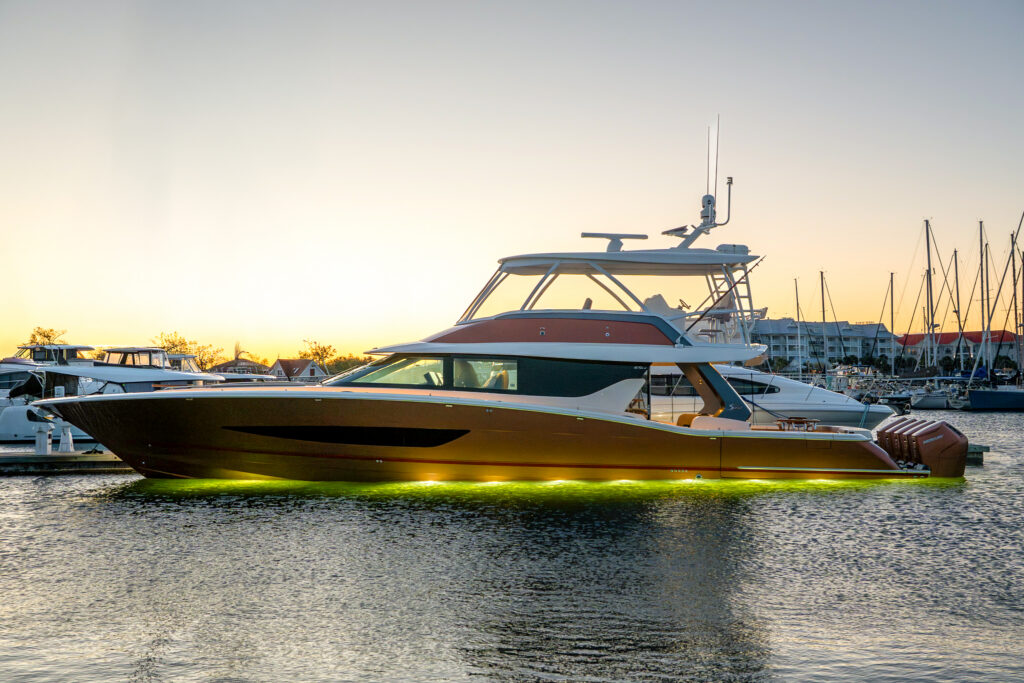
Scout Boats’ 670 series, known internally as Project Everest, represents a new world of outboard yacht design. The 67-footer is not only the company’s largest and most ambitious model to date, but it’s also the largest outboard-powered recreational boat in the world. The achievement took more than four and a half years to design, develop and build.
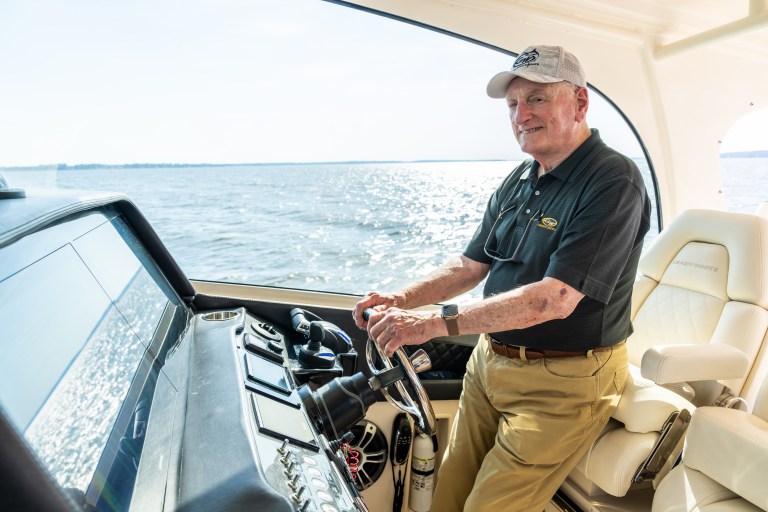
“We coined the phrase ‘expect everything,’ ” says Scout Boats founder and CEO Steve Potts. “We wanted to design a boat that could handle extended stays with the three staterooms and make it beachable, which is a challenge with outboard motors.”
He also says the 670’s early success with buyers provides insight into why there are so many used boats being sold versus new boats. One of the reasons, he says, “is that there’s really nothing new. We wanted to address that.”
Systems Integration
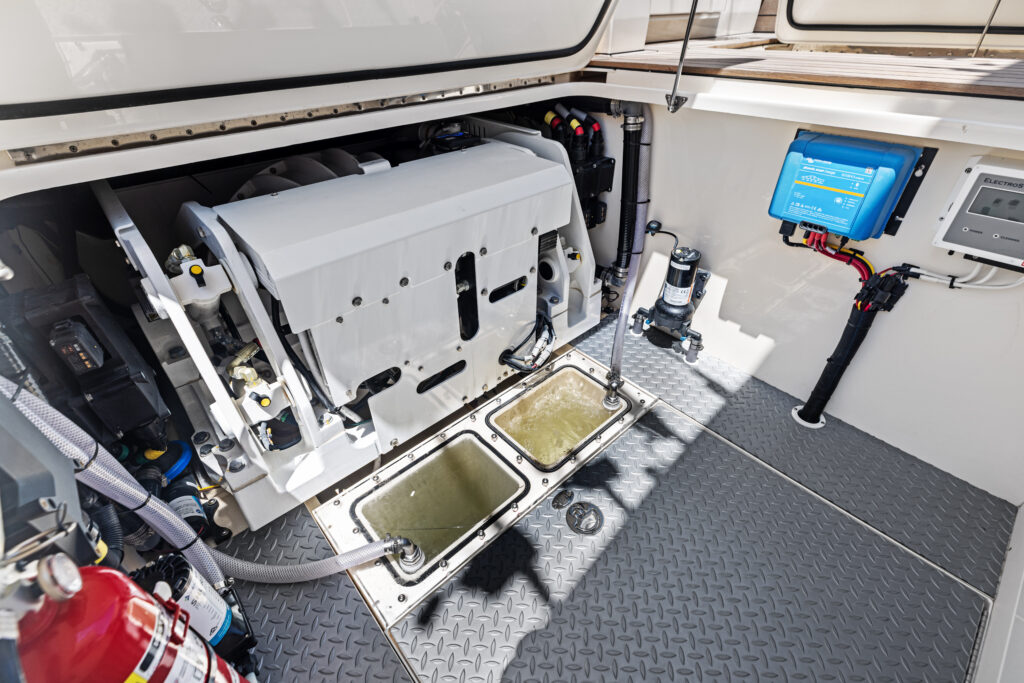
To make the 670 series a reality, Scout’s design team faced what lead designer Stevie Potts called their most intricate puzzle in marine engineering and systems integration, starting with the boat’s layout. Building a 67-foot center console with three staterooms meant packing in the functionality of a 100-foot yacht — everything from the diesel generator and a Seakeeper gyrostabilizer to advanced air conditioning and digital controls — without losing balance, efficiency or structural integrity.
Early in the design process, Scout focused on components layout and weight distribution. Heavy items such as the fuel tank and gyrostabilizer were positioned first to fix the boat’s center of gravity. “You want to get that CG right,” Stevie says. “Once you have all those laid out, what’s left over is the room that you have for the systems.”
One of the biggest challenges was the boat’s weight, Steve says. “What methodology do we use to build a boat that has all these features in it, but not weigh 100,000 pounds?” Scout turned to carbon fiber and epoxy infusion, producing a lightweight, high-strength composite hull that can withstand the elements.
“We have cowboys that run these boats,” Steve says. “And when they shouldn’t run 60 miles an hour in 10-foot seas, they do. So we’ve got to be able to build a boat to stand up to this.”
There are three models in the 670 series: LXS (Luxury Sport), LXF (Luxury Fishing) and LXC (Luxury Cruiser). As with many of Scout’s models, each boat is semicustom. “No two boats are built alike,” Steve says, “and because of that, it’s hard for us to pinpoint what’s standard on every one of these.”
Design Collaboration
Scout hired London-based design firm Harrison Eidsgaard to collaborate on the 670. “They’re a designer of superyachts, so trying to get them to think about this boat was a little bit of a challenge because they’re not used to developing a boat that doesn’t have $10 million worth of hardware on it to make it operational,” Stevie says.
Harrison Eidsgaard helped refine not only the living spaces, but also the vessel’s running profile. Remote collaboration, mostly via video calls, shaped much of the development process.
“We had our 53, and the 67 was kind of a scaled-up version of that,” Stevie says. “H&E looked at our line drawings and said, ‘We do design the profile of these megayachts. You mind if we share some drawings with you?’ And we were really impressed with what they came up with.”
Systems Partners
Scout also worked extensively with Mercury and Garmin to integrate the boat’s systems. “What Mercury Marine is doing now with 48-volt systems, what they call their Fathom systems, is compelling a lot of development for smaller boats,” Steve says. “I think there’s a space in our market today for outboard powerboats that are generatorless, but I think there’s not enough output even with five 600s to power all the systems on the 67. The 67 needed its own generator to power its features.”
Garmin’s engineering team worked alongside Scout to design the electrical and digital switching network, with all systems routed through a central interface.
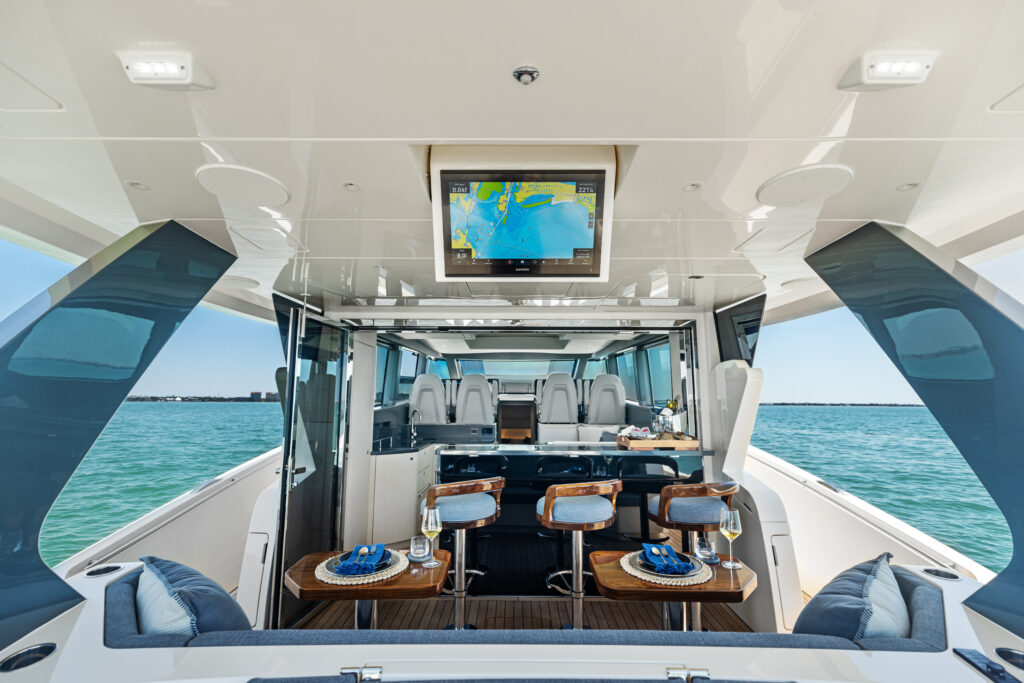
“We built it all in-house,” says Courtney Guice, Scout executive vice president. “Running all the electrical for all of those systems and making sure that everything is integrated, that was super-challenging.”
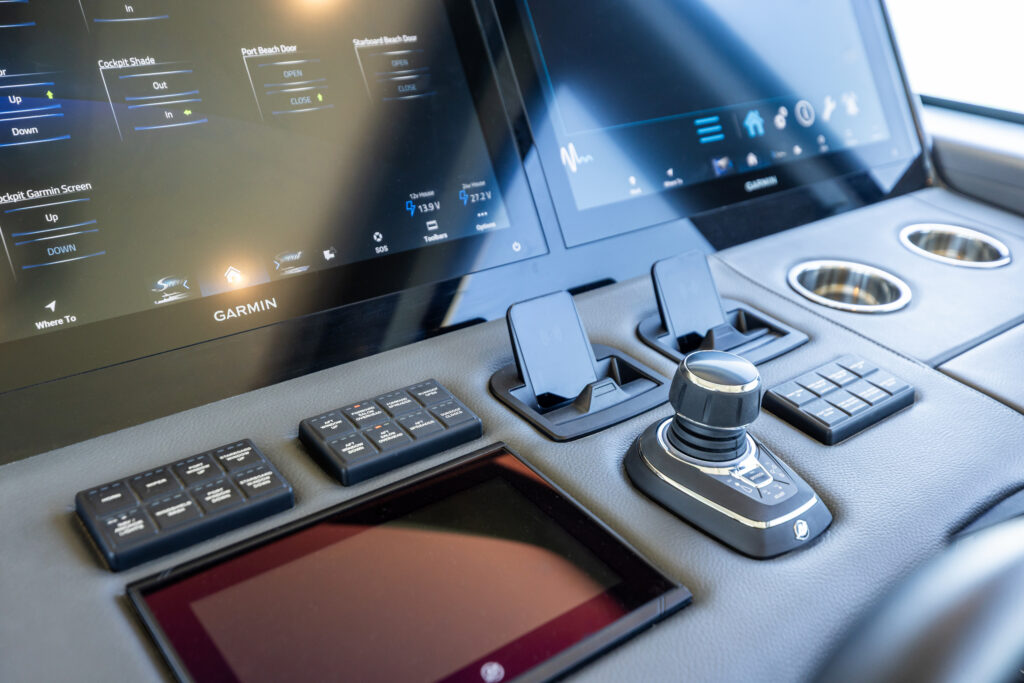
At the helm, Garmin touch screens replace nearly every traditional switch and breaker panel. “It’s really more convenient,” Stevie says. “Everything is controlled on these panels instead of just switches above your head and all over the place. We try to keep that dash super clean and basically put it all into your Garmin unit.”
The user interface design was another challenge. Scout and Garmin customized it to be intuitive, drawing inspiration from Garmin’s aviation technology. “It’s interesting to know that Garmin is also the leader in avionics,” Steve says. “There’s a lot of trickle down from their higher, much more sophisticated equipment that they develop for other industries that comes to our industry.”
Scout also worked with Dometic for installed systems, Navico for electronics and tech, Vectorply for composites and laminate schedules, and East Coast Interiors for cabinetry and finishing.
Redundancy and Reliability
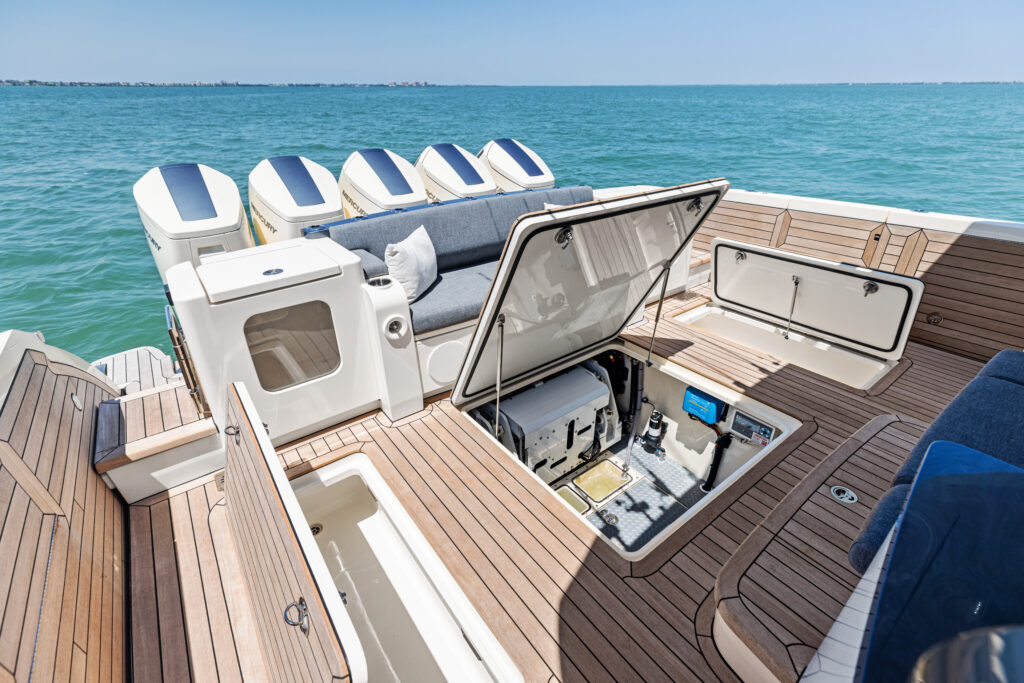
Redundancy became a design mantra. Scout’s team decided that on a 67-foot, owner-operated boat, every system must be not only reliable and recoverable, but also have manual control possible.“We were one of the first ones back in 2001 to come up with a digital boat,” Steve says. “That was a big change, but with that, people get fearful because they’re going to be offshore, and we want to know that what they put in a boat is reliable.”
Scout combines technology with manual switch panels, hydraulic hand pumps and emergency mechanical levers. “We definitely try to build redundancy in everything,” Stevie says. “When you have doors that are folding down on the side of a boat, it’s all hydraulic systems, so we have hand pumps. You can hand-pump that hull-side up if you need to.”
Electric sliding doors to the master stateroom also include a failsafe. “If something were to fail electrically, you’ve got to be able to get out of the master bedroom,” he says. “So on the internal part of it, there’s a lever there that you can pull to bypass that.”
Redundancy, Steve adds, is about peace of mind. “If you’re out in the ocean, far away from land and something doesn’t work, then you get a little bit nervous.”
Market Evolution
The Scout 670 series emerged as a response to changing customer expectations. Today, Steve says, buyers want boats that fish, cruise, entertain and travel — often all in one weekend. “These consumers don’t look at a one-dimensional boat anymore,” he says. “It’s got to be versatile. It’s got to be able to do a variety of things.”
Scout’s modular design includes interchangeable transoms that allow customers to choose configurations for fishing or relaxation. “If someone doesn’t fish, they want more seating,” Stevie says. “So instead of cutting something and rebuilding it, we tool in receivers that can take either a fishing transom or a leisure one.”
In the broader market, Scout sees outboard propulsion driving the next major evolution. “There are so many big outboards now that are designed to go on boats that stay in the water,” Steve says.
He adds that outboards are overtaking traditional inboards, offering ease of maintenance and more. “You get better performance, higher speeds,” he says. “If you run aground, you don’t ruin your wallet. You just trim your motors up and keep going.”
Future Vision
Scout is now looking toward smarter tools and faster development cycles. “AI is a new tool to use for design,” Stevie says. “It’s amazing what that can do. [Our designer] can literally hand-sketch over top of an existing model, put it into an AI program, and it’ll actually spit it out in a realistic picture.”
AI-driven visualization and motion simulation now help Scout prototype faster than ever. “If you want a window to go down or a side of the boat to slide or fold down, it can actually animate the motion, as well,” he says. “It’s something we’re just now starting to touch into, but it’s an amazing tool.”
For Steve, that spirit of exploration captures the essence of Project Everest. “This 67 is the biggest,” he says. “It’s pushing the envelope in terms of the size of an outboard boat, but it’s for today. In two to three years, there might be a half-dozen 60-plus-foot boats.”
This story originally appeared in the May 2026 issue of Soundings Trade Only.