In the U.S. market, when we think of primary navigation electronics, we typically think of products from Furuno, Garmin, Navico and Raymarine. These companies — the “big four,” as they’re known — have been producing navigation equipment for decades. They all offer mature, highly functional products, but it has been the same four for quite some time.
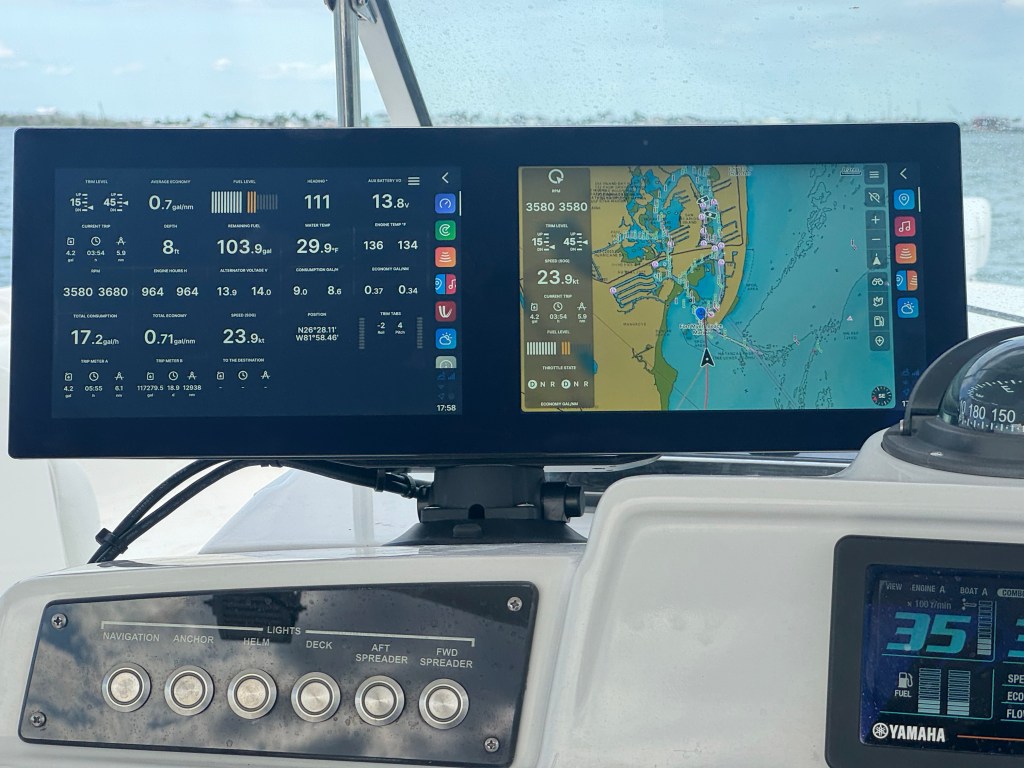
A new contender from Finland would like to expand that group of four to five, and the company is making its case for inclusion with a fresh take on a chart plotter. NextFour’s Q Experience traces back to Finnish builder Buster Boats and its search for a plotter that’s intuitive enough to master without prior experience. Buster approached NextFour, a technology product development firm, to deliver the vision. It included a single interface to control all aspects of the boat, as well as simplified hardware requirements.
The solution builds nearly all aspects of systems management, navigation, entertainment and connectivity into a single device. And yes, the Q is a nod to the famous quartermaster from a certain film series about a British secret agent.
The Q Display is available in numerous sizes, with single and double displays, and traditional or floating mounts. The displays all run the same software and have the same hardware stack for chart plotting, entertainment, cellular communications, boat monitoring, network-connected sonar and radar and more. The single-screen displays range from 10 to 24 inches, and there’s a dual, 10-inch configuration. The single-screen displays all support a second monitor, and Q offers display-only options in all sizes.
This past spring, the Q Float made its debut. Floats come in 10-, 12- and 15-inch displays, all of which use the same small, oval mount to secure the display to the helm. A cable routes from the display to a processor box that’s mounted out of view.
The Q Experience marketing materials say the goal is to deliver automotive-like experiences by integrating all aspects of monitoring, controlling and navigating into a single interface and product. And every time I write about delivering automotive functionality, I cringe. The truth is, boats aren’t cars, and simply re-creating your car’s experience on a boat likely isn’t the best option. In fact, our industry is littered with examples of companies that failed to understand those differences and paid the price. Automotive volume in a day exceeds marine volume in a year. Still, what we experience in our cars sets many of our expectations. The comparisons are unavoidable, and for the most part, cars do lead the way.
One interesting parallel with automotive trends is the lack of branding on the Q Display. Where every other electronics manufacturer prominently features its branding on the hardware — generally centered above or below the display — it is nowhere to be found on the Q Display. That lack of branding likely speaks to the OEM focus NextFour employed at launch for the Q Experience.
A relative newcomer to marine navigation, NextFour does not have a complete ecosystem of cartography, sensors and scanners. As a result, Q displays utilize Navionics cartography, Raymarine Quantum radars, and sonar from Raymarine CP-100s or a few Airmar combination transducers with built-in sounders.
NextFour says it set out to build a device as easy to use as your phone. If I’m grabbing my phone, chances are good it’s to look at Google Maps or check the weather. Q offers both of those features right on the plotter, leveraging the built-in 4G connectivity. And on a cool night, you can gather around the electronic fireplace on-screen.
In all seriousness, while charts outperform Google Maps in open water, coastal boating often involves checking out land features, as well. Google Maps is a great tool for that. In fact, in my relatively short time with Q, I have used the app quite a few times. When it comes to checking the weather, the 10-inch screens of my Q Display are far easier to see than my phone. And weather information can come through Windy or AccuWeather.
NextFour isn’t the only company taking a fresh look at plotters. LXNav started out making electronics for flying and navigating gliders. The Slovenian company’s family of marine-focused products includes several affordable chart plotters. All of them, similar to the Q Experience, have an operating system with a clean, modern user experience. But LXNav also offers something a little different: a full touch-screen chart plotter in a 4-inch, round, gauge-style housing.
Last October, I was part of the DAME Design Awards jury that awarded LXNav’s E360 a category win and the overall win for the 2025 program. I was impressed with the novel circular display of the E360 and the options it unlocks for boatbuilders and those refitting helms, especially on smaller boats. Like Q, the E360 offers an experience consistent with what we encounter in automotive.
Despite just a 4-inch display, the E360 has all the features needed to handle navigation, engine and systems management, and entertainment. Plus, LXNav’s jog wheel hardware controller allows for significantly easier control from the deck of a boat underway. I was taken by the seamless way the E360 blends into the helm of classically styled launches and boats with more modern designs.
New players to the marketplace bring a greater willingness to experiment. Models such as the Q Floating displays and LXNav’s round offerings give boatbuilders flexibility in designing and laying out helms that traditional displays may not. These chart plotters join other creative offerings, like Orca’s hybrid tablet navigation system, that are freeing builders to think outside the box.
Helm displays have become the primary interaction point for control of nearly every facet of the boat’s operations. It’s exciting to see creative takes on how those displays look and how we interact with them.
This story originally appeared in the August 2026 issue of Soundings Trade Only.