Every year, the marine industry receives a set of standards updates. Some arrive with small edits that only a few engineers or certification specialists will appreciate. Others land with a broader message about where boatbuilding, service, safety and consumer expectations are headed. Supplement 66 of the American Boat & Yacht Council’s “Standards and Technical Information Reports for Small Craft” falls into the second category.
At its core, this supplement is about making technical information more useful in the places where it matters most: on the production floor, on the capacity label, in the owner’s manual, at the service yard and, ultimately, in the hands of the boat owner. The changes span several areas, but the heartbeat of this year’s update is capacity. How much can the boat carry? What engine weight is appropriate? How should that information be shown, and how can the industry make sure the answer is clear before a boat leaves the dock?
That may sound like familiar territory, but Supplement 66 takes a fresh look at the way capacity information is calculated, labeled and understood. The revisions to S-7, H-5, H-28 and H-35 are not just technical adjustments buried in standards language. They reflect the reality that boats have changed, outboards have changed, and the way boaters interact with information has changed.
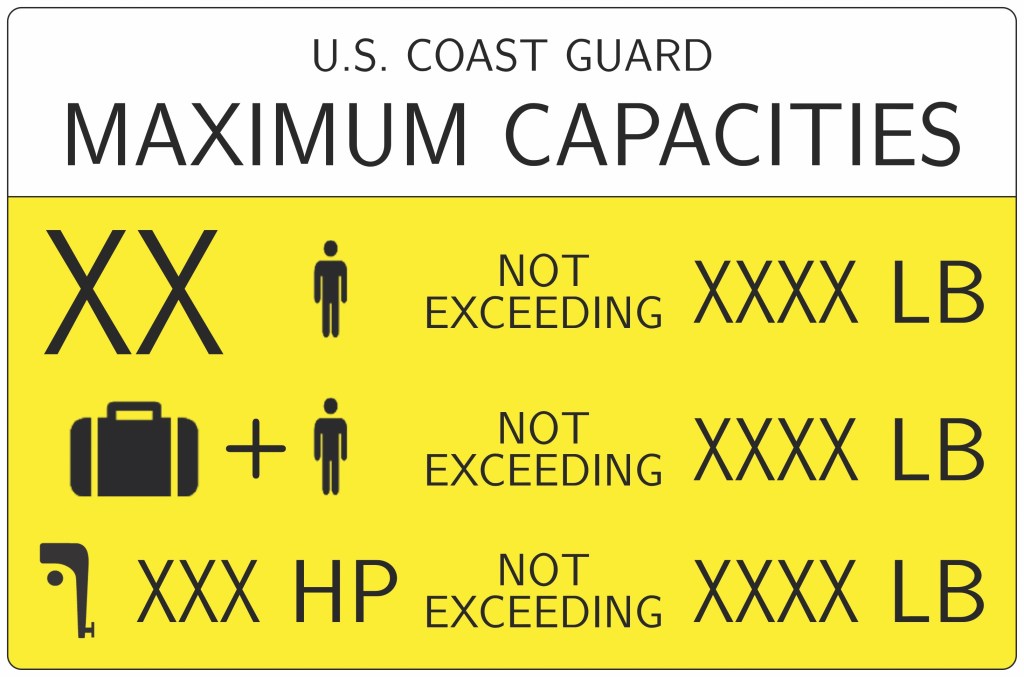
One of the clearest themes is the “not exceeding” language. A capacity label should not be read as a choice between two options; rather, it is a limit. S-7 uses pictograms, acknowledging that a clear symbol can sometimes communicate faster than a sentence in the moment an operator needs the information. The revised label provides manufacturers a clearer way to communicate with operators and gives boaters a better chance of understanding what the numbers on the label actually mean.
The engine-weight discussion is even more significant. As outboards have grown in power, complexity and weight, simply stating a maximum horsepower is not always enough. Including the maximum engine weight on the label can help prevent confusion during engine selection and repowering. For boats 20 feet and larger, the revisions allow manufacturers to specify a maximum outboard running weight, which can be below the values listed in S-30. This information can be of great benefit with certain types of outboards.
The Coast Guard’s policy accepting S-7 and H-5 as equivalent to 33 CFR Part 183, Subparts B and C, gives those updates added support. Additionally, the standards’ two-year compliance date gives manufacturers time to make thoughtful changes, but it also starts the clock. Labels, manuals, calculations, drawings and internal procedures all need to be reviewed before the transition is complete.
Pontoon builders will see the capacity conversation carry directly into H-35, which echoes the changes in H-5, including the addition of upper-deck capacity placard requirements. Inflatable manufacturers will see similar attention in H-28.
Beyond capacity, Supplement 66 continues the annual work of keeping standards aligned with current practice. H-2 and H-25 update gasoline ventilation and portable fuel system language. H-33 revises diesel fuel filter marking requirements. A-27 updates genset requirements, including grounding conductor sizing and auto-start warning language. P-6 revises shaft alignment, shaft-bearing installation and propeller installation guidance.
These updates may not all make headlines, but they shape the everyday decisions that builders, installers, technicians and surveyors make.
The technical information reports also point toward a broader industry shift. T-5 adds guidance on electronic media, recognizing that safety information now lives in more places than a printed label or paper manual. T-32 updates references related to aquatic invasive species, a reminder that design and construction decisions can have consequences beyond the boat.
The real test of any standards supplement is not whether it is published, but whether it is put to work. Supplement 66 gives the industry a practical opportunity to do that, and the first step is knowing where to look. The updated standards are available through the American Boat & Yacht Council’s Standards Library, where members can review the revised language directly and compare it against their current designs, products and technical files.
ABYC’s Technical Tool Box also provides practical resources to help manufacturers move from reading the standards to creating technical files documenting standards compliance. For companies working through the changes, these tools can help frame the right internal conversations among engineering, production, quality assurance, sales, service and training teams.
The conversation will continue during ABYC’s free standards update webinar Aug. 27. The session will give the industry a chance to hear more about Supplement 66, and to better understand how the revisions affect day-to-day work.
With this update, the message remains straightforward: Capacity information should be clear, engineering decisions should be documented, and safety standards should follow the boat from design to ownership. n
Brian Goodwin is vice president of standards and compliance at the American Boat & Yacht Council.
This story originally appeared in the September 2026 issue of Soundings Trade Only.