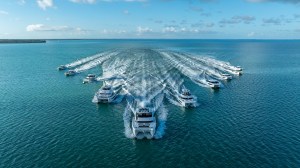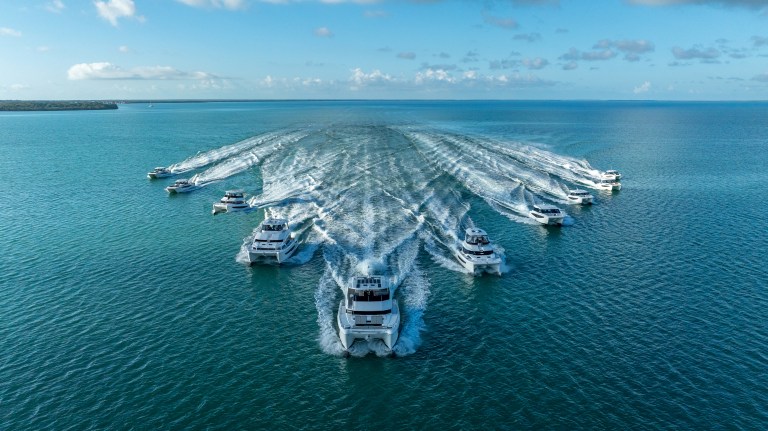
Few innovations have changed boating quite like Volvo Penta’s IPS propulsion. The efficiency and maneuverability of pod drives, paired with a joystick, has made docking more like a video game and ushered in a new, younger wave of boaters. IPS has also allowed traditional boaters to grow into larger vessels than their skills may have previously allowed.
And yet, at first, the Inboard Propulsion System was met with widespread skepticism. Would the pods be difficult to service? Could forward-facing props even work? What kind of catastrophe would boaters face if they ran aground and sheared off one of the drives?
 Volvo Penta
Almost 20 years later, not only is IPS widely accepted and respected, but Volvo Penta is now using its testing center in Krossholmen, Sweden, for the company’s first fully integrated hybrid-electric propulsion system, which it hopes will revolutionize the marine industry again. Built in partnership with Groupe Beneteau, the system has been installed on a Jeanneau NC37 with the goal of a soft launch to gather feedback from the press and key dealers.
I visited Krossholmen to experience the twin 60-kW electric motors paired with 320-hp D4s and Aquamatic sterndrives. The package slid the NC37 silently from its slip and toward the channel. This system was exceptionally quiet, and the joystick maneuvering seemed even more responsive than the builder’s IPS joystick, thanks to the near-instant torque that electric propulsion provides.
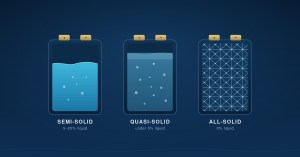
The only aspect of the hybrid system that Volvo Penta does not (yet) produce in-house is the MB battery bank with eight lithium-ion subpacks — weighing 1,322 pounds — that lend the boat 67 kWh of capacity. That capacity reportedly gives the NC37 a three-hour, or 15-nautical-mile, range at 5 knots and a top speed of 10 knots.
After navigating a slow zone, we pushed on the throttles in hybrid mode and brought the engines to 1,500 rpm, automatically engaging the diesels and achieving 37 knots. Pulling back on the throttles, the motors shifted the system back to silent, electric cruising at 1,200 rpm.
 Volvo Penta
Among the other features the hybrid system offers is DPS (dynamic positioning) in electric mode, and an option for what the company calls “electric boost.” In that mode, propulsion is delivered from diesel and electric power to get the boat up to speed faster. It worked as advertised during my time on board, helping the NC37 reach planing speed a few seconds faster than the diesels alone.
For charging the batteries, owners can use shore power, use the diesels while underway (up to 80% of the battery capacity) or, for the most time efficiency, use the boat’s diesels while stationary in a slip or on the hook. With the latter option, operators should be able to restore a full charge from nearly empty within an hour and then power all the boat’s systems for days at a time.
The company has yet to release pricing or a production-model launch date for consumers, but expect to see this NC37 on the boat show circuit in the United States this fall.
Joystick Driving
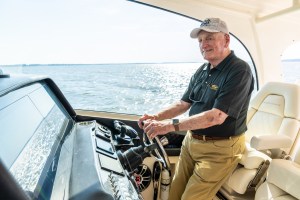
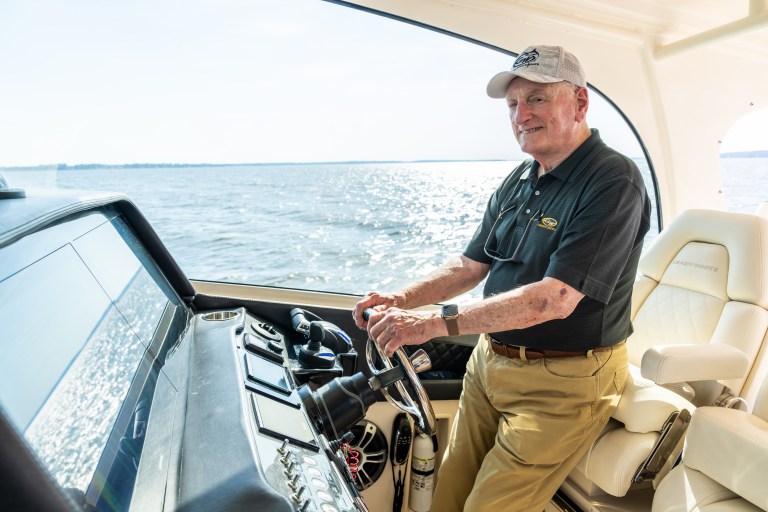
The demo of the NC37 was paired with a cruise aboard a Prestige to showcase Volvo Penta’s joystick driving advancements. I was at the helm, and the captain engaged docking assist, which ensured that, with the help of the joystick, I wouldn’t inadvertently kiss the bulkhead beside me. I maneuvered the boat into open water with the traditional joystick functionality, then touched a new button in the top right-hand corner of the joystick, placed in the armrest of the helm seat. This button engaged the joystick driving function, which allowed me to shift from neutral into gear and then throttle up and turn by leaning the joystick to port or starboard.
 Daniel Harding Jr.
I could also make course corrections with the autopilot by turning a couple of degrees with a twist of the wrist. In a matter of minutes, I got the feel for joystick driving, and the boat felt like an extension of my hand.
Pulling back on the joystick reduces speed until you land back in neutral. Continuing to pull back from there, you shift into reverse. A smart safety feature here is that when you release the joystick in reverse, it defaults to neutral.
This level of joystick control makes the wheel and throttles largely redundant, if not unnecessary.
Culture of Innovation
All of these advancements are happening under the leadership of Volvo Penta Marine Unit president Johan Inden, who says the company’s goal is always to be thinking 20 years ahead.
“In January at CES, we shared what we call our ‘Boating for Everyone’ vision where we outline everything from how we think people will go boating to how we solve charging,” Inden says.
Part of that vision is a floating island/ village where boaters can dock, charge their boats, walk around the perimeter and get a meal. “It got a fantastic reaction,” Inden says. “We got calls from builders asking when we plan to build it because they wanted to be the contractor. It was fantastic. And boaters were saying, ‘Couldn’t you build the first test island just out here in the archipelago so we could start playing with it?’ Restaurant owners called and said, ‘I want to run the restaurant,’ so you saw an idea triggering ideas.”
Other ideas include an underwater, manta-ray-shaped power generator that “swims” up to a boat and uses underwater currents to power it. And more ideas are always coming. At Volvo Penta’s factory in Vara, Sweden, there’s a monthly competition where employees can earn prizes for submitting innovative ideas. One recent winner thought about placing QR codes around the facility so employees could file their ideas while they were fresh in their minds.
This article was originally published in the August 2023 issue.