
Albany, N.Y., is not known as a hotbed of boatbuilding. But way up the Hudson River, 150 miles north of New York City, mere miles before boaters enter the locks to Lake Champlain and the Erie Canal, is a yard that builds classic schooners and commuter-style motoryachts with a modern twist.
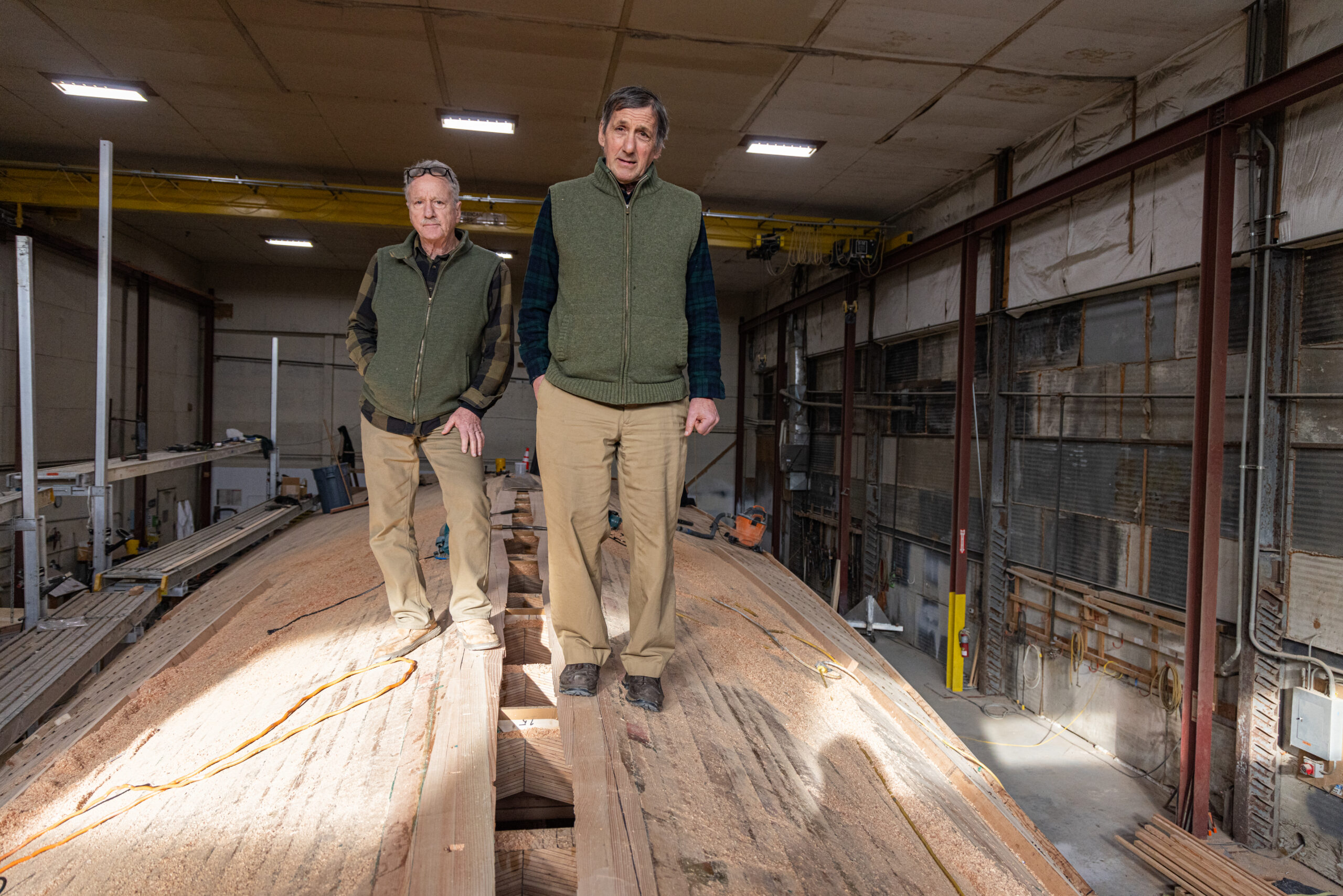
Scarano Boat Building was founded in the mid-1980s by brothers John and Rick Scarano. Born in the 1950s, they fell in love with boats in the Berkshires on Kinderhook Lake, where one of their grandfathers had a camp. With their siblings Paul and Bob, they messed around in rowboats, outboard-powered runabouts and canoes.
“The Tub” captured their imagination. It was an 8-foot lug-rigged sailboat fashioned out of a World War II disposable fuel tank. Early tanks were made of metal, but because metal was of value to the enemy, the Allies started making them out of heavy paper, laminated with glue. That’s how The Tub came about. “This imaginative entrepreneur bought these Army surplus fuel tanks, cut them in half and built a really, good little sailboat out of each half,” John Scarano says. “It was a Bakelite-like material. As best I can tell, it was paper or cotton impregnated with phenolic resin. The original sort of composite material.”
When John was young, his father started a company and purchased the latest fiberglassing tools, which included a chopper gun. They built John’s first boat, a 12-foot fiberglass Stinger. “It was a learning experience because I designed the sailing rig and learned a little bit about balance,” John says.
He attended SUNY Maritime College, where he was on the sailing team under Graham Hall — whose teams won national championships and who once coached Gary Jobson, the America’s Cup sailor. John ended up dropping out of college. He dove into Howard Chapelle’s Yacht Designing and Planning and Norman Skene’s Elements of Yacht Design. For everything else, he turned to his father and one of his older brothers, both professional engineers. “I was always a poor formal student,” John says, “but I just continued on with my primary interest.”
He started racing at the Saratoga Lake Sailing Club, where he got involved with the International 14, a sporty boat that John still considers the ultimate sailing machine. He worked in a factory, picked up skills from the best racing sailors, and built his own International 14. “What I learned from sailing International 14s was that nothing could beat wood,” John says. “We’ve been using laminated wood ever since I built that International 14.”
His International 14 led to designs that were truly his own, including the Scarano 21. That boat had an internal ballast centerboard and would win the Lake George PHRF division. The 21 was also cold molded out of red cedar, with yellow cedar stringers. More boats followed, using the same building method, including a 1974 Herreshoff Meadowlark ketch that was sailed on Lake George for 40 years, and whose owner still keeps it at the Scarano yard.
Between bigger jobs, John built the Bushel Basket, a 6-foot, lightweight yacht tender, also out of laminated red cedar. He sold one to a customer who wanted a sailing rig on it. Another went to his older brother Paul, who put it on the deck of his 25-foot sailboat for a trip to Florida, and someone bought one to hang up inside his chandlery in Ohio because it looked so nice.
In the mid-1980s, John teamed up with his younger brother Rick, who’d been trucking boats across the country. In the early days, John designed the boats, which they would build together, and Rick handled the mechanical aspects. They incorporated the business but quickly realized that building little, wooden sailboats that were three or four times as expensive as fiberglass production sailboats wasn’t going to make them a living. “People didn’t want wooden boats,” Rick Scarano says.
So they built a hybrid. They made a mold of the bottom of a cold-molded Scarano 22, used the mold to build a fiberglass bottom, and built the rest of the hull from above the waterline out of laminated white cedar. “For running aground, for trailering, for beating it up, why not have the heavy rugged stuff on the bottom and the light, stiff stuff on the top?” John says. “The theory was good, but in practice, putting all of the necessary pieces together and coming up with a product that had superior value over alternatives was something that we never really did.”
Then the Scaranos got a break. A local operator hired them to build a 65-foot, wooden Coast Guard-certified tour boat. “It was a real challenge,” Rick says. “It was a big transition for us, but the Coast Guard worked with us really well. It changed our operation forever.”
Because they needed a bigger space to build Dutch Apple II, they leased a 50-by-80-foot section of a vacant agricultural farm storage facility on the southern end of the Port of Albany, on the Hudson River. “It was pretty rough,” Rick recalls. “It was a fertilizer plant. We spent so much time cleaning the place out. We hung reinforced poly from the ceiling, and as the boat got bigger, we’d go up into the structure of the building and raise it up some more.”
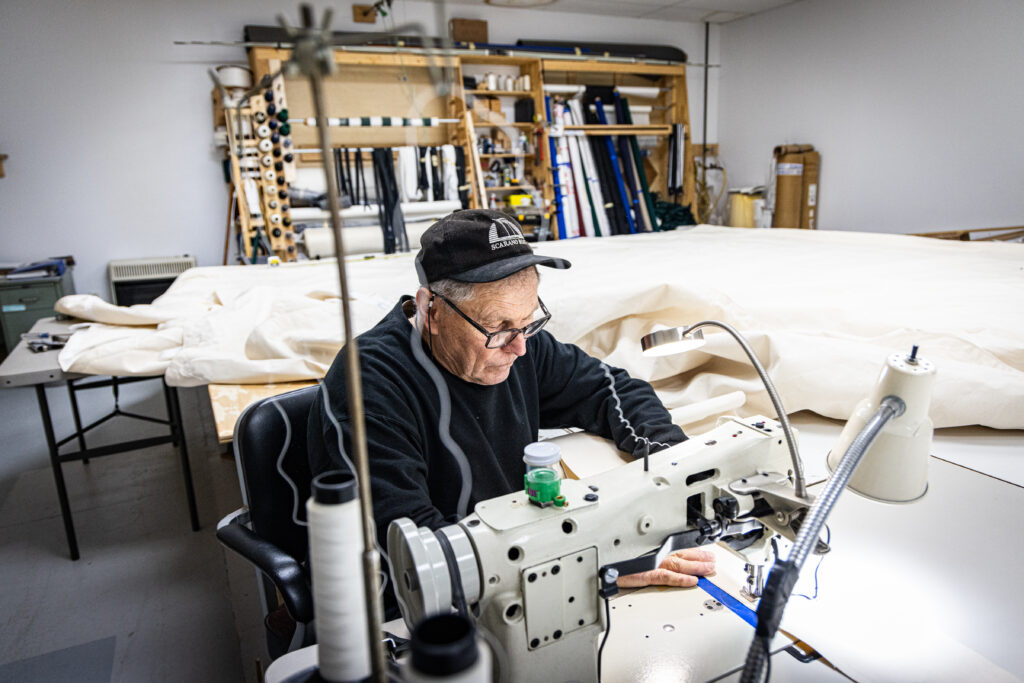
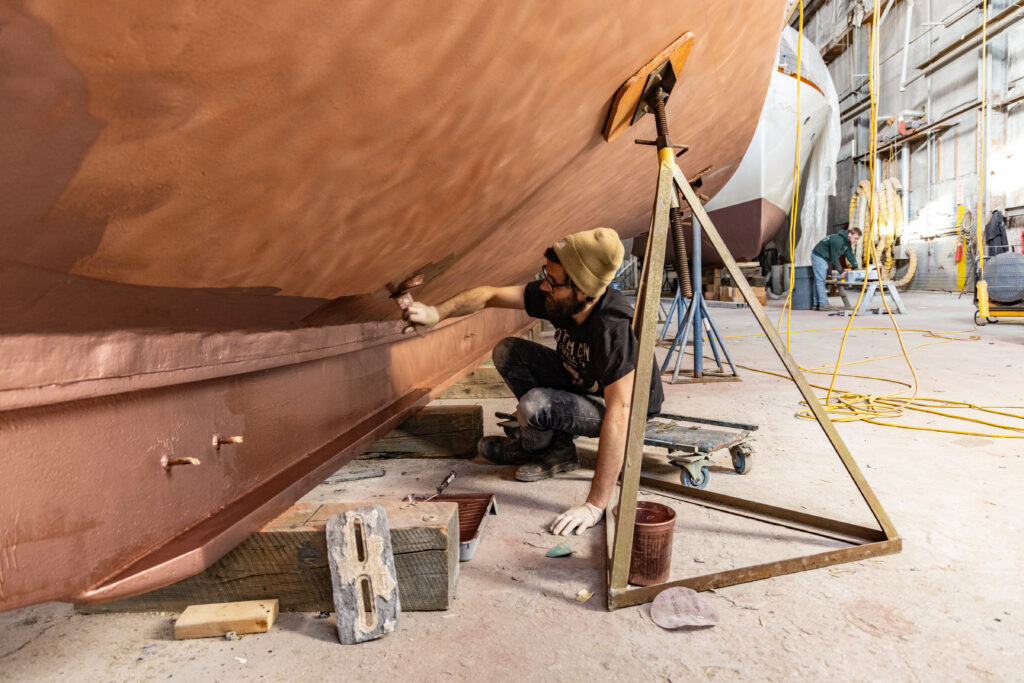
Eventually, they purchased the entire 4.5-acre property. Today, it includes two heated sheds, a three-axis CNC cutter, a sail loft, a Travelift and more. Dutch Apple II was followed by Horicon, an 86-foot commercial excursion boat built almost entirely out of mahogany, teak and yellow pine. In 1989, they launched two 31-foot Canoe Island sloops to replace Canoe Island Lodge’s aging fleet of Sound Interclubs on Lake George.
They also built Carillon, a 60-foot cruise boat inspired by Thousand Islands-style powerboats. It still sails out of Fort Ticonderoga on Lake Champlain. “We were going day and night,” Rick says. “We were going seven days a week. That was not unusual.”
Their first schooner client was in 1992. The customer wanted to start a sailing excursion business in Newport, R.I., and wanted a 60-footer based on a Down East lumber schooner. “It was lighter than a true lumber schooner design would have been, but it did have the basic full keel, attached rudder of a traditional 19th-century commercial schooner,” John says.
Madeleine caught the eye of another client, who wanted a schooner that was more contemporary. The buyers were racers and wanted a good performer. “The boat had to be fast,” John says. “And Woodwind would also have to maneuver around Annapolis Harbor in traffic with tight docking conditions.”
In 1994, they struck a deal with the Newport Yachting Center to put customers on a schooner that the Scaranos would build and operate. That boat, Adirondack, an 80-foot 1890s-style pilot schooner, turned heads and proved fast, winning line honors at that year’s Great Chesapeake Bay Schooner Race. For the next 14 years, various Scarano schooners would dominate that race, and Woodwind continues to be a top finisher.
Their next schooner client, a Virginia restaurant operator, wanted a replica of the schooner America, the original America’s Cup winner. The Scaranos suggested it would be less expensive — and the boat would be faster — if they made it considerably lighter. It would be about 5 feet longer and a couple of feet wider, but still be about 30% lighter than the original.
The boat was completed in 1995, and the owner sailed America 95 until he died about five years later. Then an operator in San Diego used it for day charters. At one point, Cup legend Dennis Conner was a partner in that venture.
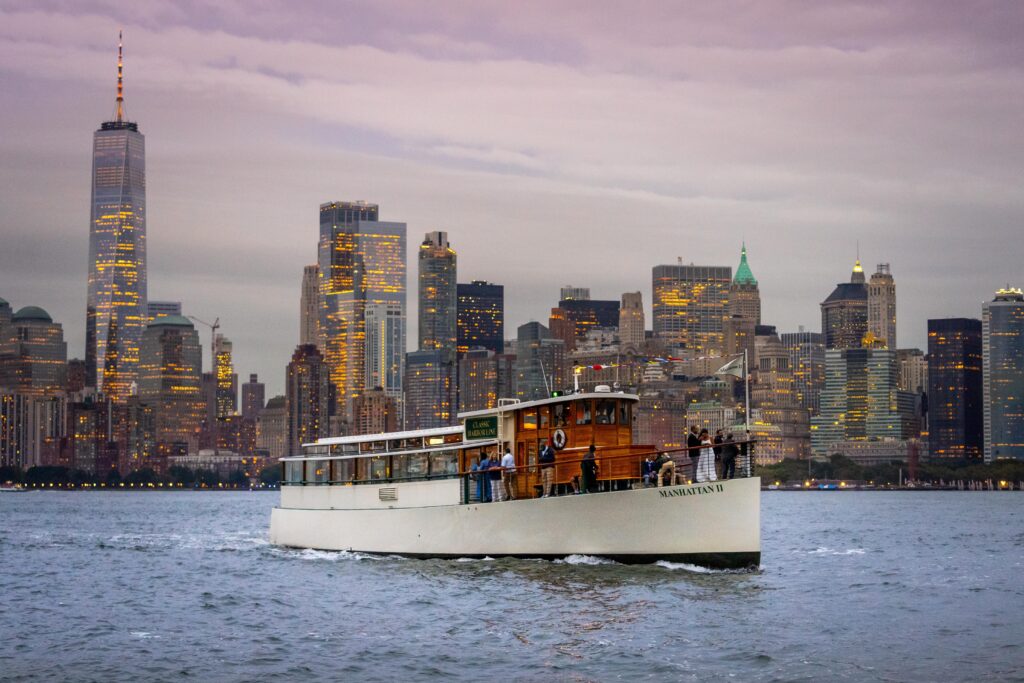
Adirondack did well as a charter boat in Newport, but in 1999, the Scaranos built Adirondack II, sent it to Rhode Island and put it on the Newport waterfront. Adirondack was brought to Manhattan, where it began to sail out of Chelsea Piers. The Scaranos then launched Manhattan, a 1920s-inspired motoryacht, in 2005. Although built with an aluminum hull, it had a traditional look with teak decks and mahogany throughout.
Chartering turned out to be profitable. In 2007, the Scaranos bought Imagine, an 80-foot schooner they had built for a client in 1997, rechristened it Adirondack III and added it to their fleet. The next year, they sailed Adirondack II to Key West, Fla., to join the local schooner fleet for the winter. All along, they designed and built Coast Guard-certified vessels out of wood, aluminum, steel and composite materials for other clients, while their own fleet continued to grow.
In 2011, they launched America 2.0, their own America replica. That boat’s two-part hull was built with a removable, aluminum deadwood section for the water and fuel tanks. To save weight, the upper hull was constructed of end-grain balsa core, sandwiched between two layers of Port Orford cedar over aluminum ring frames and laminated wood frames. The vessel’s construction also included composite board, Plascore, wood-veneered carbon spars and other composite materials. At 105 feet, it became Classic Harbor Lines’ flagship vessel, sailing out of Chelsea Piers in the summer and Key West during winter.
In 2014, Adirondack III was sent to Boston. It has since been joined by Adirondack II and the 115-foot Northern Lights, a turn-of-the-century-inspired motoryacht the Scaranos designed and built in 2003 for a Lake Champlain operator.
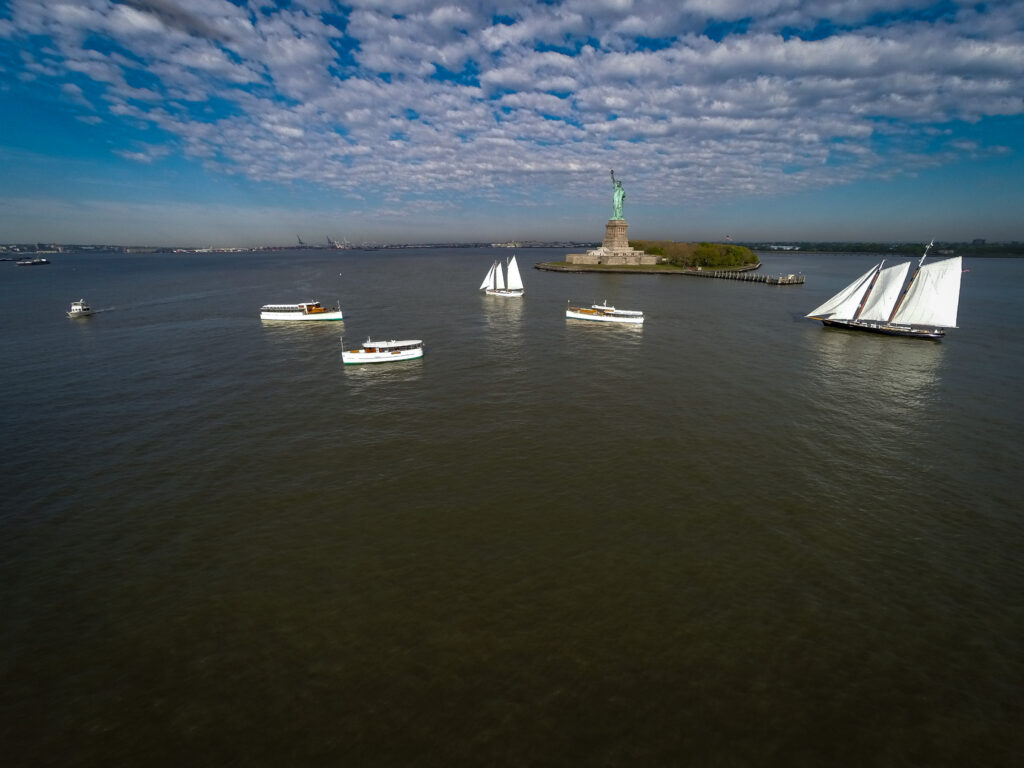
The Newport fleet now includes four boats: their most recent schooner, Adirondack IV; a 90-foot knockabout schooner; the 48-foot sloop Eleanor, completed in 2016; Madeleine, the first schooner they built, in 1991, and bought back; and the 1929 58-foot Elco-built Rum Runner II, which the Scaranos renovated for a client in 1992 and purchased in 2022.
In New York, in addition to Adirondack and America 2.0, the fleet includes the 50-foot motoryacht Kingston, added in 2013; the 80-foot Manhattan and the 100-foot Manhattan II, launched in 2015. Every spring and fall, the 1950, 65-foot Grebe yacht Full Moon joins the New York fleet and spends June through September in Newport.
And the Scaranos are not done. Though now in their 70s, this summer they expect to launch the 114-foot Manhattan III as the 12th boat from their yard, to give them a 14-boat fleet. “We’re creating a situation where we will not be soliciting work in any great way,” Rick says. “We’ve created our own, and the shop work keeps us going. So it’s working out.”