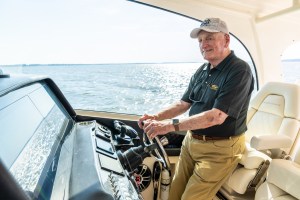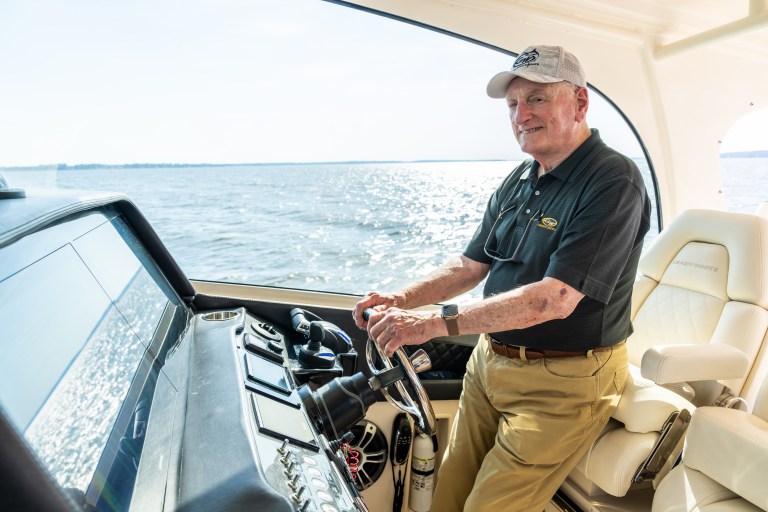
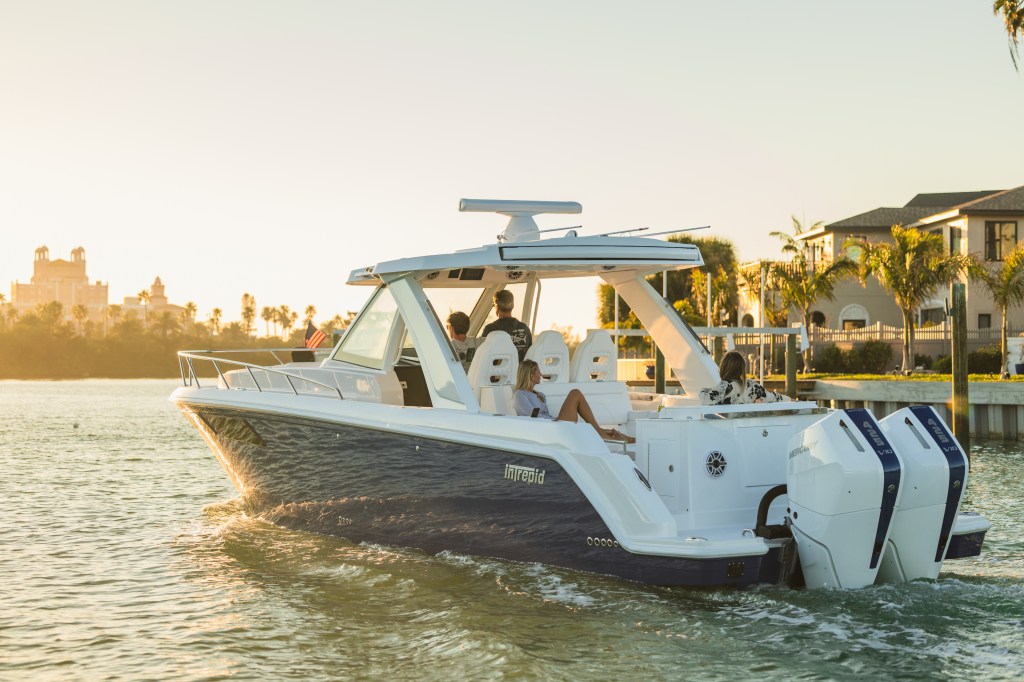
When Terry McNew came out of retirement for the second time, it wasn’t for nostalgia. It was for triage.
McNew, who stepped in as president of Intrepid Powerboats in January 2025, has nearly four decades of experience in marine manufacturing. He began at Sea Ray in the late ’80s and rose through the ranks at the builder’s parent, Brunswick Corp., to oversee global engineering and production. Later, he led turnarounds at Correct-Craft and MasterCraft Boat Holdings, where he helped guide the company to a successful public offering.
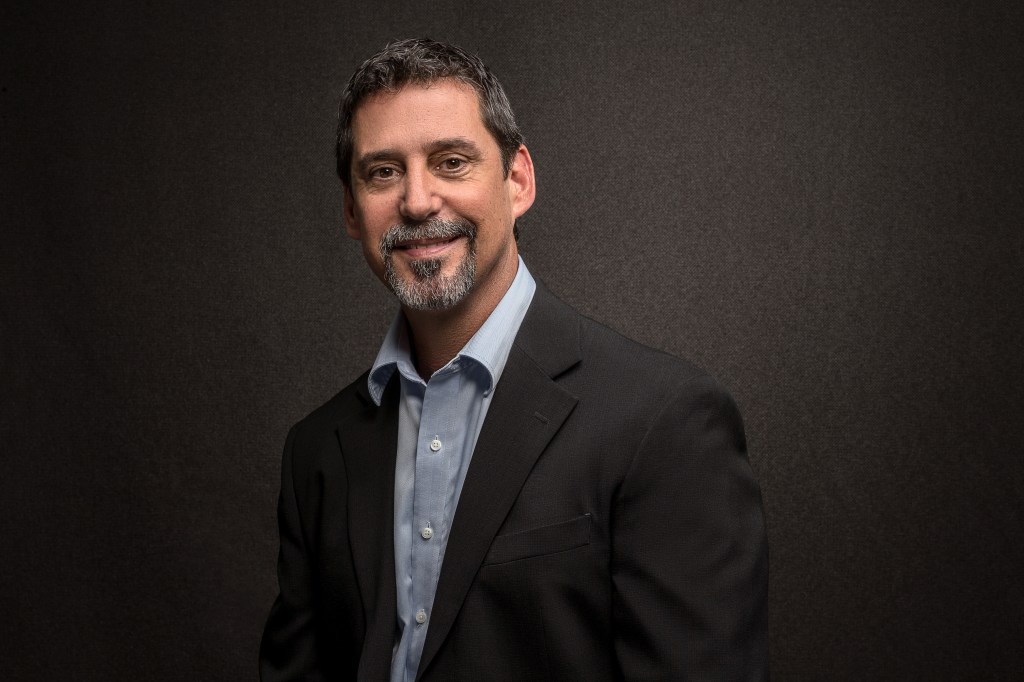
When MarineMax acquired Intrepid in late 2021, it didn’t take long for CEO Brett McGill to reach out to McNew: “Can you come fix it?” McNew didn’t hesitate. There are people in the marine industry who build boats, and others who build companies. McNew has made a career of the latter, though not without getting resin under his fingernails along the way.
From his office in Largo on Florida’s Gulf Coast, his tone is easy and unhurried. Beneath it, though, is the cadence of someone accustomed to diagnosing problems at scale: systems, not symptoms. “I love fixing things,” he says. “That’s what I do. This is the second time I’ve come out of retirement. It may take me three to figure it out.”
It’s a deceptively simple statement. Intrepid is, by any measure, a legacy brand. Founded in 1983, it built semicustom powerboats that blurred categories — center consoles with cruising comforts, express-style models with fishability. In South Florida, the brand carries significant weight. Nationally, its reach has been more limited. “About 96% of our sales were in South Florida,” McNew says. “And most of that in the southeast part of the state. So people have heard of it, although many have not. When I look at what defines an iconic brand, this doesn’t match that definition. It’s more of a boutique builder.”
Before the acquisition, Intrepid operated as both builder and retailer. One of MarineMax’s first moves was to separate those functions. “That was a smart thing to do,” McNew says. “They’re the largest dealer in the world. They understand distribution. My job is everything else.”
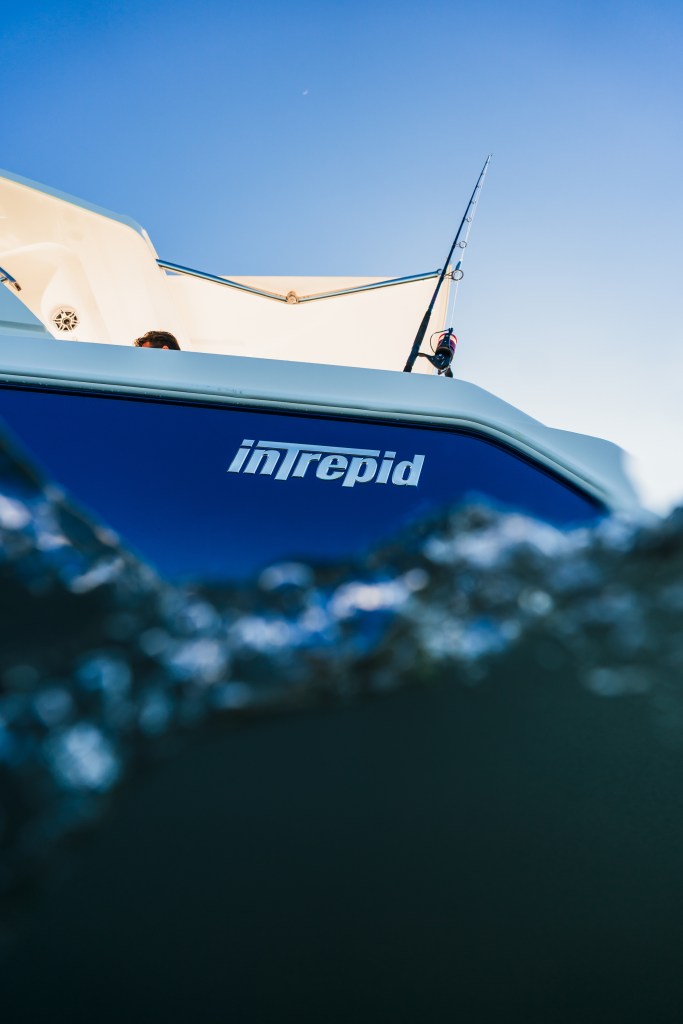
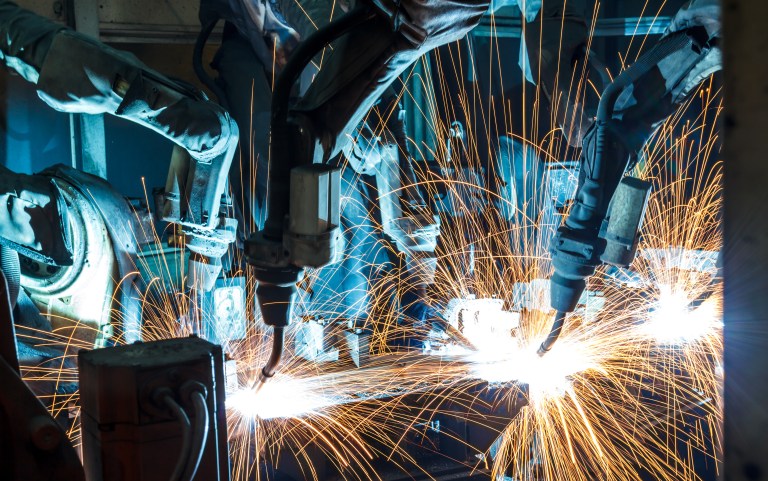
In the marine marketplace, the attributes that sell a boat are visible: the hull sheer, the upholstery, the performance, the stance at rest. They help to determine whether a builder succeeds. At Intrepid, McNew says, he identified the core issue almost immediately. “The approach Intrepid had used for years was inadequate,” he says, with regard to dimensional accuracy — how closely the physical measurements of a manufactured object match the dimensions specified in its digital design. “I grew up making molds to zero tolerance. Dimensional accuracy is critical. Without it, you introduce variation, and that variation shows up everywhere.”
At Intrepid, he says, variation had become systemic. Tooling lacked precision. Designs had grown overly complex. Customization, long a hallmark of the brand, had expanded beyond what the business could efficiently support. “There were a lot of special instructions,” he says. “The brand always welcomed them, but when you have that much customization, mathematically it becomes very difficult to make a profit. Historically, the company hasn’t been profitable operating that way.”
For those reasons, all of Intrepid’s legacy models will be concluded by August, McNew says. Longtime followers of the brand may find the shift abrupt, but a new system will be instituted. “We’ve adopted a strategy of common platforms,” he says.
The concept is familiar in the automotive world: multiple models built on shared architectures. Styling and layout may differ, but the underlying structure remains consistent. “If you look at Nissan and Acura, or Toyota and Lexus, a lot of what’s underneath is the same,” he says. “The customer doesn’t see that. They just want reliability.”
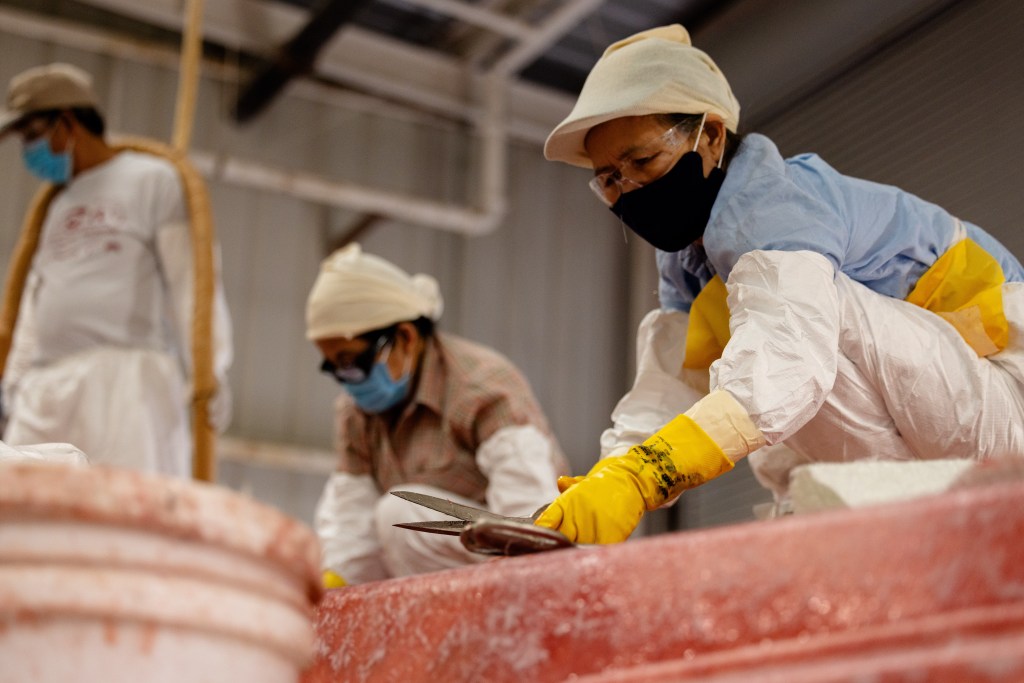
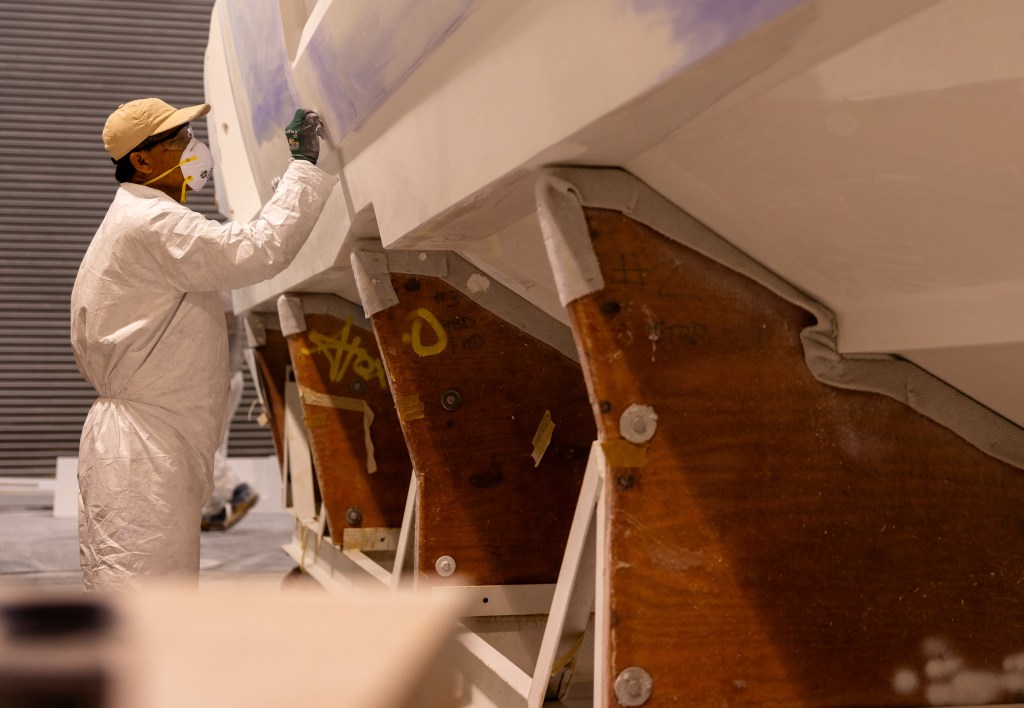
McNew sees platform standardization as essential. “We have common harnesses, common stringers and, in many cases, common hulls,” he says. “We’ve reduced the number of fiberglass parts from about 45 down to 15.”
The effects are cumulative, he says. They lower tooling costs as much as 40% on some models, as well as bring simplified supply chains, faster builds and more-consistent quality. This production approach also changes the dynamic on the factory floor. “It’s easier for employees to build,” he says. “You’re not relying on tape measures. It’s more plug-and-play.”
About 20% to 30% of Intrepid owners use their boats to fish, he says. Many are focused on cruising, entertaining and day boating. The Intrepid lineup will lean into that reality without abandoning the brand’s roots. “Our primary focus is cruising and entertainment,” he says. “But we maintain the ability to incorporate fishing features.”
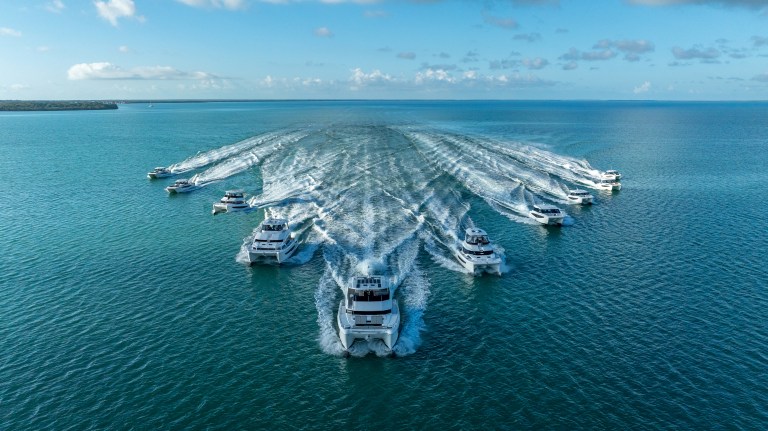
Intrepid’s eight-model line — from the 345 Nomad SE (34 feet, 6 inches) to the 51 Panacea (51 feet, 6 inches) — is being phased out. With McNew’s arrival came the 35 Panacea and 35 Valor, boats that represent the shift in production process. The Valor, at 35 feet, is a walkaround design with a good-size cabin that’s well-suited for families. Below are sleeping space and a shower, features absent from the model it replaces. “There’s a split head,” McNew says. “I’m not aware of another 35 that has that.”
On deck, the layout prioritizes comfort and flow. Performance reflects the same thinking. A double-stepped hull reduces drag and extends range, improving efficiency and usability. “It has superior range and better fuel economy,” he says. “And when we say it’s a 35, it’s truly 35 feet from bow to transom, not including the swim platform. Truth in advertising.”
The 35-foot Panacea is a center console for day boating, fishing and water sports. A new derivative of that model is due mid-summer. A 38-foot center console is also in development and may be in production by the fourth quarter of this year.
Some of the most significant changes to the Intrepid lineup are less visible. For decades, wiring has followed a largely analog approach: point-to-point connections and complex harnesses with numerous potential failure points. Intrepid is shifting to fully integrated digital switching. “It runs through every subsystem,” McNew says, “lighting, helm controls, dash, everything.”
The benefits include fewer failure points, reduced weight, lower power demand and easier serviceability. “It also shortens build time,” McNew says. “And it makes it easier for dealers to diagnose and repair issues.
“I’m developing what I call the Betty Crocker recipe,” he adds. “Two cups of water, stir, and you get a consistent result.”
That philosophy of brand evolution extends beyond manufacturing. McNew is also expanding Intrepid’s dealer network, a move that aligns closely with the strengths of parent MarineMax. “If you have one dealer, your sales cap at a certain level,” he says. “If you have 20, your growth potential increases.”
At the same time, McNew has brought in former colleagues, elevated internal talent and made structural changes at Intrepid. “We’ve reconstituted the engineering team,” he says. “We’ve trained the staff and streamlined the organization.”
McNew turns 65 this year. He says his goal is to work until he’s about 70. “Then I’ll retire for the last time,” he says.
This story originally appeared in the July 2026 issue of Soundings Trade Only.