
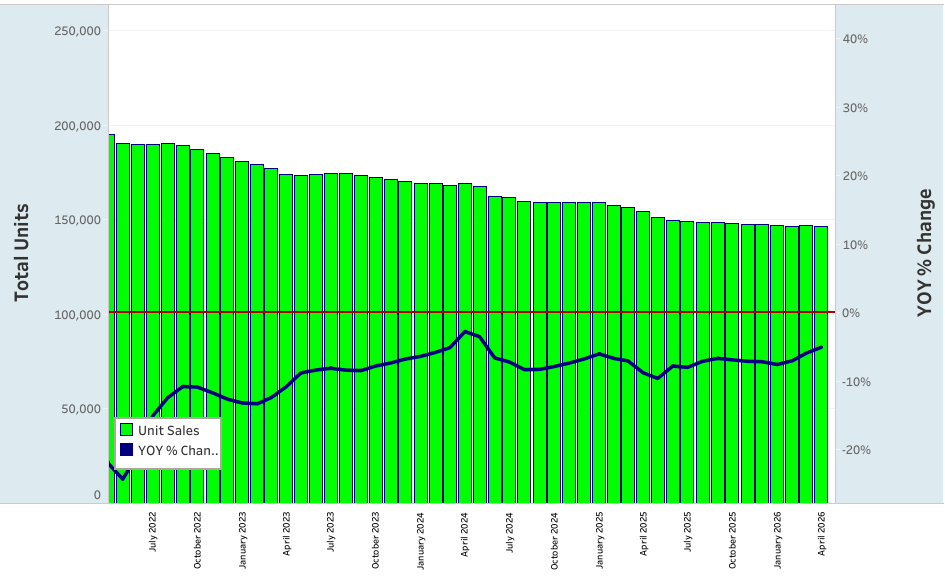
Registration numbers for the 15-foot-and-over U.S. powerboat market through April were down 5% relative to the 12-month rolling average, marking the third consecutive month of improvement against that average. Registrations across all segments totaled 216,217.
The data for new-boat registrations was provided by Info-Link, a Florida-based company that compiles registration numbers from the Coast Guard and individual states.
In the April sales report, towboats were down 10.6% for a running total of 7,763 units sold. Runabouts were down 15.6%, with a total of 13,519 units sold, and pontoons were 9.1% off their 12-month average, with 47,766 units.
The freshwater fishboat category gained 1.9% on its 12-month average in April, with a total of 54,432 units sold, again putting up strong numbers relative to other categories and relative to its 12-month average, as it has for the past year.
“We’re seeing the freshwater fishing buyer has been a little more consistent because that purchase is usually tied to a very specific use. If someone fishes regularly, the boat is not just a nice-to-have; it is part of how they spend their time,” says Naiche Sedillos, national sales manager at OceanPoint Funding, which specializes in financing for boat purchases and refinancing. “With pontoons, runabouts and towboats, affordability can be a bigger issue right now. Buyers are looking at the total picture — the price of the boat, the rate, insurance, fuel, storage and the monthly payment — and some are deciding to wait.”
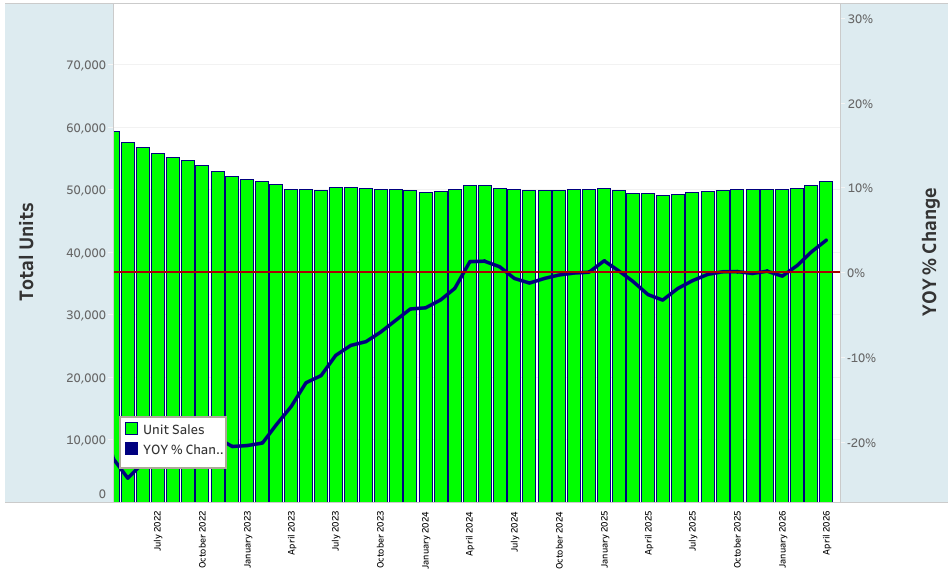
In April, another category that showed improvement relative to its 12-month average was the unclassified/other segment, which includes houseboats, fliteboards, airboats and other water-sports vehicles. That category showed a 6.4% increase on its 12-month average with 5,304 units sold.
“I would not read too much into that category by itself because ‘other’ covers many different products, but it provides insight into how people are shopping right now,” Sedillos says. “Buyers are more intentional. If the product feels unique, fun, easy-to-use or fits a very specific lifestyle need, they are more willing to take a closer look, but they’re not just buying because something is available on the lot. Buyers want to understand how they are going to use it, the total costs each month and whether it really adds value to their family or their time on the water.”
In other categories in April, PWC sales were 9.7% below their 12-month rolling average, with a total of 60,317 units. The cruiser/yacht category was down 6% from its 12-month total, with 4,604 units. Saltwater fishboat sales were off 6.1% from their 12-month averages, for a total of 21,512 units sold.
Among the bigger state markets in April, Florida was 5% below its 12-month average for 28,235 units yearly. Texas was down 4%, with 15,926 units. Michigan was also below its 12-month average by 4%, for 11,401 units, while Minnesota was down 9% with 8,898 units.
Some Southeast states showed sales strength. Georgia showed a 5% increase in its 12-month average, with 8,366 units. Alabama was up 3%, with 7,465 boats sold on the yearly average, and Mississippi rose 4%, with 2,796 units.
“The Southeast has a few things working in its favor: a longer boating season, a strong boating culture and a lot of people who can use their boat for more of the year,” Sedillos says. “When a buyer knows they are going to get real use out of the boat, it is easier to justify the purchase and the payment. In states like Florida, Georgia, Alabama and Mississippi, you also have a good mix of lakes, rivers and coastal access, along with a lot of families looking for recreation close to home. So I think the strength there makes sense. Boating is part of the lifestyle in those markets, not just a short, seasonal purchase.”
Other states that showed increases in April were Idaho, up 11% with 2,065 units on the running figure; West Virginia, up 12%; Rhode Island, up 8% in the 12-month average; and Alaska, up 8%.
Overall, Sedillos says, consumers’ desire to get on the water is still real, but they are asking better questions and taking a closer look at the full deal before they commit. “They want to know what the payment looks like, what options they have and whether the financing fits their budget,” he says.