
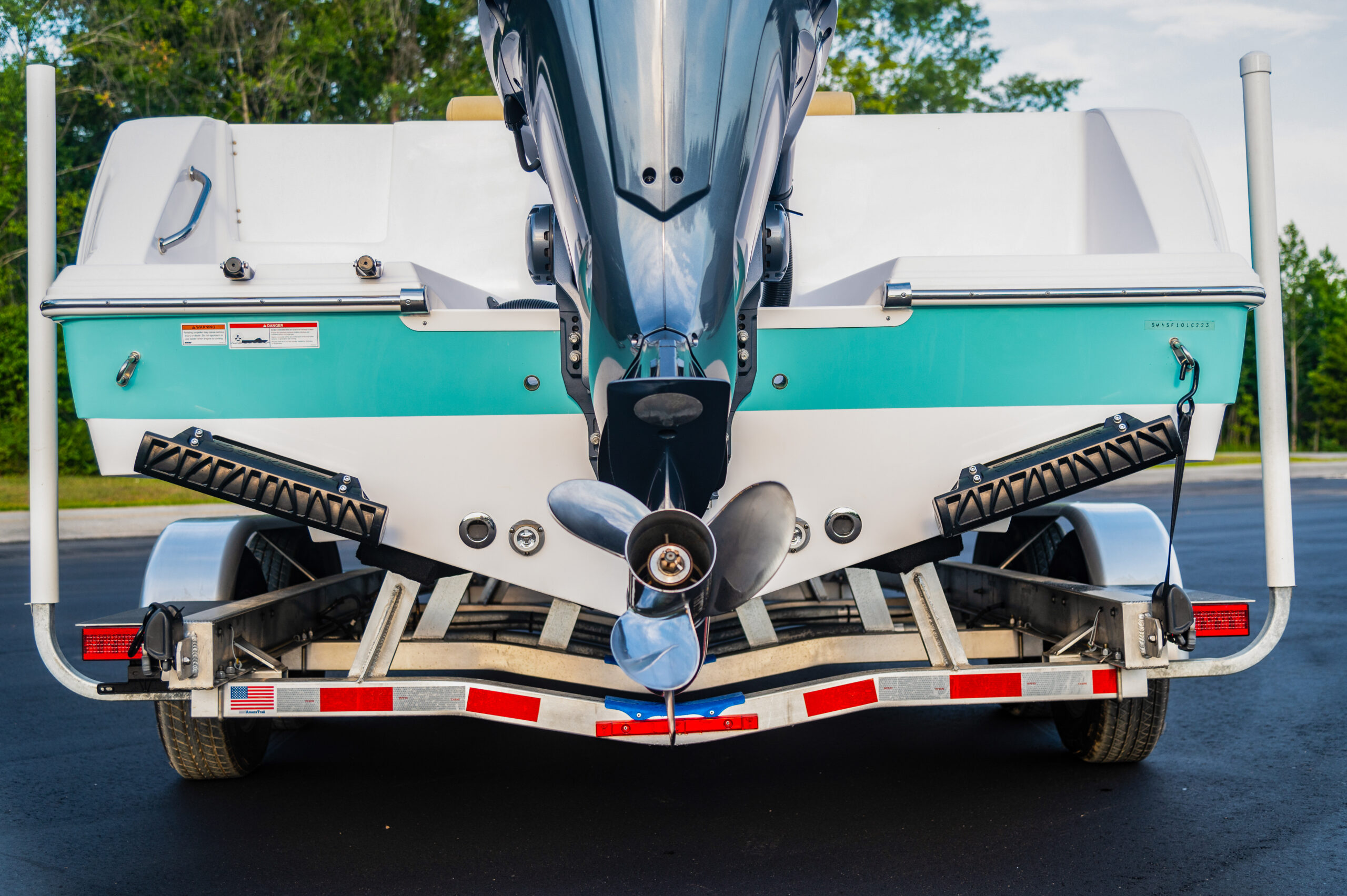
Not so long ago, a traditional trim tab was just about the only thing we put on the stern of a boat to improve the ride on and through the water. Generally speaking, boats had two tabs: port and starboard. Manually controlled trim tabs helped a boat get on plane and then level out the ride. Pretty simple, right?
Today, the world of stern-mounted devices to help a boat run through the water is complex. In fact, there isn’t even a good term to describe all these devices. We tend to fall back on trim tabs, but the reality is that we’re talking about a slew of pitch-and-roll control devices. For short, we can call the category PARCD.
For many years, Bennett and Lenco owned the vast majority of the PARCD market. Their hydraulic tab systems were relatively simple and highly reliable. However, hydraulic systems require a hydraulic reservoir and pump in the boat’s transom. Electrically actuated tabs replaced the hydraulic reservoir and pump with a small electric motor inside each tab’s actuator. This move reduced the complexity of the systems and the number of steps required for a boatbuilder, or retrofit dealer, to complete installation.
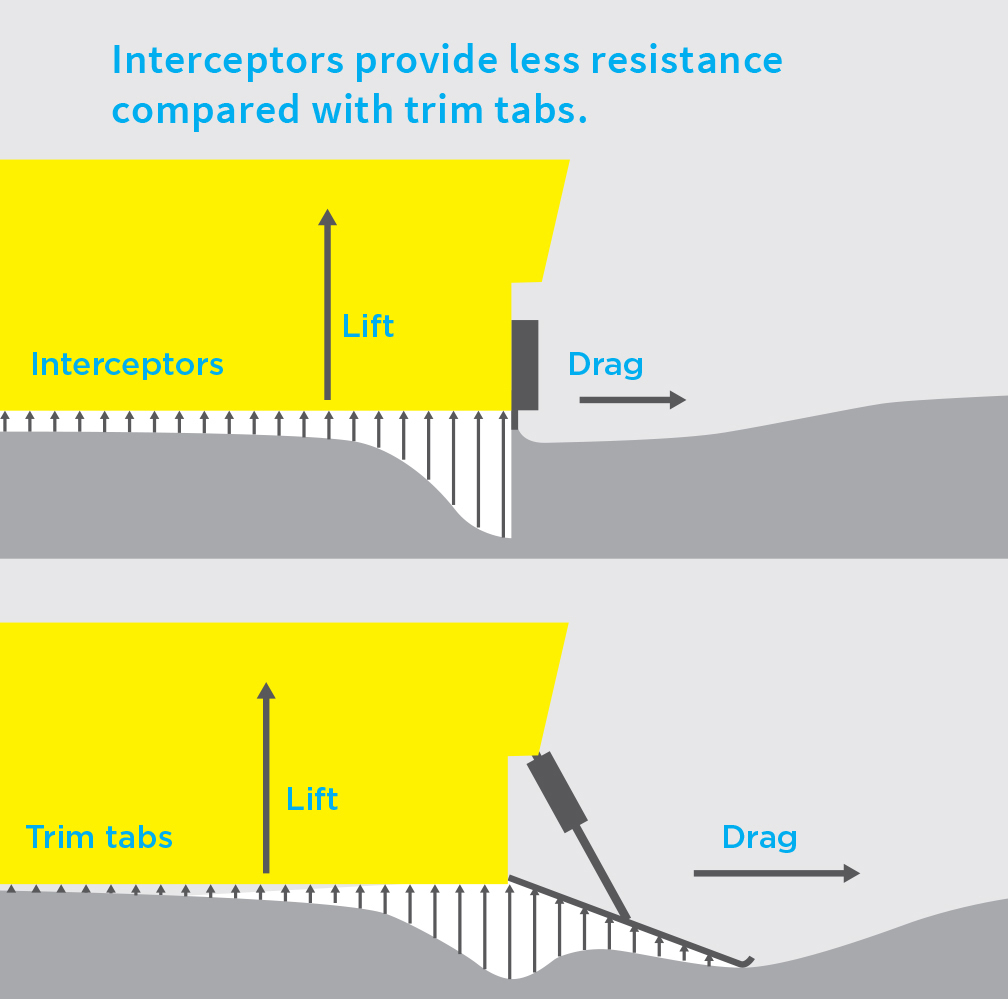
In 2002, Niclas Olofsson co-founded Humphree and introduced interceptors. They generate lift at the stern by mounting a deployable blade on the transom. The extended blade deflects water as it passes by the transom, generating lift. The farther the blade is deployed into the water, the more water it deflects and the greater lift it generates.
Very little blade deployment is required to generate significant lift. Many systems have a maximum deployment of only 1 or 2 inches. Research has shown that interceptors generate lift more efficiently than traditional trim tab planes.
In 2015, Olofsson founded his second interceptor-focused company, Zipwake. It’s a system with launch control, and with automatic pitch and roll correction. The company offers numerous blade sizes and shapes for crowded transoms on boats up to 100 feet, and with as many as six interceptors per system. Zipwake is following its current products with higher-performing Pro versions.
In the United States, Zipwake is represented by Imtra. Product manager Jamie Simmons says the two big upgrades Pro will bring when it starts shipping this summer are speed and automatic pitch.
“First, the new systems will be five times as fast as the systems they replace,” Simmons says. “Second, we used to follow a pitch curve, which would tell the system how much to deploy the blades based on speed. We would follow that curve no matter the sea conditions. Now it will be active pitch. So instead of using a set percentage of the blade, we will use the gyro and a target pitch angle. The boat operator will set an optimal pitch angle throughout the speed range, and the system will work to achieve that pitch at all times.”
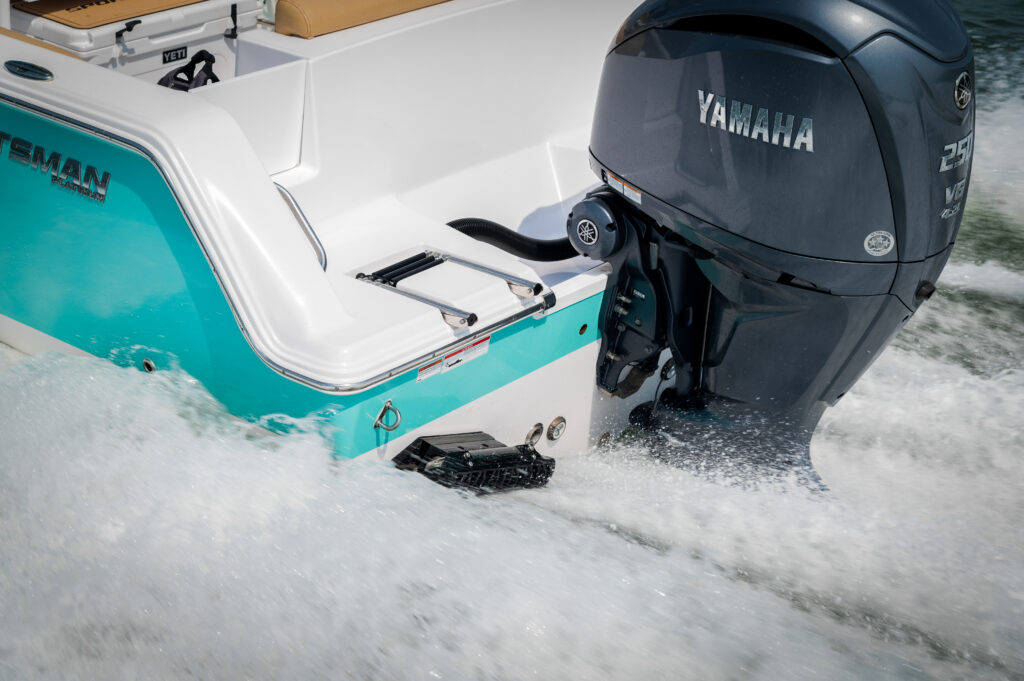
In 2022, Seakeeper joined the category with Ride. Its in-water, rotary-deployment devices are called controllers. Their blades tip down by rotating the outer portion of the assembly. Ride allows for hole-shot control, list control, automatic trim, roll stabilization and coordinated turns. Seakeeper touts Ride’s 1,000 calculations per second, and up to 100 controller adjustments per second.
“It has always been Seakeeper’s vision to control motion in all axes, at all speeds, and on all boat sizes,” says CEO Andrew Semprevivo. “We had several iterations of what is now Seakeeper Ride in development throughout our first 15 years, but it wasn’t until 2019 that we had all the pieces to deliver the ‘wow’ performance. It took the following three years to get a cost-effective system that worked for every boat, at every speed, in every heading and in all conditions, and we launched to the market in 2022.
“We plan to continue to expand our product offering, but it’s not just about copying and pasting what we’ve already done,” he adds.
The most recent PARCD entrant is Lenco’s Pro Control, which builds on trim-tab lineage to bring similar pitch, roll, list and turn coordination to tabs. The system uses upgraded actuators, a Navico inertial measurement unit and a control panel.
“We set out to achieve a modern CAN-connected auto-leveling system with linear actuators and conventional trim tabs,” says Navico actuation product manager Ryan Taffet. “This was important to our business model, as we also use these actuators in the surf tab space, where patented tab designs dictate the use of linear actuators. There was also a lot of thought put into our ease of retrofit to existing Lenco trim tab systems, as we sell heavily in the aftermarket through distributors and retailers, as well.”
Although each of these systems claims similar functionality, they achieve it quite differently. Feature sets and performance capabilities align with product prices. Lenco’s Pro Control is the least-expensive system, with starting retail prices below $2,000 for a retrofit when existing tabs are reused.
Next comes Zipwake’s Series S, with retail prices starting around $2,800. Seakeeper Ride’s smallest system starts at $4,500.
Installation requirements vary. Pro Control’s tabs are installed in the same manner as any other trim tabs. Lenco designed the actuator’s mounting points for compatibility with existing products. So on the factory floor or in a refit application, a minimum of modification is required. Many builders place trim tabs in pockets on the transom. Those pockets can present challenges for interceptors and Ride’s controllers, requiring either modification or filling of the pockets.
Interceptors screw into the transom, so once the required hull modifications are complete, the installation is straightforward. Seakeeper uses a structural adhesive to bond Ride’s controllers to the transom. That process is more time-consuming, so installation is a little more expensive.
There are notable differences in the functionality of each system. All three offer hole-shot, coordinated turns, list control and stabilization. But what they deliver and how they deliver it varies widely. To understand the differences, we need to look at how fast the actuators move and the length of their stroke. Lenco’s actuators move at up to 0.7 inches per second and have a 2.25-inch stroke. The best-case time to full deployment for Lenco is 3.2 seconds.
Zipwake’s blade moves 0.8 inches per second over a 1.2-inch stroke. Time to full deployment is 1.5 seconds. Seakeeper moves at 11.8 inches per second over a 1-inch stroke. Its full-stroke deployment time is just 0.08 seconds. Put another way, Seakeeper’s full-stroke deployment time is 40 times faster than Lenco’s.
You may have noticed that when you adjust a manually controlled trim system, the boat rotates, and steering correction is required to correct for asymmetrical drag. That twisting movement of the boat, or yaw, is a side effect of generating lift through drag. When the operator commands the movement, it quickly becomes second nature to add counter-steer to correct for yaw. But when an automatic system is making constant deployment changes, the operator has to react to those forces without the benefit of knowing what’s coming.
Seakeeper takes advantage of its deployment speed and quickly moves the actuators to counter the yaw they induce. This is done with a target deployment to make the intended correction. But the controllers rapidly move to reduce yaw, too. Overall, the system works to maintain an average deployment at the target, but with varying individual movements. Seakeeper is the only system with the deployment speed to make rapid corrections. Those yaw-correcting movements also account for much of the apparently spastic controller movements I mentioned earlier.
Although each system addresses pitch, there is a surprising variation among them in how those corrections are determined and made. During commissioning, Lenco measures the static pitch of the boat when it’s settled in the water, then measures the pitch once it’s on plane. The system then works to maintain that pitch in all conditions. The operator can command the system to operate with the bow lower, to mitigate impact in rough conditions.
Zipwake and Ride control pitch via pitch curves. Zipwake Pro will move toward active pitch control similar to Lenco’s approach. For now, Zipwake uses the curve to dictate deployment percentage at a series of speeds. Ride uses a similar concept but targets an average deployment percentage rather than a specific number. Targeting an average allows the blades to move quickly, to counter roll and yaw while controlling pitch. Additionally, Ride measures the rate and direction of pitch changes. When it detects pitch changes, it either deploys or retracts the controllers until the pitch change is controlled.
“By not aiming to hold a fixed running angle, we can work with, not against, other systems on board, like engine trim,” Semprevivo says. “The system senses boat motion along the pitch, roll and yaw axes, and with a deployment speed of 300 millimeters per second, is able to respond to downward pitch acceleration instantaneously, with no operator input, by retracting the blades to bring the bow up in all scenarios.”
Although at first glance, these three systems may appear to offer the same functionality, the reality is that the differences in speed of deployment, features and control algorithm maturity represent a significant spread. Fortunately for boatbuilders and owners, options are suitable for numerous price points and intended uses.