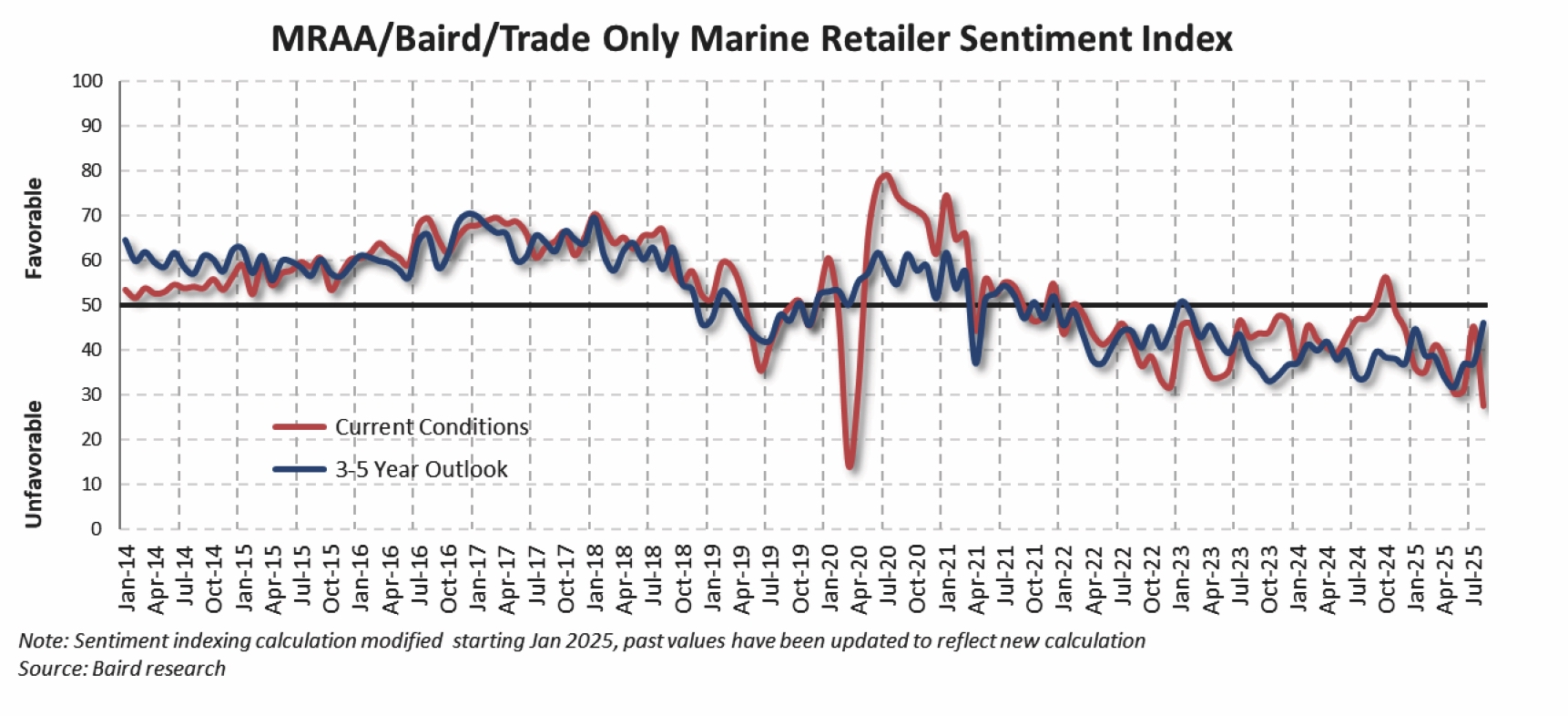
Dealer sentiment on current conditions declined in August (28 compared with 45 in July), while the three- to five-year outlook was higher at 46, up from 37 in July. These figures are both below the neutral outlook of 50.
For this month’s Pulse Report, Soundings Trade Only, Baird Research and the Marine Retailers Association of the Americas asked 79 retailers to assess recent trends in North America.
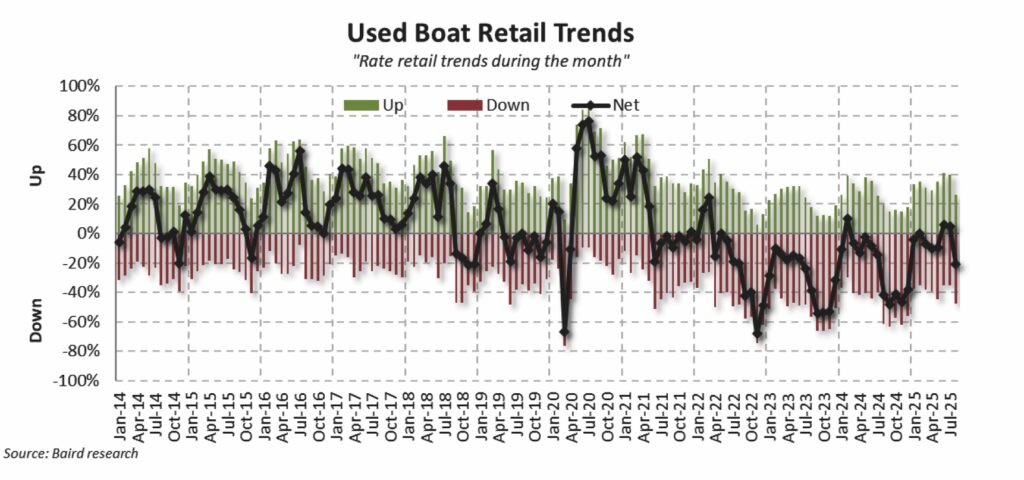
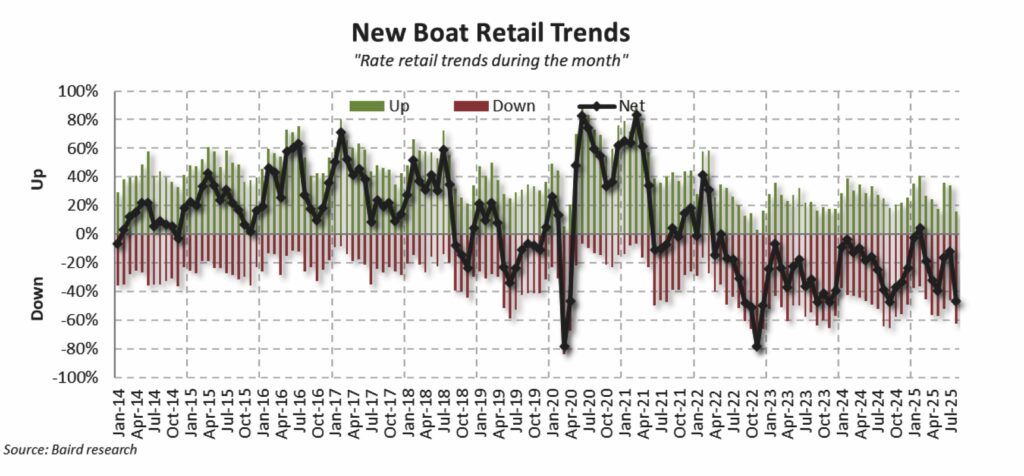
More dealers reported retail declines (63%) than growth (16%) in August, with the ratio of growth-to-declines deteriorating from recent months, Baird’s report said. On the used side, 47% of dealers reported declines, and 26% reported growth, snapping the growth trend in used-boat sales that started in June.
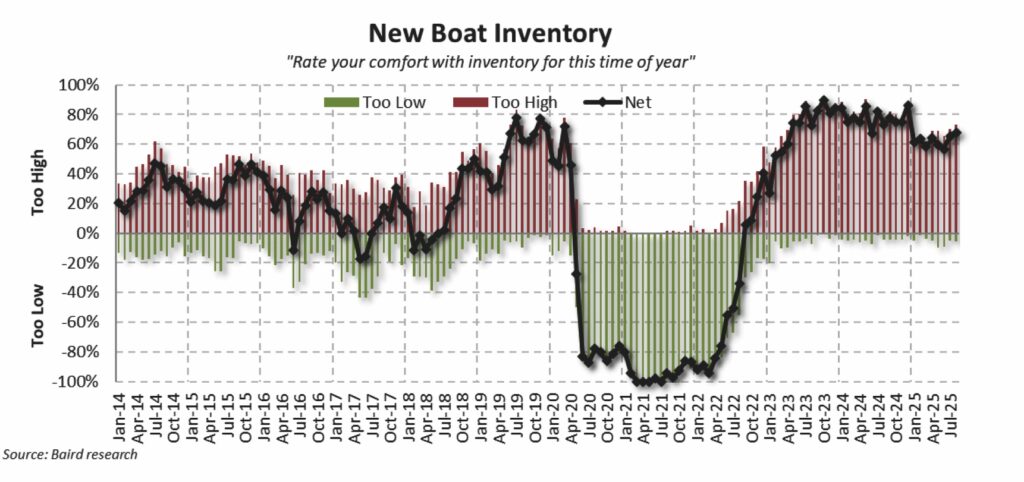
New-boat inventory remained high, with 73% of dealers reporting it was too high, compared with 5% who reported it was too low. “The cost of floorplan is our largest concern,” one dealer said. “Being a seasonal business, you are used to ups and downs, and run lean. But aging inventory and the relentless pounding of interest and principal payments is the looming black cloud.”
Another dealer said, “We are trying to be careful with the inventory we are being challenged to bring in by our manufacturers. I want to balance cautious optimism with being smart with our floorplan. We got a fair amount of 2025 model-year product late in the summer that we still need to sell through.”
Another dealer said, “New-boat sales are trickling through but, overall, remain down, especially in the 18- to 21-foot categories. Buyers with average household incomes are struggling to justify the payments. Big boats continue to sell but at a slower rate, as most of the big-boat buyers have not had dramatic changes in wealth.”
Dealers said their used-boat inventory was better balanced, with 35% reporting it was too high and 30% saying it was too low. “Used/late-model stuff is almost all that’s selling,” one dealer said. Another said, “Used boats are selling, can’t give away a new one.”
When asked what was working, one dealer said, “Taking trades — contacting previous customers about trading into a new boat.” Another said, “Word of mouth in our area is what keeps us growing in our service side of the business. The fact that we are a family business has given us an edge over our competition.” Another commented, “Get your nose dirty. Commit to being the best service and fixed ops operation you can be. Hire fresh and energetic people and train them with your best or yourself to ensure processes are adhered to. Incentivize your sales department the right way to retain marine and reward sales volume.”
When dealers were asked what was not working, many expressed frustrations with the lack of sufficient promotions from manufacturers to help move inventory. “Leads are way down,” one dealer noted. “Not sure what marketing strategies are working for others.” Another cited consumer hesitancy: “A lot of people who are interested in buying a new boat are still sitting on the sidelines.” Another said, “Nobody wants to spend over $100,000 on a boat right now. Completely reversed from last year.”
The survey also asked dealers what strategies they’re employing as they move into the slower sales season in North America. Dealers cited managing inventory and maximizing service revenue as the top strategies. Selling older inventory was seen as a crucial step in preparing for a better 2026.
One dealer said to “keep the hammer down on marketing efforts and do not back off. Stay proactive but not pushy on follow-ups. Stress to manufacturers not to push new dealers in areas where there are established dealers, and enforce dealer agreements and not turn a ‘blind eye’ to those who would skirt around the edges of ethics.” Another dealer planned to “continue in-depth analysis of all operational systems for improvement. Advise our manufacturers that are not helping but asking for orders to back off on new order requests.”
The overall economic pressures facing new buyers remained a significant concern, too. One dealer wrote: “What little demand we have is quickly turned off when the customer is sticker-shocked by the price increase versus what they paid for their last boat less than five years ago, compounded by the interest rate being a 50% to 100% higher rate than they received when they financed their current boat. It’s very tough to get the customer back into a payment anywhere near what they are used to paying on their current boat.”